Super excited Matryoshka Attribution is finally out! 🪆
MAttr learns a nested ranking of model components across sparsities, directly optimizing intervention performance.
#1 on MIB by a wide margin, transfers across tasks and extends to parameter attribution!
Really enjoyed working on it with @aryaman2020, @NathanHu12, @StevenyzZhang, @noahdgoodman, @jurafsky, @ChrisGPotts
New paper! 🫡
We introduce Matryoshka Attribution, a new attribution method which uses gradient descent to find which parts of a neural network are responsible for a behaviour.
MAttr is #1 on the Mechanistic Interpretability Benchmark by a wide margin (2.9× the runner up).
@karinanguyen@jakubzegzulka@karinanguyen very impressive! I believe this is the right direction to interact with information, and not old-school static ways. It can also be applied to the papers, articles and the rest. Exciting!
We're releasing Terminal-Bench-Science: a benchmark for evaluating AI agents on research workflows across scientific domains.
An ongoing Stanford-led community effort, built by the team behind Terminal-Bench together with scientific domain experts at research institutions worldwide. v0.1 has 70 tasks. Claude Opus 5 solves only ~30%.
1/n 👇
Grateful to be included in @TIME's 2026 TIME100 AI.
This recognition reflects work on AI evaluation, measurement, safety, and security that isn't mine alone: the students and postdocs at @stai_research; collaborators across @StanfordAILab and @StanfordHAI; the @VirtueAI_co team, whose work continues elsewhere; and the colleagues who reliably tell me when an evaluation doesn't hold up.
Congratulations to everyone else on this year's list, and thanks to TIME.
#TIME100AI
https://t.co/wxEvPy3oSp
Introducing Online KL Shampoo (OKLS), an optimizer that brings a KL-optimal approximation of full-matrix AdaGrad to language-model training.
Diagonal optimizers ignore correlations between gradient coordinates. Full-matrix AdaGrad captures this geometry but requires quadratic state. Muon considers correlations but not their history. OKLS closes this gap using KL-optimal Kronecker factors, whitening matrix gradients across both row and column directions while remaining naturally scale-invariant.
The main challenge is computing fresh inverse-square-root preconditioners at every step. Even one-step staleness can destabilize training. We make zero-staleness preconditioning practical with Scaled CANS Coupled Newton–Schulz: 10 iterations, 27 FP16 GEMMs, and FP32 accumulation.
OKLS achieves 1.45× the parameter efficiency of Muon while retaining 98% of its training throughput. Across 200M–1B models, an OKLS model matches a Muon model roughly 1.5× larger.
Hi everyone! I’m looking for internship positions in industry to gain a valuable experience. I’m particularly interested in internships with a focus on optimization aspects of LLM pre-training/post-training, where I believe my research experience can be useful
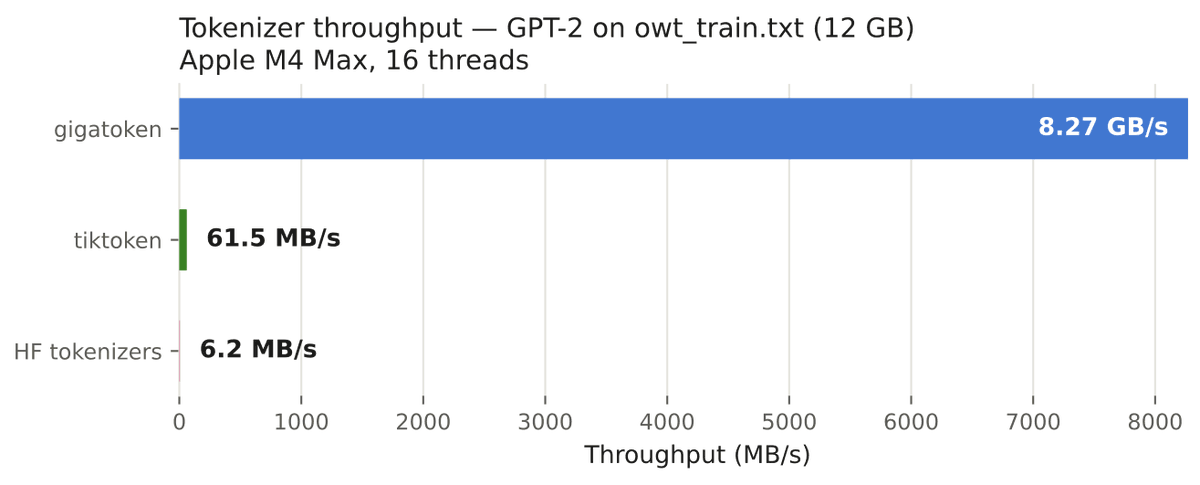
Introducing the world's fastest tokenizer implementation, Gigatoken!
Gigatoken is ~500-1000x faster than HuggingFace, and ~100x faster than OpenAI's tiktoken for most tokenizer definitions on most machines.
These baselines are already multithreaded Rust implementations! 🧵
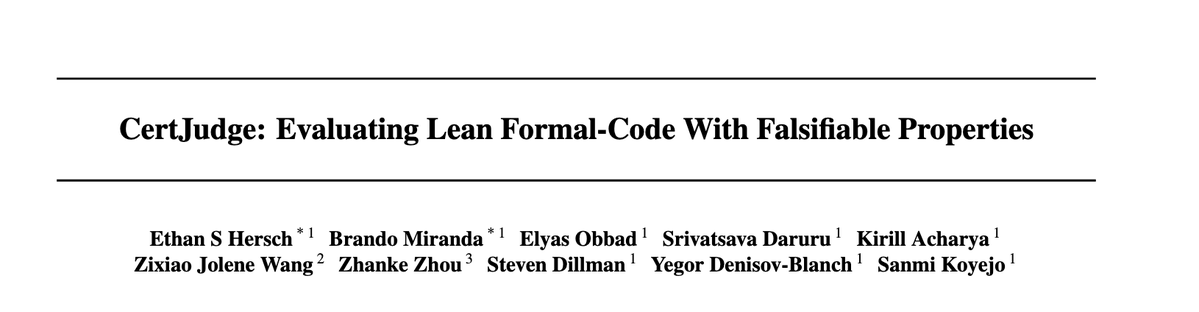
Had a lot of fun presenting CertJudge at @icmlconf ICML 2026 AI4Math and Deep Learning for Code Workshops on July 10-11. Thanks to all authors and listeners!
Presenting “Internal Data Repetition Destroys Language Models” today as an oral at the Foundations of Deep Generative Models workshop (#ICML2026)! Hope to see you there.
⏰ 11:15am Friday July 10
📍 Conference room S 318
Also, some exciting news: we're grateful and honored to have received the workshop's Runner-up award!
With @JoshuaK92829, Noam Levi*, @RylanSchaeffer, @yegordb, @sanmikoyejo, and David Donoho