A peak life advice from Alex Hormozi:
“The fastest way to become the person you want to be is to put yourself in a situation where you have no choice but to become them.”
Recommended reading.
(bookmark it)
Pay attention to the prices and what a combination of models can unlock for you.
You don't need the absolute best model for everything.
I am not that impressed with the Rust SQLite replica. A totally new and improved SQLite (or something more creative and new) could be a more interesting test.
Takeaways:
- Use a frontier model for decomposition, architecture, key design choices, and trade-offs.
- Have cheaper, faster workers execute well-defined, narrow implementation tasks.
- Do not have planners implement or workers make broad design decisions.
Use a swarm or harness with a recursive task tree: planners break the original spec into subtrees, delegate them, and workers operate at the leaves. Cursor argues this helps mostly because each agent has a constrained context, rather than simply because many agents run in parallel. Pay extra attention to biases and failures that might emerge from poor/inefficient agent coordination.
Fascinating.
iOS: "I will not allow .vibrate in the browser."
Also iOS: The toggle <input /> can have the "switch" attribute, which makes the phone vibrate when you toggle it -> people build the entire haptic library on top of this fact.
Also, creating a dope video of your library will greatly help it become popular.
something interesting with all these openclaw alternatives popping up - they saw the original and all its drawbacks and have made it possible to fit their binaries on hardware as low as $10 - no more vps/mac minis needed.
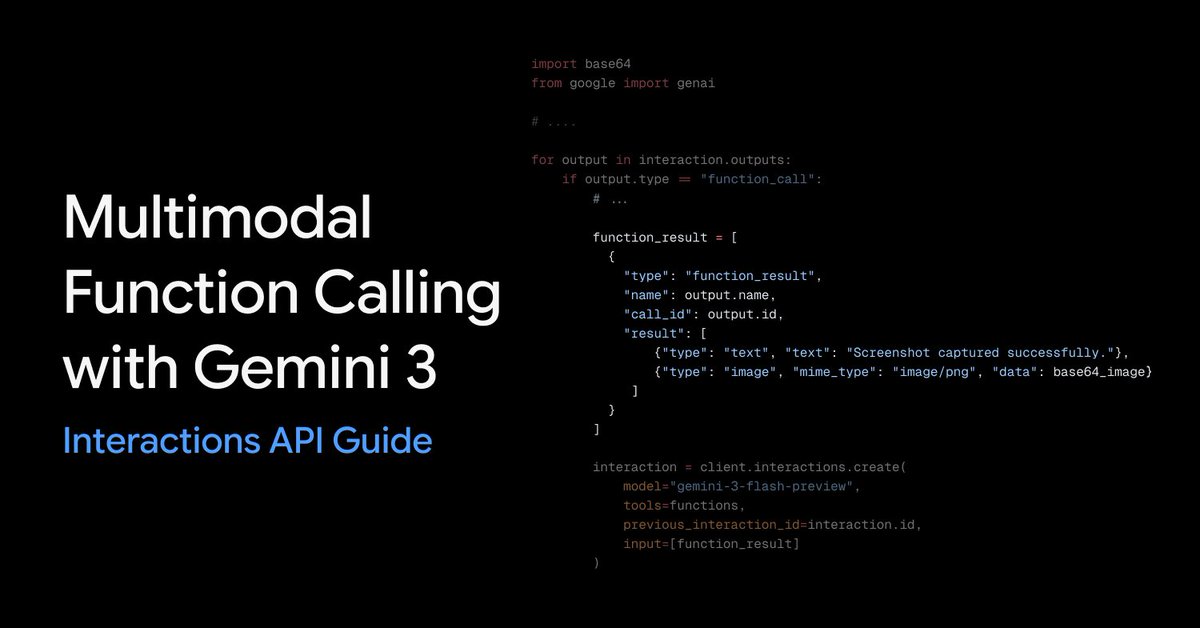
Multimodal function calling is now available in the Gemini Interactions API, build agents that can see and process images natively.
🖼️ Tools return actual images, not text descriptions
👁️ Gemini 3 natively processes returned images
🛠️ Function results support mixed text and image
🆕 Guide on how to build visual agents with Python
My Anthropic bill for the past 2 weeks has been insane and I've been desperately trying to figure out how to cut costs. I think I finally figured out how to cut it by 10x, so I hope this works.
Most agent tasks are janitorial. Reading files, checking status, formatting output, answering "what time is it in Tokyo?" or "why is ETH price down so bad?" This stuff doesn't require a $15/M model.
The fix is hierarchical routing based on task complexity:
- Routine (80%) > DeepSeek at $0.14/M
File ops, status checks, simple Q&A, formatting
- Moderate (15%) > Sonnet at $3/M
Code, summaries, drafts, light analysis
- Hard (5%) > Opus at $15/M
Debugging, architecture, multi-step reasoning
$225/month on pure Opus vs $19/month with hierarchy.
Packaged this into an agent skill that teaches your AI to classify tasks and route them to the cheapest model that can handle them. 28 tests, works with OpenClaw, Claude Code, or any agent system. Boom. Check it out and lmk if it saves you money without degrading your output.
https://t.co/3aP4MTPKhv
New art project.
Train and inference GPT in 243 lines of pure, dependency-free Python. This is the *full* algorithmic content of what is needed. Everything else is just for efficiency. I cannot simplify this any further.
https://t.co/HmiRrQugnP
𝗔𝗜 𝗔𝗴𝗲𝗻𝘁’𝘀 𝗠𝗲𝗺𝗼𝗿𝘆 is the most important piece of 𝗖𝗼𝗻𝘁𝗲𝘅𝘁 𝗘𝗻𝗴𝗶𝗻𝗲𝗲𝗿𝗶𝗻𝗴, this is how we define it 👇
In general, the memory for an agent is something that we provide via context in the prompt passed to LLM that helps the agent to better plan and react given past interactions or data not immediately available.
It is useful to group the memory into four types:
𝟭. 𝗘𝗽𝗶𝘀𝗼𝗱𝗶𝗰 - This type of memory contains past interactions and actions performed by the agent. After an action is taken, the application controlling the agent would store the action in some kind of persistent storage so that it can be retrieved later if needed. A good example would be using a vector Database to store semantic meaning of the interactions.
𝟮. 𝗦𝗲𝗺𝗮𝗻𝘁𝗶𝗰 - Any external information that is available to the agent and any knowledge the agent should have about itself. You can think of this as a context similar to one used in RAG applications. It can be internal knowledge only available to the agent or a grounding context to isolate part of the internet scale data for more accurate answers.
𝟯. 𝗣𝗿𝗼𝗰𝗲𝗱𝘂𝗿𝗮𝗹 - This is systemic information like the structure of the System Prompt, available tools, guardrails etc. It will usually be stored in Git, Prompt and Tool Registries.
𝟰. Occasionally, the agent application would pull information from long-term memory and store it locally if it is needed for the task at hand.
𝟱. All of the information pulled together from the long-term or stored in local memory is called short-term or working memory. Compiling all of it into a prompt will produce the prompt to be passed to the LLM and it will provide further actions to be taken by the system.
We usually label 1. - 3. as Long-Term memory and 5. as Short-Term memory.
And that is it! The rest is all about how you architect the topology of your Agentic Systems.
Any war stories you have while managing Agent’s memory? Let me know in the comments 👇
The Top AI Papers of the Week (January 5-11)
- GDPO
- SWE-EVO
- Deep Delta Learning
- Confucius Code Agent
- Recursive Language Models
- On the Slow Death of Scaling
- Adversarial Program Evolution with LLMs
Read on for more:
The number of full-fledged Free and open-source software (FOSS) products and initiatives coming out of the 4th Phase, JP Nagar (Zerodha Tech), must be unprecedented for a team of its size globally.
All of these projects started as a way to solve problems we faced internally and were then open sourced. We use them at scale in our stack, and several large organisations and even government departments globally use many of these tools today.
Read more, check the website in the comments.