For my first post, I’m sharing a letter @NVIDIA signed on why open models matter.
AI will transform every industry, power every company, and be built by every country.
Open models strengthen safety and cybersecurity, accelerate innovation and diffusion, and enable sovereignty.
The world needs both frontier closed models and frontier open models.
https://t.co/AUKzoQ5Ikb
I nearly shut down my longevity company last year.
I was asking myself what one should build on the eve of superintelligence.
The answer is obvious now: cure all diseases.
But this wasn’t an obvious path for an individual like myself 12 months ago. Sid Sijbrandij hadn’t yet put his cancer into remission by going founder mode. The Australian engineer hadn’t shrunk his dog’s tumor by building a custom mRNA vaccine. And Kate and I hadn’t yet been diagnosed with disease.
Curing disease was something that big, billion dollar companies did over ten years. Not individuals.
That’s now changed.
Two weeks ago, I started focusing my company, Immortals, on building the infrastructure to allow individuals to discover and resolve their own health issues. Kate and I are the first customers as we both try to address our recent disease diagnoses.
If you’re a cracked engineer looking for a hard challenge, come build this with me.
Immortals will continue to be best-in-class with nutrition, GLP-1s, longevity medicines, hormones, peptides, biomarkers and concierge medicine.
We’re now adding induced pluripotent stem cells, organoids, deep cellular characterization, and personalized therapy development among other things.
I hope what we build in the coming year makes current health care look like it’s medicine from the 1500s.
Hit me up if you’re building biotech that matches in goal.
When our basic needs are met, solving all diseases is the only rational next thing to do. And to not wait around for someone else to do it on your behalf.
The faster technology moves, the more I think about Bezos' question
What won't change in the next 10 years?
Things I've been writing down over time:
- Humans will always need shelter, food, energy, and healthcare.
- The desire for ownership and the accumulation of wealth.
- The physical world will move more slowly than the digital one.
- Every increase in technological capability, especially AI, will require more energy.
- People and businesses will continue to need access to capital.
- Capital will continue to seek returns that exceed inflation.
- Underwriting methods evolve, but demand for credit (loans) is persistent.
- Trust remains scarce and becomes increasingly valuable as content, code, and fraud become cheaper.
- Verified identities and reputation becomes more important as information becomes abundant and synthetic.
- Long-term wealth creation and dynastic (multi-generational) thinking predate modern technology, and will persist.
- Coordination and transaction costs never fully disappear; market friction will continue to justify the existence of firms and intermediaries.
- People will continue to compete for status.
- Consumers will pay a premium for products and services that confer status.
- Time remains fixed at 24 hours per day.
- But attention is a finite resource and an enduring constraint.
- Products that credibly save time (or enable delegation) have a perpetual market.
- Inaccessible, proprietary data will be a persistent moat. The more inaccessible and difficult to aggregate, the deeper the moat.
- People want accountability, recourse, and clearly identifiable responsibility when things go wrong.
- Regulation consistently lags technological innovation.
- Compliance requirements, licensing, and regulatory moats persist even when machines can perform the underlying task.
- Local knowledge remains valuable and difficult to replicate.
- Heterogeneous markets (like real estate) continue to reward people with deep contextual understanding.
- Incumbent organizations tend to underinvest in disrupting their own businesses, which always creates opportunities for challengers.
Bezos' insight on what wouldn't change in 10 years was "Customers will always want lower prices and faster delivery."
It's boring/ true, but I think that's the point.
Everything we build today can and will be rebuilt more cheaply, faster by someone else.
Build on the invariants, not the trends.
What have I missed?
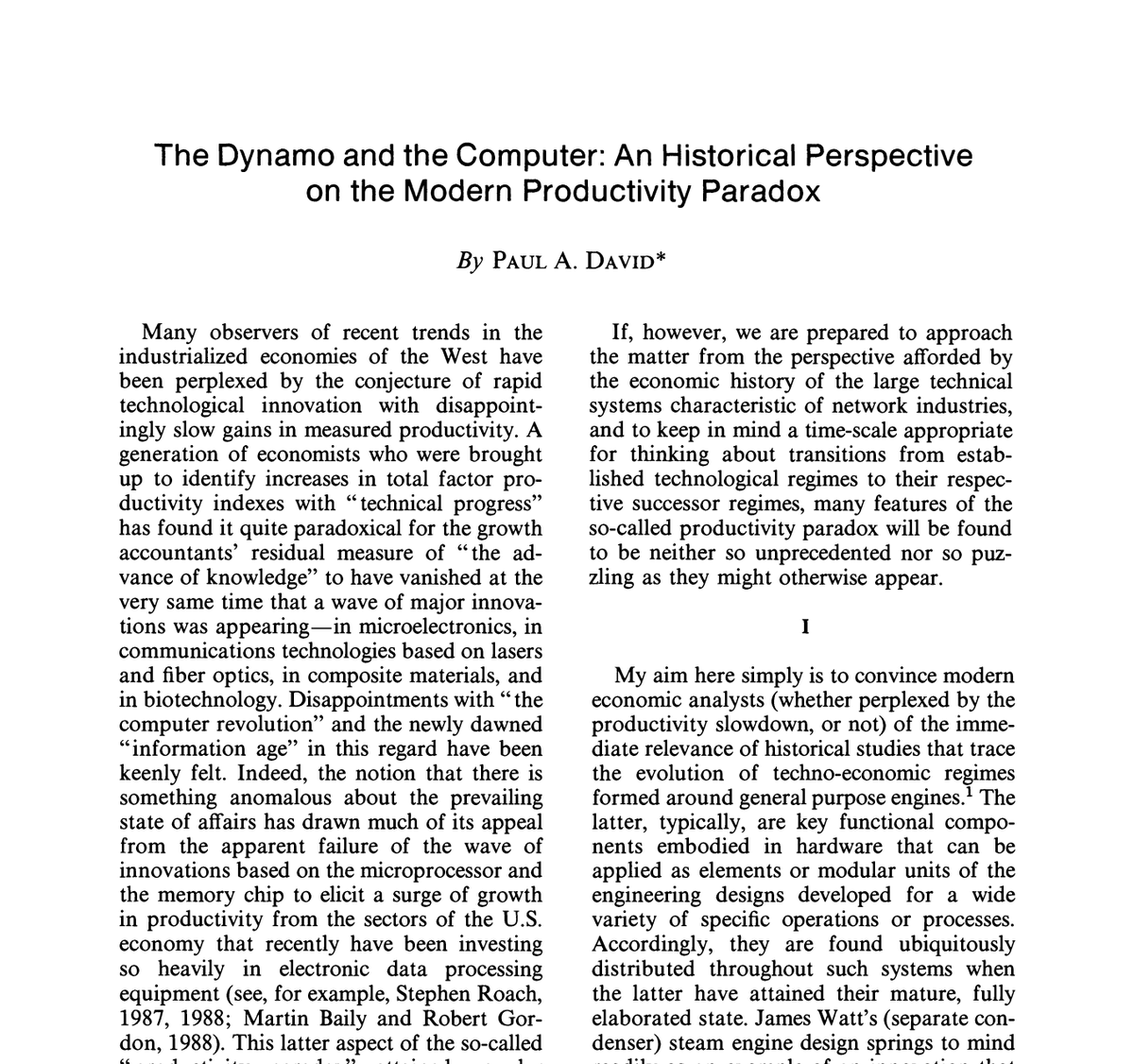
If you've adopted AI at your company but haven't seen any tangible results, read this 1990 article: "The Dynamo and the Computer" by Paul David.
When electricity first arrived, factories that "adopted" it barely got faster. They just swapped the steam engine for an electric one and ran everything else exactly as before: same machine layout, same workflow, same management. Electricity in, no real gains out.
The most common mistake with any new technology is to drop it into the old organization and then declare the transformation done.
The real leap came decades later, when each machine got its own small motor. Suddenly machines no longer had to be lined up around one central drive shaft. They could be rearranged around the actual flow of work.
The productivity gains didn't come from electricity. They came from REDESIGNING THE ENTIRE FACTORY around it.
AI is the same. Bolting it onto your existing process gets you a faster steam engine. The payoff comes when you redesign the work itself.
(link to paper in comments)
🇦🇺An Australian tech founder with zero biology background sequenced his dog’s tumor DNA, then used ChatGPT and AlphaFold to design a custom mRNA cancer vaccine.
A month later, the tumors shrank by half.
And this is just the start of AI medicine.
It has been said that AI is the new oil, the new electricity, and the new internet. And the once nimble and highly profitable software companies (MSFT, GOOG, ...) became like utilities, investing in nuclear energy, among other things, to run AI data centres. Open Source and the #DeepSeek #Sputnik have once again shown that such companies "have no moat" in the field of AI.
In many talks over the last decade, I mentioned the rich guy I knew when I was young. He had a Porsche with something incredible: a mobile phone. He could call other people who had such a Porsche via a satellite. But 40 years later, everyone had a cheap smartphone in their pocket, which is far superior to what he had in his Porsche.
And it's the same with AI. Every five years, compute becomes ten times cheaper - a trend that has continued since the first general-purpose computer was completed in 1941. The basic techniques of modern AI were developed in the last millennium, when compute was still very expensive, but this trend has made them so cheap that AI has been on your smartphone since the 2010s.
The trend will not break in the coming decades (the physical Bremermann limit is still a long way off). An AI data centre that is worth 100 billion today will only be worth 1 billion in ten years' time. Soon, small, cheap computers with increasingly efficient open source AI software will do what the large data centres do today.
So AI will not be controlled by a few big AI utilities. No, everyone will own cheap but powerful and transparent AI that improves their lives in many ways. See the old motto of @nnaisense founded in 2014: ‘AI∀’ or ‘AI For All’.
Job seekers in the U.S. and many other nations face a tough environment. At the same time, fears of AI-caused job loss have — so far — been overblown. However, the demand for AI skills is starting to cause shifts in the job market. I’d like to share what I’m seeing on the ground.
First, many tech companies have laid off workers over the past year. While some CEOs cited AI as the reason — that AI is doing the work, so people are no longer needed — the reality is AI just doesn’t work that well yet. Many of the layoffs have been corrections for overhiring during the pandemic or general cost-cutting and reorganization that occasionally happened even before modern AI. Outside of a handful of roles, few layoffs have resulted from jobs being automated by AI.
Granted, this may grow in the future. People who are currently in some professions that are highly exposed to AI automation, such as call-center operators, translators, and voice actors, are likely to struggle to find jobs and/or see declining salaries. But widespread job losses have been overhyped.
Instead, a common refrain applies: AI won’t replace workers, but workers who use AI will replace workers who don’t. For instance, because AI coding tools make developers much more efficient, developers who know how to use them are increasingly in-demand. (If you want to be one of these people, please take our short courses on Claude Code, Gemini CLI, and Agentic Skills!)
So AI is leading to job losses, but in a subtle way. Some businesses are letting go of employees who are not adapting to AI and replacing them with people who are. This trend is already obvious in software development. Further, in many startups’ hiring patterns, I am seeing early signs of this type of personnel replacement in roles that traditionally are considered non-technical. Marketers, recruiters, and analysts who know how to code with AI are more productive than those who don’t, so some businesses are slowly parting ways with employees that aren’t able to adapt. I expect this will accelerate.
At the same time, when companies build new teams that are AI native, sometimes the new teams are smaller than the ones they replace. AI makes individuals more effective, and this makes it possible to shrink team sizes. For example, as AI has made building software easier, the bottleneck is shifting to deciding what to build — this is the Product Management (PM) bottleneck. A project that used to be assigned to 8 engineers and 1 PM might now be assigned to 2 engineers and 1 PM, or perhaps even to a single person with a mix of engineering and product skills.
The good news for employees is that most businesses have a lot of work to do and not enough people to do it. People with the right AI skills are often given opportunities to step up and do more, and maybe tackle the long backlog of ideas that couldn’t be executed before AI made the work go more quickly. I’m seeing many employees in many businesses step up to build new things that help their business. Opportunities abound!
I know these changes are stressful. My heart goes out to every family that has been affected by a layoff, to every job seeker struggling to find the role they want, and to the far larger number of people who are worried about their future job prospects. Fortunately, there’s still time to learn and position yourself well for where the job market is going. When it comes to AI, the vast majority of people, technical or nontechnical, are at the starting line, or they were recently. So this remains a great time to keep learning and keep building, and the opportunities for those who do are numerous!
[Original text; https://t.co/zbIhZHfCC0 ]
🇮🇳 Good morning India! A lot of you asked for full-length mock JEE Main tests in @GeminiApp at no cost - done! Good luck on your prep!
Last week, SAT. This week, JEE.
What other global exams would be most helpful?
History in the making from Odisha!
Excavations underway may reveal a civilisation dating back up to 10,000 years, possibly older than Mohenjo-daro & Harappa.
The ASI has begun digging at the Bhimmandali mountains, Redakhol (Sambalpur) after discovering rock-cut paintings and ancient Stone Age tools.
Experts believe these imprints could predate the Indus Valley Civilisation, opening a new chapter in India’s ancient past.
Introducing Alterego: the world’s first near-telepathic wearable that enables silent communication at the speed of thought.
Alterego makes AI an extension of the human mind.
We’ve made several breakthroughs since our work started at MIT.
We’re announcing those today.
How a true "Made In India" brand is beating Chinese competitors? Here is a story from Karnataka.
I had a very inspiring conversation with Sachin Naik, the founder of Cuzor Labs today.
Sachin comes from Holealooru, a village in Ron taluk of Gadag district, Karnataka. From there, he has gone on to build a consumer electronics company that now beats even seasoned chinese competitors!
Cuzor’s flagship products, GaN (Gallium Nitride) based fast chargers, aren’t just rebranded imports. They are indigenously designed, IP-driven, and engineered in India. These use GaN semiconductors instead of traditional silicon in their chargers. GaN allows chargers to be smaller, faster, and more efficient. Today, they’re the highest-rated, highest reviewed products on Amazon, beating not only Chinese competitors but also the so-called “Made in India” sticker-on-import products.
And this is no small feat that they’ve scaled to Rs 12 crore annual revenue with a lean team that hustled day and night, making every rupee count.
What impressed me the most is Sachin’s mindset. Instead of keeping his hard-won learnings to himself, he’s mapped out an ecosystem of enablers for hardware founders in India, from suppliers, to processes, and hacks that can help others build faster. And he’s more than willing to share this knowledge freely with anyone who dreams of building hardware from India.
During our chat, I also mentioned another Hubballi-based deep-tech hardware startup that is building the world’s first subwoofer-based headphones and already shipping to 60+ countries. Sachin was genuinely surprised, and his immediate reaction was: “There are so many amazing people and stories like this, but we hardly know what each other are building!”
That’s exactly where initiatives like @mundhebanni come in, bringing out these hidden stories in Kannada, celebrating them, and inspiring others to dream big.
I’m thrilled that he has readily accepted our invite to join the our Podcast, where we’ll dive deeper into his journey and vision.
This is the kind of story that shows why regional India can, and will, build world-class companies.
Stay tuned!
@AirIndiaX 1612, just wondering—why keep us packed in a bus if the plane isn’t ready to board? The airport lobby’s way more comfortable to wait in, with chairs and food stalls around 😀