Zoom Stock Jumps 11%. Why the Anthropic IPO Is Good News for the Video Calling Company.
By Kit Norton
Follow
June 01, 2026, 12:49 pm EDT
https://t.co/mCcDePdNNW
My old numbers were off as I did not factor in all the dilution from additional rounds.. but still its a whopper of a holding for @Zoom
Fun fact. @Zoom ($ZM ) invested $51M into @AnthropicAI in 2023.
At the last round of $380B it’s around a 78x.
At current aftermarket of $1T for @AnthropicAI it around 223x or an $11B+ holding.
At $ZM market cap of $26B; with ~$9B cash and ~$11B of liquid (and rising) holding of solana:Pren1FvFX6J3E4kXhJuCiAD5aDmGEb7qJRncwA8Lkhw
Net of cash and holdings market cap is around $5-$6B.
$ZM is roughly a $5B revenue company w ~$1.7B FCF
1-1.1x sales (net of cash and holding)
~3X net cash flow.
I need to double check these numbers as they seem totally illogical. Maybe I made a mistake!
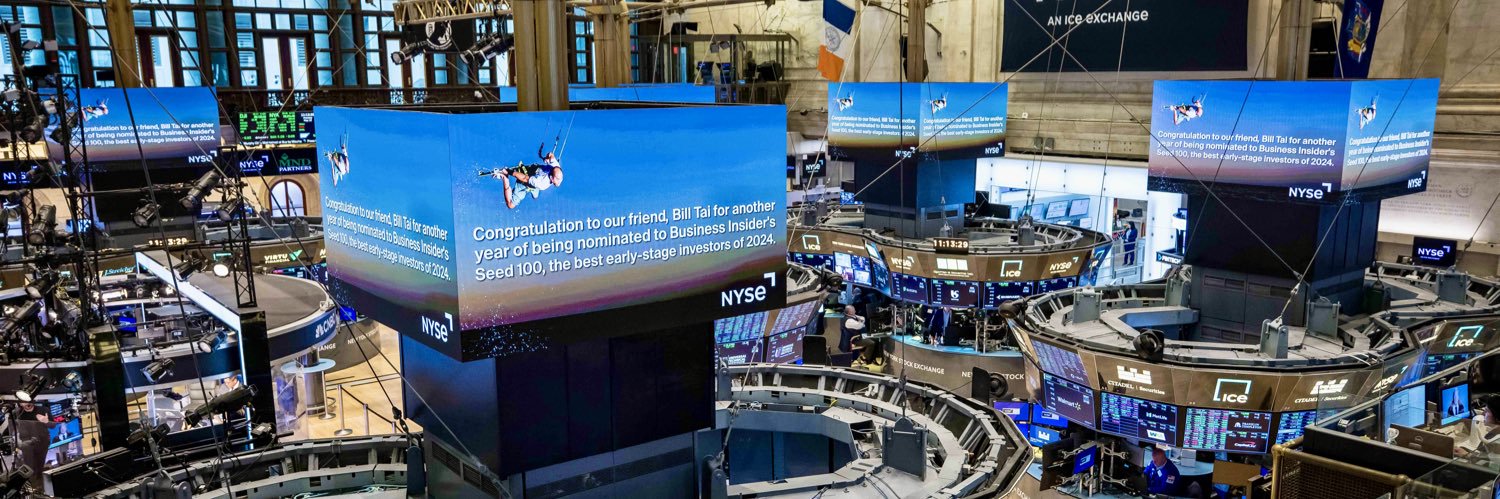
A life is measured less by what it accumulates than by what it creates.
Companies.
Communities.
Friendships.
Opportunities.
The highest form of leverage isn’t capital. It’s the ability to bring exceptional people together around meaningful ideas.
Few have embodied that more consistently or more generously than Bill.
Grateful for the friendship, wisdom, adventures, and the countless lives he’s touched along the way, including my own.
Happy Birthday, Bill @KiteVC ✨
Keefe, Bruyette & Woods raises $HUT price target to $138 from $89 and assigns an Outperform rating on shares
Hut 8 in the last two months:
• Stock +158%
• 15yr/$9.8B hyperscaler lease
• Cosed $3.25B of investment grade senior secured notes
$HUT CEO @ashergenoot says their Beacon Point site in Texas is one of the most power dense datacenter buildings in the world.
"Nvidia actually wanted us to share they were design partner on this campus because of how exciting and innovating it is"
@Hut8Corp@nvidia
I promised once our incubated companies Bitfury USA a.k.a $CIFR and Bitfury Canada a.k.a. $HUT would BOTH become DECACORNS I would make the tweet. WHAT a RIDE! Congrats to outstanding leadership by @rftylerpage and @ashergenoot and their respective teams. Next Stop - HECTACORN 🚀
@zerohedge From Worldometer:
India has a population of approximately 1.48 billion with a nominal GDP per capita of $2,813. Taiwan has a population of 23 million with a nominal GDP per capita of $42,103.
Interesting 23M people can out produce 1.48B
Everyone is focusing on the soaring memory cost in the Vera Rubin rack. But the real shocker in this Morgan Stanley slide is actually power, because the industry is now talking about moving from roughly 120kW per rack today toward potentially 600kW per rack by the Vera Rubin Ultra generation in 2027, which is an almost unimaginable escalation in power density within an incredibly short period of time.
To put this into perspective, many traditional enterprise datacenters historically operated at only a few kilowatts per rack, while even modern hyperscale campuses today often consume only tens of megawatts in total facility power draw. But once you begin deploying hundreds or thousands of 600kW AI racks simultaneously, the math becomes almost absurd because a large-scale Vera Rubin Ultra cluster could eventually consume gigawatts of electricity, effectively rivaling the energy demand of a mid-sized city.
And this is where the market still massively underestimates the second-order implications of the AI boom, because the bottleneck is no longer simply semiconductors, GPUs, or memory supply. The bottleneck increasingly becomes electricity itself.
The US power grid can barely keep up with current AI infrastructure demand already, while transmission congestion, transformer shortages, substation constraints, cooling limitations, permitting bottlenecks, and aging grid infrastructure are becoming increasingly visible across major datacenter hubs. Importantly, grid infrastructure cannot scale at semiconductor speed. You can accelerate chip production with enough capital expenditure and engineering talent, but building transmission lines, substations, generation capacity, cooling systems, and interconnection approvals often requires many years due to environmental reviews, local opposition, labor shortages, and physical construction constraints.
This is precisely why we continue believing the AI buildout is not a two-to-three-year investment cycle, but instead a decade-long industrial transformation that increasingly resembles the buildout of railroads, electricity networks, and telecom infrastructure during previous industrial revolutions.
And this is also why energy infrastructure is quietly becoming one of the most important and underappreciated AI trades globally.
The winners are no longer just GPU companies. The winners increasingly include utilities like Constellation Energy and Vistra, nuclear-related plays like Oklo and NuScale Power, gas infrastructure companies like Kinder Morgan and Williams Companies, grid and electrical equipment suppliers like GE Vernova, Eaton, Schneider Electric, and Vertiv, as well as transformer, cooling, and datacenter infrastructure providers that now sit directly inside the physical backbone required to support next-generation compute.
Hyperscalers themselves are starting to understand this reality. Companies like Microsoft, Amazon, Alphabet, and Meta are no longer simply software companies buying servers. They are increasingly becoming quasi-energy infrastructure companies because securing long-duration power availability is becoming strategically inseparable from securing compute capacity itself.
That is why nuclear power is quietly returning to the center of the conversation. Hyperscalers may eventually fund or directly partner on nuclear generation projects out of pure necessity because renewable intermittency alone cannot reliably support ultra-high-density AI clusters operating continuously at scale.
In many ways, AI is beginning to collide with physical reality. You cannot run trillion-dollar next-generation compute infrastructure on transmission systems and grid architectures that were largely built decades ago for a completely different industrial era.
The semiconductor story may have started the AI race, but energy infrastructure may ultimately determine who wins it.