How do you tell a countertrend rally from the start of a new market uptrend?
Following Nvidia's announcement that Jensen Huang is back as CEO, $NVDA is up 32% and $QQQ is rallying nearly 7%.
That's an impressive move, and certainly a positive development for the bulls.
However, here's something worth paying attention to.
Despite several semiconductor stocks rallying 20-30% today, many are still testing their declining 9-day and 21-day EMAs.
That tells you how much technical damage occurred during the correction.
One strong green day doesn't necessarily mean the correction is over.
Some of the biggest rallies happen during broader market downtrends. That's why confirmation matters more than the size of the bounce.
Here are five things you should be watching:
1. Follow-Through Day (FTD)
A strong index gain on higher volume, typically on Day 4 or later of a rally attempt, can signal that institutional buying is returning.
2. Market Breadth
We need broader participation, not just Nvidia and a handful of mega-cap technology stocks lifting the indexes.
3. Leading Stocks
Are fundamentally strong stocks reclaiming their 21-day, 50-day, and eventually 200-day moving averages? Are new leaders emerging and holding their gains?
4. Volume Confirmation
Strong buying volume on advances and lighter volume on pullbacks would be constructive. Repeated distribution days would raise concerns.
5. Higher Highs and Higher Lows
A sustainable uptrend should gradually establish higher highs and higher lows rather than repeatedly failing at declining moving averages.
One important point: Even a Follow-Through Day doesn't guarantee a new bull market. Some fail, especially when leadership and breadth remain weak.
For me, the real test comes after today's rally.
Can the indexes hold their gains? Will leading stocks continue showing relative strength? Can the market absorb its first pullback without breaking recent lows?
A countertrend rally can look impressive for a few days. A sustainable uptrend proves itself over time.
The goal is to capture a meaningful portion of the next sustained uptrend while managing downside risk.
Earlier in February this year I made a model book based on @Qullamaggie 's Swing School series on Youtube. Basically all the examples he referred to in the series. Includes quotes of his that resonated with me, all in one document. Not perfect, but inspired by @mwebster1971 I want to share this if it's of use to anyone. I will be printing this out and writing more notes on the charts.
Open to feedback!
https://t.co/0WzApHHPNk
6+ years of grit in 1 sentence:
Scan for leadership + best weekly charts, wait for daily tightness off the 9/21EMAs, execute off 15/30min pivots on the right-side curl & sit.
Took me years of overcomplicating everything to realize the answer was to keep it stupid simple.
Leading and emerging themes with incredible setups
These groups/stocks are likely to lead the market if we go higher from here:
Semiconductors:
$AMD
$INTC
$MRVL
$ARM
$ALAB
$SMTC
$AMBQ
$SWKS
$MXL
Data storage/servers:
$HPE
$DELL
$NTAP
$SMCI
Memory:
$SNDK
$SKHY
$MU
$DRAM
Crypto:
$PURR
$ASST
$HOOD
$BLSH
$MSTR
$BMNR
$COIN
Cybersecurity:
$CIBR
$CRWD
$OKTA
$FTNT
$NET
$PANW
Genomics:
$TXG
$TEM
$TWST
$NTRA
$ILMN
These are the stocks ill be watching to long over the next few weeks...
Quote for the Weekend:
"Read voraciously, across disciplines, then protect large blocks of quiet time to think. Knowledge without reflection doesn’t compound nearly as well."
~ Charlie Munger
He then adds that being a great investor is spending a lot of time reading and thinking.
If you're struggling in this envrionment read this post.
I think 1 of the biggest jumps I made as a trader was realizing that my job isn’t just finding good setups, but recognizing when the market is actually paying for them.
There are risk-on periods where it almost feels stupidly easy. Breakouts follow through, pullbacks get bought, leaders give you immediate cushion, and every time I put a little risk on, the market basically says, “Yep, keep going.” Those are the environments where I want to progressively increase exposure because my trades have earned me the right to press.
Risk-off periods feel completely different.
The exact same setup that was running +15% 2 weeks ago suddenly breaks out, goes +2%, and round-trips by lunch. My stops start getting hit, fewer names are holding gains, breadth deteriorates, and my equity curve stops progressing. I think of it like surfing...I can have the nicest board on the beach, but if the ocean is flat, paddling harder isn’t going to create a wave. A great setup in a garbage environment is still fighting a massive headwind.
This is why I use my own positions as a feedback loop.
I’ll put a toe in the water with smaller pilot positions, and if they start working, giving me cushion, and other leaders are confirming the same thing, I’ll add exposure pretty quickly.
If those first few trades keep failing, I don’t need some economist on CNBC to officially declare it “risk-off”. The market is already telling me through my P&L that I probably need to chill out.
I think the hardest part is accepting that doing nothing is still a position. Call me what you want, but this is the truth.
$$ can be ridiculously easy to make during certain stretches and incredibly difficult to keep during others, and I’ve learned the expensive way that I don’t need to prove I can make money in every environment.
Sometimes the highest EV decision I can make is protecting my financial + mental capital, building the watchlist, and waiting.
I’d much rather be bored in cash when conditions suck than exhausted and down in a -20% drawdown when the next real opportunity finally arrives.
Your own trading can tell you a LOT about the current environment.
“If you follow a disciplined system, you just have to watch your own results and have to believe in yourself. Success breeds success. I know when I am hot and when I am cold. You have to learn to play big when you are on a streak. Sometimes when I am cold, I will just start trading very small. The purpose of the trading is to know when you have got it again”
- Stanley Druckenmiller
Quote of the Day:
“Trading shouldn’t be hard. You shouldn’t be sitting there and working your ass off making trades all the time. You should only trade a certain setup when the conditions are good for that setup”
- @Qullamaggie
It has taken me a while to internalize this, but I think I am making some breakthroughs.
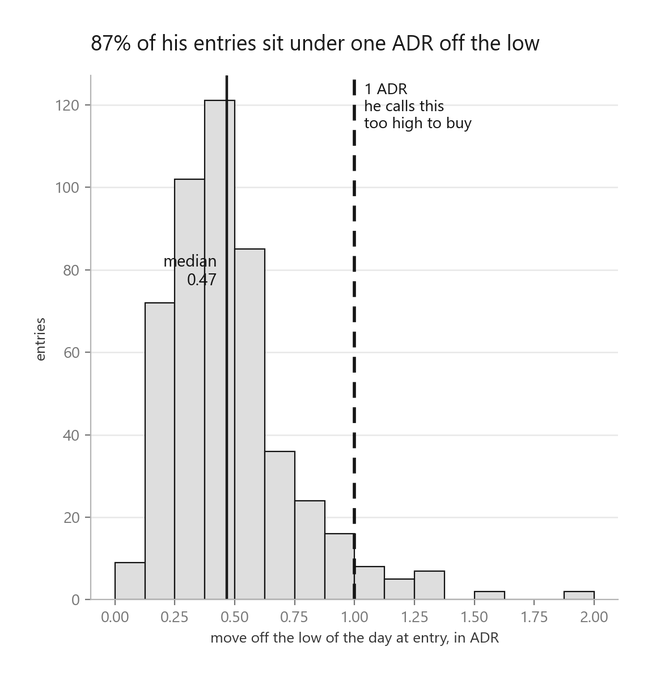
I studied over 900 of Market Wizard @Qullamaggie breakouts and EP trades
I made me stop caring when to enter.. how extended a stock is, is far more important than when you buy
Robotics is nearing its “ChatGPT moment.”
But the biggest fortunes may not be made by the companies building the robots.
They may be made by the companies supplying the brains, memory, vision, motion, power, and materials inside them.
This is the robotics wealth stack investors should know:
Deep dive:
https://t.co/2QLIbzo8Zi