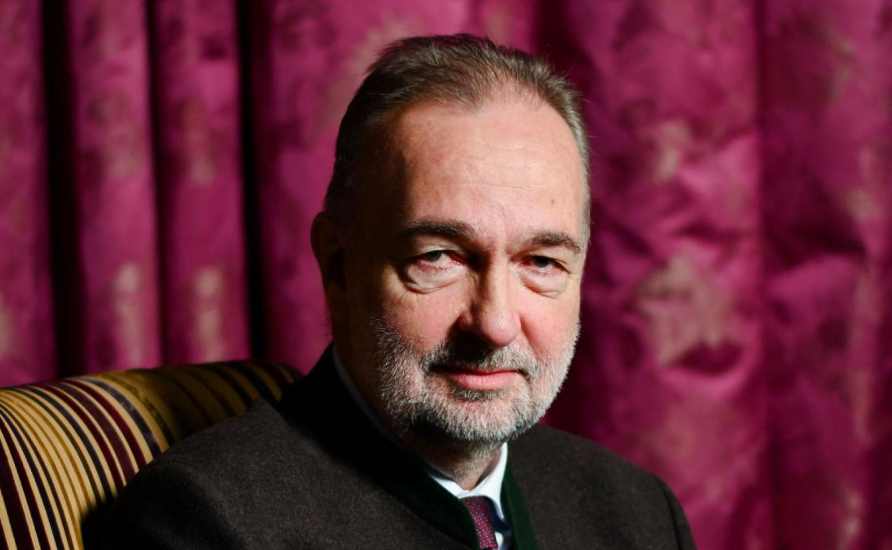
Dans une interview accordée à Profil, l'archiduc Karl de Habsbourg-Lorraine, prétendant au trône 🇦🇹-🇭🇺, se dit confiant dans les résultats attendus par la Commission montée et chargée déterminer si les bijoux retrouvés au 🇨🇦 sont bien la propriété de sa famille 1/4👇👑
The night of May 1, 1945. Hitler has been dead for a day and a half. The Red Army is a few hundred yards from the bunker.
Martin Bormann, the man who controlled who could see Hitler, what papers crossed his desk, and who rose or fell in the Nazi Party, walks up the bunker stairs into a burning Berlin.
He was never seen alive again. Probably.
Bormann was the most powerful Nazi most people had never heard of. Insiders called him the Brown Eminence. He was Hitler's private secretary, ran the Party Chancellery, and in Hitler's final will he was named Party Minister. He witnessed that will himself.
Then he tried to escape.
He went out with a breakout group that included Hitler Youth leader Artur Axmann and an SS doctor named Ludwig Stumpfegger. They tried to cross the Spree at the Weidendammer Bridge behind German armor under Soviet fire. They got split up. Bormann and Stumpfegger started following the railway tracks toward the Lehrter station.
Axmann later swore he found both of them lying near a bridge by the station, not moving. He didn't stop to check. He assumed they were dead and kept running.
That was it. That was the only eyewitness.
And for the next 27 years, nobody believed him.
At Nuremberg, Bormann became the only defendant tried in absentia. He got a court appointed lawyer, a trial, and a death sentence in October 1946. The court had no idea whether it was sentencing a living man or a corpse.
Then the sightings started. Argentina. Paraguay. Brazil. Chile. A monastery in Italy. When Israeli agents grabbed Adolf Eichmann off a street in Buenos Aires in 1960, it seemed to prove the point. Nazis really were hiding in South America. Why not Bormann?
It got stranger. In 1971, Reinhard Gehlen, the former head of West German intelligence, published memoirs claiming Bormann had been a Soviet agent all along and was living comfortably in Moscow.
A few years later a bestselling book claimed Bormann was alive in Argentina and the author had nearly tracked him down.
Meanwhile, back in Berlin, there was a detail almost nobody paid attention to. In 1945 a postal worker said the Soviets ordered him to bury bodies found near the Lehrter station. One of them carried papers belonging to an SS doctor. Stumpfegger.
In 1965, West German authorities dug near the station looking for Bormann. They found nothing and gave up.
In December 1972, construction workers laying cable in the same area hit bones. Two skeletons, close to where the 1965 search had come up empty.
Both had fragments of glass in their jaws. Crushed cyanide capsules.
One skeleton was tall, matching Stumpfegger. The other matched Bormann's dental chart, which had been drawn from memory after the war. West Germany officially declared Bormann dead in 1973.
The doubters still weren't finished. Some pointed to red clay on the skull and claimed it wasn't Berlin soil, that the body had been buried somewhere else and brought back. Paraguay was the favorite theory.
So in 1998, German investigators ran DNA from the skull against one of Bormann's elderly relatives.
It matched.
The man hunted across two continents, sentenced to death at Nuremberg, and "spotted" in half of South America had been lying under a Berlin street the whole time. He made it maybe a mile from the bunker before he bit down on the capsule.
In 1999 his remains were cremated and scattered in the Baltic Sea, so no grave could ever become a shrine.
One last detail. Bormann's eldest son, Martin Jr., was Hitler's godson. He grew up to become a Catholic priest and spent much of his life speaking out against everything his father stood for.