Join Matthieu Merchadou @Matmerkad , @blocksquare_io, Oceanpoint and the panel for a conversation on what real estate tokenization needs next: verified asset data, lifecycle visibility, and a trusted data layer behind the token.
Tune in here 👇
https://t.co/qISZ6PIWzd
On June 18, Matthieu Merchadou @Matmerkad, CEO of @magmarealestate, is joining an X Space hosted by @blocksquare_io & Oceanpoint: "Beyond Tokenization: Building the Data Layer for Real Estate 3.0
Tokenization has moved fast but tokenization alone isn't enough. If the asset behind the token is still fragmented documents, static data rooms, and unverified assumptions, we're only digitizing the financial wrapper.
The real opportunity is the data layer: connecting real estate to verified information about its condition, performance, compliance, and lifecycle. That's what makes tokenized real estate transparent, useful, and trusted.
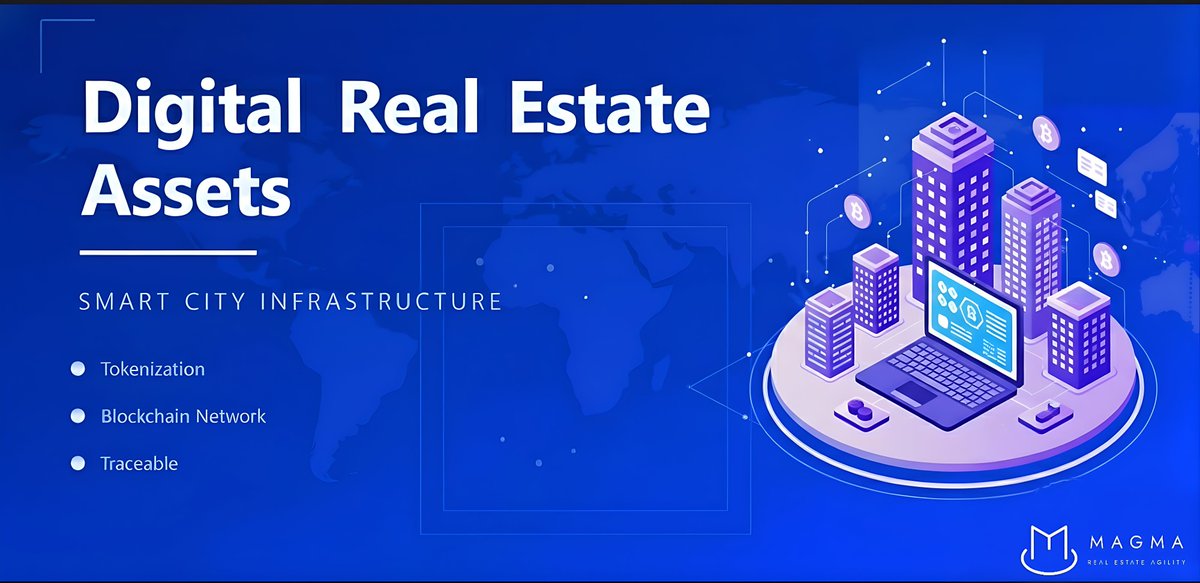
At Magma, that's the infrastructure we're building through the Digital Twin Token (DTT®), a verified digital identity for every building.
Looking forward to the conversation with:
🔷 @dp_blocksquare CEO, @blocksquare_io
🔷 @Ludovico_Rossi CRO, @Brickken
🔷 @mattschneid3r CEO, @BuildingInc
🔷 @MarkTokuti CEO, https://t.co/41REUfIGQH (moderator)
📅 June 18 · 16:00 UTC / 12PM ET
📍 X Space / @blocksquare_io
🔗https://t.co/N0Ktpk7QDw
#Tokenization #PropTech #DigitalTwin #RWA #Magma #DTT
@magmarealestate Great point. Operational inefficiencies often go unnoticed because they're small individually, but the impact becomes significant across an entire portfolio.
In Magma’s approach, the focus is on connecting building data with a structured digital representation of the asset, so operational behavior is no longer invisible or fragmented across systems.
By analyzing operating vs non-operating hour consumption across core systems like lighting and HVAC, it becomes possible to identify:
🔷 Unnecessary after-hours consumption
🔷 Deviations from expected usage patterns
🔷 Systems operating outside defined schedules
🔷 Optimization opportunities across assets and portfolios
The value is not only in monitoring, but in turning operational data into decision-ready insight across the full lifecycle of the asset.
When buildings become continuously readable systems, efficiency stops being reactive and becomes structural.
A significant share of inefficiency in real estate does not come from poor design, it comes from a lack of continuous visibility into how buildings actually operate.
Lighting left on after hours.
HVAC systems running in unoccupied zones.
Equipment consuming energy outside intended schedules.
At portfolio scale, these small inefficiencies compound into material cost and performance leakage.
This is where real-time building intelligence becomes critical.
Real-world asset tokenization will not scale on liquidity alone.
It scales when the data behind the asset is trusted, structured, and continuously verifiable.
Most real estate data today is fragmented across vendors, platforms, and disconnected systems. Ownership records, compliance updates, operational history, and building performance rarely exist in a single reliable source of truth.
That is the real infrastructure challenge.
At MAGMA , the focus is not only on tokenizing assets, but on building the data foundation that makes tokenization credible at institutional scale.
With the Digital Twin Token (DTT®), every building maintains a persistent digital record that evolves with the asset over time:
🔹 Legal and compliance updates
🔹 Operational changes
🔹 Asset history and performance data
The token matters.
But the data layer behind it matters more.
Because without trusted building intelligence, RWAs become difficult to verify, value, and scale.
A landmark moment for digital assets.
The CLARITY Act represents one of the most consequential regulatory developments for the U.S. digital asset market to date.
If enacted, it would establish a clearer framework for how digital assets are classified and regulated, define the respective roles of the SEC and CFTC, and provide institutions with the legal certainty they have been waiting for.
That matters.
For years, tokenization has been held back not by a lack of interest, but by uncertainty around the rules governing issuance, trading, custody, and compliance.
Clear regulation changes the conversation.
It gives asset managers, banks, custodians, and infrastructure providers a more predictable environment in which to build.
But regulation is only one part of the equation.Tokenization does not scale because a law is passed. It scales when the underlying infrastructure is ready.
That means:
- Legal structures that define investor rights clearly
- Custody arrangements that meet institutional standards
- Transfer restrictions and eligibility rules enforced programmatically
- Audit trails that withstand scrutiny
- Reliable valuation and reporting processes
- High-quality data supporting the underlying asset
This is especially important in real-world assets.
@magmarealestate This is a fascinating use case for Digital Twin Tokens. If you're interested in where real estate, data, and tokenization are heading, the Magma Telegram community is definitely worth joining.
Real estate is becoming a data-driven asset class.
At Magma, the Digital Twin Token (DTT®) creates a verifiable digital identity for every building, preserving its documents, models, and operational history in one trusted environment.
No more fragmented records. No more rebuilding information every time an asset changes hands.
Just structured, auditable building data that stays with the property throughout its lifecycle.
Join our Telegram community to see what we’re building and be part of the conversation shaping the future of real estate.
👉 https://t.co/1t7T5H8oye
Miami is where real estate, capital markets, and emerging technology converge.
We’re excited to welcome industry leaders to 𝗔𝗳𝘁𝗲𝗿 𝗛𝗼𝘂𝗿𝘀 𝗮𝘁 𝗕𝗼𝘂𝗹𝘂𝗱 𝗦𝘂𝗱, an exclusive private networking reception following the Greater Downtown Miami Founding Convening during @Future_Proptech Miami.
Hosted alongside Greenberg Traurig @GT_Law and Future Proptech Miami @Future_Proptech , this evening brings together innovators across real estate, investment, infrastructure, and tokenization.
We’re also proud to have @Brickken as sponsor of the event, alongside co-sponsor @Shokworks .
From institutional tokenization infrastructure to the future of programmable real estate assets, the conversations shaping the next era of property and capital formation are happening here in Miami.
📍 Boulud Sud: JW Marriott Marquis Miami
📅 May 13, 2026
🕢 7:30 PM – 11:00 PM
🔒 By invitation only
Looking forward to connecting with founders, developers, investors, and operators driving the future of real estate innovation.
#FutureProptechMiami #RealEstate #Tokenization #Proptech #DigitalAssets #RealEstateInnovation #Miami #Web3 #CapitalMarkets
🚨 It’s 2026, and real estate still runs on paperwork.
A meme coin can move in seconds, but a $10M building still requires audits, PDFs, and multiple intermediaries.
What if every building had a trusted digital twin?
🔹 Live data on energy, maintenance, and ESG
🔹 Verified documents and asset information
🔹 Secured through a Digital Twin Token® (DTT®)
Magma is helping turn real estate into transparent, efficient, and finance-ready digital assets.
🌋 Real estate is finally moving onchain.
#RealEstate #RWA #Tokenization #Web3
While Visa scales rails and Meta pays creators in stablecoins, the real question isn't whether tokenization works.
It's whether what's being tokenized can actually be trusted.
That's what Magma solves.
Every Magma Digital Twin Token (DTT®) embeds verified legal documents, BIM data, and a full audit trail directly into the token, turning real estate into a finance-ready onchain asset.
Not a promise of ownership. Proof of it.
🔗 https://t.co/JnwMH2djWI
Follow @magmarealestate for weekly tokenization updates
RWA Weekly Roundup
Another landmark week for tokenization.
Proxy voting comes to tokenized stocks, Visa scales stablecoin settlement to five new chains, and stablecoin transaction volume quietly crossed $4.5 trillion in a single quarter.
Latest tokenization news ↓
1️⃣ Visa expands stablecoin settlement to five new blockchains
Settlement volumes in Visa's pilot grew 50% quarter on quarter, hitting an annualized rate of $7 billion. Stablecoin settlement is scaling fast across the world's most used payment network.
2️⃣ Ondo brings proxy voting to tokenized stocks via Broadridge
Holders of Ondo tokenized stocks and ETFs can now express proxy voting preferences for the underlying securities, closing a meaningful gap between onchain ownership and the full rights that come with it.
3️⃣ Meta starts paying creators in stablecoins
Creators in Colombia and the Philippines can now receive payouts in USDC via Solana and Polygon, with Stripe powering the infrastructure. One of the world's largest platforms has made stablecoins part of its standard payment stack.
4️⃣ Western Union launches stablecoin and stable card on Solana
Western Union is rolling out USDPT, a new stablecoin on Solana, alongside a stable card product. One of the oldest names in global money transfer is now building directly on onchain payment rails.
5️⃣ Korea's Shinhan Card pilots stablecoin payments on Solana
One of South Korea's largest card issuers is testing stablecoin-based payments on Solana, adding another major Asian financial institution to the list of incumbents actively building on public blockchain infrastructure.
6️⃣ a16z: stablecoin adjusted transaction volume hit $4.5 trillion in Q1 2026 alone
The figure, released in a16z's latest report, signals that stablecoins have moved well past experimental usage. At this volume, they are no longer a crypto instrument, they are becoming a core layer of global financial settlement.
Closing note
Payment networks, social platforms, money transfer giants, and card issuers all moved in the same direction this week.
The infrastructure for tokenized finance is not being planned. It is processing trillions of dollars, right now.