I can’t find coverage of the exact vote tally, but I know the student body voted to repeal the ARC — and I believe by a substantial margin. As far as I can tell, that would never happen today. Middlebury has, sadly, become a far less tolerant place. I stopped donating many years ago and would never send my kids there. Which is a great shame, because the liberal arts model can accomplish impressive things in the right environment.
I graduated from Middlebury College in 2002. One of my first experiences there, as a freshman in 1998, was the student body *voting down* the Orwellian “Agreement to Respect Community” that was, in substance, a Marcusean speech code. Yes, there was plenty of lefty campus nonsense at Middlebury at the turn of the century, but I got along just fine as a conservative-minded kid from the midwest, and I had friends and professors from all over the political spectrum. 1/n
The “Agreement to Respect Community,” or “ARC,” would have required students to sign a pledge stating “I commit to promoting a culture of consideration and respect for the individual and collective dignity of the College Community by assuming ownership of my words and actions, and weighing their inevitable impact on others.” Many students were concerned about the chilling effect it would have had on free speech and inquiry, as documented in this December 1998 Middlebury Campus article: https://t.co/xEgCMMDbsg. 2/n
The Michigan game will be a bigger deal with more talent on the field, but from an overall experience point the choice is Notre Dame. Seeing a college football game in South Bend is akin to seeing a major soccer match at Wembley. The atmosphere is off the charts, plus you can pair it with some time in Chicago, which is around an hour away.
Isn’t this just a simple matter of incentives? *Within academia,* the incentive structure still rewards or tolerates nonsensical faculty lounge type behavior; there are few if any costs for such behavior. Actors *outside of* academia have started to take action to alter the cost/benefit mix, but the costs imposed from outside are, for the most part, too small to change the overall dynamic. There may be exceptions, for example at public universities in red states that have energetic & reform-oriented legislative and executive branches. But outside that narrow context and perhaps a few others, the bubble remains because there is not a sufficient incentive for anyone to pop it.
Society would be more willing to pay if the “knowledge production” contributed to advancement of society in some way. 30,000 word essays on why exercise is bigotry do not make the cut. We have the same problem in law. As Chief Justice Roberts once observed, papers on The Influence of Immanuel Kant on 18th Century Bulgarian Evidence Law may product knowledge, but the knowledge doesn’t matter to anyone outside the academy.
The American ppl are so caring. I hv offer of a used Hoover fr a good Iowan in Sioux City. IT WONT SURPRISE ANYBODY BUT I ACCEPTED. BETH IS BACK BUT NEWER MODEL
U willl see Beth no more See black that’s from electrical sparks. It’s not safe to use anymore. GOOD BYE BETH . U hv been a real workhorse. Ur namesake still is hard worker. I will miss u
Exactly. The SCOTUS merits docket is the smallest it has been in decades. There are lots of important lower court rulings that escape SCOTUS review as a result. That dynamic needs to change.
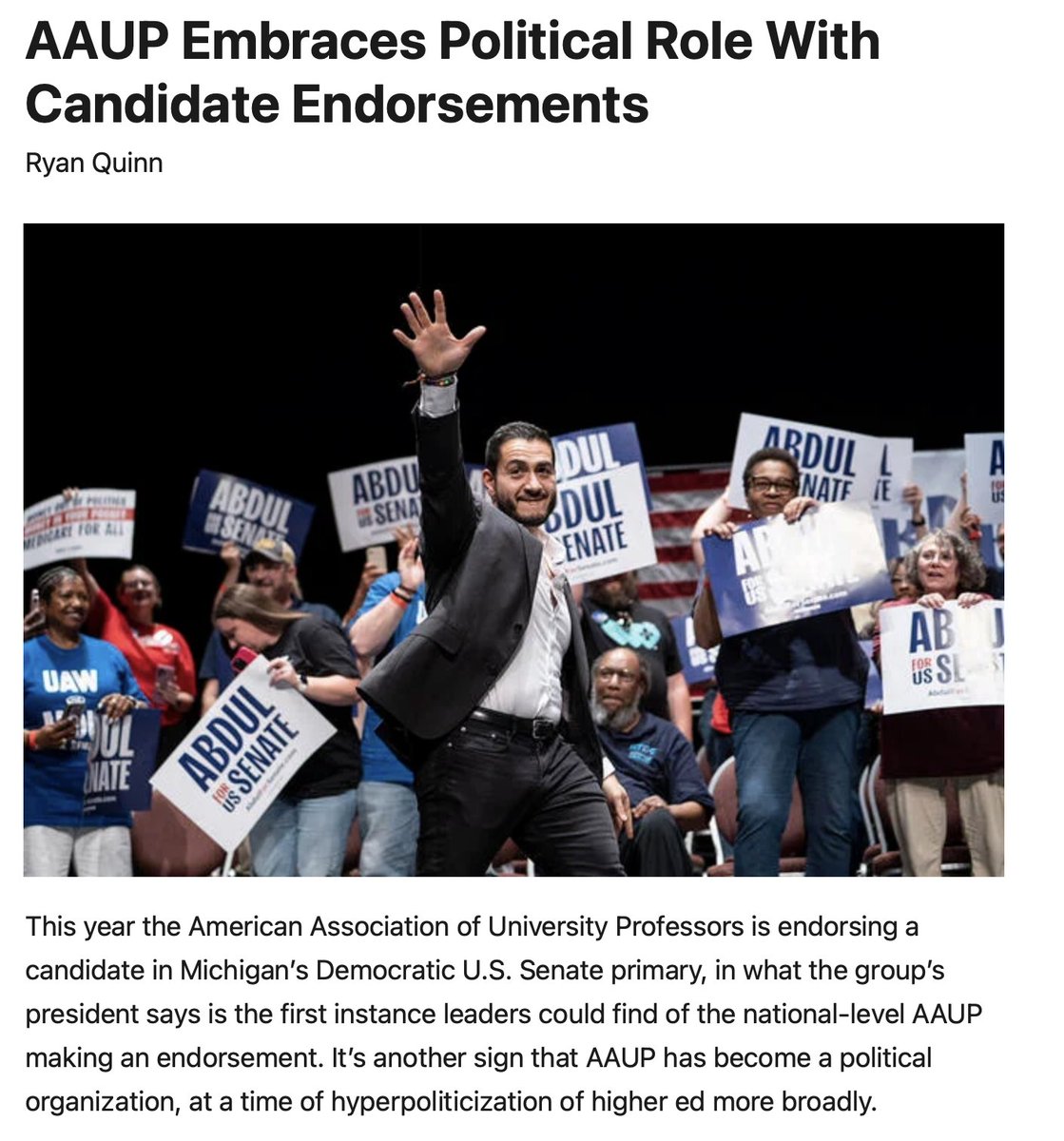
I am not an AAUP member, but I think it is a really bad idea for the American Association of University Professors to be endorsing candidates, especially in a factional Democratic primary.
Nothing, in the abstract. But there is something wrong — seriously wrong — with judicial abdication. Courts should enforce the Constitution’s protections for speech, property, religion, and other fundamental rights, not reach for flimsy procedural grounds to duck the issues. It can be challenging to sort out where restraint ends and abdication begins, but it is still worth having that debate. @mike_frags is doing us all a service by facilitating the discussion.