The most detailed 3D reconstruction of a cell ever created.
Blows my mind every time.
But what exactly are we looking at here?
The average human cell contains:
~ 15-20 total distinct organelle types, totalling between ~1-10 million working together per cell.
All these nano-machines in the cell are made up of proteins.
~ 8,000-10,000 distinct types of unique proteins, adding up to between 40 million - 10 trillion total proteins making up all those cellular systems.
~ 10,000 - 15,000 distinct types of RNA shuttling information around the cell, totalling up to ~10 million RNA molecules moving around the cell simultaneously.
~ Billions of Lipid molecules packed together into the cell membrane, which is also packed tightly with millions more protein-based nano-machines.
And let's not forget billions of lines of DNA information to build and run it all.
That's TRILLIONS of of individual molecular pieces working together to make a single cell function.
That means there is more complexity in a single cell than humanity's largest cities.
And people still believe this wasn't Divinely Designed.
This is God's Glory on Display.
But to make the point.
A cell couldn't have evolved from some nebulous simpler "protocell" because even the simplest cells still require massive complexity.
The "simplest" cell ever created was engineered by scientists knocking out pieces of a functional cell until it stopped functioning.
Here is what they found is the absolute necessary minimal requirements of a cell to function:
- Over ~531,000 lines of coded DNA information
- 473 total genes to create hundreds of unique protein products (they later added 19 genes back in because the cell was so weak)
- Hundreds of thousands of total proteins all working together
- Extensive regulatory networks guiding all these interactions
If the cell doesn't have all these systems in place, from the start...
it doesn't live.
Cell rely on an intricate network of complex systems, which are themselves built from complex interconnected pieces woven together into an incomprehensibly complex web of functionilty.
Only intelligence has ever been observed creation vast interconnected systems like this.
Life was clearly Created.
It couldn't happen any other way.
A Harvard study found large-scale wind farms change local temperatures by mixing the boundary layer.
At night, cooler air sits near the surface. Warmer air sits above it. Turbine blades stir those layers together. Warmer air is pushed downward, causing surface temperatures to rise.
The study modeled enough wind power to supply current U.S. electricity demand. The results show about 0.24C warming across the continental U.S., with wind farm regions warming by 0.6C.
The effect is immediate and strongest at night.
The study does not say turbines create new heat. They redistribute heat already in the atmosphere. But for people, crops, soil, and ecosystems near the turbines, the result is still warming.
Warum das aktuelle Konzept der Energiewende uns in den Ruin treibt. Eine kurze Geschichte über exponentielle Kosten:
Stellen wir uns vor, wir haben ein einziges, wichtiges Gerät, das genau 1 kW Strom braucht, um zu laufen.
Wir bauen ein Windrad. Es liefert 1 kW. Wir merken aber schnell: Der Wind weht nicht immer.
Also bauen wir Solarzellen dazu. Jetzt haben wir mittags oft zu viel Strom, nachts aber immer noch keinen.
Also kaufen wir uns einen teuren Batteriespeicher. Der deckt nun den normalen Tag-Nacht-Rhythmus ab.
Dann kommt der eiskalte Winter. Die klassische Dunkelflaute. Kein Wind, keine Sonne und die Batterie ist schnell leer.
Jetzt MÜSSEN wir zwingend ein vollwertiges Backup-Kraftwerk (Gas/Kohle) daneben stellen, das unser 1 kW immer verlässlich garantieren kann, damit das Gerät nicht ausgeht.
Jetzt kommt der finanzielle Ruin im Detail: Dieses Backup-Kraftwerk kostet im Bau, beim Personal und in der Wartung ein absolutes Vermögen, läuft aber nur ein paar wenige Wochen im Jahr. Die Kosten für jede produzierte Einheit sind in diesen paar Wochen gigantisch. Kaufmännisch ausgedrückt: Wir bezahlen die komplette Jahresmiete für eine Luxus-Wohnung, in der wir nur drei Nächte im Jahr schlafen.
Wenn wir nun feststellen, dass wir viel mehr Strom brauchen (weil wir die Industrie elektrifizieren und alle per Gesetz Wärmepumpen und E-Autos nutzen sollen...), wächst dieses System nicht einfach brav linear mit.
Wir müssen massiv neue Stromleitungen ziehen und diese komplette dreifach redundante Infrastruktur (massiver Überbau an Wind/Solar + gigantische Batterien + Milliarden teure Backup-Kraftwerke) immer weiter mit ausbauen.
Der Sargnagel: Alle 15 bis 20 Jahre ist diese Hardware (Windräder, Batterien, Wärmepumpen) am Ende ihres Lebenszyklus angelangt und muss komplett neu gekauft und aufgebaut werden.
Wir bezahlen hier also dauerhaft ein völlig überdimensioniertes, dreifaches System, das sich permanent selbst erneuern muss, nur um ein paar Wochen Winter zu überbrücken. Das ist keine lineare Rechnung mehr, das ist eine exponentielle Kostenspirale.
Das Resultat dieser Labor-Mathematik ist völlig banal: Die Industrie wandert in Länder mit günstiger Grundlast ab, weil unser Strom unbezahlbar wird. Keine Industrie bedeutet keine Steuereinnahmen. Und keine Steuern bedeuten das schnelle Ende unseres Sozialstaates. Physik und Ökonomie verhandeln nicht! 📉🏭🦊
Why is university education today so broken?
In the Middle Ages, it was profoundly different. It was less about acquiring skills, and more about the process of thinking itself.
You learned the seven liberal arts...
In ancient and medieval societies, education wasn't about readiness for work, but the cultivation of the moral and intellectual virtues that free the mind.
From the 12th century, a standard university course consisted of 7 liberal arts: 3 humanities (the trivium) and 4 sciences (the quadrivium). These weren't distinct "subjects" as we understand them, but modes of learning.
What was "liberal" about them? They were the kind of thing studied by free men, as opposed to strictly practical education (cooking, agriculture, toolmaking, etc.) for servī, "slaves."
"Free men" were able to gain knowledge that wasn't for a pre-defined purpose, but instead to transform them personally. Music was studied not for its practical applications, but for its effects in purifying the soul.
A medieval university course first taught you the trivium: grammar, dialectic, rhetoric. These were tools for later learning; to free your mind first so that you can think. And since all knowledge is conveyed through language, you must learn that first.
First, Grammar is the mechanics of language. It taught you language in the basic sense: how to comprehend and convey ideas — so you studied the greatest works/ideas from history, like Virgil's Aeneid.
Dialectic (logic) is the mechanics of thought: how to compose sound arguments and identify wrong ones. You'd study Porphyry's introduction to Aristotle's logical works.
Rhetoric is using language to instruct or persuade. Knowledge (grammar), now understood through logic, can be passed onward as wisdom. You'd likely study Cicero's great dialogue, De Orate…
After that, you're ready for the quadrivium: Arithmetic, Geometry, Music, and Astronomy. Why were they grouped as sciences? Because ancient thinkers understood the universe as bound by a mathematical, musical harmony.
You'd read Euclid's Elements, Plato's Timaeus, and Boethius's De Musica to understand the properties of numbers, shapes and the cosmic order — and how mathematics connects us to the universal music of the cosmos.
After all this, your mind was finally ready for philosophy and the higher faculties: law, medicine, and theology. Theology was considered the highest, and studying it would culminate a complete Christian education.
The key difference back then was to see education not simply as a set of disciplines to gain factual knowledge from. Subjects instead worked together on a journey to free the mind, preparing it above all in the process of thinking.
Only once you'd completed the 7 liberal arts (6-8 years) could you move on to higher faculties. So no matter what people went on to do, their minds had all been trained in the same rigorous basics of thought.
6-8 years may seem long, but university education back then typically started around 14-16 years of age. Besides, Plato believed students ought not to be taught philosophy until the age of 30:
"For a young man is a sort of puppy who only plays with an argument; and is reasoned into and out of his opinions every day; he soon begins to believe nothing."
Student data should be minimal — or zero. Learn how MyComputerBrain delivers effective learning without emails, DOB, or gender collection. Read the blog: https://t.co/fx5ogKoDAi #EdTech#StudentPrivacy#PrivacyByDesign
🧩 Introducing Cyber Mystery: AI & Coding with Blockly
A free coding adventure for primary students to learn Blockly through immersive challenges: print, input, variables, AI, binary, decisions, and loops
✅ Free
✅ Curriculum aligned
✅ 🇬🇧 🇩🇪 🇫🇷 🇪🇸 🇨🇳
https://t.co/5hJzlVvIHQ
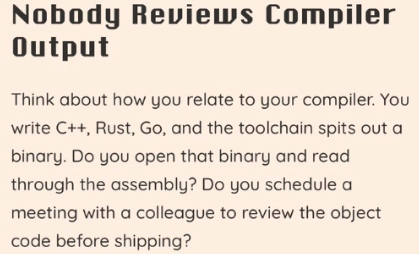
"Nobody reviews compiler output, why review AI code?"
Wrong. We do review compiler output. Godbolt exists. Disassemblers exist. Anyone doing serious performance work reads what the compiler produced. The premise is false.
But the analogy itself is flawed. It compares two things that aren't comparable.
A compiler takes a formal language as input. Languages with grammars and semantics defined precisely enough that "what does this code mean" has only one answer.
An LLM takes natural language as input. Natural languages are ambiguous. "Write me a function that handles user input safely" has a thousand valid interpretations and a thousand more invalid ones. The LLM picks one. You don't know which. Unless you look at the code.
Compilers are built from specifications and designed to meet them. The output is the result of a defined translation. When the output violates the spec, it's a bug.
LLMs are built from whatever was in their training data. There is no spec. There can't be one, natural languages have no defined semantics that map to code.
Compilers are semantically deterministic. The same input produces output with the same behaviour, every time. LLMs are not. Partly by design and partly due to hardware variance, batch size, inference order, and floating point operations (and no setting temperature to zero does not address those). All of which can push the same prompt to produce different code.
Compilers complain loudly when the input is nonsensical. LLMs fail silently, producing plausible-looking, but wrong code.
We trust compiler output because the trust was earned across decades of use, with millions of engineers using the same tools. Early compilers were reviewed heavily. Hand-written assembly was the default because trust hadn't been earned yet.
We're at the hand-written assembly stage with AI. We may never get to the trust-the-output stage for the reasons explained above.
If you’re a software developer, you should own what goes to production. The compiler analogy is a way of skipping that responsibility.
What a beautiful way to kick off your Saturday!
This is J.S. Bach’s Cello Suite No. 1 in G Major, performed by Yo-Yo Ma at the reopening of Notre Dame, 2024.
The human brain is truly a marvel of nature.
If you horribly reductive, and boiled it down to a language model, you'd be looking at roughly 100 trillon parameters running as a sparse MoE architecture
Only about 1-5% of neurons fire at any given moment, meaning the brain "activates" maybe 1-5 trillion parameters per inference step.
For context, the largest AI models we've built probably top out around 5 trillion parameters.
The brain is roughly 100x larger. Even its active params at any given moment are larger than almost every model in existence today.
Here's what melts my brain (pun intnended) though
Your brain does all of this on about 20 watts of power, less than a dim light bulb.
Training a frontier AI model consumes enough electricity to power small cities for months. Running inference across data centers pulls megawatts.
Your brain runs 24/7 for 80+ years on the equivalent of a phone charger.
We haven't come close to matching the brain's scale. And we're not even in the same universe when it comes to efficiency.
Evolution spent 500 million yrs optimizing the most energy-efficient intelligence architecture ever known. we're trying to brute force our way there with compute and electricity.
Nature is still the best engineer in the room.
Yesterday, I interviewed a candidate for a Graphics Design role.
No fancy degree.
No big-name company on his CV.
But his portfolio? Clean. Intentional. Story-driven.
I asked him to redesign a basic flyer.
In 15 minutes, he didn’t just design…
He asked:
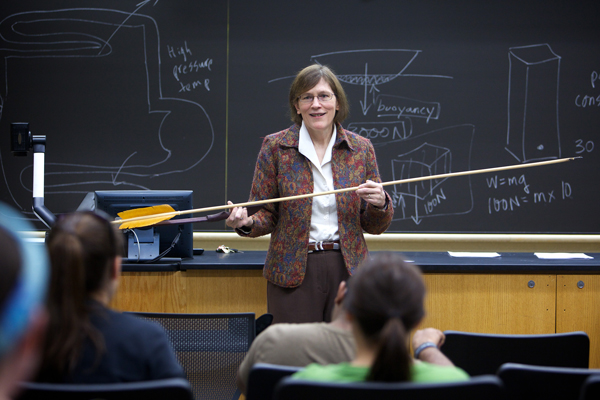
A professor of engineering who failed math all through school built one of the most popular online courses in history by figuring out exactly why her brain had been working against her the whole time.
Her name is Barbara Oakley, and she did not teach herself how to learn until she was in her mid-twenties, after leaving the military with a head full of Russian and almost no useful science knowledge. What she discovered about her own brain eventually became a Coursera course that over 4 million people have taken, and the core insight she teaches has been sitting in neuroscience research for decades waiting for someone to explain it in plain language.
Here is the framework that changed how I think about every hard thing I am trying to learn.
Your working memory is an octopus sitting in your prefrontal cortex with exactly four arms. Those four arms reach out and grab pieces of information, hold them in place, and manipulate them while you are actively thinking through a problem. Four is the limit.
When you try to hold more than four things in conscious awareness at once, the arms start dropping things and everything becomes a scramble which is exactly what you experience as confusion when learning something genuinely difficult.
This is not a flaw. It is a design feature. And the entire game of becoming expert at anything is learning how to game this constraint.
The mechanism is something neuroscientists call chunking, and it is the most underexplained concept in all of learning.
When you practice something enough times that it becomes automatic a guitar chord, a grammatical structure, a mathematical procedure, a debugging pattern in code your brain compresses it into a single neural package stored in long-term memory. That compressed package now fits in just one of your four working memory slots instead of filling all of them.
Which means once you have built enough chunks, your octopus can reach down into long-term memory, pull up an entire complex procedure in a single grab, and still have three arms free to work with new information on top of it.
This is what expertise actually is. Not raw intelligence. Not natural talent. A library of compressed patterns that can be retrieved quickly and stacked together to solve problems that would overwhelm a beginner whose working memory is still occupied with fundamentals.
The finding that Oakley emphasizes most forcefully is the one that sounds backward until you understand the mechanism. People with smaller working memory capacity those who can only hold two or three items at once rather than four are often forced to develop stronger chunking habits earlier and more aggressively than people with larger working memories, because they have no choice. Their constraint becomes their training. Over time, that aggressive chunking practice can produce more robust expertise than a larger working memory that never had to be disciplined in the same way.
The most powerful practical implication is this: when you feel completely overwhelmed trying to learn something, that feeling is almost always your four-slot octopus running out of arms. The solution is not to concentrate harder. The solution is to stop, isolate one small piece of the problem, practice it until it compresses into a single chunk, and only then pick up the next piece.
You cannot learn everything at once because your brain was never designed to hold everything at once. It was designed to build libraries of compressed knowledge and retrieve them on demand.
Every expert you have ever admired is not smarter than you. They just have a bigger library.
Elon Musk didn't have a background in mechanical engineering or rocket science when he founded Tesla and SpaceX.
He didn't.
He was once asked how he packed so much knowledge into his brain so quickly.
His answer: "It is important to view knowledge as sort of a semantic tree — make sure you understand the fundamental principles, i.e. the trunk and big branches, before you get into the leaves/details or there is nothing for them to hang on to."
Most of us do it backwards.
We go straight for the leaves - the tactics, the hacks, the step-by-step methods - before we've built any trunk to hang them on.
The information doesn't stick.
-We read a book, forget it within a week.
-We take a course, can't apply it a month later.
-We collect knowledge without ever building understanding.
Musk builds the trunk first.
The science backs this up.
Neuroplasticity is the brain's ability to rewire itself and works like a tree.
Learning something new is a series of attempts, failures, and adjustments.
Neural connections that result in success grow stronger.
Unproductive connections eventually break off like dead branches.
This is why understanding fundamentals isn't just academically satisfying, it's mechanically how the brain learns best.
When you have a solid trunk, new information has somewhere to attach.
Without it, everything slides off.
Here's what that looks like in practice:
Instead of learning how to build a rocket engine, Musk learned why rockets work the way they do - the physics, the materials science, the thermodynamics.
Once those principles were in place, the specific engineering decisions became far easier to evaluate, question, and improve upon.
Instead of memorizing investing methods, Charlie Munger built what he calls a "latticework of theory" from psychology, history, mathematics, physics, philosophy, and biology and then used that latticework to make better decisions across all of them.
This is the difference between linear and residual knowledge.
A method works once, for one problem.
A principle works hundreds of times, across dozens of contexts you haven't even encountered yet.
Harrington Emerson, the American efficiency engineer, put it plainly: "As to methods, there may be a million and then some, but principles are few. The man who grasps principles can successfully select his own methods. The man who tries methods, ignoring principles, is sure to have trouble."
So the next time you sit down to learn something, whether it's a new skill, a new industry, or a new discipline, resist the pull of the tactics.
Ask instead:
-What are the trunk and big branches here?
-What are the first principles that, once understood, make everything else easier to figure out?
That's how residual knowledge works.
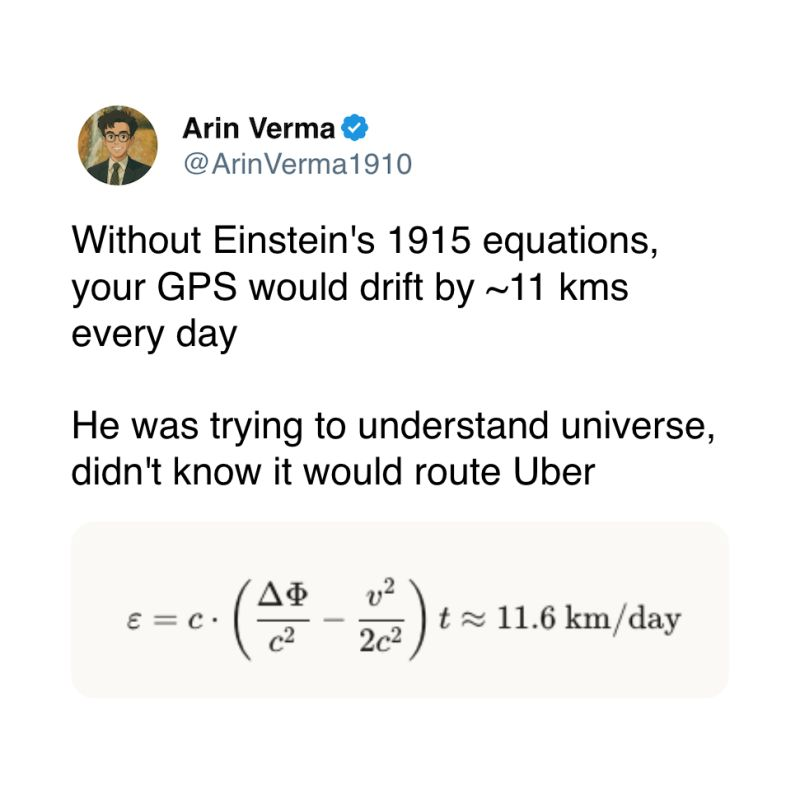
In 1905, Einstein published special relativity. In 1915, he published general relativity. Einstein was just trying to understand the universe.
But without Einstein's math, Google Maps would be wrong by 11 kms every single day.
Let me tell you why - this is very interesting :))
Your phone doesn't "talk" to GPS satellites. It only listens. Each satellite is broadcasting one thing, constantly: "I am satellite 'A', and it is currently 14:23:00.000000."
Your phone receives signals from 4 satellites simultaneously. Because light travels at a known speed, tiny differences in arrival time tell it exactly how far it is from each satellite.
'A' satellite tells you: you're somewhere on a sphere of radius 20,000 km.
'B' satellite: that sphere intersects another sphere - now you're on a circle.
'C' satellite: that circle intersects a third sphere - now you're at 2 points.
'D' satellite: eliminates the last ambiguity and only one point remains.
That's you!
Except there's a problem nobody thought about until Einstein.
The satellites are orbiting at 20,200 km altitude, moving at 14,000 km/h.
Two things happen to their clocks simultaneously:
- Special relativity: Moving clocks tick slower. At orbital velocity, the satellite clock loses 7.2 microseconds per day
- General relativity: Clocks in weaker gravity tick faster. At that altitude, gravity is weaker. The clock gains 45.9 microseconds per day.
Net effect: 45.9 - 7.2 = +38.7 microseconds per day.
In 38.7 microseconds, light travels 11.6 kilometers.
So without correction, the system would accumulate 11.6 km of error. Every single day. In a week, your navigation is useless.
The fix is one of the most elegant things in all of engineering.
Before each satellite launches, its atomic clock is physically tuned to tick slightly slower than it would on Earth - by exactly 38.7 microseconds per day.
Once in orbit, relativistic effects speed it back up. And it arrives at exactly the right rate.
Einstein's 1915 paper is baked into the hardware of your phone's navigation system.
The next time Google Maps routes you correctly, you're experiencing general relativity.
You just didn't know it.
A physicist who spent 30 years studying why massive engineering systems fail realized one terrifying truth:
Optimizing anything other than the primary bottleneck is an absolute waste of time.
His name is Eliyahu M. Goldratt, the man who famously revolutionized modern operations management. He argued that we obsess over making individual teams faster and completely ignore the actual flow of the system.
Here are 4 operational frameworks he used to build elite, hyper-efficient organizations: