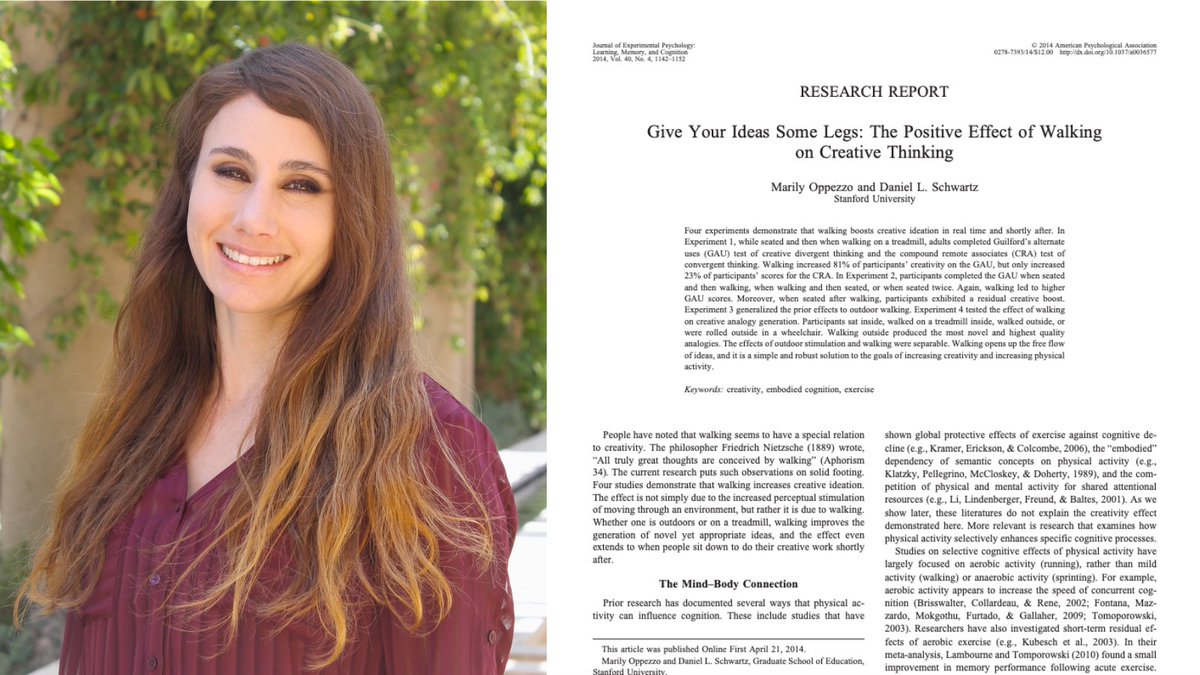
A Stanford psychologist spent 4 years proving that the simple act of walking generates 60% more creative ideas than sitting, and the experiment she designed to kill every alternative explanation is one of the most decisive findings in modern psychology.
Her name is Marily Oppezzo.
She got the idea for the study while walking with her advisor at Stanford to discuss her thesis topic, and the paper she eventually published in the Journal of Experimental Psychology in 2014 is sharp enough that it should have ended the seated meeting on the day it came out.
She ran 4 experiments on 176 people. Same person tested twice. Once sitting, once walking. The creativity tasks were the standard ones psychologists have used for decades to measure how good a brain is at generating novel useful ideas.
The result was almost too clean to publish.
81% of participants in the first experiment produced more creative ideas while walking than while sitting. In the second experiment, 88%. In the third, 100%. Every single person walked into a more creative version of themselves.
On average, people generated 60% more novel useful ideas the moment their legs started moving.
The skeptical question is the obvious one. Maybe it was the fresh air. Maybe it was the scenery passing by. Maybe it was the change of environment doing the work, not the walking itself.
Oppezzo killed every one of those explanations with one experimental decision.
She put people on a treadmill facing a blank wall. No scenery. No fresh air. No environmental change. Just legs moving in place while staring at white drywall. The 60% boost held.
Then she ran the experiment that closed the case completely. She took participants outside in two conditions. Half of them walked through a Stanford courtyard. The other half were pushed through the exact same courtyard in a wheelchair. Same outdoor stimulation. Same scenery passing at the same speed. The only difference was whether the legs were moving.
The walkers produced dramatically more novel high-quality ideas than the wheelchair group. The outdoors did almost nothing on its own. The walking did everything.
This is the part of the study that hit hardest when I read it the first time.
She also tested the opposite kind of thinking. Convergent thinking. The kind where there is one right answer and you have to narrow down to it.
Word puzzles where 3 words share a hidden fourth word that connects them. The seated participants did slightly better on these. Walkers got slightly worse.
Walking is not a general intelligence enhancer. It does one specific thing. It opens up the divergent search inside your brain. The part that generates options. The part that produces unexpected connections. The part that takes a problem and finds five ways into it instead of one.
When you need to converge on the single right answer, sit down. When you need to find the answer in the first place, get up.
The mechanism is now well understood. Walking selectively activates what neuroscientists call the default mode network, the system inside your brain that runs when you are not consciously focused on anything. The DMN is where mind-wandering happens. Where memories cross-reference each other. Where ideas that have been sitting in separate folders inside your head finally bump into each other.
When you sit at a desk and force yourself to concentrate, you suppress the DMN. When you walk at a natural pace, the executive part of your brain gets just busy enough handling the walking that the DMN comes online and starts doing the work that focus was blocking.
The most useful finding in the entire paper is the one almost nobody quotes.
The boost did not turn off the moment people stopped walking. Participants who walked first and then sat back down stayed elevated. Their next round of seated creativity work was still significantly better than people who had been sitting the whole time. The rest lingered for at least several minutes after the legs stopped moving.
You do not need to do creative work while walking. You need to walk before the creative work. The brain holds the state.
The history of this is the part that should haunt anyone who still does meetings in chairs.
Charles Darwin built a gravel loop behind his house in Kent called the Sandwalk and walked it 3 times a day for the rest of his life. The theory of evolution was developed one lap at a time on that path.
Nietzsche walked up to 10 hours a day during the years he wrote his most important books and openly said the work was conceived on his feet.
Beethoven composed for the morning and walked for 5 hours every afternoon with a pencil in his pocket for when something landed.
Kahneman said the best thinking of his Nobel Prize-winning career happened on leisurely walks with Amos Tversky. Steve Jobs refused to take important conversations sitting down. He held them on foot.
Every one of them was using the system Oppezzo would not measure until 2014. They just did not know what to call it.
The question worth sitting with is the one almost nobody asks.
Every meeting you have ever attended sitting around a table was a meeting held at a fraction of the brain power that was actually available to the people in the room. Every brainstorm that got stuck inside a conference room. Every problem you tried to solve at a desk and gave up on. Every idea you could not quite get to.
The intervention is the easiest one in modern science. No supplement. No app. No subscription. No training program. Just a pair of legs and 15 minutes.
The Stanford lab proved it. The philosophers knew it. The neuroscience explains it.
And almost everyone reading this is still trying to think their way out of problems sitting completely still.
“It is frustrating because, as a manager, you are also responsible if things happen time and time again, you are hired to try to prevent that for the next time,” Slot added. Even Arne admits he is out of his depth. #LiverpoolFC
@SkySportsNews With the best will in the world after researching the art of motivation for 30 plus years - this man gives me ZERO confidence that he can turn Liverpool fortunes around. I only hope he has known all along he was leaving for Ajax because every interview gets progressively worse.
A group of UC Berkeley students did a 9-week digital detox… and the results were striking.
Cognitive neuroscientist Dr. Sahar Yousef (UC Berkeley Haas) found that participants experienced less anxiety, less depression, and more mindfulness. Some students said they suddenly started noticing all the positive things in their real life once the constant scrolling stopped.
Dr. Yousef also raised a concern, noting that heavy daily tech habits may be linked to brain changes: “We’re actually seeing brain atrophy… degradation of certain brain areas related to self-awareness [and] cognitive control.” (Note: This is an emerging area of research — more long-term studies are needed.)
This feels very relatable. The longer I step away from endless scrolling, the clearer and calmer my mind seems to get.
Our digital habits have become so automatic that we rarely stop to consider their impact on mental health and focus.
Have you ever tried even a short digital detox? What difference (if any) did you notice?
A man spends 50 years teaching at MIT.
He knows his time is running out.
So he records one last lecture — everything he knows, distilled into a single hour.
He died 5 months later.
This is that lecture.
The most important hour you'll watch this week. 👇Bookmark it for later
This MRI study on young kids just exposed something terrifying:
They scanned the brains of 60 children aged 3–5 — including 5-year-old Rose — and found interactive screen time is causing measurable loss of white matter in their developing brains. Even just 2 hours a day is linked to impaired neural connectivity, language, and literacy development.
Professor Mike Nagel (neuroscientist and father) said his first reaction was simply: “Wow… I was not anticipating seeing anything like that.”
We’re physically changing children’s brains before they even start school — and the damage is visible on scans.
This one actually unsettled me. I’ve always suspected too much screen time was bad, but seeing real white matter loss in toddlers hits different.
Parents of little ones — has this kind of research changed how much screen time you allow?
In 1972, a Stanford psychologist gave 4-year-olds a choice.
"One marshmallow now or wait 15 minutes and get two."
Rich kid waits. Poor kid eats it immediately.
For 50 years, psychologists said this proved poor kids lack self-control.
Wrong.
Poor kids learned that promises get broken. The second marshmallow isn't coming.
Professor Jiang Xueqin spent 50 minutes explaining why the poor kids are the rational ones:
The psychologist was named Walter Mischel. He put a marshmallow in front of 4-year-olds and said: "You can have it now, or wait and get two."
He tracked them for decades. The kids who waited did better at everything.
His conclusion: success means delayed gratification. Long-term planning. Self-control.
So educators built curricula around it. Teach kids self-control, resilience, self-assessment. They'll succeed.
It didn't work.
"If you take a bad student and teach him self-control, resilience, and self-assessment, the student doesn't actually get better."
The reason is simple: correlation does not equal causation.
Successful people wake up at 4am. But waking up at 4am won't make you successful.
If you're successful, you wake up early because you're motivated. If you're successful, you have self-control because your environment rewards it.
The traits don't cause success. Success causes the traits.
Here's what actually determines success:
"We know for a fact that rich people are much more likely to succeed than poor people. School doesn't really matter. If your parents are rich, you'll be successful. If your parents are poor, you will not."
The difference starts with parenting.
A rich kid touches a hot stove. The parent says: "You made a mistake. Don't worry about it. Let me explain why fire is dangerous. You could burn yourself. We'd have to go to the doctor."
A poor kid touches a hot stove. The parent says: "Don't you ever do that again or I'll beat the crap out of you."
Same lesson. Completely different worldview.
The rich kid learns: the world is safe. I am respected. Adults explain things to me.
The poor kid learns: the world is scary. I must fear authority. Don't ask questions.
There's another difference. Rich parents keep promises. Poor parents can't.
"Next week we'll go to Thailand." Next week, you go to Thailand.
"Next week we'll go to McDonald's." But the paycheck isn't enough. "Sorry, we can't go anymore."
Rich parents offer stability. Poor parents can only offer volatility.
Now go back to the marshmallow test.
"If you believe the teacher will keep his promise, you won't eat that marshmallow. If you think the teacher is lying, you will eat it."
If you're a poor kid, you've learned that promises get broken. Adults lie. The second marshmallow probably isn't coming.
So you eat the first one. That's not lack of self-control. That's rational decision-making.
"Poor kids are not stupid. Poor kids are rational. They're responding to the circumstances they live in."
The same logic applies to resilience.
"The idea of resilience is that you believe the world will help you. If you're rich and you fail, someone will help you get up. If you're poor and you fail, that probably tells you that you shouldn't be doing this."
Why try again when trying again has never worked?
And self-assessment? "If you're a poor child who lives under a lot of stress, it's hard to be self-reflective. Because if you look back at yourself, all you think about is your pain and your stress."
Here's the deeper structure.
"As a poor person, if you want to survive, you have to obey authority. As a rich person, you maximize your outcome by negotiating with others."
Poor parents command their children because that's what the world will demand. Obey the police. Obey the boss. Don't talk back.
Rich parents teach their children to debate, argue, negotiate. Because that's their game.
"From day one, rich kids know they're playing a different game."
Here's something stranger.
500 students took an IQ test. Then they guessed their ranking.
The top 5% thought they were top 20%. The test was easy for them, so they assumed it was easy for everyone.
The bottom 5% thought they were average.
"People who are stupid lack the capacity to know they're stupid."
This is the Dunning-Kruger effect. And it explains why the most confident people are often the least competent.
"This helps explain why the world is why it is. Often the people in power are stupid. They don't know they're stupid. They were confident."
Can poor kids escape?
"Yes. But it means leaving your community. You have to be extremely individualistic. Very ambitious. High risk tolerance. Most people don't have that."
The professor is one of them.
"I'm a poor kid who succeeded. My father was a dishwasher. But I left Canada for the United States. I got lucky."
"You can work as hard as you want, but the chances are against you. It takes luck. And that's often the exception to the rule, not the rule itself."
Here's what he wants you to understand:
When we see differences in success, our default explanation is differences in ability or effort.
We forget that a poor kid eating the marshmallow isn't weak. He's learned that waiting doesn't pay.
We forget that a poor kid giving up isn't lazy. He's learned that no one's coming to help.
We refuse to admit that the traits we associate with success are products of environment, not causes of it.
The marshmallow test is about measuring childhood, not measuring character.
In the 1920s, a Stanford psychologist tracked genius children for 50 years.
Malcolm Gladwell breaks down what he discovered:
Rich families → successful. Poor families → failures.
Not average. Failures. Genius-level IQs that produced nothing.
He spent 60 minutes at Microsoft explaining why we're wrong about success:
The psychologist was named Terman. He gave IQ tests to 250,000 California schoolchildren.
He identified the top 0.1%. Kids with IQs of 140 and above.
His hypothesis: these children would become the leaders of academia, industry, and politics.
He tracked them. And tracked them. For decades.
The results split into three groups.
The top 15% achieved real prominence. The middle group had average, moderately successful professional lives.
And the bottom group? By any measure, failures.
The difference wasn't personality. Wasn't habits. Wasn't work ethic.
It was simple: the successful geniuses came from wealthy households. The failures came from poor families.
Poverty is such a powerful constraint that it can reduce a one-in-a-billion brain to a lifetime of worse than mediocrity.
There's a concept called "capitalization rate."
It asks a simple question: what percentage of people who are capable of doing something actually end up doing that thing?
In inner city Memphis, only 1 in 6 kids with athletic scholarships actually go to college.
If our capitalization rate for sports in the inner city is 16%, imagine how low it must be for everything else.
Here's something stranger.
Gladwell read the birth dates of the 2007 Czech Junior Hockey Team:
January 3rd. January 3rd. January 12th. February 8th. February 10th. February 17th. February 20th. February 24th. March 5th. March 10th. March 26th...
11 of the 20 players were born in January, February, or March.
This isn't unique to the Czechs. Every elite hockey team in the world shows the same pattern. Every elite soccer team too.
Why?
The eligibility cutoff for youth leagues is January 1st.
When you're 10 years old, a kid born in January has 10 months of maturity on a kid born in October. That's 3 or 4 inches of height. The difference between clumsy and coordinated.
So we look at a group of 10 year olds, pick the "best" ones, give them special coaching, extra practice, more games.
We think we're identifying talent. We're just identifying the oldest.
Then we give the oldest more opportunities, and 10 years later they really are the best.
Self-fulfilling prophecy.
The capitalization rate for hockey talent born in the second half of the year? Close to zero.
We're leaving half of all potential hockey players on the table because of an arbitrary date on a calendar.
Kids born in the youngest cohort of their school class are 11% less likely to go to college.
11% of human potential squandered because we organize elementary school without reference to biological maturity.
Now here's the part about math.
Asian kids dramatically outperform Western kids in mathematics. The gap is enormous and consistent across decades of testing.
Some people say it's genetic. It's not.
It's attitudinal.
When Asian kids face a math problem, they believe effort will solve it.
When Western kids face a math problem, they believe the answer depends on innate ability they either have or don't.
Here's the proof.
The international math tests include a 120-question survey. It asks about study habits, parental support, attitudes.
It's so long most kids don't finish it.
A researcher named Erling Boe decided to rank countries by what percentage of survey questions their kids completed.
Then he compared it to the ranking of countries by math performance.
The correlation was 0.98.
In the history of social science, there has never been a correlation that high.
If you want to know how good a country is at math, you don't need to ask any math questions. Just make kids sit down and focus on a task for an extended period of time.
If they can do it, they're good at math.
Why do Asian cultures have this attitude?
Gladwell's theory: rice farming.
His European ancestors in medieval England worked about 1,000 hours a year. Dawn to noon, five days a week. Winters off. Lots of holidays.
A peasant in South China or Japan in the same period worked 3,000 hours a year.
Rice farming isn't just harder than wheat farming. It's a completely different relationship with work.
There's a Chinese proverb: "A man who works dawn to dusk 360 days a year will not go hungry."
His English ancestors would have said: "A man who works 175 days a year, dawn to 11, may or may not be hungry."
If your culture does that for a thousand years, it becomes part of your makeup.
When your kids sit down to face a calculus problem, that legacy of persistence translates perfectly.
Now consider distance running.
In Kenya, there are roughly a million schoolboys between 10 and 17 running 10 to 12 miles a day.
In the United States, that number is probably 5,000.
Our capitalization rate for distance running is less than 1%.
Kenya's is probably 95%.
The difference isn't genetic. The difference is what the culture values and where it spends its attention.
Here's the most fascinating finding.
30% of American entrepreneurs have been diagnosed with a profound learning disability.
Richard Branson is dyslexic. Charles Schwab is dyslexic. John Chambers can barely read his own email.
This isn't coincidence. Their entrepreneurialism is a direct function of their disability.
How do you succeed if you can't read or write from early childhood?
You learn to delegate. You become a great oral communicator. You become a problem solver because your entire life is one big problem. You learn to lead.
80% of dyslexic entrepreneurs were captain of a high school sports team. Versus 30% of non-dyslexic entrepreneurs.
By the time they enter the real world, they've spent their whole life practicing the four skills at the core of entrepreneurial success: delegation, oral communication, problem solving, and leadership.
Ask them what role dyslexia played in their success and they don't say it was an obstacle.
They say it's the reason they succeeded.
A disadvantage that became an advantage.
Here's what Gladwell wants you to understand:
When we see differences in success, our default explanation is differences in ability.
We forget how much poverty, stupidity, and attitude constrain what people can become.
We refuse to admit that our own arbitrary rules are leaving talent on the table.
We cling to naive beliefs that our meritocracies are fair.
The capitalization argument is liberating.
It says you don't look at a struggling group and conclude they're incapable. It says problems that look genetic or innate are often just failures of exploitation.
It says we can make a profound difference in how well people turn out.
If we choose to pay attention.
This 60 minute Microsoft talk will teach you more about success than every self-help book you've ever read combined.
Bookmark this & give it an hour today, no matter what.
@henrywinter Totally agree - “we are in survival mode most of the season” isn’t the best leadership quote to share with the team - watching Joe Gomez becoming the new Rory Delap was fairly gut wrenching - unfortunately I believe Arne totally out of his depth.
I have zero confidence in Arne Slot’s ability to motivate this or any other team. FSG need to act before the season is a full car crash and we don’t even qualify for Europe. #needinspirationnow
@GraemeKelly1 Devoid of confidence and I personally believe they aren’t playing for A Slot - and part of their lack of allegiance comes from Arnes man management - poor strategy of naming and shaming players when they make mistakes - these comments should always be kept in house.
🇮🇹 The great Italian tenor, Andrea Bocelli, performs Puccini's classic "Nessun Dorma" at the opening of the 2026 Winter Olympics in Milan.
Italy is back, with class and style, and while cherishing her past, she has a renewed hope for the future.
#Olympics2026
I built an AI marketing agent to run my $100K media company.
After 4 months of prompting, tooling, and integrations, I built this agent that effectively replaced my content team.
Here’s how it works under the hood:
→ Scrapes Reddit, Hacker News, X, and Google News
→ Publishes a Morning Brew–style daily AI newsletter (10k daily readers)
→ Repurposes that content into:
• viral Twitter threads (like this one)
• short-form videos for TikTok & Instagram
• Reddit posts
• high-engagement LinkedIn updates
→ Produces content that’s driven millions of impressions
→ Generates custom, brand-aligned images for every unique asset
All automated.
The entire system runs through Jarvis-like voice commands, powered by ElevenLabs + n8n (see video below, I literally trained it on Jarvis from Iron Man).
No manual content creation.
No team to manage.
Runs while I sleep.
I'm no longer focusing on this business, so I'm giving all this away for free. If you want the complete system, prompting, n8n templates, & setup walkthrough:
Comment “AGENT”
Like & Retweet
Follow me (so I can DM you)
I’ll send everything over.