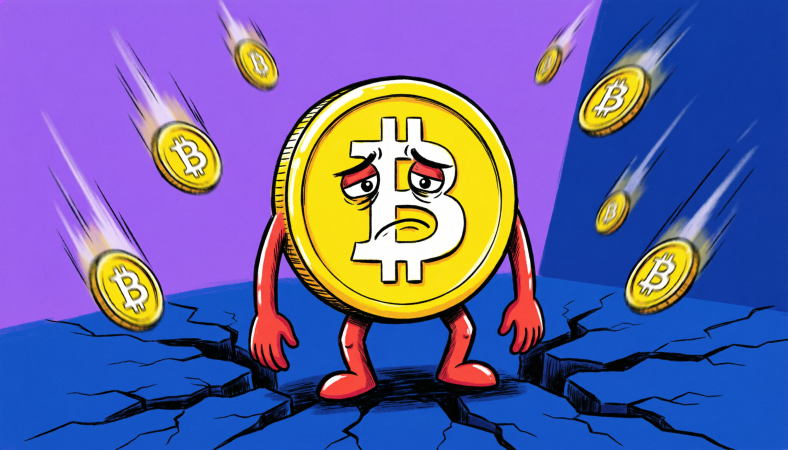
1/ The total crypto market capitalization fell 1.11% to $2.22 trillion as Bitcoin led the selling pressure. Digital assets now share a 63% correlation with the S&P 500 and a 68% correlation with gold. This proves crypto operates as a mature macroeconomic asset class reacting directly to traditional liquidity events and central bank policies.
2/ Bitcoin dipped below $64,000 and wiped out $25 million in leveraged positions within one hour. The Royal Government of Bhutan added direct selling pressure by transferring $34.5 million in Bitcoin to Binance. Bitcoin holds 58.24% market dominance, so this technical breakdown drained liquidity from smaller tokens and triggered automated margin calls across the ecosystem.
3/ Major altcoins like Cardano, XRP, and AAVE fell between 2% and 4% while underperforming the broader market decline. The CMC Fear and Greed Index dropped to 22, indicating extreme fear and a complete lack of buyer confidence. Traders are actively reducing exposure to higher-beta assets and are preferring to hold stablecoins during this broad sell-off.
4/ US benchmarks slumped after Federal Reserve Chair Kevin Warsh held rates at 3.50% to 3.75% during his first FOMC meeting. The updated dot plot signals a potential rate hike by year-end. The US two-year yield jumped 13 basis points to 4.18%, marking the highest level since February 2025 and increasing borrowing costs.
5/ The Federal Reserve revised its 2026 inflation forecasts upward, projecting 3.6% headline PCE and 3.3% core PCE. Officials also lowered GDP growth expectations to 2.2% from 2.4%. Nine of the 18 FOMC members pencil in a rate hike for 2026, highlighting a deeply divided committee that contrasts sharply with previous expectations for rate cuts.
6/Rate-sensitive sectors like Discretionary, Real Estate, and Communications dropped more than 2% as investors fled to safety. Gold tumbled 1.7% due to elevated real yields, while the US Dollar index rose 0.8% to 100.3. Brent crude slid to $78 per barrel, hitting a three-month low ahead of the US-Iran peace deal signing.
7/ Retail investors poured into US stocks at a record pace during the SpaceX initial public offering, treating the market like a casino. The immediate crypto trajectory hinges on Bitcoin holding the $64,000 support level. A break below this threshold will test the $2.1 trillion yearly low and trigger further liquidations across the digital asset ecosystem.
1/ Cursor is an excellent AI-powered code editor (basically a smart fork/enhancement of VS Code) with great agent features like multi-file editing.
2/ It grew extremely fast and is loved by developers.But at its core, it's an app layer on top of existing large language models and not a foundational model company with unique AI tech, in my opinion.
3/ "VS Code wrapper with AI" for $60B feels like buying a fancy interface rather than core technology.
4/ I do not fancy an extreme valuation multiple relative to revenue.
Crossed $1B ARR in late 2025
Hit ~$2B ARR early 2026
Maybe $3–4B ARR by mid-2026
Even at the higher end, $60B is still 15–30x revenue. That's a very rich multiple for a software company that isn't yet massively profitable.
5/ If I am Elon, I will go with a different structure. SpaceX to pay $10B for deep partnership/ collaboration or buy for $60B. Going all-in on the full acquisition locks them into a huge number when they could have gotten a lot of the benefits (compute access for Cursor + data for xAI) at a lower effective cost. Building or partnering more aggressively in-house might have been cheaper in the long term.
1. The Illusion of High Yields
Crypto yields often originate from minting new tokens rather than genuine economic productivity. Traditional finance generates returns through tangible activities like mortgages and taxes. In contrast, many decentralized platforms dilute token value to pay users, creating a dangerous illusion of profit that relies entirely on continuous new user entry.
2. Lack of Legal Protection
Traditional banking systems protect capital with insurance and legal recourse. Decentralized finance offers zero such safeguards. Investors deposit funds into smart contracts hoping the code is flawless. When bugs occur or developers abandon projects, capital vanishes without any regulatory authority to call or legal avenue for recovery.
3. Volatility Negates Yield
High percentage yields become meaningless if the underlying asset price collapses. Earning a seven percent return is instantly wiped out if the token value drops by half in a month. Investors must evaluate total returns rather than just advertised interest rates, as extreme volatility frequently destroys actual wealth.
4. Asset Appreciation versus Yield
Traditional assets like index funds and physical gold build wealth through intrinsic value, corporate profit growth, and price appreciation. Staked crypto tokens merely act as digital receipts dependent on market sentiment. Real wealth generation requires underlying economic value, proving that traditional assets often outperform high yield crypto schemes with significantly less existential risk.
5. The Shift to Tokenized Treasuries
The market is gradually awakening to the yield illusion and shifting toward tokenized treasuries. These instruments bridge both worlds by using blockchain technology to hold actual government debt. This approach provides sustainable returns backed by real economic value rather than complex software layers or inflationary token mechanics.
6. Inevitable Regulatory Oversight
Governments will eventually impose strict reserve laws and audit requirements on crypto platforms. This inevitable regulatory oversight will eliminate the lawless advantages of current decentralized finance. As markets mature, the chaotic yields generated by unregulated platforms will compress, leaving only boring but secure returns for smart investors.
7. The Need for Sustainable DeFi
I support decentralized finance but strongly advocate for a strategic pivot. The industry must move away from inflationary gambling and software speculation. By exploring meaningful use cases that generate actual economic value, the ecosystem can transition toward sustainable models that offer genuine yields without the ticking time bombs of insolvency.
https://t.co/K4EYlkLFXD