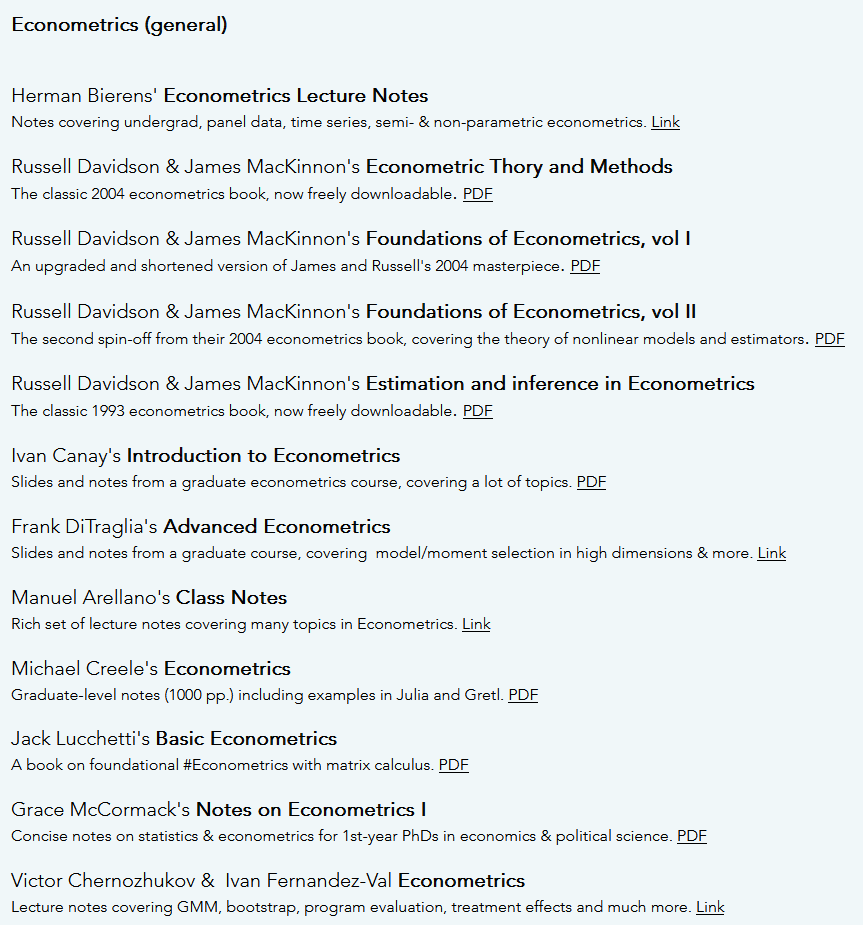
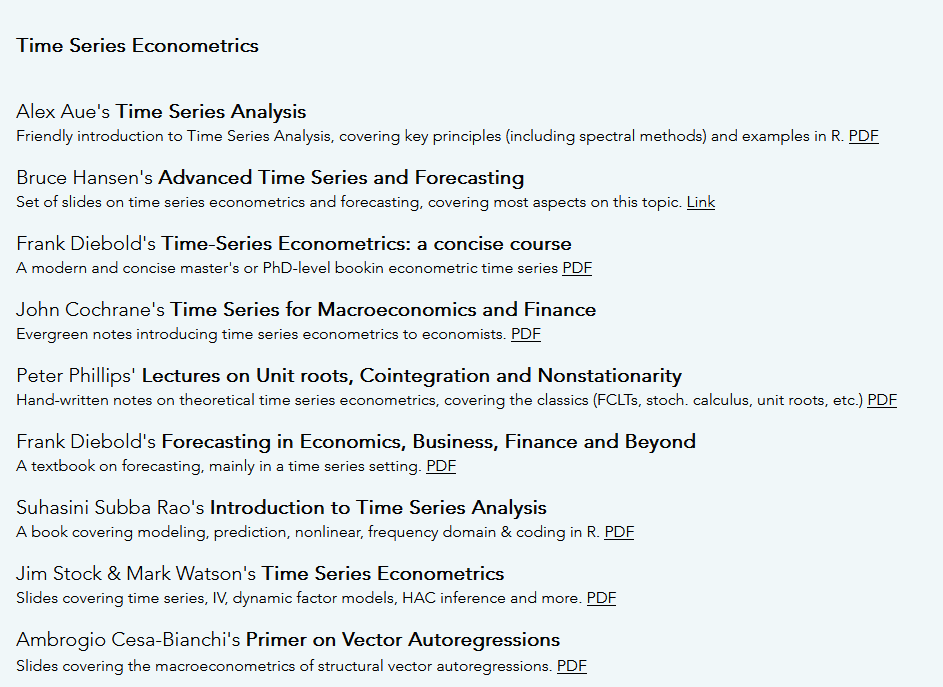
Over the last years, we have been working on a new website for empirical researchers. It provides lots of information on how to set up workflows for empirical projects. It also introduces researchers to freely available tools. And there is starter code. https://t.co/QfwDKqtuI9
Advice for PhD students in economics about using AI, from the brilliant Isaiah Andrews. This should probably be circulated to all PhD cohorts
https://t.co/07xEbmx5n5
Let's discuss different DiD estimators with unbalanced panels -- often due to missing data on Y, or attrition. I will use the Stata commands csdid and jwdid as part of the discussion. First, a review. Assume time-constant covariates, X and a balanced panel.
I have recently received several DMs from both first year grad students and first year assistant professors. The link is not surprising because there is a specific kind of vertigo that comes with Year 1 of grad school and Year 1 of a professorship. It's the gap between who you think you should be and who you feel like you are in the moment, where two worlds collide:
The Imposter Syndrome: "They're going to realize I'm just guessing."
The Uncertainty: "There is no map for this, and I'm the one driving."
For all of those out there, please hear me: the first year isn't a test of your intelligence; it's a test of your endurance through the "I don't know" phase.
But I want to go further than just reassurance, because reassurance alone doesn't build anything.
That discomfort you're feeling? It's actually diagnostic information. It means you're operating at the frontier of what you know, which is exactly where you're supposed to be in a research career. The people who never feel that discomfort are often the ones playing it too safe with their questions.
And the fog doesn't just clear on its own. It clears because you do specific things: you read papers you don't fully understand and struggle through them anyway. You sit in seminars feeling lost and eventually start recognizing the shape of arguments. You write terrible first drafts and revise them into less terrible drafts. The endurance isn't just emotional, it's the endurance to keep doing the work when the feedback loop is painfully delayed.
One more thing: there actually are maps. Advisors, reading lists, established literatures, methodological frameworks. The real challenge is that nobody hands you the map. You have to go find it and figure out which one applies to your particular problem. That's a learnable skill, not a character trait.
So yes, you are not broken. But pair that knowledge with this: start building the thing you're missing. Find the map. Do the next hard read. Write the next bad draft.
The fog clears for the people who keep walking through it. I'm rooting for you.
Hi all, I've uploaded the 2025 update to my PhD Applied Econometrics slides:
➡️ More on regression & causality
➡️ Dynamic panel data models
➡️ Streamlined diff-in-diff extensions
➡️ More on spillover effects
➡️ Results from new papers on many topics
Link in the original tweet
In 2014, Peter Thiel gave a 1-hour masterclass on how to build a monopoly from scratch.
He broke down how:
• Google became untouchable
• PayPal beat the odds
• Facebook crushed competition
Here are 11 timeless lessons from his masterclass:
1. Create value, then capture it
The CEPR Virtual Industrial Organisation Seminar #VIOS Series kicks off the Fall 2025 sessions on 1 October featuring Leon Musolff @Wharton presenting: 'Sources of Market Power in Web Search: Evidence from a Field Experiment'
Discussant: @kleintob@TilburgU
More info and register: https://t.co/PlsLfmWes5
I have just made a chatbot 👩🏫 for my econometrics bachelor's course. I've uploaded the material and the syllabus. Students can now ask questions about course logistics, contents of the slides, the R code we use, and derivations. I love it! 📷 Powered by https://t.co/4q1j95wuix