In 1968 Finland banned for profit education, the few private schools that exist in Finland have to reinvest any profit they make or pay it back to parents.
It has been in the Top 3 in education for the last 20 years.
There should be no profit in education or healthcare.
Canada has the lowest net debt of G7 countries. Statista - Government net debt of G7 countries as share of GDP from 2010 to 2023, by country https://t.co/cvVwFXexfi
So what's up with charging Albertans $90 a year for the #Kananskis#Conservation pass when they're logging the area anyways? What kind of Conservation are we paying for? We asked the Hub's own @JennyYeremiy & @cpawssab's @JoshuaKilleen on this month's #ClimateLens pod! #yyc
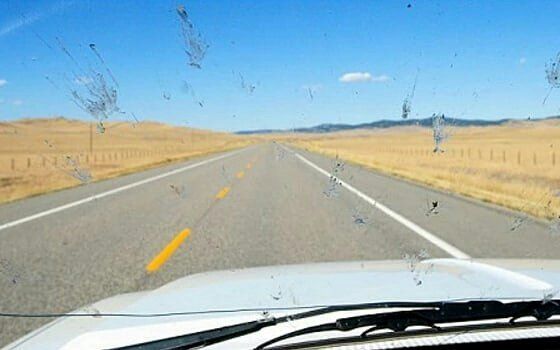
If you're old enough, you may recall that 20 years ago or more, you used to see many more dead insects on your car's windshield, while today you see almost none.
This is called the Windshield Phenomenon.
In the first years 2000s it became a commonplace observation among drivers that after a long drive, windshields no longer had to be cleaned of numerous insects.
It was basically born as a meme, but in 2016, naturalist John Acorn noted that the phenomenon had real and objective proofs.
Since 2017, major publications and media covered the topic of reductions in insect abundance over the last few decades and entomologists linked this withthe fact they no longer had to frequently clean their windshields.
It turned out that a meme was aware of a proved trend.
A 20-year study measured the number of dead insects on car windshields on two stretches of road in Denmark from 1997 until 2017. Adjusted for variables such as time of day, date, temperature, and wind speed, the research actually found an 80% decline in insects.
Several factors are thought to contribute to the declining insect populations.
The expansion of human settlements, agriculture, and infrastructure has led to the destruction and fragmentation of natural habitats, essential for insect survival and reproduction.
The widespread use of pesticides in agriculture and urban areas has had a devastating impact on insect populations, directly killing insects and indirectly harming their food sources.
Rising global temperatures and extreme weather events are disrupting insect life cycles and altering their habitats, leading to population declines and even extinctions.
Artificial light at night can disrupt insect navigation and foraging patterns, reducing their reproductive success and overall survival.
The introduction of non-native insect species can disrupt ecological balances and compete with native insects for resources, further contributing to their decline.
One can still consider the trend and the effect as anecdotal, but the studies conducted created a connection between the global redutction of insects species and what people of a certain age can actually confirm as something more than a simple perception.
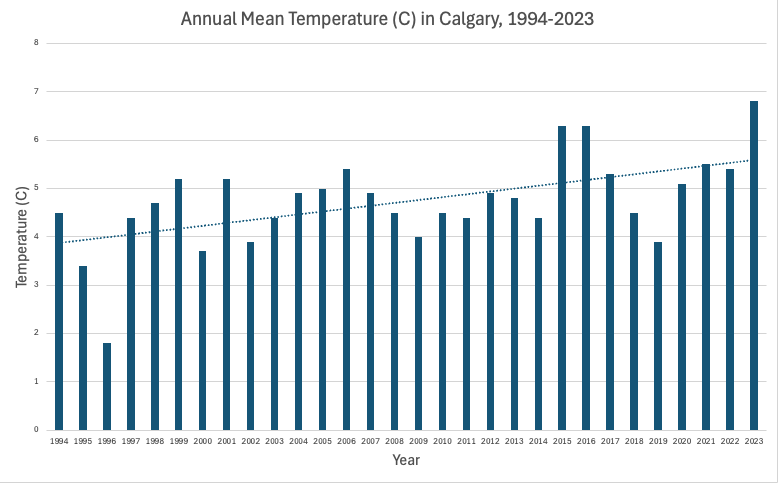
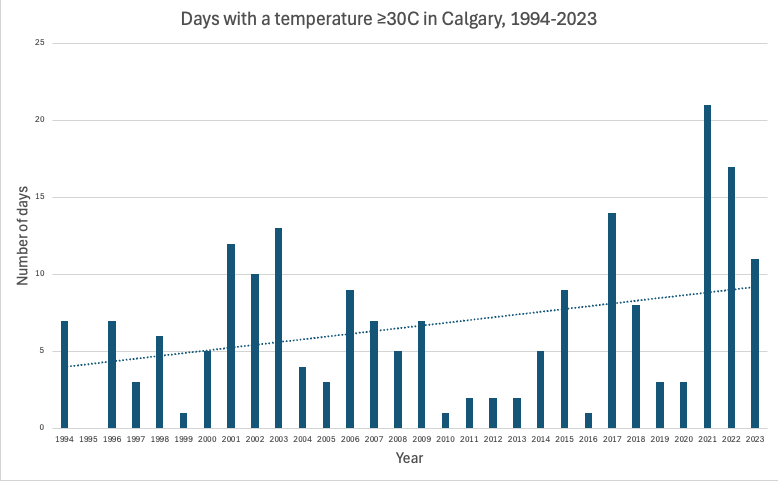
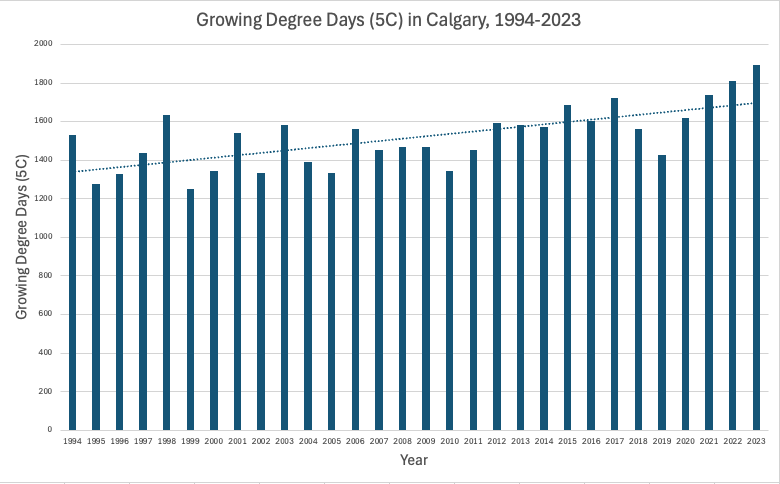
You aren't imagining it...Calgary is getting warmer 🥵🪭
Over the past 30 years, there has been an increase in the number of hot days (≥30C), and an increase in cooling degree days (18C).
Annual mean temperature is also trending upward, along with growing degree days.
#yyc
🔴 A major, unrelenting "heat blob" has been located over Mexico for months. Here's what's been going on in the atmosphere:
An El Niño-related jet stream anomaly (bottom plot, burgundy coloring) has been present in the Pacific dating back to late 2023. Extending well south and west of Hawaii, this feature has helped to transport very warm air out of the deep tropical western Pacific toward the east - and right across Mexico.
On the southeastern flank of this jet anomaly, converging air has been rife in the upper levels of the atmosphere. This has been associated with a resilient ridge of high pressure, which has caused blistering heat (top plot, red coloring over Mexico) and abnormally dry conditions for months on end.
The pattern may have been amplified by much warmer than average ocean water in the western Pacific, from which air masses were modified as they crossed the Pacific en route to Mexico.
Severe marine heatwaves now surround Mexico, forming a positive feedback loop, with above average sea temperatures causing above average air temperatures and vice versa 🔁
This climatic event warrants further investigation but may well be a case where El Niño's impacts and related teleconnections were enhanced by excessive tropical ocean heat.
The pattern shows signs of continuing into June, but could eventually be alleviated by the arrival of hurricane season...
🌊 Weekly ENSO update: El Niño on its way out the door...
The 30-day Niño 3.4 Index (central equatorial Pacific) recently dipped below +0.5˚C, now below NOAA's El Niño threshold.
The 30-day Niño 1+2 Index (eastern equatorial Pacific) is -0.22˚C, the lowest value since February 2023.
As of late May, the pace of Niño 3.4 Index cooling is in the middle of the range of the climate model predictions. Out of the nine models I monitor, three are looking too warm for May and two are looking too cool. An average of the four remaining models yield a moderate strength La Niña by October (-0.98˚C in Niño 3.4).
I'd expect that El Niño will very soon be declared over by agencies that are still acknowledging it.
The Moon may have formed in a matter of hours, when material from the Earth and a Mars sized-body were launched directly into orbit after the impact.
[🎞️ NASA's Ames Research Center]
Where does all the additional heat come from that's shattering regional and global temperature records?
@NASA's CERES 🛰️ data gives some insight.
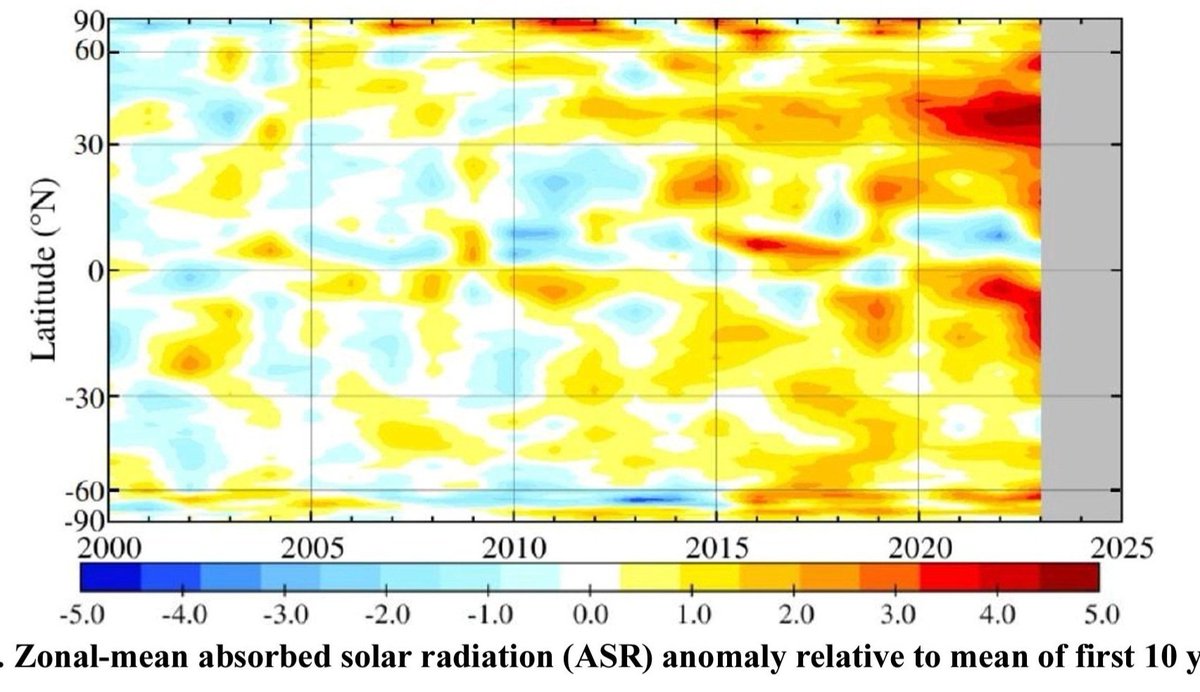
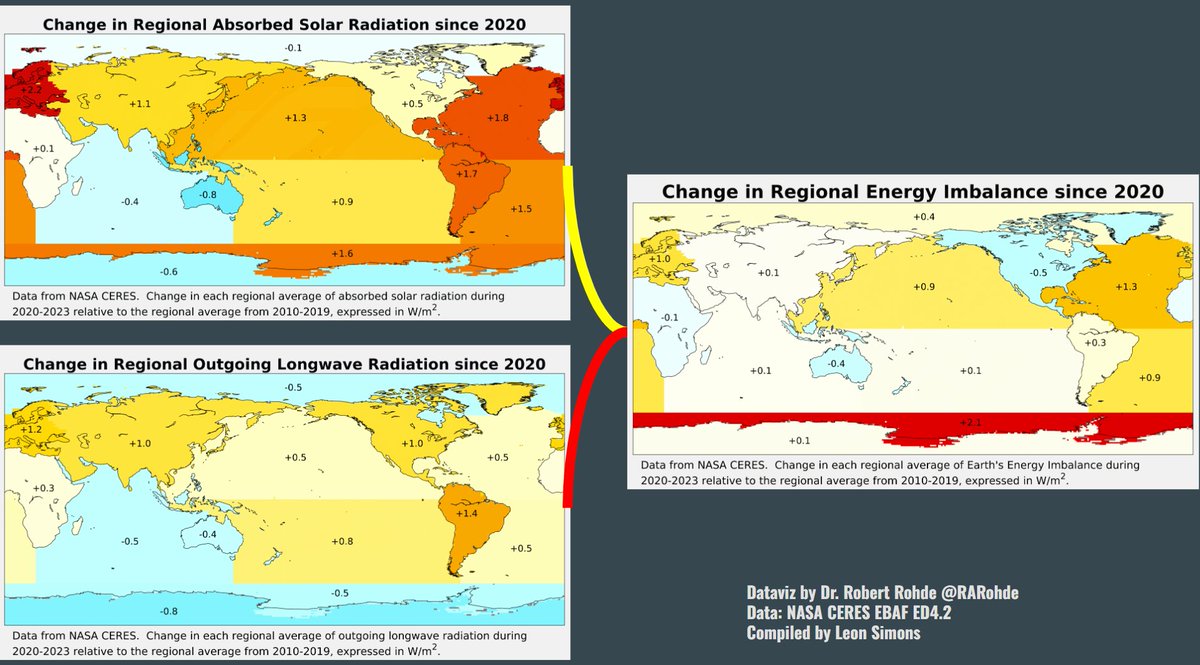
Reductions in aerosols, clouds and ice & snow make the planet darker. Which causes it to absorb more sunlight.
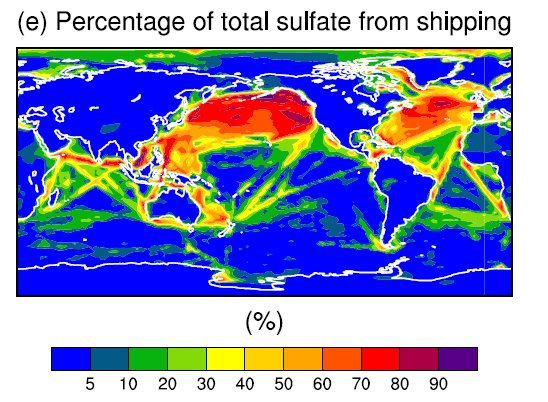
There was a strong increase in absorbed sunlight expected in the regions where sulphur emissions reduced most from the @IMOHQ 2020 clean shipping regulation.
Before 2020, most of the sulphate in the atmosphere over the North Atlantic and Pacific oceans originated from shipping.
We see a strong increase in absorbed sunlight.
Especially in the Northern Hemisphere mid latitudes:
This is the same region where we see a significant increase in Sea Surface Temperatures since 2020:
As the planet heats up, it also radiates more heat to space (in the infrared wavelengths). This compensates for part of the increase in absorbed sunlight.
But not all of it. That's why there is a strong increase in the Global and Regional Energy Imbalance.
More heat is coming in than is going out.
Faster and faster.
Aerosol emissions are decreasing, while greenhouse gas emissions do not. This increases the rate of global heat uptake and global warming.
The CO₂-equivalent concentration is now about 560 ppm (double pre-industrial CO₂). This causes a radiative GHG forcing of about 4 W/m².
Without the increased greenhouse gas concentrations, the planet would be rapidly cooling down.
People need to understand these basic drivers of regional and global climate change in order to be able to mitigate the associated risks.
Not sure how the mainstream press are missing this, can’t find a single report over past month (except Le Monde), as we have hottest global sea surface temperatures EVER recorded. #ClimateCrisis
@LorenMcGinnis Re Alberta electric issue. Recommend CBC interview @politicalham regarding failure of Alberta to link into BC's hydro as power in low wind, solar output. IPPSA is the problem.