My win rate for June was +70%.
That means out of the 35 trades I placed 10 of them were losses.
That’s 10 reasons for me to focus on risk management.
That’s 10 reasons for me to never full port.
That’s 10 reasons for me to think in probabilities.
The 25 wins had multiple 500% to 1000% gainers and I literally doubled my account this month!
That was only possible because I didn’t go on tilt and blow my account on those 10 losses.
Losses are like jabs. If you don’t plan for them and learn to react properly you will be getting KO’d by the market shortly after 🥊
I trade $SPY $QQQ $IWM options for a living.
This is my day trading strategy wrapped up in a single post 📝
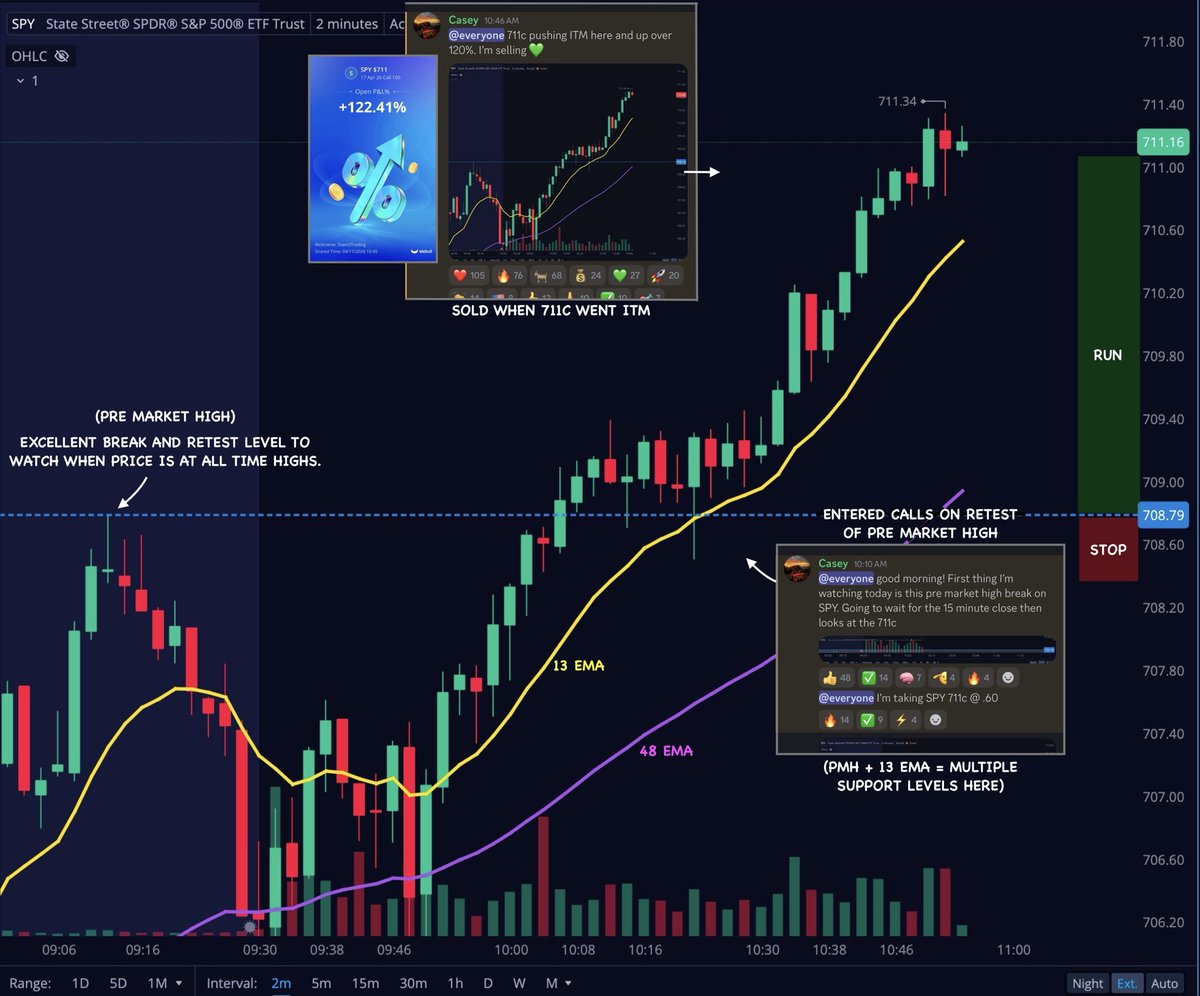
Support & Resistance…
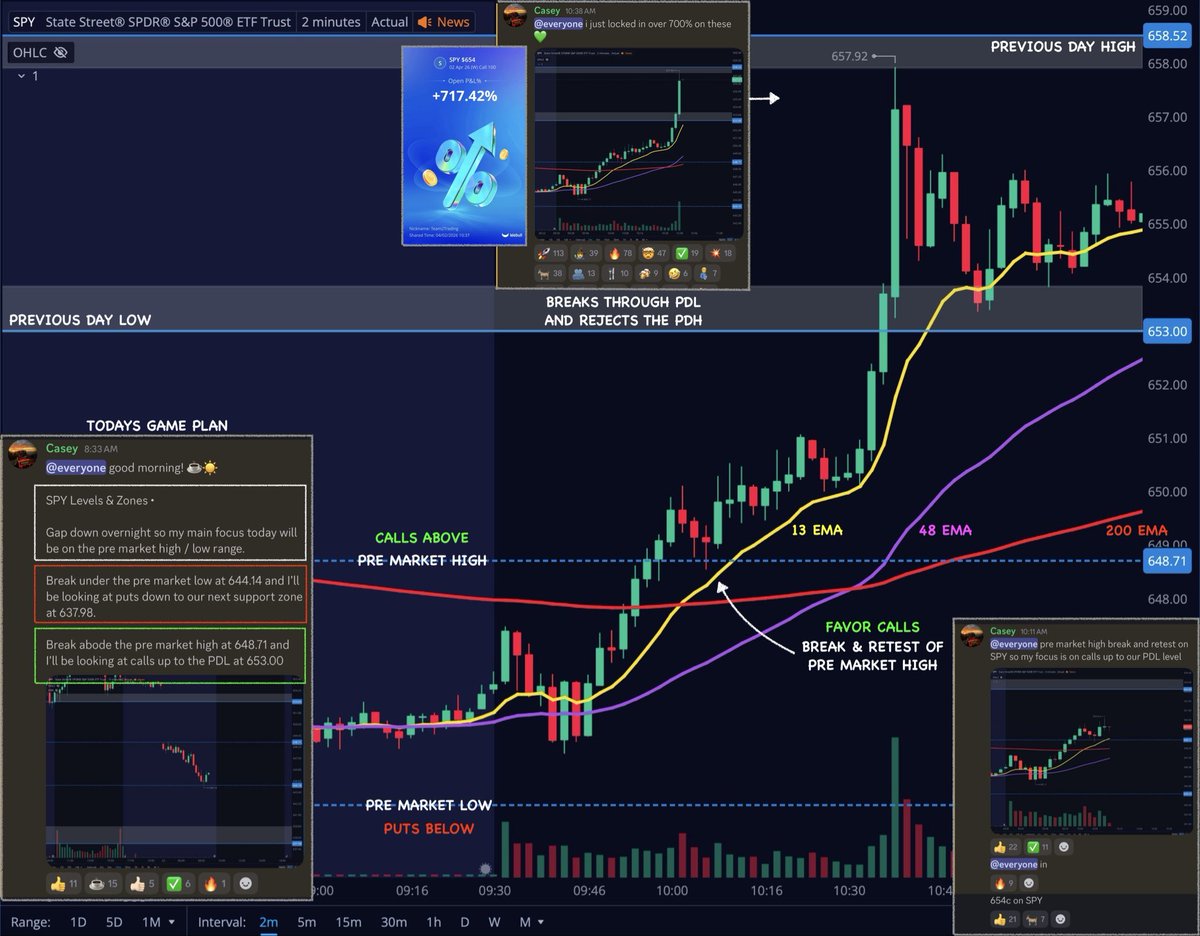
My main focus is on these 4 levels…
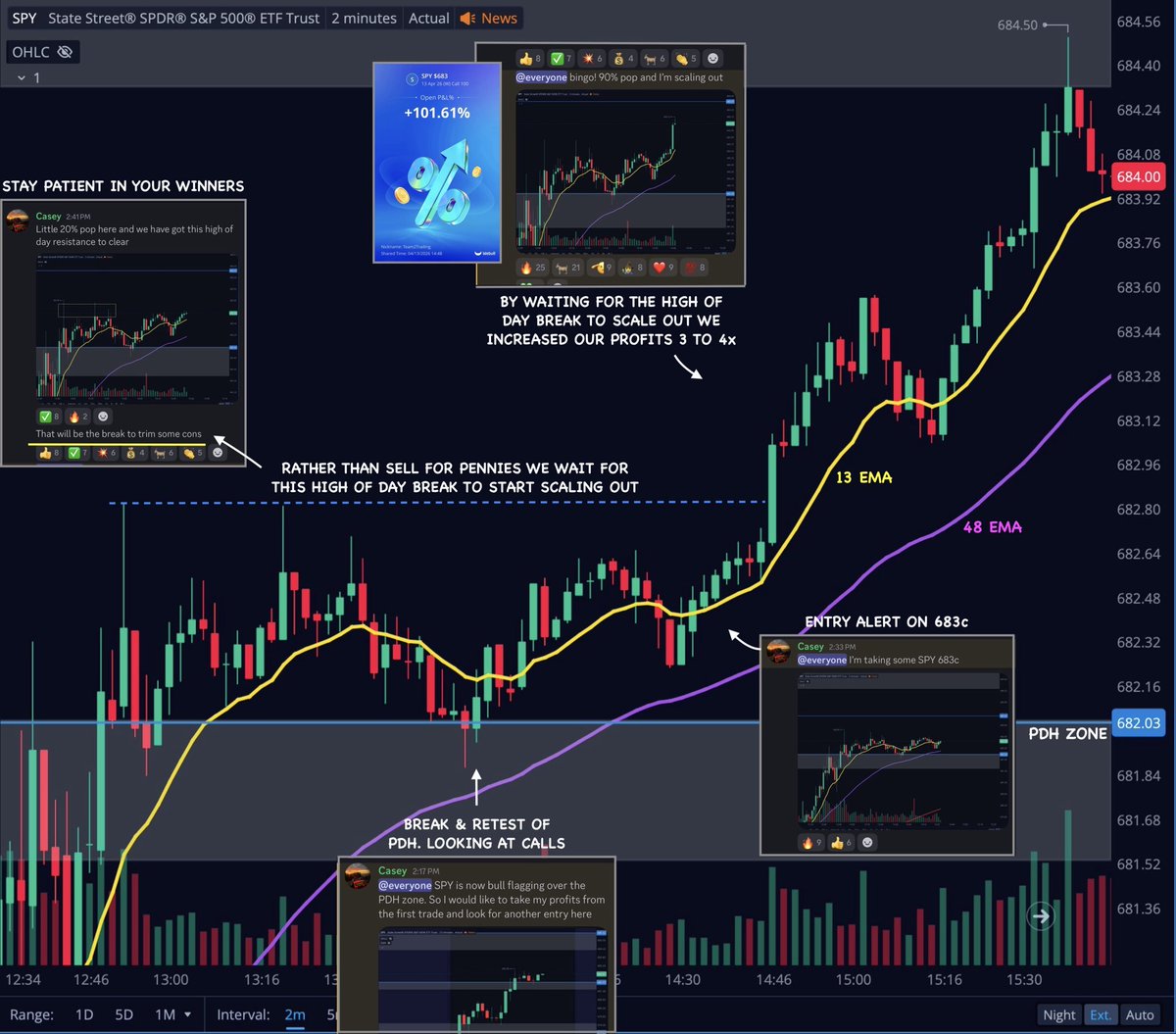
Previous Day High
Previous Day Low
Pre Market High
Pre Market Low
I watch the reaction to these 4 key areas and trade the rejections or the break & retests.
EMA trends…
I use the 13 • 48 • 200 EMA
Bullish trend =
13 EMA on top 🟡
48 EMA in middle 🟣
200 EMA on bottom 🔴
Reverse it for bearish trend.
Basic chart and candlestick patterns…
Flags , trend lines , hammers ect. are all used as added confirmation.
Combining these 3 basic principles gives me more than enough opportunities to make a few bucks every week.
Check out some recaps. Every one of these trades was alerted in real time 👇
This is a great question.
My trading gains get withdrawn and put into:
1. Long term assets (when applicable)
2. Dividend portfolio I’m working on
3. Most of my cash goes into a high yield to collect interest until a nice market crash comes or I find an investment property.
$MSTR hit my $200 target, or very close to it at least.
Now with Bitcoin having very likely bottomed in the $60k level, and starting to catch a nice bounce/recovery - stock like $MSTR and $COIN will likely also follow suit.
$MSTR finally caught a nice green candle last week, after being stuck in a 9 month downtrend.
If Bitcoin can break $80k then it’s likely going to $100k + -> and in that event $MSTR likely continues its recovery to $200 & $300.
The first major resistance level is a level of previous support around $231. Break that and it’s $300 next.
Obviously this will also depend on the wider macro economic environment and Bitcoin as well, as Bitcoin continues to the upside, $MSTR will follow.
THIS IS NOT A STRATEGY IT’S A MONEY PRINTING MACHINE
4H FVG + 4H Direction → 1H Liquidity Sweep → 5M Sniper Entry
C1 → C2. Simple. Repeatable. Relentless.
Stop overcomplicating.
Let the HTF guide you.
Let the sweep hunt liquidity.
Enter like a sniper.
Price > News
In the last 2 weeks:
-Historic rally off the lows
-Every bad news gap down got bought
-Hundreds of stocks breaking out of multi month bases
-New leaders making breakaway gaps
-All time high breakout on the indexes
Instead of worrying about news...
What you should be doing this weekend:
1. Scanning for leading stocks that broke out
2. Mapping out strong buy levels into key spots
3. Executing without fear if/when the buy levels hit
You are getting an opportunity in the next few days/weeks...
That many will end up regretting, not capitalizing on
Don't make that mistake.
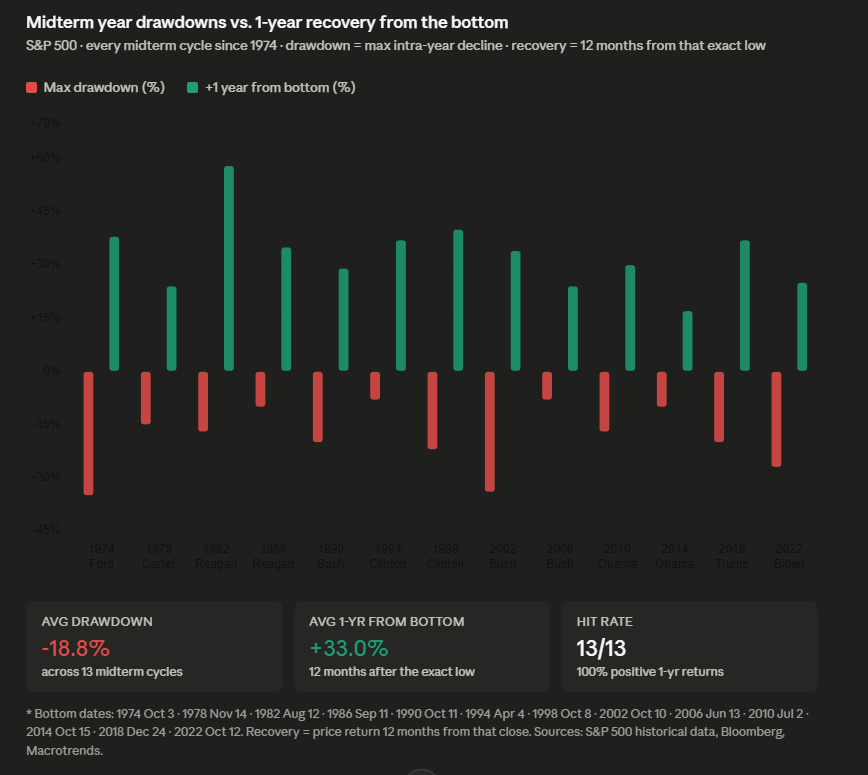
This is Trump's midterm year. SPY crashed from $697 to $629 so far. Its at $712 right now.
The average drawdown for any given midterm year is 20%. Trump says he will have to end ceasefire and peace agreement with Iran this weekend.
You'll get 1 more chance to buy the dip.
Every midterm year since 1974. Its the same pattern.
1974 Ford: −35% → +38% a year later
1978 Carter: −15% → +24%
1982 Reagan: −17% → +58%
1986 Reagan: −10% → +35%
1990 Bush: −20% → +29%
1994 Clinton: −8% → +37%
1998 Clinton: −22% → +40%
2002 Bush: −34% → +34%
2006 Bush: −8% → +24%
2010 Obama: −17% → +30%
2014 Obama: −10% → +17%
2018 Trump: −20% → +37%
2022 Biden: −27% → +25%
2026 Trump: -10% so far...
Avg drawdown: −19%
Avg 1-yr from the bottom: +33%
13 for 13. Never missed.
The market doesn't care who's president.
It bleeds. Then it rips.
"Some of the best traders I know have been trading the same setup, on the same time frame, on the same market for 20 years. They don't care about anything else."
That's from John Carter in "Mastering the Trade" and it's probably one of the more underrated messages in the book.
We live in a culture that romanticizes variety. New strategies. New markets. New indicators. The idea of doing the same thing for twenty years sounds like a boring proposition to most people. But in trading, depth beats breadth more often than not.
I went through a phase where I was trading momentum one week, mean reversion the next, and some other strategy the week after. I was learning a lot and making nothing. Because every time I switched, I reset my pattern recognition back to zero. I never got deep enough into any one approach to develop real feel for it.
The turning point was when I committed to masterings 1-2 setups. 1-2 timeframes, which for me is the daily or the weekly. This in combination with 1-2 market conditions where I had an edge. And I just did that. Over and over.
Although at first it felt limiting, with time it started feeling like mastery. I could suddenly see setups developing before they fully formed. I knew the failure patterns. I knew when to push and when to pass. That level of intuition only comes from deep repetition, not from knowing a little bit about a lot of things.
Master one way of making money. Then, slowly, add a second. Then maybe a third. The traders who last decades tend to be specialists, not generalists.
Every stage for a millionaire trader:
Stage 1 – The Gambler
Right now you’re trading outcomes, not structure. Your decisions are emotional, inconsistent, and heavily influenced by P&L. There’s no stable process yet just reactions.
Review Process:
At the end of each day, log every trade and answer:
Did I follow any defined setup?
Was this planned or impulsive?
What emotion drove this trade?
Focus only on awareness, not fixing.
Timeline:
Typically 1–3 months (can be longer if ego is high).
To move to Stage 2 (The Student): commit to one market, one setup, and journal every trade. Your goal is to replace chaos with structure.
This trading coach here https://t.co/3tOgluwPFB will help analyze trades and thought process so you can go from stage 1-6 in less than 6 months! (Try it)
Stage 2 – The Student
You’re learning aggressively, but execution is inconsistent. You believe more knowledge will fix the problem it won’t. The issue isn’t information anymore, it’s application.
Review Process:
Track ONE setup only:
Screenshot entry/exit
Grade execution (A–F)
Note if rules were followed
Ignore P&L completely.
Timeline:
Typically 2–6 months.
To move to Stage 3 (The Emotional Trader): stop adding strategies and master one setup. Track execution quality, not profits.
Stage 3 – The Emotional Trader
You know what you should do, but you don’t always do it. Discipline breaks show up under pressure overtrading, cutting winners early, revenge trades. Awareness is high; control is unstable.
Review Process:
After each trade ask:
Did I feel fear or hope during this trade?
Did I exit based on plan or emotion?
Where did I break discipline?
Track emotional triggers daily.
Timeline:
Typically 3–9 months (this is where most fail).
To move to Stage 4 (The System Trader): reduce size, enforce hard stop rules, and measure rule adherence %. Emotional stability comes before performance.
Stage 4 – The System Trader
You have defined entries, exits, and risk. Losses are planned and structured. Now the challenge is patience and selective execution not taking trades that almost qualify.
Review Process:
Track strict metrics:
Rule adherence % (target 90%+)
Number of trades taken vs valid setups
Missed vs forced trades
Precision over frequency.
Timeline:
Typically 3–6 months.
To move to Stage 5 (The Consistent Executor): trade less, wait for full confirmation, and eliminate impulse entries. Precision separates you now.
Stage 5 – The Consistent Executor
You trust your system and understand variance. Emotional swings are smaller and you no longer need constant action. The threat now is boredom and over-optimization.
Review Process:
Weekly review only (not daily):
Did I follow my system all week?
Were any trades outside plan?
Am I forcing trades out of boredom?
Focus on consistency, not improvement.
Timeline:
Typically 6–12 months.
To move to Stage 6 (The Professional): think in weeks and months, not trades. Focus on capital preservation and long-term consistency.
Stage 6 – The Professional
You operate on probabilities, not emotion. Risk management is automatic. Trading is process-driven and stable.
Review Process:
Monthly performance review:
Equity curve trend
Max drawdown control
System consistency over time
Refine edges slightly, never overhaul.
Timeline:
Ongoing this is mastery.
Your job now:
Protect discipline, avoid complacency, and continue refining execution without increasing emotional exposure.
Day traders listen to me:
Don't enter until the 15M and 1H confirm what the 4H is showing you.
If they don't confirm, sit on your hands.
This one filter will save you so many blown accounts.
Big Picture View: The last 3 weeks were charting 101. On April 3rd, I posted #ES_F built a massive month long bull flag, ready to breakout. We brokeout & rallied 600 points
Plan Next Week: Backtesting. Bulls must hold 7085 to keep 7230, 7300 live direct. 7085 fails, sell 6982
I’ve been trading for 7 years and seen one repeating pattern.
The traders who make 6-7 figures have simple systems. Think about it have you ever successfully out smarted the market?
This indicator is a core part of my system
https://t.co/wDH6kQx3Om
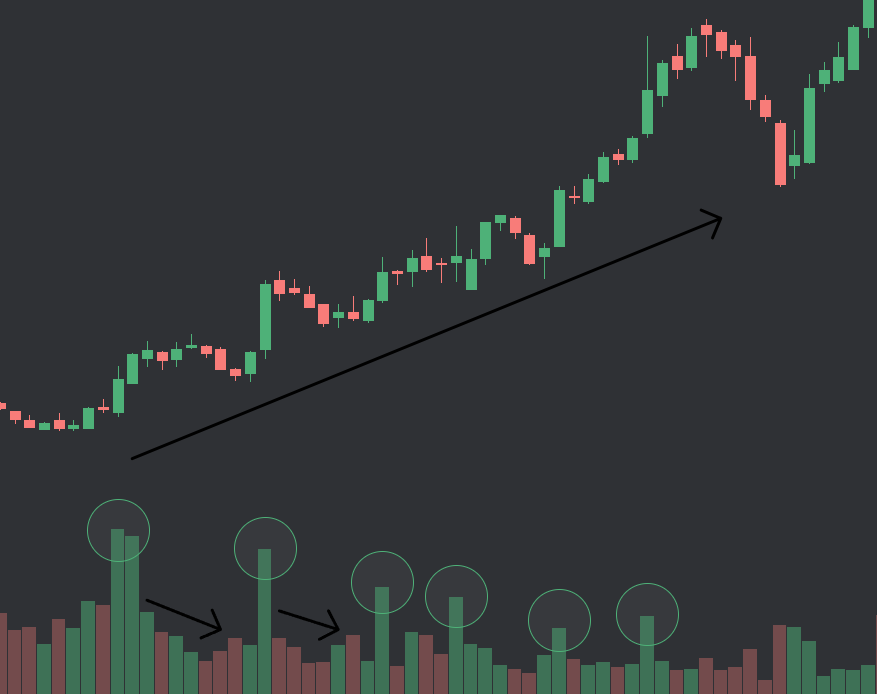
Volume Price Analysis (VPA) Trading Strategy... FOR BEGINNERS
Volume is the best indicator in the world. This thread will show you a simple way to use it effectively
🧵👇
10 rules for profitable LEAP trades:
1. Only buy on stocks you'd own for years
2. Wait for RSI oversold on multiple timeframes
3. Buy when IV is low
4. Enter at meaningful support levels
5. 360+ days to expiration minimum
6. Cheap premium doesn't mean good deal
7. Tight spreads or skip the trade
8. Size it so you can lose it all and be fine
9. Exit plan before 60 DTE
10. A handful per year max
Comment "LEAP" and I'll send you my free cheat sheet.
The morning note, the GEX levels, and the real‑time read were all shared inside the Alpha Pod before the move happened. This is what the tools are built for.
If you're interested in learning more, come check us out: https://t.co/RiRg4jmScY