As someone who regularly works within corporations, I can guarantee these will continue. Corporations would rather hire 10 engineers just out of a coding boot camp and have them vibe code with Luna than hire one good engineer to harden the security of their systems.
" $OHM forks always die "
Well, it seems like that era may be coming to an end as projects embrace the Treasury engine side of Olympus, and not just the 3,3 part
$NET now accepts hOHM Bonds into Treasury to mint discounted NET and Olympus have created wsNET <> hOHM Liquidity
Weekly Digest (Sep 14 - 20) recap 👇
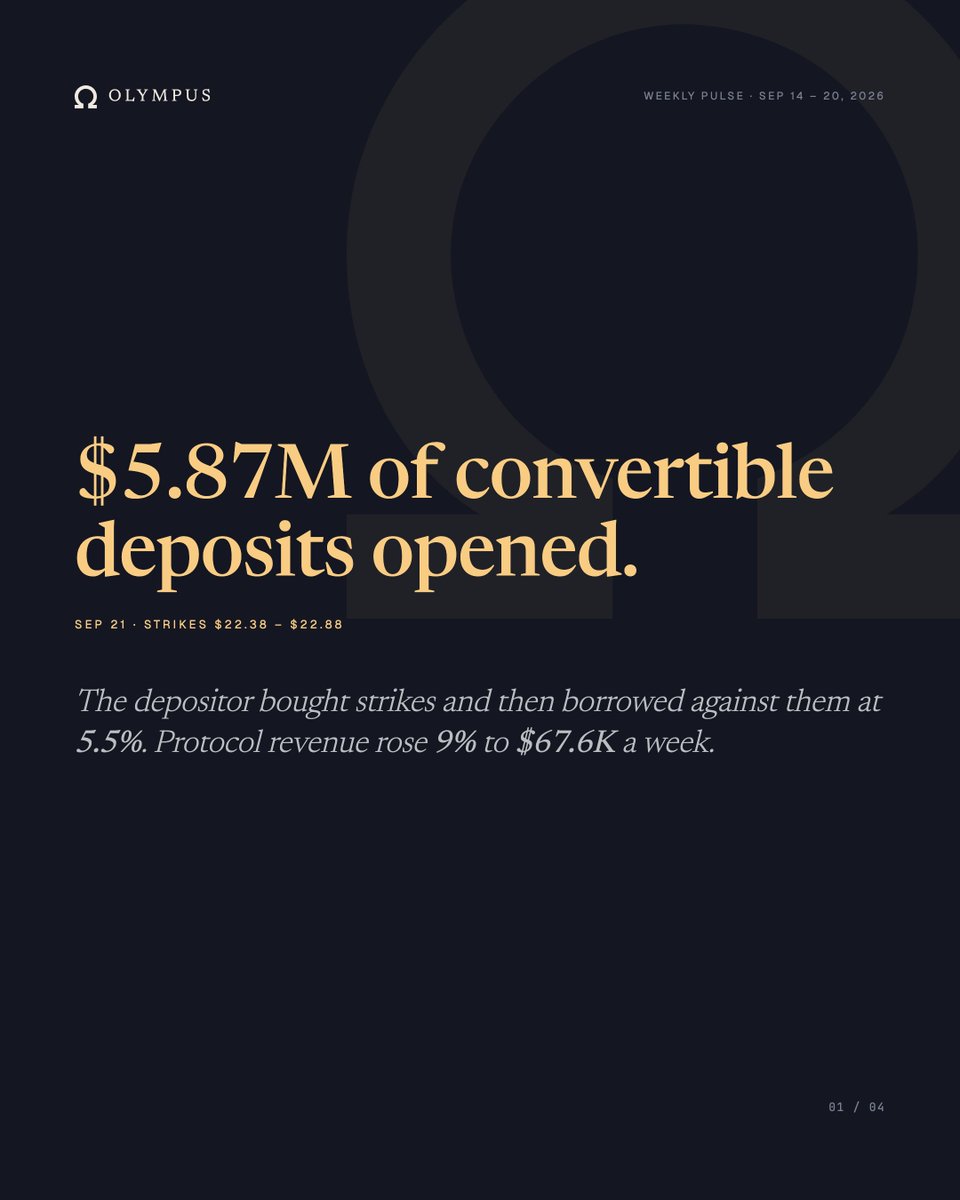
(1) $5.87M of convertible deposits opened, at strikes from $22.38 to $22.88. The depositor then borrowed against them at 5.5%, lifting protocol revenue ~9%.
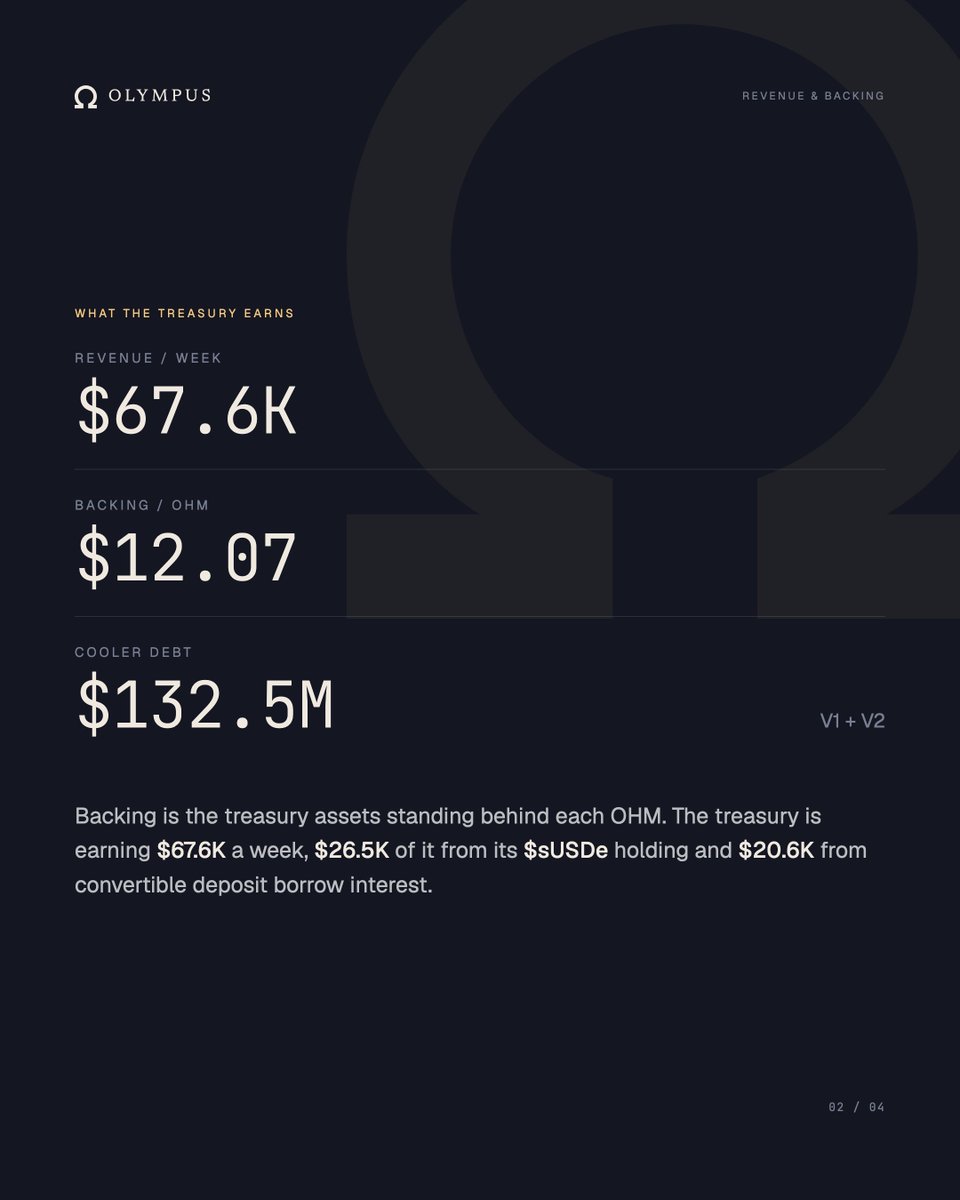
(2) Revenue $67.6K/wk — $sUSDe $26.5K, convertible deposit borrow interest $20.6K, Cooler interest $12.7K, liquidity fees $4.5K, $sUSDS $3.4K.
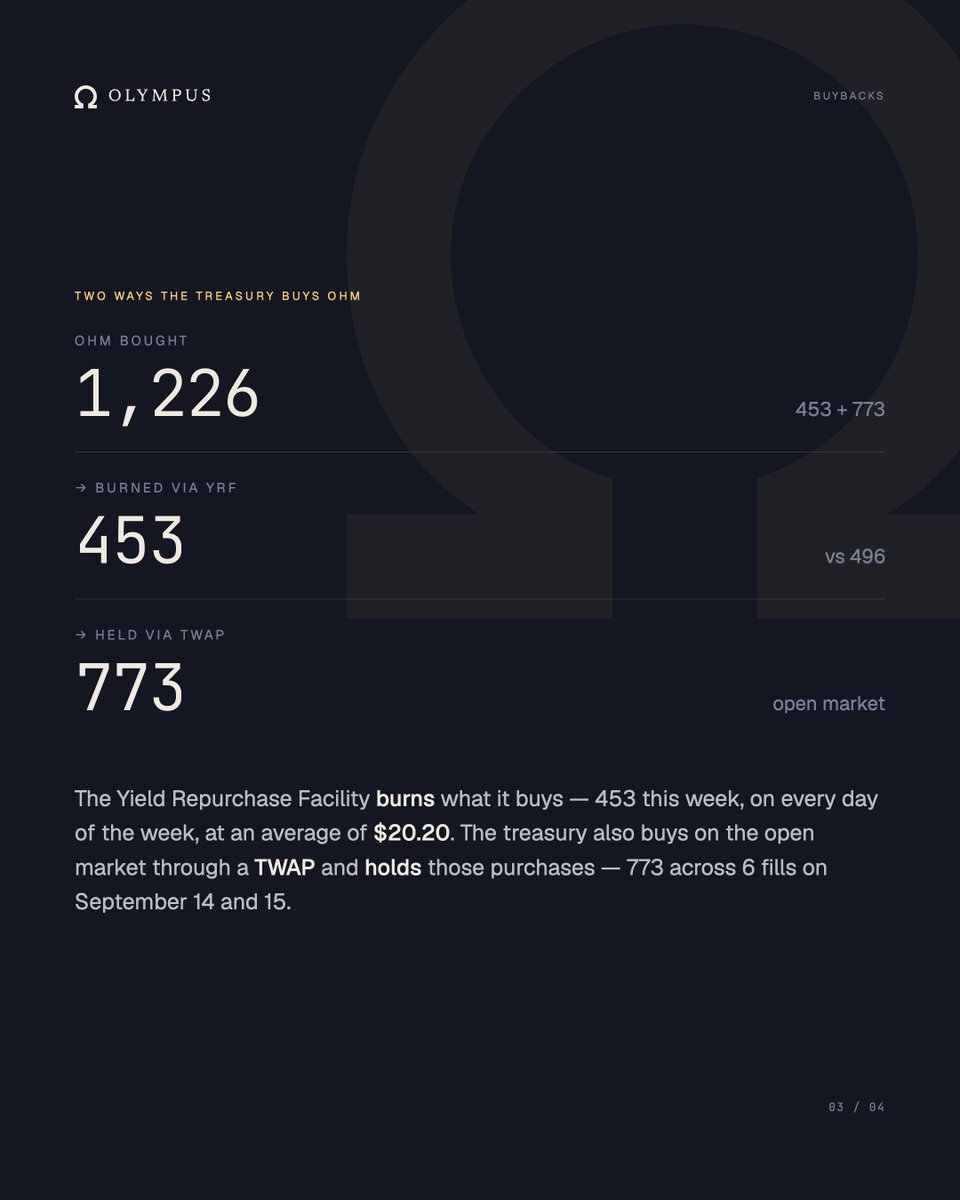
(3) 1,226 $OHM repurchased — 453 burned via the Yield Repurchase Facility, 773 held via the open-market TWAP across 6 fills.
(4) The treasury deposited 500,000 USDG into a @mellowprotocol vault on Robinhood.
$NEO is a monetary architecture built around the interaction of liquidity, backing, supply, and credit.
Over the next few days, we’ll be releasing a series of short videos breaking down each component and how they interact.
Starting here:
Yesterday, we launched NEO. I’ve been looking forward to finally talking about what we’ve built, because I think the idea behind it has the potential to change how people think about launching and structuring tokens.
In 2021, I was part of the core development team at Olympus DAO. Olympus became far bigger and more successful than any of us expected, and it remains one of the most important things I’ve had the opportunity to work on. It also showed me firsthand what can happen when a new piece of monetary design reaches the market at the right moment.
The industry has evolved considerably since then. Market structure is better, token design is more sophisticated, and we now have real-world assets beginning to exist as genuine onchain primitives. I’ve spent much of the last few years thinking about what those changes make possible and, specifically, whether the basic architecture around token liquidity can be improved.
NEO is the first implementation of that work.
The idea begins with a distinction that I think is more important than it initially sounds:
Paired does not equal backed.
Almost every token has some form of liquidity. An asset sits on the other side of a pair and allows the market to function. That infrastructure works extremely well, but it does not mean the token itself is economically backed by the asset it trades against.
I started asking what happens if we keep the existing liquidity layer exactly where it belongs, but add something underneath it.
With NEO, there is a normal market and liquidity layer, but behind it sits a vault containing tokenized QQQ. The QQQ in that vault is not there to facilitate trades. It is protocol backing, and NEO can be redeemed against it.
That changes the structure of the token.
As trading occurs, protocol fees can add additional QQQ to the vault. NEO that returns through the system is burned. Market activity therefore does not only create volume and price discovery; it can continuously increase the amount of backing underneath the remaining supply.
We call this the rising floor.
The important point is that this floor is not a chart level, a target, or a promise about where the market should trade. It is an economic value derived from assets held by the protocol.
That is why the distinction matters so much:
Paired does not equal backed.
I think this could become a much broader design principle.
For most of crypto’s history, liquidity has existed around a token. NEO explores what happens when market activity can also build something underneath the token.
If that model works at scale, I think it opens up a different way of thinking about token construction altogether: liquidity on one layer, protocol-owned backing on another, and trading activity progressively strengthening the economic base of the asset.
That is much bigger to me than one launch.
We deployed the contracts yesterday and intentionally remained quiet at first. Before explaining the thesis publicly, I wanted to see the protocol operating under real market conditions. The initial activity has been substantially higher than we expected and so far the system is behaving as intended.
Now we can start explaining what is actually here.
Over the next several days we’ll release documentation, videos and deeper technical material around the mechanism. There is a lot more to the system than can reasonably fit into one post.
More importantly, what went live today is only the first stage.
We already have step two and step three built out, and we are working on a much broader set of ideas around how backing, liquidity and onchain assets can interact. The protocol you see today is the first proof of concept, not the end state.
The timing is especially interesting because tokenized equities are finally becoming usable onchain assets. QQQ is the first backing asset we are using, but the much larger opportunity is that stocks, treasuries and other real-world assets can now become components inside token architecture itself.
That design space barely existed when Olympus was built.
Now it does.
During Olympus, there was a point where it became clear that the mechanism itself had escaped the original protocol. People were studying it, modifying it, building around it and thinking differently because it existed.
I think the idea behind NEO has that kind of potential.
Not because every token should use this exact implementation, and not because one model solves every problem, but because I think backing can become a first-class component of token design rather than an afterthought.
@fattybagz , who also worked on Olympus, is building this with me, alongside a group of people across protocol development, markets and infrastructure that I’m extremely happy to be working with.
I’m particularly interested in what other developers, market makers and liquidity providers make of the architecture once they have had time to pull it apart. If the idea is as useful as I think it is, I expect people will find applications for it that we have not considered yet.
Olympus was an extraordinary chapter to be part of. The years since have given me a lot of time to think about how a new monetary experiment might be designed differently.
Today, that experiment is live.
NEO is the first implementation.
And I think we are only beginning to understand what this model can become.
$NEO Contract Address: 0x37f5b13345c6723E17CE45d388c9C4f7aD8342C3
In the latest episide of the @FullyVested_Pod, @defidave and @patfscott sat down with the @OlympusDAO team to discuss their thoughts on new Olympus forks, developments over the last 5 years and what the future holds for Olympus and OHM.
0:00 Intro
1:06 What Olympus is Today vs 2021
4:35 The Ongoing Merger of TradFi and DeFi
7:11 Long Term Vision of Olympus
10:59 Most Misunderstood thing about Olympus
16:10 Crypto Bull Runs Compared to the Dotcom Bubble
18:03 Olympus Team's Thoughts on New Forks
31:23 New Products & Future Plans for OHM
40:20 OHM Holder Composition and Buybacks
43:53 Where They See OHM in a Few Years
Does anyone have a contact at @Uniswap that we can talk with? We have a V4 hook that keeps getting blocked, and the current point-of-contact refuses to elaborate on rejection reason.
@zerokn0wledge_@standard_rsv That’s not what $OHM was selling. It was selling the idea that each OHM was backed by $1 and it would issue new tokens to stakers until each was backed by $1 again. It was unable to actually emit enough to achieve that goal because people were willing to pay so much for it.
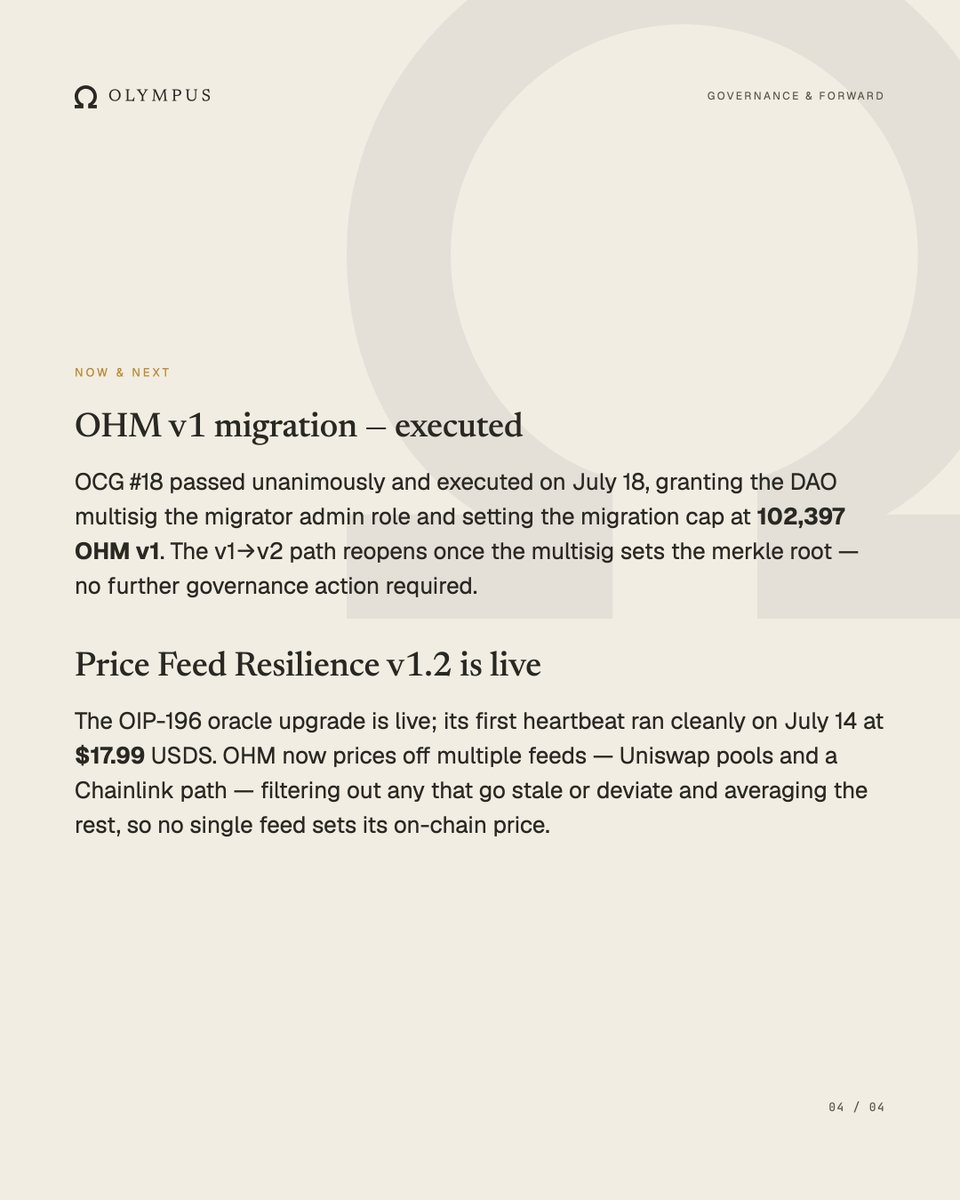
Weekly Digest (Jul 13 - 19) recap 👇
(1) The institutional Convertible Deposit market reopened. A sharp wallet committed ~$1M of new capital, building positions totaling ~$4.7M at a weighted conversion price of $20.42 — above $OHM's current price and well above backing of $12.05.
(2) Protocol revenue ran at ~$49.5K for the week, roughly 48% of it from the treasury's $sUSDe position. Backing edged up to $12.05 per $OHM.
(3) 985 $OHM repurchased and burned (~$18.0K) through the Yield Repurchase Facility (YRF).
(4) Forward: OCG #18 passed unanimously and executed July 18, setting the v1 migration cap at 102,397 $OHM v1. And Price Feed Resilience v1.2 (OIP-196) is live. $OHM now prices off multiple feeds, filtering out any that go stale or deviate and averaging the rest, so no single feed sets its on-chain price.
Earlier in the day there was a selloff in $BULLISH.
Usually sells are bearish but @BaselineMarkets mechanics direct trading fees to stakers, boosting the APR. Let's explore the impact the selloff had on that.
I looked at the decline window where we saw price go down 35% Jul 11 11:00 - 22:00 utc. Sellers sold off 90K usdg and paid 2.3K in fees. 1.5K of that went to stakers.
Against the staked base of 343K bullish (195K in usdg), this represented +153% APR points bump. This is on top of the 400% APR points stakers are receiving from bidirectional trading flows. So about 30% of the APR was contributed by the heavy sells. Not bad.
Something to keep in mind: APRs will accelerate as more sellers exit the system bc remaining holder base dwindles and thus get more of the remaining fees. This is by design: last man standing is a powerful incentive.
I don't know of any other token that does this on Robinhood, and I wish everyone holding a non-Baseline token good luck. Maybe if you sell asap when you see others selling you can recoup some money.
For me, ill stick with Baseline memecoins. Bullish on @varuntheog. $BULLISH on @bulldotmarkets
@jordanhall It splits everything up into research, questioning, prototype, and synthesis tasks, adding new tasks as it goes. You can pick and choose what it should work on next assuming it’s not blocked, making corrections, etc.
I've been on the wrong side of every launch meta. Scam pump and dumps bc bundlers corner supply. Surprise liquidity rugs. Team insiders dumping.
@bulldotmarkets is my solution to the problem. Fixed supply, no allocations, fees flow to who most deserves. All wrapped in a theme familiar to all of us: equities & IPOs.
Shoutout to @BaselineMarkets for handling the liquidity side. The dynamic fees, the dividend ponzi, the supply tokenomics all managed by their AMM.
Shoutout to @RobinhoodCrypto and @vladtenev for taking a bet on memes and building a massive distribution of degen traders.
Excited for everyone to try it.