The Domain is always what mattered - code and infrastructure are artifacts that exist to serve the Domain: what your business actually does.
Engineering is so hard it spawned a whole industry of tools, gurus, and courses, so we mistook it for the point.
The point is your Domain running correctly and being easy to evolve.
Truly what is the best case end state for fully autonomous agents? What am I missing with the infatuation building an agent that does things on its own all the time?
AI Models are going to get better...but I also had fake cell numbers hallucinated into a spreadsheet today for no apparent reason. Brand new session, I didn't ask for it in the prompt and it wasn't in the source image I was extracting info from....soooo....yeah. ??
I'm at a loss why Apple thinks that in finder I should see some iPhone mirroring version of an app before the actual app I'm looking for on the computer I'm looking for it on. I fail to see any value in the mirroring app anyhow. What do people even use it for?
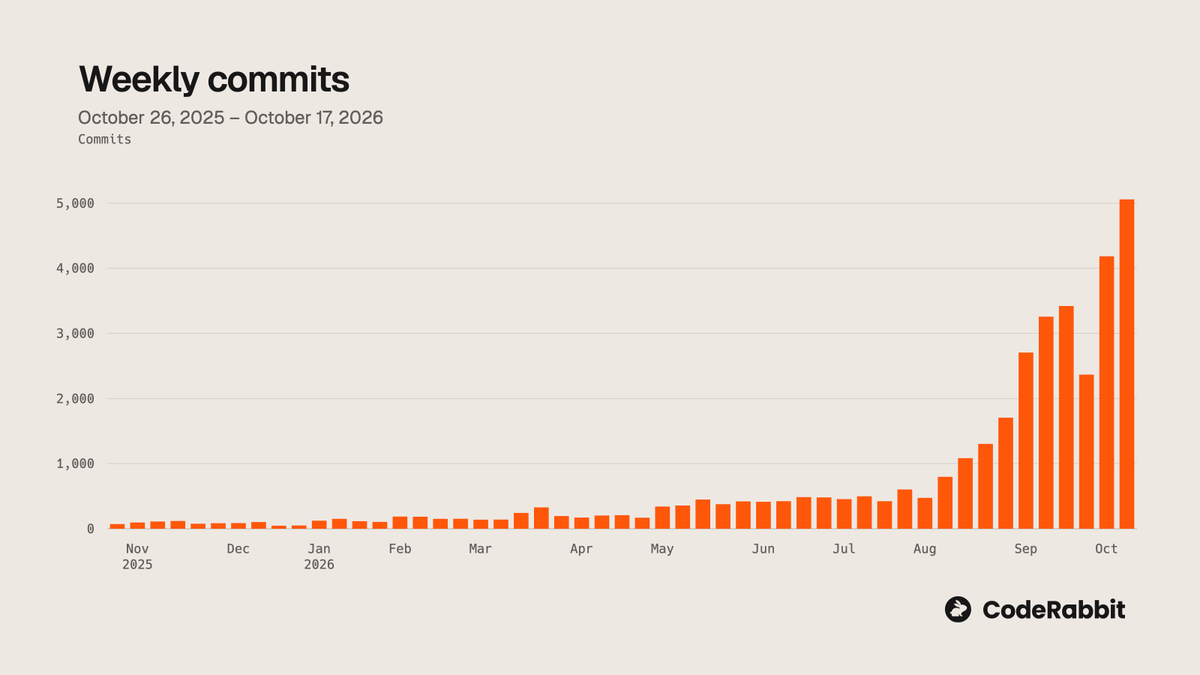
This is silly, I don’t think any sane person sees this as a flex. What does maximum potential look like here anyway? 10k PRs a week? What are we even talking about?
We at @coderabbitai shipped 5K PRs last week. Our tiny team is shipping more than a thousand-person dev team. And we are nowhere near hitting our maximum potential. If we industrialize software development correctly, 50K PRs a week are totally achievable, if not more. At this point, it’s machines building machines.
We are looking for pioneers to join our software factory initiative. Must meet one of the following criteria to join the project:
- Tastefully shipped at least 1000 PRs in the last 30 days.
- Played at least 500 hours of strategy or simulation games such as Civilization, Age of Empires, Transport Tycoon, Factorio, etc.
This is a once-in-a-lifetime opportunity to define the UX/DS for building and shipping software at scale. You'll solve a broad spectrum of problems, from designing provably correct software using formal methods to achieving operational excellence with agentic operations. You will also get millions of dollars of token budgets!
Please DM me only if you qualify and want to spend your next few months/years on this!
This makes logical sense and I understand it, but I can't help but think what happens when we remove every 'review' surface that ever existed. 'Well Adam nobody reviews anymore what does it matter?' True! but then where will the decision making layer live? Long lived chat histories? .md files? SOPs? Ontology/spec? ...and to that end where will we go to interact with a history of decisions that dictate an entire business that nobody reviews implementation for? @ontoapp is inevitable.
Why are you still using pull requests?
Is it for code review?
If so, do you really think your or your colleagues catch bugs and mistakes that an Opus 5.5 or Fable or Astra won't find? You can literally spawn all three of them and have them check four times each.
(Also, don't tell me you don't have a "stamp plz" Slack channel or group chat somewhere.)
Is it for knowledge sharing?
Surely there's better ways for that now than the PR, no? We have models that can generate explainer videos, presentations, podcasts, games, quizzes, walkthroughs, ... for any piece of code it can reach.
Is CI the reason?
Well ackshually, CI means continuous integration and its original meaning is the *opposite* of having long-lived branches and PRs.
But, leaving that aside, your agents are hopefully already running the tests before they push something, and hopefully they can run as long as they want and don't block you so they can run the whole test suite and generate "irrefutable proof" and end-to-end demo videos and so on... And so they run the tests and confirm and then you push to a branch and everything runs again and then you merge and then it runs again? That doesn't make sense, does it?
Maybe you work in open source and you accept contributions, in which case I can't speak to the value of pull requests. It's been 2 years since my last OSS contribution. But from what I heard, the time of the PR is coming to an end in OSS too?
I honestly don't get why people still stick to PRs.
With agents you can now move 10x faster, you can finally do real continuous integration, and get more confidence in the changes the agent made.
Don't slow yourself down by having all the changes pile up in a PR.
Why is changing software so hard? In the traditional development process, even small changes can trigger cascading regressions—even with highly capable models. Onto’s structured Stories & Rules make changes easy, without the fear of regressions.
While some people will get clever with CI and tests, there are alternatives to software factories that make compute prices irrelevant while improving coordination
If the ideal ratio is 1:1 and every team in an org is a single engineer and pm, ownership and understanding of the ontology and it's ability to pass hands when someone leaves becomes the single most important thing.
Yeah, I’ve been feeling this too. Agents make engineers extremely powerful, but PMs are generally still bottlenecked on their bandwidth they have to talk to customers.
So the ideal ratio is 1:1
@apoorva_mehta UI is trivial and the best patterns for each domain already exist in some form or another. Instantly getting the best pattern for your use case without knowing about UX/UI design is a breakthrough for anyone that just wants to build.
Creating silos and product teams of 1 is great for enabling efficient ai use, but it feels completely unrealistic to me as a path forward for the majority of orgs. Silos help unblock coordination at one level and defers coordination farther upstream.