Wars are funded by the government backed fiat money system & BITCOIN FIXES THIS. This is proof. We are at the beginning of it. Let's stop the fucking wars.
Bitcoin is a REVOLUTION.
It is much more than number go up. It is an invention which can free humankind from the long sad history of monetary debasement, which empowers few and taxes everyone else. In a fiat system the wrong people win. We all pay for it. It is unjust and unfair. Throughout all of human history we never had a monetary standard that did not dilute over time. Now we do. Those of us who are partisans and are fighting for it understand the stakes. Freedom, fairness, prosperity, less war, etc.
Unsound money is the issue of our age. Currently few see it, but this will change. This Fourth Turning is well on its way and the monetary issue will be resolved.
As I observe the current Bitcoin landscape and the attacks on its leaders i am reminded of the opening of Thomas Paine's second writing, The American Crisis. Written in December 1776 after Washington had gotten his ass kicked on Long Island and retreated from Brooklyn and through New Jersey, Paine wrote:
"These are the times that try men's souls. The summer soldier and the sunshine patriot will, in the crisis, shrink from the service of their country: but he that stands by it now, deserves the love and thanks of man and woman. Tyranny, like hell, is not easily conquered; yet we have the consolation with us, that the harder the conflict, the more glorious the triumph. What we obtain too cheap, we esteem to lightly: it is dearness only that gives everything its value."
Sound money has to win. Sound money will win. History will be kind to sound money partisans. This is about a lot more than number go up. Don't forget why we are in this fight. Spread the word. The system they run is evil. We know the antidote. Time is on our side.
Hear me out: Strategy executes an OTC trade with BSTR. BSTR’s $1.5B is added to Strategy’s USD Reserve, bringing it to $2.9B. BSTR adds 25,000 BTC to its 30,021 BTC and jumps to #2 on the rankings with 55,021 BTC.
Everyone is happy.
On this day in history, 16 years ago, Satoshi Nakamoto wrote: “Lost coins only make everyone else's coins worth slightly more. Think of it as a donation to everyone.”
On this day in history, 9 years ago, the Bitcoin symbol (₿) was officially added to Unicode library.
This important moment established bitcoin as a currency symbol alongside the US Dollar ($), Euro (€), and others. Anyone can send a (₿) through text messages and posts.
For decades, Israel's parasite leaders kept this rhetoric hidden from the foreigners on whose money and weapons they rely. They are now confident enough in their control of their hosts they no longer bother hide it.
This chart says "Bitcoin is most owned where it solves very real problems"
The data tells us it is solving a lot of problems, at scale, and often at an existential level
For example for 10 of the top 14 countries adopting Bitcoin, here's the problems it solves
UAE: Remittances
The world's highest-migrant-share workforce sends money home through banks that skim 6%+ a transfer. Bitcoin moves it for a fraction
Vietnam: Bank-account control
The state deactivated 86M+ bank accounts in a single "AML sweep". I personally spoke to people this happened to who lost their savings. They had left Vietnam years before, and found the account that held their money simply closed. A bank that can freeze you for going quiet is the whole argument for holding your own keys.
Philippines: Remittances
Overseas workers wire billions home each year. Bitcoin rails undercut the high-fee operators they are otherwise forced to use.
Iran: Sanctions
Locked out of the dollar system, Iran mines its subsidised energy into Bitcoin and spends it on imports the banks can't touch.
Brazil: Inflation hedge
Brazilians hold Bitcoin as hard money against a currency that keeps losing ground, and as a serious investment asset
Venezuela: Hyperinflation
As the bolivar collapses, Venezuelans move savings into Bitcoin to hold value the state can't erase
El Salvador: Day-to-day transactions
The IMF stripped the legal-tender mandate in 2025, so nobody has to touch Bitcoin. But ~ 1 in 10 Salvadorians still do anyway, by choice. One story that moved me was of a rural Salvadorian who used Bitcoin to pay his utility bill so he didn't have to have a half-day round trip to the nearest bank each month.
Ukraine: War
When ATMs capped withdrawals and savings froze, Bitcoin crossed borders money couldn't, and funded the defence.
Argentina: Inflation.
After decades of a falling peso, Argentines save in Bitcoin to protect what their melting-icecube currency keeps eroding.
South Africa: Hedging the rand.
The rand has devalued 8x against the USD since 2000. A weak, volatile currency and a deep investor base push South Africans into Bitcoin as an alternative asset
Notice the common theme? With the exception of US/Thailand/Saudi (Investment) and Singapore (Zero Capital Gains Tax) all the other countries are using Bitcoin to solve problems that affect basic livelihood in ways most of us struggle to imagine even being necessary in the West.
There is a name for this: "Solipsistic". It means treating one's own experience as the only reality.
(source references for each country and chart reference in comments)
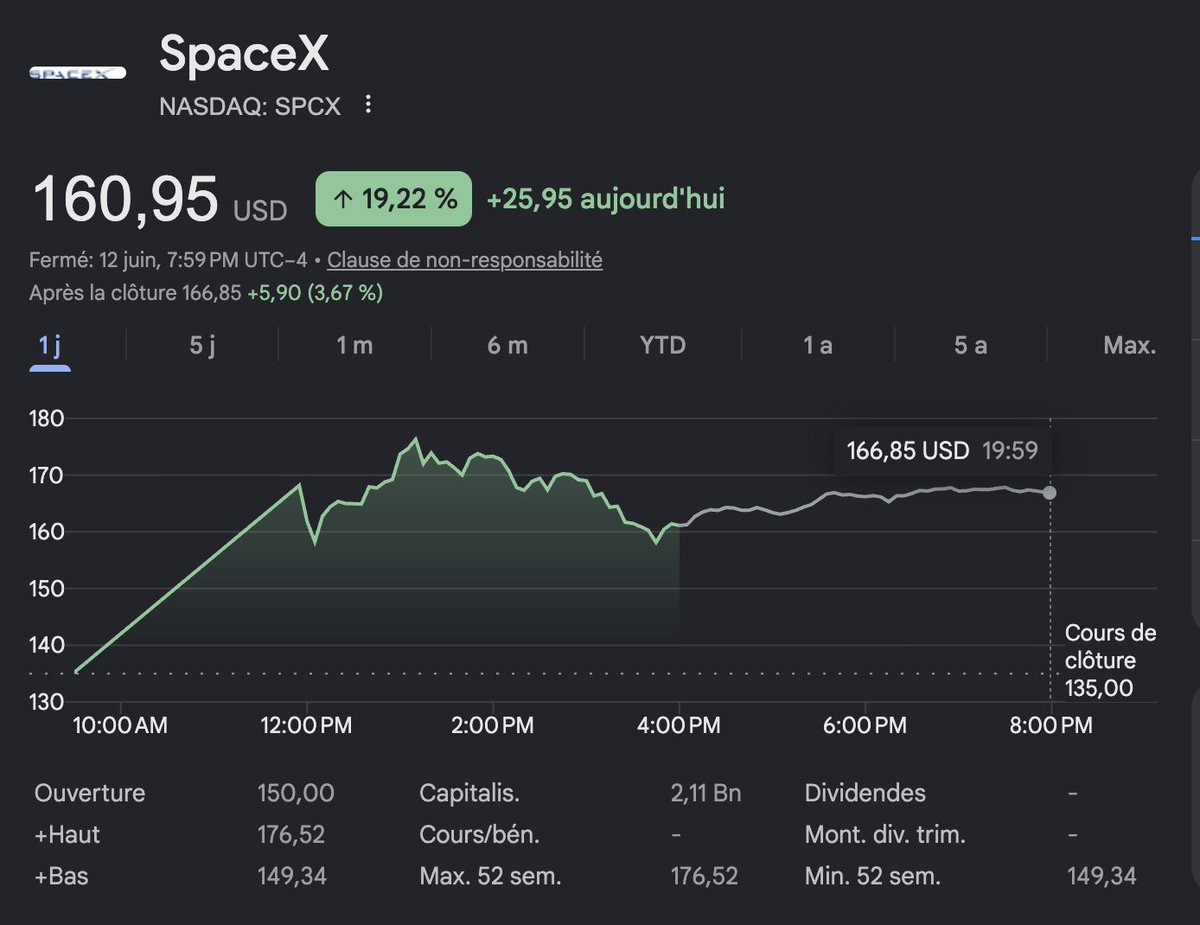
SpaceX a clôturé son premier jour de cotation à 2 100 milliards de dollars, +19%. Tout le monde regarde le chiffre. Personne ne regarde ce qu'il price réellement.
Laissez-moi vous dire ce que le marché vient d'acheter, et pourquoi je pense que cette boîte vaudra 30 à 50 trillions d'ici 5 ans.
D'abord, le symbole. Cette IPO est un référendum. D'un côté, 20 ans de discours sur la décroissance, la sobriété, la redistribution, la fin de l'histoire gérée par des comités. De l'autre, un homme qui a dit "je vais rendre l'humanité multiplanétaire", que tout le monde a traité de clown, et qui vient de créer la plus grosse entreprise cotée de l'histoire en partant d'un entrepôt à El Segundo. Le marché a voté. Le wokisme avait des départements RH, SpaceX avait des fusées. Les fusées ont gagné.
Ensuite, la mécanique économique, parce que c'est là que tout le monde se trompe. Les analystes valorisent SpaceX comme une entreprise de lancement plus Starlink. C'est comme valoriser Internet en 1995 sur le marché du fax. Starship ne réduit pas le coût du kilo en orbite de 20%, il le divise par 100. Et chaque fois dans l'histoire qu'un coût d'infrastructure est divisé par 100, ce n'est pas le marché existant qui grossit, ce sont des industries entières qui naissent. Le coût du calcul divisé par 100 a donné Internet, le smartphone, l'IA. Le coût de l'orbite divisé par 100 va donner une économie spatiale complète.
Faisons la liste de ce qui devient rentable quand le kilo en orbite coûte le prix d'un billet d'avion. Les data centers orbitaux, avec énergie solaire continue et refroidissement gratuit, au moment exact où l'IA fait exploser la demande énergétique terrestre. La fabrication en microgravité de semi-conducteurs, de fibres optiques, d'organes imprimés impossibles à produire sous gravité. Le tourisme orbital de masse, puis les hôtels lunaires, qui passeront du fantasme au business plan exactement comme la croisière de luxe au 20ème siècle. Le transport point à point terrestre, Paris-Tokyo en 40 minutes. L'industrie minière des astéroïdes, dont un seul corps de classe M contient plus de métaux que tout ce que l'humanité a extrait depuis le néolithique. Et Mars en ligne de mire, pas comme destination touristique, mais comme le plus grand projet d'infrastructure jamais entrepris, avec tout ce que ça implique de demande en énergie, matériaux, robotique, IA.
SpaceX ne participera pas à ces marchés. SpaceX possède le péage d'entrée de tous ces marchés. C'est AWS, mais pour la civilisation. Apple vaut 3 500 milliards en vendant des rectangles de verre sur une seule planète. Le premier monopole d'accès à une frontière infinie à 30 ou 50 trillions dans 5 ans, ce n'est pas de l'exubérance, c'est une simple règle de trois sur l'expansion du marché adressable.
Et maintenant, la partie que je préfère. Ce futur n'a pas besoin de bureaucrates. Il n'y a pas de comité consultatif en orbite. Pas de commission Théodule sur Mars. Chaque dollar de cette nouvelle économie sera créé par des ingénieurs, des techniciens, des soudeurs, des pilotes, des entrepreneurs. Les diplômés en gestion de la norme vont devoir apprendre un métier utile, et franchement, c'est une excellente nouvelle pour eux aussi : construire est infiniment plus fun que contrôler.
Parce que c'est ça, le vrai signal d'aujourd'hui. Pendant 50 ans on nous a vendu un futur rétréci : moins d'énergie, moins d'enfants, moins d'ambition, gérer le déclin proprement. Et là, d'un coup, le plus gros actif financier du monde est un pari sur l'abondance, l'expansion et l'aventure. Le pessimisme vient de passer en position vendeuse sur lui-même.
Le futur sera méga fun. Il y aura des hôtels avec vue sur la Terre, des honeymoons en orbite, des gamins qui diront "papa, c'était comment avant les fusées réutilisables" comme on dit "c'était comment avant Internet". Et quelque part dans les années 2030, un humain marchera sur Mars en livestream devant 5 milliards de personnes, et ce jour-là plus personne ne se souviendra du nom d'un seul de ses détracteurs.
Achetez de l'optimisme. C'est encore sous-valorisé.
A man who earned $28 an hour at SpaceX is about to become a millionaire today because of the IPO.
But he is just 1 of 4,400 SpaceX employees becoming millionaires today.
SpaceX begins trading on Nasdaq today under the ticker SPCX, priced at $135 per share and valued at $1.77 trillion.
The offering raised $75 billion and drew more than $250 billion in investor demand, more than three times oversubscribed.
More than 4,400 current and former SpaceX employees are projected to become millionaires today. Around 400 of them will hold stakes worth over $100 million each.
To put that in context, the Google IPO in 2004 created roughly 1,000 millionaires. Facebook's 2012 listing produced a similar number. SpaceX is doing more than four times both of them in a single day.
And the majority of these people are not founders or executives.
They are engineers, welders, machinists, and launch technicians who took equity over cash and held it for years.
Juan Hernandez moved from Mexico and learned to weld for the money.
He joined SpaceX in 2015 earning $28 an hour. When he went full time, the company gave him $10,000 worth of stock. He held it, bought more through payroll deductions, and sold a small portion in 2020 to buy property in Texas.
His remaining shares are worth $880,000 today.
Trevor Hise joined as a launch engineer straight out of college in 2011. He spent 12 years accumulating shares through salary, bonuses, and reinvestment. He is 37 years old and walking away with more than $13.5 million.
Gavin Petit started in 2012 on an $80,000 base salary with a small initial grant priced at $13.80 per share. He took every bonus in stock.
He has already paid off his home in Denver from earlier tender offer windows and now holds a stake worth several million dollars.
J. André Lavoie, an engineer who received grants years ago, is sitting on more than $28 million. He is currently in Italy renovating a hotel.
Tom Mueller was SpaceX's first employee, hired in 2002 to build the engines that made all of this possible. He left in 2020 but kept his equity.
This week he said: "Elon always said that your salary is one thing, but it's the equity that's gonna be worth something. That day is here."
This is what SpaceX's compensation model actually looked like from the beginning. The company paid below market salaries and made up the difference in equity at every level of the organisation, not just at the top.
Stock options vested over four to six years. Workers could buy additional shares at a 15% discount through a company purchase plan.
Early option grants were priced below $2 per share. Even 2025 grants carried exercise prices between $37 and $42. At $135 today, those positions are sitting at 3x returns minimum.
The physical impact is already visible in Brownsville, Texas, one of the poorest cities in the United States, where more than 3,000 SpaceX employees work at Starbase.
Median home prices in the surrounding county have gone from $131,000 in 2014 to over $281,000 today.
More than 100 SpaceX employees pooled their combined holdings, estimated between $1 billion and $5 billion to negotiate institutional level wealth management fees as individual workers.
Today, SPCX opens and 4,400 people find out what years of holding actually pays.
The Iranian navy, which has been destroyed eight times, has apparently closed the Strait of Hormuz again, because the United States, for the seventh time, won the war that wasn’t a war, so now the United States has to open the Strait of Hormuz that was already open before the not-war began.
The not-war began because Iran had uranium that was totally, completely, beautifully obliterated, so they can’t build the nuclear bomb they weren’t building, which is why the United States had to start the not-war it definitely didn’t start.
Now the United States, which has nuclear weapons, is threatening to use nuclear weapons to stop Iran from getting nuclear weapons, because nuclear weapons are far too dangerous for countries with nuclear weapons to allow other countries to have.
If the United States saw the United States doing what the United States does in other countries, the United States would invade the United States to liberate the United States from the tyranny of the United States.