The mature are humble. The opposite is being filled with self-importance.
Self-importance leads to:
Comparison
Entitlement
Need for recognition
Pressure to prove yourself
Being radically truthful and transparent with your colleagues and expecting your colleagues to be the same with you ensures that important issues are apparent instead of hidden. It also enforces good behavior and good thinking, because when you have to explain yourself, everyone can openly assess the merits of your logic. If you are handling things well, radical transparency will make that clear, and if you are handling things badly, radical transparency will make that clear as well, so it helps to maintain high standards. #principleoftheday
It makes people crazy, but my phone is always on silent, I have no notifications on, and I don't text often.
Give yourself the gift of uninterrupted living.
"The hardest thing in the world is to simplify your life. It's so easy to make it complex, but if you can strip it back to what matters most, you'll find freedom." - Hardy
Decide what matters most to you, and cut the rest.
It makes life so much easier.
The average investor is absolutely embarrassing.
Historically:
- S&P 500: ~10% annual returns
- Average investor: ~4-6% annual returns
Same market.
Completely different outcome.
Investing $2,000/month for 30 years:
- 10% return = ~$4.3M
- 5% return = ~$1.7M
That’s a ~$2.6M mistake.
Why does the average investor underperform?
- They buy after prices rise
- They sell after prices fall
- They panic during volatility
- They chase hot stocks
- They try to time the market
- They trade too often
- They ignore fees
- They abandon their plan
- They consume financial entertainment instead of following a system
The average investor doesn’t lose because they lack information.
They lose because they can’t get out of their own way.
Seven Things This 63 Year Old Surgeon Would Tell My 40-Year-Old Self
I am 63 now, and I spend my days as an orthopedic surgeon watching how people's earlier choices show up in their bodies decades later. I see it in my college friends, high school buddies, and patients that I have known for 20+ years. If I could sit across from myself at 40, here is what I would want that man to understand. None of what follows is complicated, and all of it compounds over the decades… either against you… or in your favor. You are largely in control.
What you feed your brain, trains your brain.
Big difference between:
- A Good Book vs Reality TV...or
- Watching YouTube to learn vs endless TikTok videos.
You are training your brain.
Think about the outcomes you want.
Reason’s why I love dividend investing:
-No boss
-No emails
-No lay offs
-No schedule
-No meetings
-No commute
-No phone calls
-No work drama
-No work stress
-No alarm clocks
-No requesting time off
-No need to sell shares
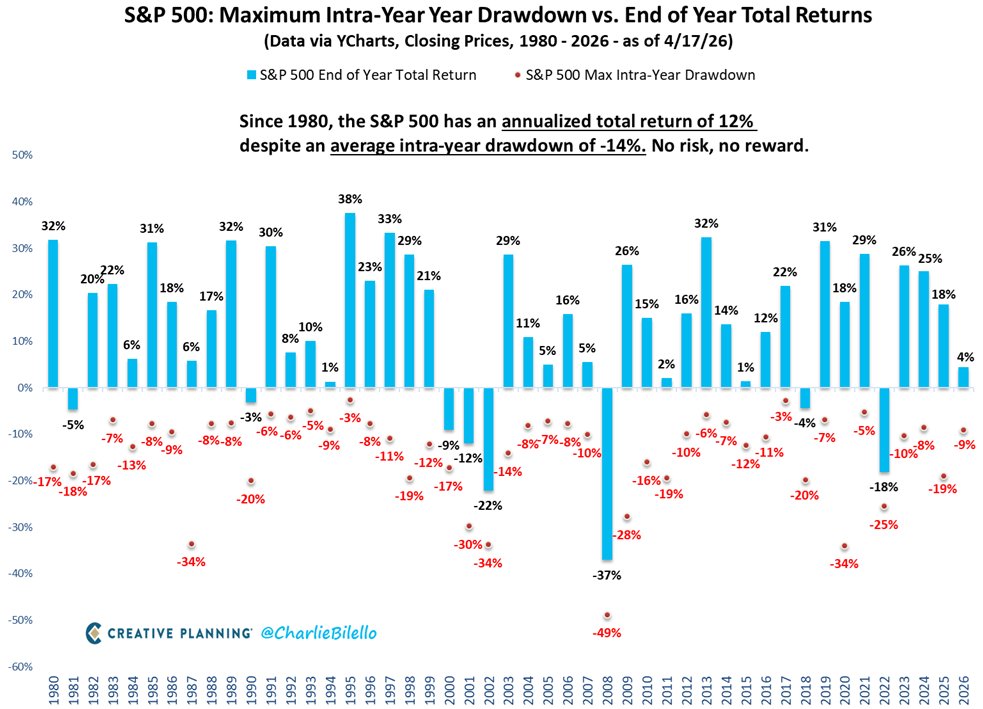
The S&P 500 has returned an average of 12% per year since 1980 and has done so despite an average intra-year drawdown of 14%, and often drawdowns that are much worse.
The lesson? Volatility doesn’t equal a permanent financial loss unless you sell.
Howard Marks:
"When you buy the S&P 500 at a 23x P/E, your 10-yr annualized return has always fallen between +2% and –2%, IN EVERY CASE, EVERY CASE!"