Nigeria cement market already has surplus installed capacity (roughly 60–65 million tonnes a year against domestic use of about 25–30 million tonnes). I think the binding constraint is weak, poorly coordinated demand rather than a shortage of kilns.
A concise national housing policy that sets annual unit targets, land release rules & mortgage finance standards would give producers a visible offtake schedule and raise utilization above the current 40–50% range.
Supporting roads, power & last-mile distribution would cut the high logistics costs that keep retail bags expensive even when plants sit idle
Closing Thoughts on the HBM Move:
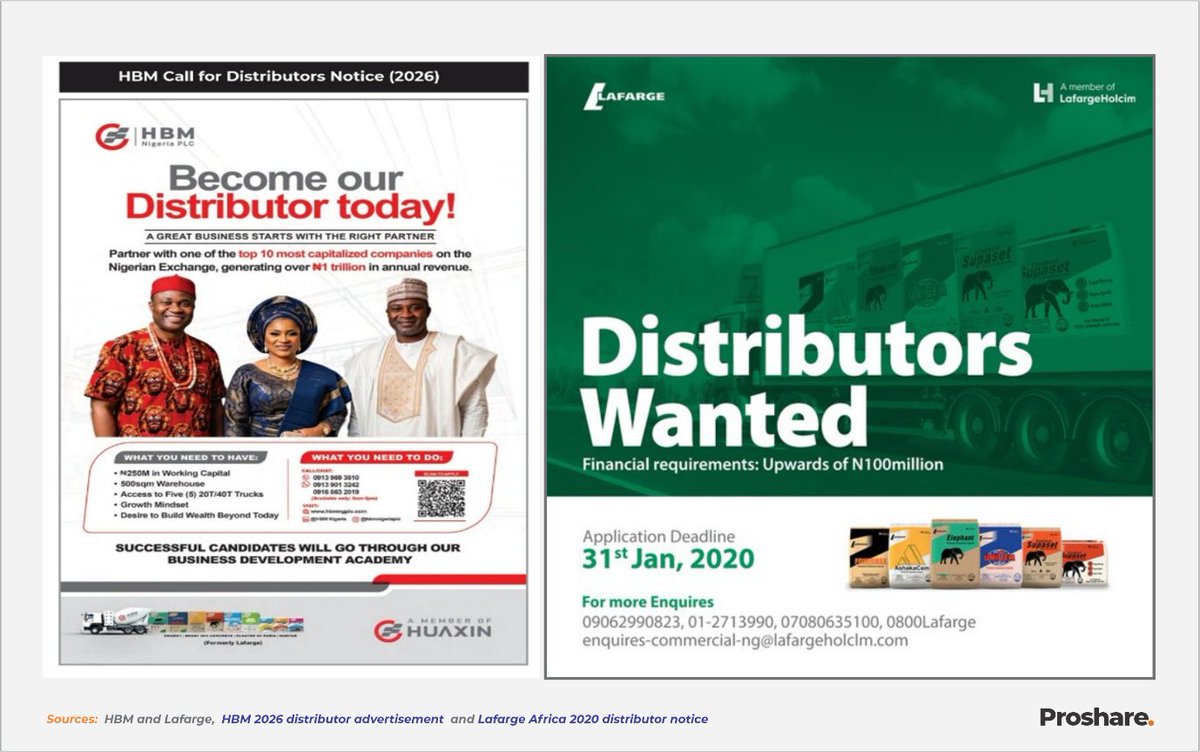
The N250m advertisement is a capital call on the channel, and the accounts explain its timing. @HBMNigeria is adding capacity at Sagamu and Ashaka to reach 14.0mtpa by the end of 2026, and the cheapest route to placing that volume is a wider, better-capitalised independent network that also carries the secondary haulage. Based on its FY 2025 accounts, the company entered this phase with a 36.8% operating margin, N388.1bn of cash, no borrowings, and a 39.4% return on equity, making the campaign a growth decision rather than a funding one.
Three FY 2026 lines will show whether it worked. Contract liabilities rebuilding from N115.9bn toward the 2024 level, while revenue grows, would appear as a working-capital release. Selling and distribution costs sustained below 15% of revenue would indicate that secondary haulage has migrated to the channel. A distributor list longer and more productive than the 894 names recorded for 2025 would confirm the funnel. Those should be read against Nigerian volume growth, realised price per tonne and capacity utilisation at Dangote Cement and @BUACement.
@DangoteCement needs not lose leadership for its economics to change. If HBM converts capacity and channel into volume, the incumbent can defend on price, on rebate and channel support, or on service levels, or it can accept volume loss. Price defence shifts margin to the channel and the buyer, rebate defence raises the cost of sales without changing the headline price, and accepting volume loss spreads fixed costs across fewer tonnes. Each path bears on the 60.1% Nigerian EBITDA margin recorded in the half year.
What the contest cannot settle on its own is the price a Nigerian household pays. Capacity has run at 40% to 48% utilisation without moving the retail price, and a housing deficit estimated above 16 million units sits on the other side of it. A wider, better-drilled channel changes who moves the tonnes and at what cost to the producer. Whether it changes what the bag costs at the depot gate is a separate question, and the sector's 2025 record does not answer it.
READ MORE>>> https://t.co/SIandwyUhL via @ecopoliticsNG@proshare
cc: @ngxgrp@MAN_NGR@nbccng@LCCI_DG
Agree with you sir.
Look at Afon road for example. This road serves Olam and the surrounding industrial layout and yet the State Govt left the place unattended to.
As you earlier mentioned, many inter street roads are in a direlict condition.
Some major roads are also riddled with potholes which only need need some patching but the State Govt have left those roads unattended to
He constructed Oja road & stopped abruptly at Ipata market (wherein lies a badly damaged section at the entrance of the gate of the market).
The road that spans Sango to Oke Ose just need repair but he left it to deteriorate further.
Harmony road that spans from Sango to Sobi Road junction is equally very bad.
I don't hate anybody let us be truthful with ourselves.
The State FAAC in August was about 20 billion naira in with about 4 billion naira as IGR.
Is the State getting the full value of accrued wealth and remember the State also has one of the most poorest salary scale in the country
@CaxtonJP I really respect Alhaji for his tenacity, vision and courage.
Even all the four combined Government refineries have a total installed capacity of 445,000 bpd.
One of my fears is that Dangote Refinery currently operates without a major domestic competitor, a state subsidy would essentially guarantee private profit margins at public expense, rather than letting market forces dictate the price.
And one of the reasons why India’s price cap model succeeds is because it features a fierce competition between massive state owned refiners & private giants (like Reliance)
While refineries in the US & Europe spend 4%-8% of their profits on salaries, India's Jamnagar refinery spends 2%-4% & Nigeria Dangote refinery operates at an incredibly low 0.6% (salary to profit ratio).
The gross refining margin for Dangote refinery in the first half of 2026 is $24.50 per barrel which is roughly double of Jamnagar current margin.
Dangote refinery with no competition fully captures the import parity premium while Jamagnar refinery has been more beneficial to the Indian masses thanks to the price capping from the India petroleum marketing board
🪖🫡 THE HARDEST BATTLES AREN’T FOUGHT WITH BULLETS. THEY’RE FOUGHT WITHIN. 🇳🇬🙏
Take a moment to look past the uniform. This powerful image captures a solitary soldier deep in heavy reflection, hands interlocked over a simple pocket Bible, his posture heavy with thought.
We often see our troops as strong, immovable pillars, but we forget the immense weight they carry every single day. Behind the camouflage is a human being dealing with:
🛑 THE MEMORIES: Reliving the intensity of the frontline and the loss of brothers-in-arms.
🛑 THE LONGING: Thinking of family, partners, and the life they paused to serve the nation.
🛑 THE FAITH: Finding the spiritual strength required to face an unrelenting tomorrow.
This isn't a picture of defeat; it’s a profound testament to resilience. Even when carrying the heaviest burdens, they still stand in the gap so we don't have to. 🛡️❤️
Let’s send them a wave of strength and prayer. Drop a SALUTE or a ❤️🙏 for all our service members dealing with unseen battles. You are not forgotten. 👇
My both kidneys failed at 31.
I went through Dialysis three times a week. I was dying slowly.
They put me on the transplant list and said I might not last. One night after dialysis I could not stand the pain. I shouted to God until I had no voice left:
The next test before transplant showed my kidneys working again.
No dialysis since. It's been four years and they still work.
The specialist said he had never seen such a thing.
I gave the rest of my life to God.
“A lot of people might be confused by this video. I just want to use this video to tell you that Jesus is real. There’s nothing He can not do. Do not wait to have a problem before acknowledging Him.”
— Nollywood actor, Femi Branch profess Jesus is Lord.
At ~0.7%, Dangote Refinery's salary to profit ratio is roughly 15–50times below global refinery peers.
This is consistent with the claim that Nigerian Corporates have some of the world's lowest salary to profit ratio.
Nigeria also has the lowest minimum wage among the top 10 largest economies in Africa.
Dangote Refinery has a total employee count of 4,106.
About 706 staff earn below N5.5m annually.
1,619 staff earn between N5.5m to N7.5m, while 1,691 staff earn above N7.5m annually.