some side quests need a handle: @gbcnews_tv
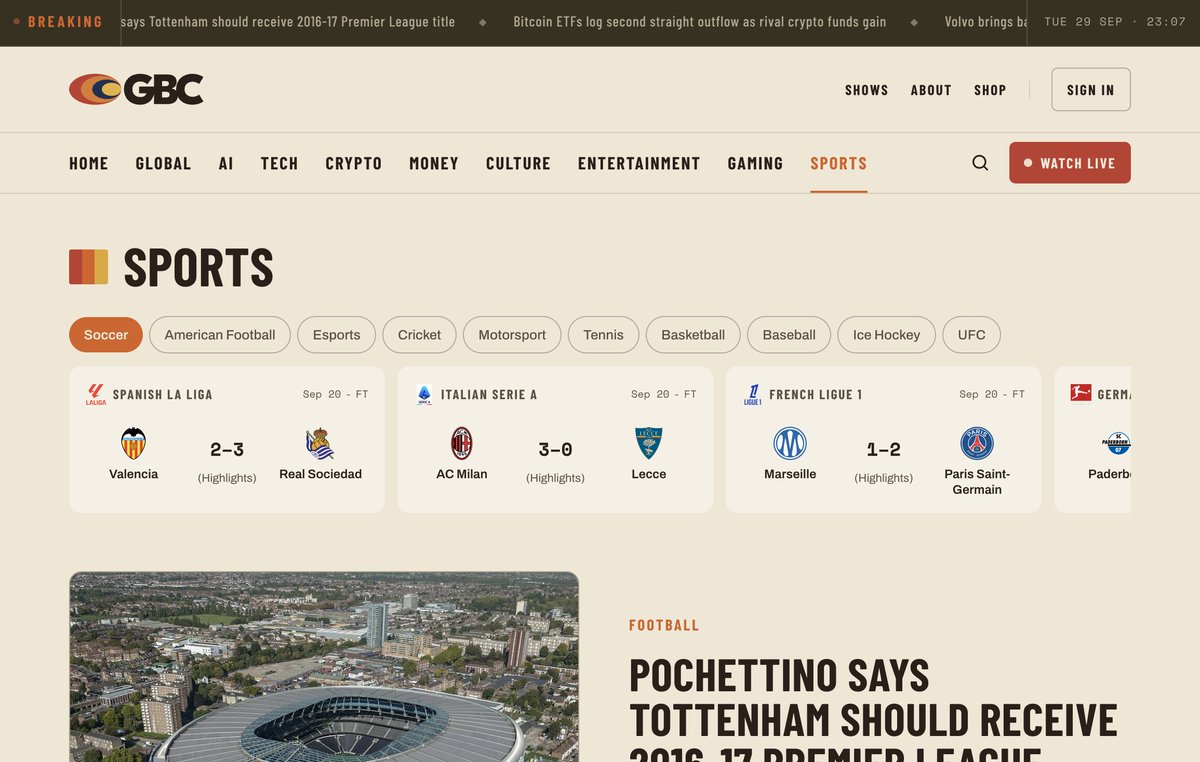
the idea: build the first 24/7 AI-run news broadcast.
launching with a fully agentic newsroom: writers, producers, editors, anchors, and prime-time shows.
early experiment for now, nights/weekends. stay tuned.
@ryolu_ extracting key vocabulary from that epsiode would be a killer follow-up (ex: flash cards for 20 new key words per episode with context and timestamp for quick rewatch.
@andrewchen Will the convenience of a jack-of-all-trades agent like Instinct, Muse, or Grok Bot outweigh the added value of reaching for a specialized travel, fashion, or real-estate scouting agent?
convergence to the mean
when everyone looks at everyone else to decide what to make, we eventually stop making anything of our own.
we copy what works. borrow the language, the aesthetic, the features. we call it learning from the market, following best practices, staying competitive. together, everything starts to feel familiar. polished, interchangeable. nothing wrong. nothing alive.
the mean isn’t necessarily bad. it’s where everything lands when we remove the reasons for it to be different.
numbers are easier to compare than feelings, so we make things that produce numbers. we study what gets attention, then shape ourselves around it. eventually the feedback stops informing the work and starts authoring it. we’re no longer asking what we want to say. we’re asking what will be rewarded for saying.
ai makes this loop frictionless. it can draw from more references than we could see in a lifetime. but access to every perspective isn’t the same as having one. it hasn’t lived a particular life that makes one detail unbearable and another beautiful. when we ask it to choose for us without bringing any intention of our own, we get something plausible, easy to approve.
then we ship it, measure it, copy it, and feed it back into the next round. a tidal wave of mid.
this changes not just the work, but the people making it.
we describe ourselves in categories platforms can distribute and markets understand. designer. founder. creator. pick a niche. build a brand. be consistent. the parts that don’t fit become inconvenient, even when those contradictions might produce our most interesting work. we become easier to classify and harder to tell apart.
i think we need to approach making things more like artists.
an artist develops a perspective through the work. making, noticing, choosing, failing, returning. learning what matters even when nobody else cares. craft gives that perspective a form precise enough for someone else to experience.
the life outside the work matters too. the places you’ve lived, the people you’ve loved, the things you’re embarrassed to care about. these aren’t distractions from having something to say. they’re how you come to have something to say.
we understand this with music, paintings, photographs, movies. we expect a person to be present in the choices. we want to experience something we wouldn’t have encountered without them.
software can do this too.
a piece of software expresses beliefs about how life should feel. what deserves your attention. what you should be free to change. whether a task should feel like paperwork or play. even a small interaction can carry someone’s care, humor, or curiosity.
but we rarely talk about software as a medium. we talk about it as an industry. markets to capture, workflows to optimize, competitors to catch up with. we add a feature because someone else has it, without asking whether it belongs. products accumulate the same parts and lose what made them worth choosing.
underneath the branding, it’s all the same thing.
artists learn from others too. the question is whether you’re absorbing those influences into a point of view, or using them to avoid developing one.
what are you trying to let someone feel, understand, or do? why this particular shape? what have you noticed that the existing tools don’t seem to notice?
those questions don’t have answers you can borrow from a competitor’s roadmap.
if we can make almost anything, deciding what deserves to exist becomes more important, not less. speed gives us more chances to exercise judgment. it doesn’t remove the responsibility.
i don’t want a world where every person becomes a more efficient distributor of the same ideas. i want people to use these tools to go further into what they actually care about. to make things specific enough that we can feel someone behind them.
what is the point of everyone being able to make something, if we all end up making the same thing?
@cogentia@levelsio gen video will only get cheaper but stay in high tens of ks for the forseable future.
at @gbcnews_tv we decided to use animated avatars and 3D scenes, allowing monthly burn to be below USD 2'000 for 24/7 news coverage.
main cost driver is @FishAudio voice synth.
@levelsio@levelsio fun!
we're building the "real news" version of this @gbcnews_tv
the feed is 24/7, covers all major topics from Sports to Finance, all done by our AI news agents.
so far, running early tests of @gbcnews_tv daily broadcasts shows costs are roughly 3/4 text-to-speech and 1/4 image-gen (llms negligible).
self-serve ads should cover the token burn.
but would the people who watch, contribute to and help grow GBC could also own part of it?
will need to explore.
final show lineup for @gbcnews_tv
covers everything from finance and entertainment to sports, AI, culture, crypto, and tech.
includes "Oracle", a late night fortune teller show