Category Labs is proud to introduce Cadence, our multiple-concurrent-proposers (MCP) consensus protocol that matches the optimal good-case latency of single-leader consensus while supporting arbitrarily short block intervals. When combined with BTX, our design for encrypted mempools, this represents a significant step towards solving the problem of MEV at the protocol level.
In nearly every blockchain today, a single party ends up in control of each block: it decides which transactions get in, and can reorder them at will. MCP is the natural fix, but most recent designs pay for it with a separate aggregation phase, adding two extra communication rounds per block.
Cadence makes the proposers part of consensus itself. Its fast path finalizes in an optimal three communication rounds, even when proposers are offline. Cadence also offers speculative finality, similar to MonadBFT, after just two rounds, revertible only if a proposer provably equivocated. In a simulation using estimated network delays between Monad mainnet's 200 globally distributed validators, finalization takes 219 ms on average, speculative finality 167 ms.
Cadence pushes pipelining to the extreme: each block is proposed and finalized in its own independent consensus instance, without waiting on preceding blocks. The block interval then becomes a protocol parameter that can be arbitrarily small. At our initial target of 100 ms, a transaction waits on average just 50 ms to enter a proposal, and oracle prices, liquidations, and auctions can update every 100 ms. Cadence dynamically throttles the opening of new instances to bound the number of outstanding slots even during periods of network instability.
When the network is healthy (under synchrony), a transaction included by an honest proposer can be neither dropped nor deferred (short-term censorship resistance), and no proposer can see the others' proposals in time to react (hiding). We prove both, together with safety and liveness under partial synchrony at the optimal 3f+1 fault bound.
The Cadence protocol is modular: each module is simple on its own, and any of them can be swapped out without touching the rest.
Cadence also builds on components already being deployed: proposals are disseminated as erasure-coded chunks over Deterministic RaptorCast, now rolling out on Monad, and validators vote on proposal digests, so voting does not wait for the full data to arrive.
Start with the interactive tutorial: https://t.co/U39juw7lWf.
Full paper: https://t.co/TVAzvaKHL8.
Joint work by Kushal Babel, Fatima Elsheimy, Lioba Heimbach, Mohammad Mussadiq Jalalzai, Tobias Klenze, Jovan Komatovic, Jason Milionis, Mike Setrin, and Victor Shoup.
🚨UPDATE: Echo team has reportedly regained control of the affected keys and has burned the attacker’s remaining 955 eBTC.
Total realized losses have now been limited to approximately $816K.
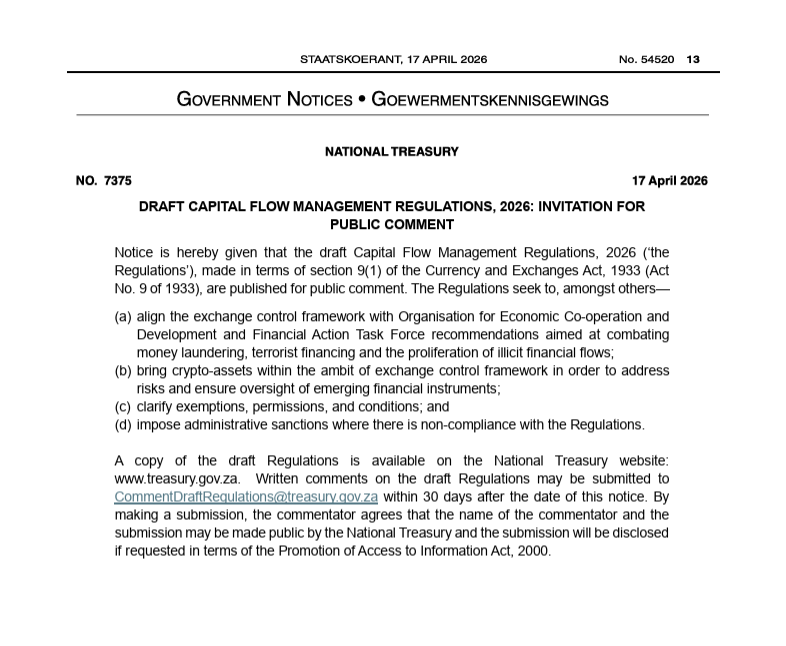
Your Action Required: Draft Capital Flow Management Regulations 2026
National Treasury has published draft Capital Flow Management Regulations, 2026, for public comment. We believe it is important that you understand the proposed Regulations and have the opportunity to contribute constructively.
https://t.co/AdWQJpr14i
I am frankly dumbstruck by the news out of South Africa 🇿🇦 that newly proposed regulations would upend self custody in that country.
South Africa's National Treasury has published draft Capital Flow Management Regulations (https://t.co/72NEvhnM1f) to replace its 1961 exchange-control regime, and the proposal extends sixty-five-year-old capital controls designed for gold bullion and foreign banknotes directly onto self-custodied crypto.
The result is one of the most invasive treatments of non-custodial wallets proposed anywhere in the world.
The mechanics are clear and severe. Any purchase, sale, loan, or transfer of crypto above a Treasury-set threshold must run through a licensed "authorised crypto asset service provider." Cross-border movement of crypto requires permission. Holdings above the threshold must be declared within thirty days, and Treasury can compel their sale at market price. Crypto can be attached by administrative order, without prior judicial process, on reasonable suspicion of contravention. Penalties run to R1 million, five years in prison, or the full value of the crypto involved.
The provision that is the real showstopper is Regulation 25(5). Where crypto has been forfeited to the state, the owner must "furnish full particulars in writing of all and any passwords, personal identification numbers or codes" necessary to give Treasury access.
That seems to be a statutory compelled disclosure of seed phrases and private keys.
There is no carve-out, no judicial check inside the regulation itself, no recognition that the keys are not separable from the user's right against self-incrimination or right to privacy under the South African Constitution.
The reason that provision appears to exist is Treasury understands that, without it, the rest of the framework cannot reach a self-custody user. Exchange-control logic depends on gatekeepers — banks, dealers, intermediaries that the state can appoint and command. Self-custody removes the gatekeeper by design. So the regulation reaches the only places it still can: the on-ramp, the holder's declaration, and ultimately the holder's body and devices at the border. Regulations 4 and 5 give enforcement officers the power to search travelers entering or leaving the country, demand they "produce" any crypto in their possession or control, and seize it on suspicion alone.
As you well know, this is not how most of the rest of the world is approaching self-custody. The EU's Markets in Crypto-Assets framework regulates issuers and crypto-asset service providers and explicitly leaves self-custody alone. The UK's financial services regime regulates exchanges and custodians and treats unhosted wallet software as out of scope. The US has spent the last two years walking back its most aggressive theories — the SAB 121 reversal, the broker-dealer rule rollback, the IRS DeFi broker rule rescission — precisely because policymakers across both parties recognized that you cannot regulate non-custodial software the way you regulate a bank. FATF's own guidance distinguishes wallet software publishers from custodial intermediaries.
South Africa's draft does the opposite. It very much intends to reach through the software to the user.
The technical reality the draft ignores is that a non-custodial wallet is a key-management tool, not a financial intermediary. @MetaMask does not hold user funds. It does not see private keys. It cannot freeze, seize, or surrender anything to a regulator. Compelling its users to declare, surrender, or hand over keys does not make Treasury more effective at managing capital flows. It makes ordinary South Africans criminally liable for using software the rest of the world treats as legitimate self-custody infrastructure.
Treasury has opened a public comment period, and anyone with a dog in the fight should ask that the compelled-key provision be struck. The cross-border search-and-seizure regime should not extend to self-custodied wallets. And the framework should distinguish — as nearly every other major jurisdiction now does — between intermediated services and the user's own software.
Grab some popcorn 🍿 for the next testnet epochs 533/4, tune to https://t.co/0NrMcPhPmm and check out the next batch of stress tests on the network conducted by the #Monad Foundation.
Focuses on sustaining high execution load and observing system behavior.
Did you know you can monitor a Monad Mainnet or Testnet validator through Monad-IO?
1. Visit https://t.co/0NrMcPhPmm
2. Select the validator from the dropdown.
3. Hit 'Alert me ... '
@socialforging
A recent viral clip showed Don Wilson of DRW criticizing public blockchains for their lack of MEV-resistance. Wilson argued that, as a result of this, public blockchains are not suitable for financial markets.
This critique isn't going to go unanswered. Last night, Category Labs published a frontier research result for encrypted mempools. This is a significant result that leads the way to practical MEV resistance, and is how our industry will prevail against the private blockchain crowd.
Background
When you submit a transaction on a blockchain, it sits in a pending state where it may be frontrun by a bot.
The cleanest fix would be for users to encrypt transactions until they're included in a block, but doing that efficiently is very hard: you need a committee of servers that can jointly decrypt only the transactions that make it into each block, fast enough to keep up with block times.
Up to now, this idea hasn't been practical, as the best threshold encryption schemes are too slow, introduce censorship attacks, or introduce impractical operational steps for users or validators.
Category Labs has a solution: BTX, a new scheme for Batch threshold encryption (BTE) that is actually practical and performant. This leads the way to encrypted mempools on Monad.
The result
Batched Threshold Encryption (BTE) lets a committee of servers jointly decrypt a specified set of encrypted results from a pool while keeping the rest private.
Prior BTE schemes each had a drawback:
- some required per-block MPC setup
- some bound each ciphertext to a specific block or epoch (limiting rollover and enabling censorship)
- some required users to pick an index from a small namespace (resulting in occasional collisions)
- and the ones that avoided all these issues were either computationally prohibitive or required a common reference string (CRS) that grows with the number of sessions.
BTX, the new mechanism proposed in the paper, is simultaneously:
- epochless
- collision-free
- computationally efficient, and
- compact
In the paper, the authors implement BTX and benchmark it against the strongest two prior schemes (PFE from Boneh et al. and BEAT++ from Agarwal et al.). (BEAT++ is a prior result by most of the authors of the present paper.)
BEAT++ is fast but has a censorship-enabling design flaw; PFE is clean but slow and has bigger ciphertexts; and Fernando et al. (a third leading scheme) is clean but doesn't scale to long-lived deployments. BTX is the first construction that's simultaneously collision-free, epochless, compact, and fast.
BTX is a significant result solving a huge problem. Check out the paper in the next post.
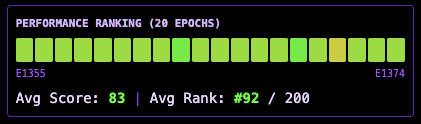
Quick check on performance rankings now available on https://t.co/D3a6DxmHo3
How we rank — pure performance, not stake size.
Score = 50% TX Efficiency + 30% Avg TX/Block + 20% Reliability
Per epoch validator rankings page now added to Monad-IO (plus a few much needed bug fixes).
Validators are ranked by execution quality, not stake size, based on: TX Efficiency, Proposal Rate, Reliability, on a per Epoch basis.
https://t.co/D3a6DxmHo3
@socialforging@keoneHD
For decades, institutional finance operated behind closed doors. The new Corda protocol opens the vault, bringing real-world financial strategies directly onto @Solana. Our vision is an open financial system where everyone can build resilient, diversified portfolios, putting the tools once reserved for Wall Street into the hands of DeFi users. Be part of what comes next: https://t.co/M91ZYakSYN
Abu Dhabi, ENTROPY engulfs you!
Check out our collabs at Breakpoint 2025:
- Main sponsor of @SagaMobileDAO house
- Figurine & custom NFT from @spenders_club
- Closing party airdrop with @SolflareKingdom
Entropy Engulfs Every End
If you’re at @SolanaConf, here’s a story you’ll want to hear.
With 4M+ users, @solflare continues to set the bar for lightning-fast wallet experiences.
How? By using our new Solana Archive Infra. 🧵👇
Introducing: Solflare Shield 🛡️
Protect your portfolio in a single tap with a hardware wallet slim enough to fit in your pocket.
No more cables, Bluetooth pairing, dead batteries, or clunky PIN entries.
Preorders start today at just $49 with free global shipping. ↓
BP25 WARMUP QUEST IS LIVE!
Kick off the action with our first quest:
“Warmup Forecast: SOL Signal” 🔮
Make your prediction for SOL’s price on Day 1 of Breakpoint and climb the leaderboard.
Big brains earn big points.
Join us today: https://t.co/z35FnlXiHh
#Solana #Breakpoint2025 #BP25