My favourite scene in Dr Strangelove is the President (Peter Sellers) calling a drunk Soviet Premier to politely explain he’s about to be annihilated.
Your imagination fills in the gaps, which makes it even funnier, because it matches exactly how your own brain interprets comedy.
Today, Elon Musk, a trillionaire, pays the same amount into Social Security as someone making $184,500.
If we end that absurdity and lift the cap on taxable income, we can make Social Security solvent for 75 years and expand benefits by $2,400. My Social Security bill does that.
When the President of France visited the United States in April 1960, he asked the FBI to help him find a man.
The man he was looking for was an American citizen. He was sixty-four years old. He had been awarded fifteen French military decorations and — six months earlier, in a ceremony in Paris — had been made a Knight of the Légion d'honneur, the highest civilian honor France can give. The medal had been pinned to his chest by the President himself, who had publicly called him un véritable héros français. A true French hero.
The FBI located the man within a few days.
He was operating an elevator at Rockefeller Center in New York City.
The elevator operator's name was Eugene Bullard. He had been born in Columbus, Georgia, in 1895, the son of a man whose own father had been a slave.
He had run away from Columbus at the age of eleven, after watching a white mob nearly lynch his father.
He spent the next several years drifting through the American South. At sixteen, he stowed away on a German freighter at Norfolk, Virginia. He landed in Aberdeen, Scotland. From there he made his way to London, where he learned to box. By 1913, at eighteen, he was prizefighting in Paris.
When Germany invaded France in August 1914, Bullard was nineteen years old. He had no legal obligation to fight. He had no French citizenship.
He went to the recruiting office on October 19, 1914, and signed up for the French Foreign Legion.
He spent the next eighteen months as an infantryman in some of the worst fighting of the war — at the Somme, at Champagne, at Verdun. He was wounded three times. The third wound, on March 5, 1916, tore open his thigh and left him with permanent damage to his leg.
He was twenty years old. The doctors told him he would not return to the infantry.
He decided he wanted to fly.
In a Paris café in the spring of 1916, while he was recovering, Bullard mentioned to three white American friends that he was thinking of joining the French air service. A Mississippian named Jeff Dickson laughed.
Gene, Dickson said, you know damn well there aren't any Negroes in aviation.
Bullard answered: Sure do. That's why I want to get into it. There has to be a first to everything, and I'm going to be the first.
Dickson bet him two thousand dollars he would not make it.
Bullard took the bet. He earned his pilot's license on May 5, 1917. He won the bet.
He reported to the front in August 1917 and flew approximately twenty combat missions over the next three months in a SPAD VII. The fuselage was painted with a bleeding heart pierced by a knife and the French phrase Tout le Sang qui Coule est Rouge — All Blood that Flows is Red.
He carried, on every combat flight, a small capuchin monkey named Jimmy in the front of his flight jacket.
The French press began calling him L'Hirondelle Noire — the Black Swallow.
When the United States entered the war in 1917, Bullard immediately applied to transfer to the U.S. Army Air Service.
His application was rejected.
The U.S. Army Air Service had a policy, in 1917, of not accepting Black pilots. The other American pilots flying for France in his unit, all of them white, were transferred to the U.S. Air Service.
He was the only one who was not.
For the next twenty years, he was one of the most familiar faces in the Montmartre nightlife of Paris between the wars. He owned a nightclub called L'Escadrille. He spoke fluent French, English, and German. Hemingway drank there. Fitzgerald drank there. Langston Hughes drank there. Josephine Baker performed there. Louis Armstrong was a personal friend.
When Germany invaded Poland in 1939, Bullard was forty-four. His fluent German and his ownership of a nightclub frequented by German officers made him useful to the French Resistance. He became an intelligence agent — eavesdropping in his own bar on conversations between German officers who did not know he understood every word.
When France fell in June 1940, friends in the Resistance smuggled him across the Spanish border before the Gestapo could arrest him.
He came back to the United States for the first time in twenty-eight years.
He arrived in New York with thirty dollars in his pocket and a permanent limp.
He did not return to a hero's welcome. He returned to a country that had no idea who he was.
He worked at a perfume counter. He worked as a security guard. He worked at the Staten Island shipyards. By the late 1940s, he had taken the job that he would hold for most of the rest of his life.
He operated the elevator at Rockefeller Center.
He was wearing the elevator uniform on the day a producer from NBC came down from the studios upstairs to ask if he was the man Charles de Gaulle had been looking for.
A few weeks later, NBC sent a film crew to interview him in the lobby. The studios where NBC produced The Today Show were on the floors above. He had operated the elevator that took the network executives up to those studios every morning for nearly ten years. He had not been recognized as he did it.
He went back to operating the elevator the following Monday.
He died of stomach cancer on October 12, 1961, three days after his sixty-sixth birthday.
He was buried in the French War Veterans' section of Flushing Cemetery, in Queens, in the uniform of the French Foreign Legion. The casket was draped with the French flag.
In 1994 — thirty-three years after his death — the United States Air Force formally commissioned Eugene Jacques Bullard as a Second Lieutenant, posthumously.
It was the first commission the U.S. military had ever offered him.
He had been the first Black combat pilot in American history.
The French had been calling him a hero since 1917.
The Americans got around to it in 1994.
There’s been a lot of talk in this race about what makes a "real man."
A man does what’s right when no one is watching. He upholds his commitments to his family and neighbors. He doesn’t lie, cheat, & steal his way through life.
Real men serve others. Weak men serve themselves.
There are 12 chapters in Laurence Rees’s book “The Nazi Mind” people should know:
Spreading conspiracy theories, using us versus them, leading as a hero, corrupting youth, conniving with the elite, attacking human rights, exploiting faith, valuing enemies, eliminating resistance, escalating racism, killing at a distance, stoking fear.
When I use the word fascism I’m not being hyperbolic.
I’m grounding it in a historical analysis of what leaders do when they want to be authoritarian.
We didn’t even get to the naming. He wants his name on the US dollar, inside the passport, and his face on everything the American people touch when they interact with their own government.
Washington wouldn’t have done that. Eisenhower wouldn’t have done that. Reagan wouldn’t. Obama certainly didn’t.
Kids start dropping out of college by the 3rd grade. That’s why I am focused on the Mississippi Miracle and making sure every child learns how to read.
College used to be an economic benefit. But today, it’s become a financial burden for too many families. On graduation day, students earn a diploma but unfortunately they also get an invoice for a lifetime of debt.
Let’s restore the promise of higher education so a college degree provides a pathway to the American Dream for every student. For too long it’s left too many families behind the eight ball.
I’ve seen more thorough autopsies from the local coroner’s office.
This DNC autopsy report has nothing to do with how to win a race. But if you want a roadmap for how to lose one, it’s probably useful.
Winning isn’t as complicated as it looks. Candidates who can appeal to a broad coalition of Democrats and Independents, who know how to communicate why they’re running and why that matters to voters — that was the secret sauce behind Bill Clinton and Barack Obama’s electoral and reelection successes. It was also the formula that helped Nancy Pelosi become Speaker.
The last three presidential elections were decided by roughly half a million voters across seven states. We need candidates who know how to win those states and earn the confidence of those swing voters. It’s that simple. And you won't find the combination to that lock in this autopsy report.
205 years ago today, Napoleon Bonaparte died on a tiny British prison island in the middle of the South Atlantic. He was 51. He had ruled most of Europe. And he changed the world so thoroughly that you are still living inside the systems he built.
Start with the obvious one. The Napoleonic Code. He commissioned it in 1800, sat in on the drafting sessions personally, argued with the lawyers, and pushed it through in four years. Equality before the law. Property rights. Religious freedom. The end of feudal privilege. It is still the basis of civil law in France, Belgium, the Netherlands, Italy, Spain, Portugal, most of Latin America, Quebec, Louisiana, and chunks of the Middle East and Africa. About a third of the planet writes contracts using rules a Corsican artillery officer wrote between battles.
He sold Louisiana to Thomas Jefferson in 1803 for 15 million dollars. Roughly four cents an acre. It doubled the size of the United States overnight. Without that deal there is no St. Louis, no New Orleans as an American city, no Lewis and Clark, no Manifest Destiny. The American century starts with Napoleon needing cash for a war.
He invaded Egypt in 1798 with an army and, weirdly, 167 scientists, mathematicians, and artists. They found the Rosetta Stone. That single slab is the reason we can read hieroglyphs at all. Egyptology as a field exists because Napoleon brought scholars to a war.
He built the Bank of France, which still runs French monetary policy. He created the lycée system that still educates French teenagers. He shoved the metric system across Europe at sword-point until it stuck. He emancipated the Jews of every territory he conquered, tearing down ghetto walls in Rome, Venice, Frankfurt. He abolished serfdom in Poland. He standardized road networks, civil registries, and tax codes that European governments still operate from.
And then there's the soldiering. He fought around 60 major battles and won most of them. Austerlitz, in 1805, against the combined Russian and Austrian empires, is still taught at West Point as one of the closest things to a tactically perfect battle ever fought. He was outnumbered, baited the enemy onto ground he had pre-selected, and broke them in a single afternoon. Three emperors took the field that morning. Only one walked off it on his own terms.
He slept four hours a night. He read constantly, dictated letters to four secretaries at the same time, and personally signed off on everything from cavalry boot specs to the seating chart at the Comédie-Française. Wellington, the man who finally beat him at Waterloo, was asked decades later who the greatest general in history was. He answered without hesitating. "In this age, in past ages, in any age, Napoleon."
He lost, in the end, because he could not stop. Russia in 1812 swallowed his army whole. Six hundred thousand men marched in. Maybe a tenth came back. He abdicated in 1814, escaped from Elba, ruled France again for 100 days, and lost it all for good in a wheat field in Belgium in June 1815.
The British shipped him to St. Helena, a volcanic dot 1,200 miles off the African coast, and waited. He spent six years there dictating his memoirs, gardening, complaining about the dampness, and quietly rewriting his own legend so effectively that Europe spent the next century arguing about him.
He died on May 5, 1821, during a storm so violent it ripped up the willow tree he liked to read under. His last words trailed off into fever. France. The army. Joséphine.
Nineteen years later France brought him home. Two million people stood in the snow to watch the coffin go by.
He was a tyrant. He was a reformer. He started wars that killed somewhere between three and six million people. He also wrote the rulebook that a third of humanity still lives under.
Most people who try to conquer the world are forgotten inside a generation. Napoleon has been dead for 205 years and we are still arguing about him because we are still using his furniture.
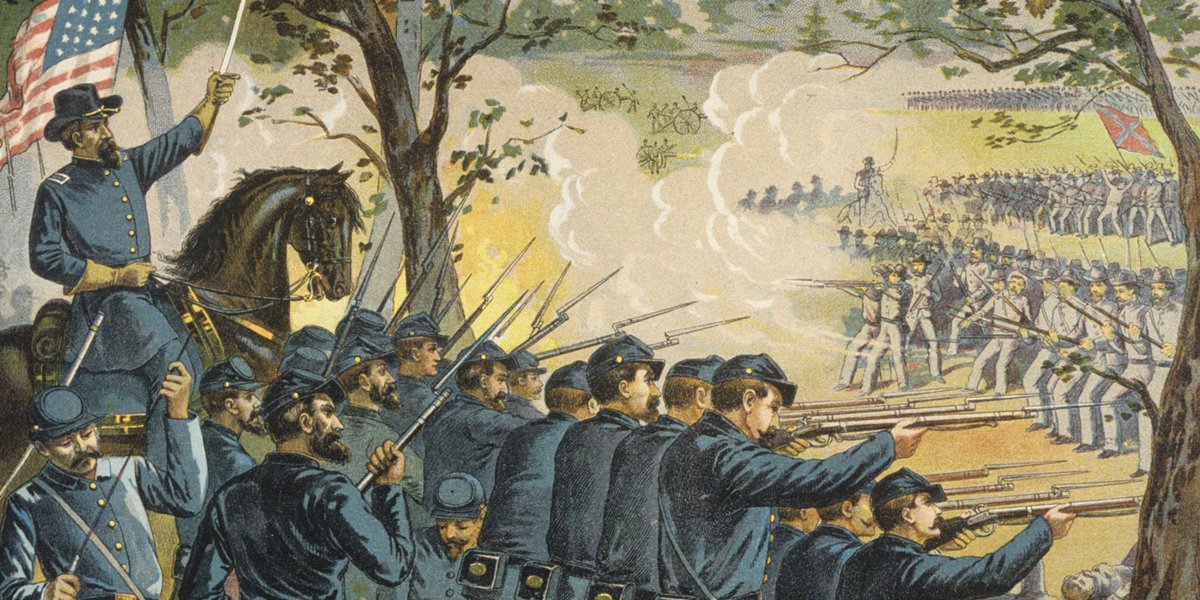
162 years ago today, on May 5, 1864, Ulysses S. Grant marched 120,000 men into a forest in Virginia and started a battle so horrific that wounded soldiers used their last bullets on themselves, generals wept openly at what they were ordering their men to do, and the woods themselves caught fire and burned the dying alive where they lay.
It was called the Battle of the Wilderness.
The forest had a reputation before the armies even arrived. Locals called it the Wilderness for a reason. It was second-growth scrub left over from a century of iron mining, a tangled hellscape of stunted oaks, dense thickets, and brambles so thick a man could lose sight of his own hand. Robert E. Lee picked it on purpose. He knew Grant had twice as many men and three times the artillery, and he knew none of that would matter in country where you could not see twenty feet in any direction.
The fighting started by accident. Two columns blundered into each other on the Orange Turnpike around midday and opened fire at point-blank range. Within an hour, both sides had thrown in entire corps. Men aimed at muzzle flashes because there were no targets to see. Officers lost regiments. Regiments lost companies. One Union colonel later said he fought all afternoon without ever seeing a single Confederate soldier, only smoke and screams and the occasional silhouette pitching backward into the brush.
Then the woods caught fire.
The underbrush was bone dry. Powder flashes ignited leaves. Wind fanned the flames. Within hours, walls of fire were rolling through the forest, faster than wounded men could crawl. Soldiers who had taken a bullet to the leg, or the spine, or the gut, lay helpless in the path of the flames and listened to them coming. Some called out for water. Some called out for their mothers. Some called out to be shot. Hundreds were burned alive. Survivors said the screams went on for hours and then, slowly, one by one, stopped.
A Union officer wrote in his diary that night, "It was as though Christian men had turned to fiends, and hell itself had usurped the place of earth." A Confederate captain wrote, "I have never prayed harder in my life, not to live, but to forget."
The fighting went on for three days. Lee's army nearly broke on the second morning when a Union assault punched through his right flank, only to be saved at the last possible moment by the arrival of Longstreet's corps after a forced overnight march. Longstreet himself was shot through the throat by his own men in the smoke and confusion, less than five miles from where Stonewall Jackson had been shot by his own men exactly one year and one day earlier, in the same forest, in the same kind of chaos. Lee considered it a curse on the Wilderness itself.
By the time the guns went quiet on May 7, around 29,000 men were dead, wounded, missing, or captured. It was, by any honest reckoning, a Union defeat. Grant had been outmaneuvered, outfought, and bled white in terrain that turned every advantage he had into a liability.
Every Union commander before him, after a beating like that, had turned the army around and retreated north to lick its wounds. McClellan had done it. Pope had done it. Burnside had done it. Hooker had done it. Meade had done it after Gettysburg, even after winning. It was simply what the Army of the Potomac did.
That night, the order came down to march. The men were told to pack up. They formed into columns by torchlight, exhausted and filthy and stinking of smoke, and they began to move. When they reached the crossroads at the edge of the burning forest, the road north went one way and the road south, deeper into Confederate Virginia, went the other.
Grant turned the army south.
The soldiers, who had been through this song and dance a dozen times before, took a moment to realize what was happening. Then they understood. They were not retreating. They were not going home. They were going to keep fighting, and keep fighting, and keep fighting, until the war was over.
The cheer that went up that night could be heard for miles. Confederate pickets heard it across the lines and knew, in that exact moment, that something fundamental had changed. One of Lee's officers wrote later that he heard the cheering and understood, with absolute clarity, that the Confederacy was going to lose the war.
He was right. Eleven months later, Lee surrendered at Appomattox.
But it started here, in a burning forest on May 5, 1864, when an unassuming little man with a cigar in his teeth refused to do what every other Union general had done, and pointed his army south instead of north.
Everyone loves asking: “If Grant was such a great general, how come he lost nearly every battle to Lee and suffered way more casualties?”
Robert E. Lee himself had a very different answer.
“I have carefully searched the military records of both ancient and modern history, and have never found Grant’s superior as a general. I doubt his superior can be found in all history.” — Robert E. Lee
The entire question is built on two flat-out falsehoods.
First: Grant didn’t “lose nearly every battle.” There was essentially ONE continuous campaign — from the Wilderness in May 1864 straight through to Appomattox in April 1865.
Grant seized the initiative in the very first clash and never gave it back. Lee spent the rest of the war reacting to Grant’s moves.
When Lee attacked in the Wilderness hoping the old forests and bogs would save him (like they always had), Grant didn’t retreat north like every previous Union commander. He simply disengaged, slid south, and flanked Lee again.
Lee never dictated the terms of battle after that day.
James Longstreet had tried to warn the Army of Northern Virginia: “We’ve never faced anyone like this man.” They didn’t listen. They learned fast.
Second: The casualty comparison ignores that Lee was almost always the defender. Context matters.
But the deeper truth is bigger than any single clash. Lee still fought war the old way — disconnected battles, win-loss record like a sports season.
Grant fought the next war: coordinated campaigns across multiple theaters, using railroads, telegraph, navy, and engineers to keep relentless pressure until the enemy simply could not continue.
Grant didn’t win by accident. He made contact and maintained it until victory was inevitable.
Lee fought the last war. Grant wrote the blueprint for the next one.
That’s why he was great. That's why he won.
Change your mind yet? Drop your hottest take on Grant vs. Lee below. 🔥
Although we don’t yet have the details about the motives behind last night's shooting at the White House Correspondents Dinner, it’s incumbent upon all us to reject the idea that violence has any place in our democracy. It’s also a sobering reminder of the courage and sacrifice that U.S. Secret Service Agents show every day. I’m grateful to them – and thankful that the agent who was shot is going to be okay.
You cannot disdain 79 million people and call it a strategy.
I have Democratic friends who want to saw Trump voters off the country.
My message to them is simple: Grow up!!
You have to look at those people and say — I get why you’re angry.
How do we bring you back into the social contract?
Nativism, isolationism, antisemitism, racism — we’ve had all of it since day one.
Lincoln called it an imperfect union searching for more perfection.
That’s still the job.
And if you’re sitting there sneering down at Trump voters with your bifocals on — take the bifocals off.
Look in the mirror and accept your own culpability for how we got here.
Trump is a wake up call. Answer it.
Last week, Rahm Emanuel told Ian Bremmer that the arrival of the Russian tanker on Monday would serve as "a test" to see if Trump would act as "Putin's poodle." The results are now clear: the tanker docked as planned, and Trump expressed he had "no problem" with it. The Kremlin later confirmed that both sides had coordinated the move "in advance."
REMINDER: While the extremely undignified trump participates in the dignified transfer today, remember President Obama was the first President to do so, saluting for 45 minutes.
That's a REAL President.🫡🇺🇸
Men such as Eisenhower and Marshall weren’t excited about killing people. They weren’t giddy. They thought it was their grim duty, and they went about their business with full recognition of its awfulness, whatever the necessity of it. That’s how leaders ought to be, I think.
They called him too weak to lead. Then he asked one simple question that ended a thirty-year war.
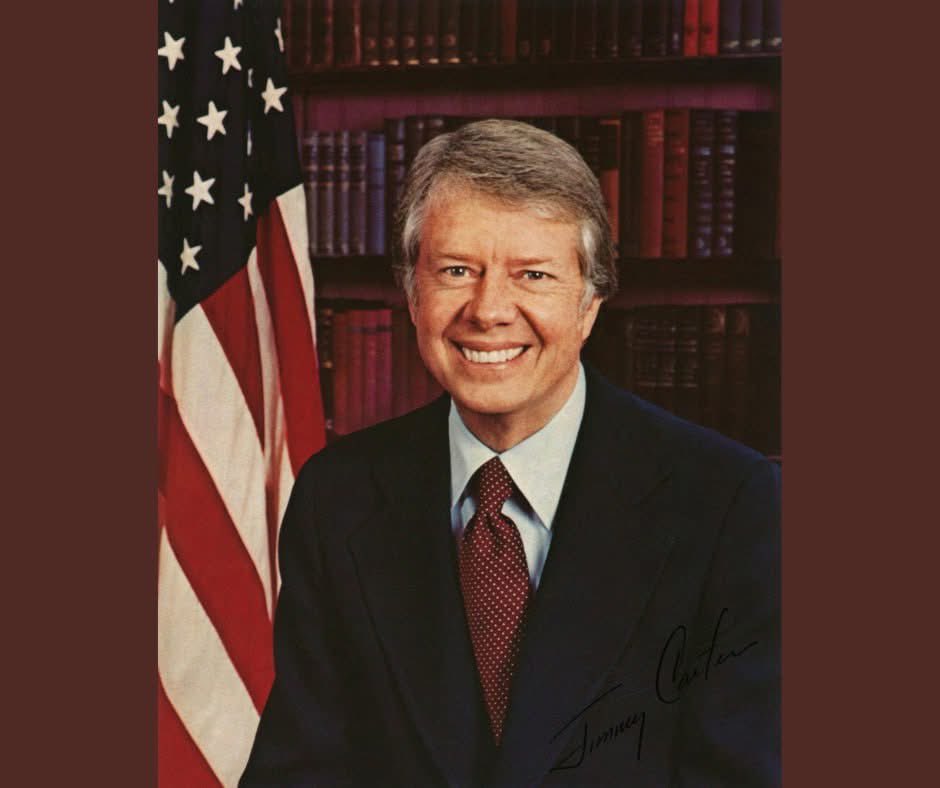
Jimmy Carter never matched America's idea of a strong president.
He carried his own bags. Wore cardigan sweaters in the Oval Office. Asked people to turn down their thermostats. He taught Sunday school and spoke, in a quiet Georgia drawl, about humility, love, and sacrifice.
Washington called him weak. Opponents called him naïve. Late-night hosts turned his decency into a joke.
But in September 1978, that same quiet man did what every powerful leader before him had failed to do.
He helped end a war that had defined a region for three decades.
Since 1948, Egypt and Israel had fought four brutal wars. Thousands were dead. Entire generations grew up knowing nothing but fear and hatred across a shared border.
Every attempt at peace collapsed under the weight of history, grief, and pride.
The conflict felt permanent.
Jimmy Carter refused to believe that.
By then, his presidency was already unraveling. Inflation crushed families. Gas lines snaked around city blocks. His approval ratings had fallen through the floor.
Advisors begged him not to gamble what little political capital he had left on an impossible dream.
Carter ignored them.
He invited Egyptian President Anwar Sadat and Israeli Prime Minister Menachem Begin to Camp David, the secluded presidential retreat in the Maryland mountains.
No press. No speeches. No escape.
Thirteen days. One mission.
He told them plainly: We stay until peace is found—or until every path has truly been exhausted.
The talks nearly collapsed immediately.
Begin was a Holocaust survivor who had lost most of his family. He believed Israel could never afford weakness again.
Sadat had led Egypt through devastating wars. He believed his people deserved an end to endless funerals.
They wouldn't sit together. They shouted through messengers. They stormed out of meetings.
Carter's own team urged him to end the summit quietly before it destroyed what remained of his presidency.
Carter refused.
Each night, he walked alone through the woods. He prayed. He wrote letters by hand. He stopped thinking like a politician trying to survive and started thinking like a human being trying to heal something broken.
On the eleventh day, Begin announced he was leaving. The talks were over.
Carter went to Begin's cabin with a small request: Would he sign a few photographs for Carter's grandchildren?
As Begin carefully wrote each child's name, Carter spoke softly. Not about politics. Not about pressure.
About legacy.
About what remains when power fades.
About the stories we tell the children who come after us.
Then Carter asked one quiet question:
"What will you tell your grandchildren about this moment?"
Begin stayed.
Two days later, on September 17, 1978, Sadat and Begin signed the Camp David Accords.
The Sinai Peninsula was returned to Egypt. Diplomatic relations were established. A framework for peace replaced decades of bloodshed.
The border violence stopped.
Sadat and Begin received the Nobel Peace Prize. Jimmy Carter did not.
Within months, his presidency collapsed under the weight of the Iran hostage crisis. Fifty-two Americans were held for 444 days.
Carter refused to sacrifice their lives for political theater or reckless force.
History would later honor that restraint—but voters did not.
In November 1980, he lost the presidency in a landslide. The hostages were released minutes after Ronald Reagan was sworn in.
The story seemed settled: Jimmy Carter, the failed president.
But Carter wasn't finished.
He returned to Plains, Georgia. To the same modest home. To teaching Sunday school.
Then he picked up a hammer and joined Habitat for Humanity—not symbolically, but physically. For decades, he built houses with his own hands, sweating under the sun, climbing ladders into his eighties and nineties.
He founded the Carter Center. Fought neglected diseases.Monitored fragile elections. Mediated conflicts others wouldn't touch.