You don’t even have to hold down button - just tap it to start and finish!
It’s not just a nice affordance of LLMs, it’s the optimal way to use them! Don’t compress or filter your raw thoughts - dump them and give the silicon brains a chance to surface insights that weren’t even on your radar
Bro it’s June 2026. Stop hand editing your prompts. Hold down the dictation button and ramble for 10 minutes. Give the model every fragment, caveat, example, and vibe in your head. It is literally a large language model. If it’s superhuman at anything, it’s reconstructing latent intent from language.
This is very true. Another source of the same psychosis is the gap between what AI can do in a prototype and what it can do in enterprise.
AI is like a smart flashlight that can work with whatever is lit up. A prototype is a new closet. Enterprise is a massive, old storage facility with decades of boxes, half mislabeled or unlabeled.
To get the flashlight to work in the new closet you just have to turn it on.
To get it to work in the old storage facility you need:
– shelves, signage, and a catalog (data infrastructure)
– boxes that say what's actually inside (clean, labeled data)
– forklifts to bring the right items into the light (retrieval, tools, skills)
– a lot of money!
It's easy to see a killer prototype and think "the flashlight lit up the whole space!" without appreciating that the whole space was a closet.
Right, add "tracking down key inventory" to the list of storage facility requirements. Even with a complete renovation, you can't shelve items that aren't in the storage facility!
(Please keep posting @levie !)
https://t.co/56Agg8oBWe
This is effectively the #1 problem for AI agents in the enterprise.
As we go from agentic coding (where a large amount of context is in the code base, and users are technical enough to get the rest to the agent easily) to a world of knowledge work agents, the context problem becomes much more acute.
We see this every day with customers at Box. For existing digital knowledge, it’s often fragmented across legacy systems or environments that don’t play nice with agents, and have access controls that don’t map to the real work that needs to be done, which become a huge hurdle for getting agents the context they need. This has to all get moved to modern, secure cloud environments.
But also, companies often haven’t captured and digitized some of the critical context that agents need to work with. Decisions, processes, and workflows often live in people’s heads and tribal knowledge that need to get turned into unstructured data for agents.
This is actually one of the biggest points of leverage for applied AI companies, because they can work to specialize in getting agents exactly the information and domain expertise they need. But it’s also one of the reasons why FDEs and new system integrator plays will also work so well right now.
The companies that figure this out will be able to get the most out of AI going forward.
This is very true. Another source of the same psychosis is the gap between what AI can do in a prototype and what it can do in enterprise.
AI is like a smart flashlight that can work with whatever is lit up. A prototype is a new closet. Enterprise is a massive, old storage facility with decades of boxes, half mislabeled or unlabeled.
To get the flashlight to work in the new closet you just have to turn it on.
To get it to work in the old storage facility you need:
– shelves, signage, and a catalog (data infrastructure)
– boxes that say what's actually inside (clean, labeled data)
– forklifts to bring the right items into the light (retrieval, tools, skills)
– a lot of money!
It's easy to see a killer prototype and think "the flashlight lit up the whole space!" without appreciating that the whole space was a closet.
CEOs are uniquely prone to AI psychosis because they’re sufficiently distant from the last mile of work that still has to happen to generate most value with AI.
So when they play with AI, they see the happy path results, often not considering the next 10 or 20 things that have to happen to get sustainable results from agents.
“Look I made this awesome product prototype”. Yes but you didn’t have to review the code before it went into production and fix a bunch of issues.
“Look I generated a contract”. Yes but you didn’t verify all the terms before it goes out to the counterparty and didn’t have to wire up all the past contracts to work with.
The best thing you can do as a CEO is to use AI a *ton* to figure out the real implications of agents in the enterprise, and come out the other side with an appreciation for both the upside and the real work that goes into them.
Organization is context engineering.
Every agentic task is like the guy from Memento (agent) waking up in the lobby of an office building (filesystem).
He has a job to do, but no lived memory of the place, and 10 minutes to piece together his reality and make progress before his memory is wiped.
If the building is organized, he spends 30 seconds reading the lobby directory, takes the elevator to the right floor, follows signs to the right wing, enters the clearly labeled room, reads the note by the door, and gets to work.
The route itself gives him context. The floor tells him the domain. The wing tells him the subdomain. The room tells him the task area. The signs on the wall tell him what is always true in this part of the building.
Almost all of his time goes to the task.
If the building is a mess, however, he may spend 3 minutes wandering through unlabeled rooms, find a few plausible documents that look like they could be right, and start working. He has less time to work before his memory is wiped, and the work is more likely to be wrong because his understanding of what’s going on is muddled by the irrelevant notes he picked up along the way.
Clean folders, clear names, source-of-truth docs, archives, and project notes are agent infrastructure. Curating an environment where the right context is easy to find, and the wrong context is clearly out of the way, is how you set agents up for success.
This is true of all agents, not just coding agents. Probably the biggest challenge that most companies run into in their agent strategy is getting agents the right constrained context to work with for a task.
Too much information or conflicting sources, and the agent can easily draw from the data and produce the wrong result. Conflicting sources of truth for documents, data sources that haven’t been kept up to date, knowledge management systems that rely on tribal knowledge to navigate, and so on.
On the other end, of course, too little information and the upside is highly limited of agents in the first place. Thus, a lot of challenges with AI strategies are actually data strategy challenges in disguise.
This is why there’s such a significant premium on getting structured and unstructured data environments setup properly so agents can work with information effectively. Critical for any large enterprise adopting agents, and also a clear benefit in some cases to startups that can be designed this way from scratch.
plaintext proliferated partly bc richer artifacts were expensive in both time and money. but thats no longer the case!
i encourage clients to replace memos, powerpoints, and pdfs with html when interactivity or visuals would improve how the work lands
HTML is the new markdown.
I've stopped writing markdown files for almost everything and switched to using Claude Code to generate HTML for me. This is why.
@thsottiaux@jxnlco Viewing sub agents is glitchy. It would be great if I could reliably monitor their creation/closing/activity via the left under their parent thread
@Dimillian More immediately, polishing subagent communication and UI would go a long way. It seems like each new recent has introduced a different bug/regression.
I'm nitpicking though - the product is truly fantastic. Great work by you and your team 🔥🙏
@Dimillian Agent Builder style GUI for workflows.
It's possible (for technical people) to cobble together the pictured process with skills and hooks, but I think that amount of friction stifles innovation at the orchestration level
You think you’re on the leading edge then a colleague tells you he’s gotten significant engineering gains from baby-talking and reading scripture to Claude Code
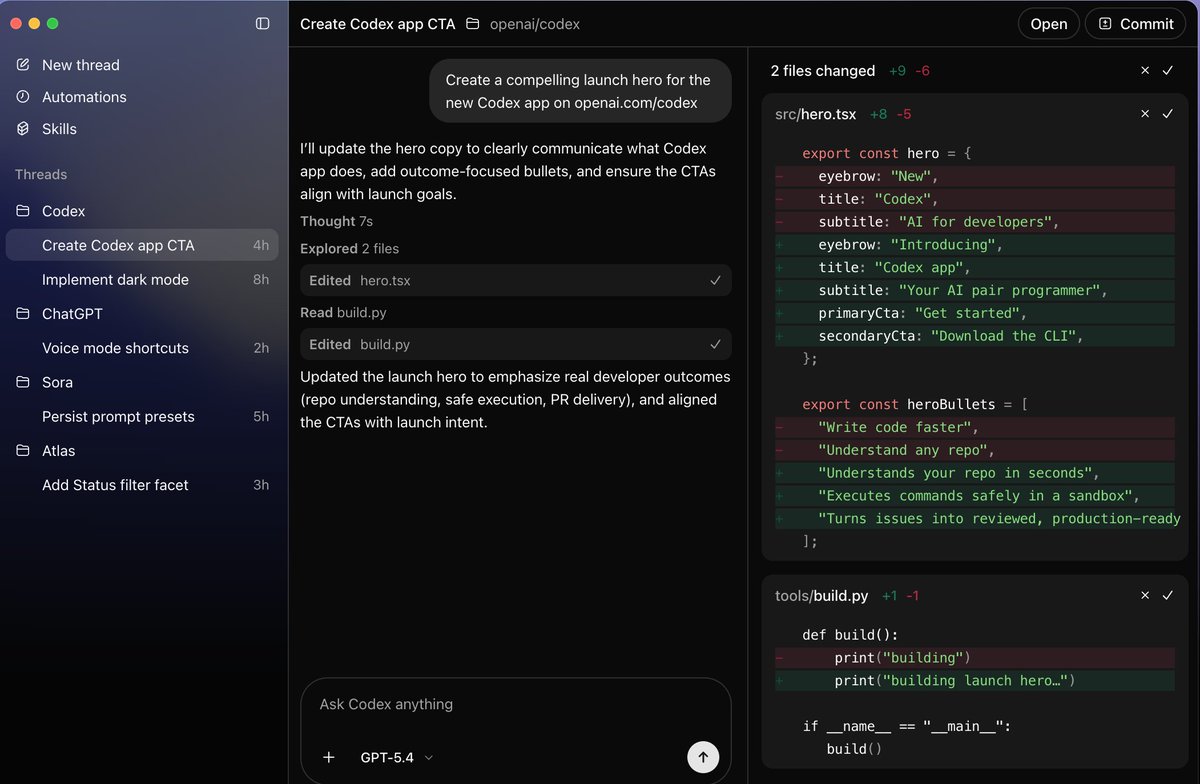
Traditional interfaces assumed one active task at a time. But as agents take on more work for longer stretches, users need a persistent place to keep multiple live contexts open and move between them while work continues in the background.
Software is converging on a new default UI for this: left rail + main canvas. I expect to see this pattern everywhere as agents come online.
Too many @GoogleChrome tabs open? Try vertical tabs, rolling out now.
Just right-click any Chrome window and select “Show Tabs Vertically” to move your tabs to the side of the browser window, making it easier to read page titles and manage tab groups.
A pattern I'm seeing:
1. AI gets good enough to saturate a medium
2. Repeated exposure makes its patterns feel normal
3. Human norms and expectations adapt to those patterns
4. The distinction erodes from both sides
You can already see this in coding, writing, and video.
As AI becomes more human-like, we become more AI-like!
This is a funny one for me bc I agree with the reflex, but I also have a lot of real-world experience suggesting spreadsheets are extremely sticky.
I spent years building bespoke finance/data analytics products. I always told my partners that I could provide the same spreadsheet experience, but MUCH richer, in a custom UI, yet I invariably ended up in the google sheets api.
I currently have a number of fund managers in my consulting caseload. I show them that building a rich, custom dashboard is ~instant and ~free, and their response is "thats great...show me how to use AI to make a spreadsheet"
I think their days are numbered, but I also think when the singularity comes a lot of people will ask to see it proven in a spreadsheet 😂
prediction re the end of spreadsheets
AI code gen means that anything that is currently modeled as a spreadsheet is better modeled in code. You get all the advantages of software - libraries, open source, AI, all the complexity and expressiveness.
think about what spreadsheets actually are: they're business logic that's trapped in a grid. Pricing models, financial forecasts, inventory trackers, marketing attribution - these are all fundamentally *programs* that we've been writing in the worst possible IDE. No version control, no testing, no modularity. Just a fragile web of cell references that breaks when someone inserts a row.
The only reason spreadsheets won is that the barrier to writing real software was too high. A finance analyst could learn =VLOOKUP in an afternoon but couldn't learn Python in a month. AI code gen flips that equation completely. Now the same analyst describes what they want in plain English, and gets a real application - with a database, a UI, error handling, the works. The marginal effort to go from "spreadsheet" to "software" just collapsed to near zero.
this is a massive unlock. There are ~1 billion spreadsheet users worldwide. Most of them are building janky software without realizing it. When even 10% of those use cases migrate to actual code, you get an explosion of new micro-applications that look nothing like traditional software. Internal tools that used to live in a shared Google Sheet now become real products. The "shadow IT" spreadsheet that runs half the company's operations finally gets proper infrastructure.
The interesting second-order effect: the spreadsheet was the great equalizer that let non-technical people build things. AI code gen is the *next* great equalizer, but the ceiling is 100x higher. We're about to see what happens when a billion knowledge workers can build real software.
Software isn’t merely technical work anymore. It’s creative.
Introducing Replit Agent 4. The first AI built for creative collaboration between humans and agents.
Design on an infinite canvas, work with your team, run parallel agents, and ship working apps, sites, slides & more.
Nice run from @OpenAI lately. Outside of deep research, their products hadn’t been in any of my workflows since Opus 4 dropped last May, but the Codex app, GPT-5.2 Codex, and GPT-5.4 have all been strong releases. Props to the team! 👏
AI is so deeply embedded in my work that colleagues and I frame messages to each other with the expectation that they will be forwarded to an agent. Human to human messages are for
1) ideation
2) synchronization
3) feedback/approval
4) help with what to ask AI
5) fun
@jeremyausmus I spent years in therapy relearning to be in touch with my emotions. I suspect a healthy relationship with them is better for performance than being disconnected from them