@rape_313@Ze_Chart "IRGC thugs can't lay a finger on a single IDF soldier"
Trans people and Shias are weak, but they love shooting and killing children, you understand? This is also Khamenei’s grandchild and the Shia children who were killed vro
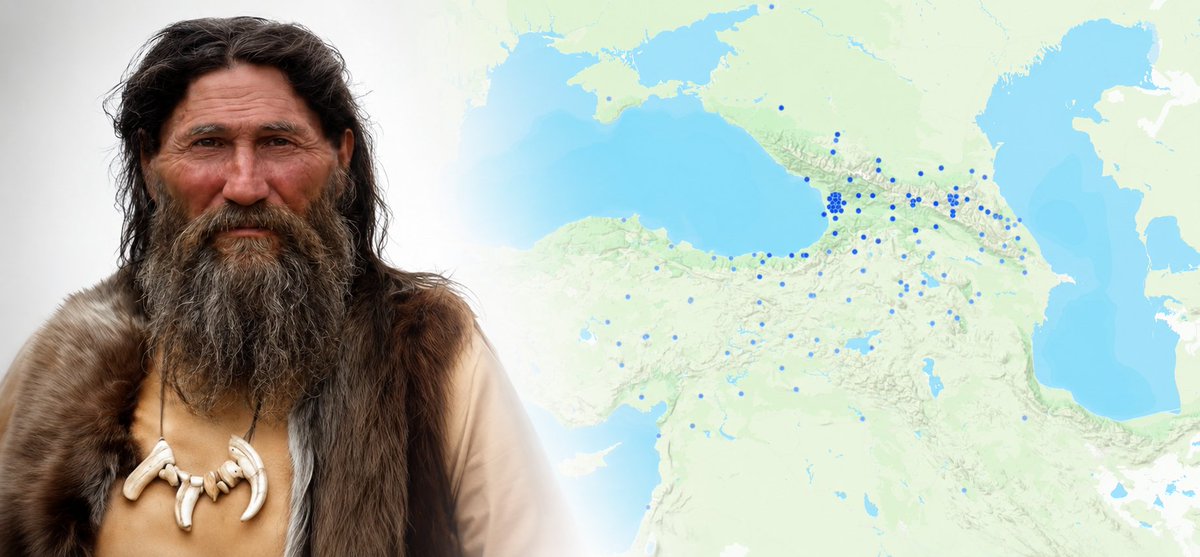
Who were the Caucasus Hunter-Gatherers — and which modern populations have the most CHG ancestry?
Caucasus Hunter-Gatherers (CHG) were one of the major ancestral populations of prehistoric West Eurasia. They are represented by three males from western Georgia: Satsurblia (~11,300 BCE), KK1 from Kotias Klde (~7,700 BCE), and the later-published NEO281, also from Kotias Klde (Jones et al. 2015; Allentoft et al. 2024).
Their Y-DNA lineages were remarkably diverse: Satsurblia belonged to J1-FT34521, KK1 to J2a-Y12379, and NEO281 to basal J2b-Z533. J2a-Y12379 is an important and widespread lineage in the modern Caucasus, and various of its subclades are present among Georgians, Circassians, Ossetians and Nakhs.
CHG were closely related to prehistoric populations of the Iranian plateau. One recent model estimates them as roughly 72% Western Asia_UP + 18% earlier Caucasus_UP (Dzudzuana cave) + 10% ANE-related ancestry (Allentoft et al. 2024).
This also means CHG were not simply descendants of the earlier people of western Georgia. Before them lived the Dzudzuana/Caucasus_UP population, genetically closer to the ancestry later found among Anatolian hunter-gatherers. Dzudzuana Cave also produced dyed and twisted flax fibres ~30,000 years old - some of the earliest evidence for sophisticated fibre technology (Kvavadze et al. 2009).
CHG-related populations later expanded northward and mixed extensively with Eastern European hunter-gatherers. Recent work identifies a Caucasus–Lower Volga (CLV) cline, whose populations contributed heavily to the ancestry that eventually produced Western Steppe Herders and Proto-Indo-Europeans (Lazaridis et al. 2025).
And where is CHG ancestry highest today?
Exactly where you might expect: the Caucasus itself.
Western Georgian groups such as Megrelians, Imeretians and Svans, together with Abkhazians and other Caucasus populations, show some of the strongest CHG affinity in modern populations (Gavashelishvili et al. 2021). Exact percentages vary by model, but in distal models some Caucasian groups can approach or exceed ~60% CHG-related ancestry.
More than 13,000 years after the Satsurblia man lived, the strongest genetic legacy of CHG is still found only a short distance from the caves where their remains were discovered.