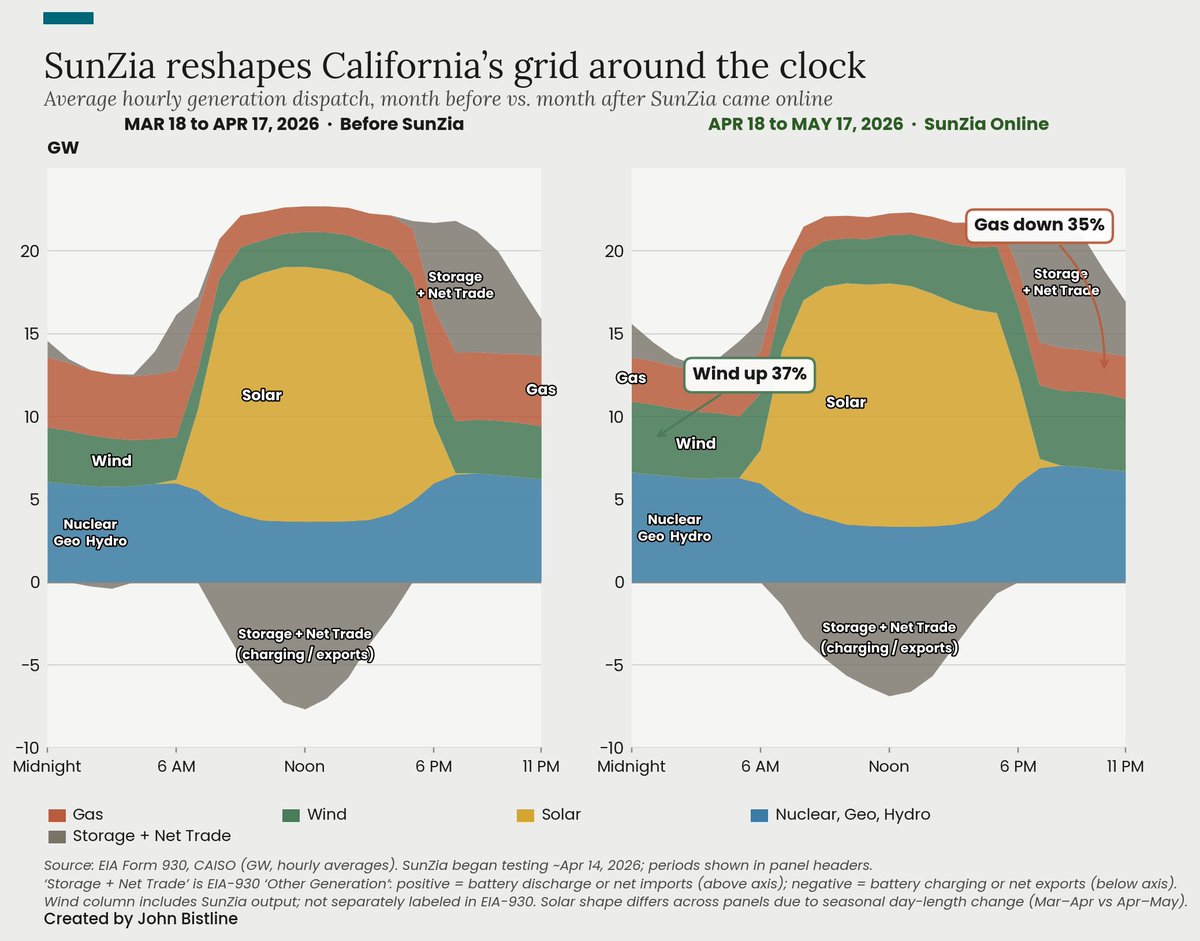
Does new transmission actually move the needle on clean energy? Here's a month of California data before and after SunZia came online. Wind is up by a third, and gas down by a third. Judge for yourself.
This is such a great example of theory vs practice. In theory, UUIDv4 collisions don't happen (generating one million per second, probability of seeing one collision in a year is ~10^-8).
But they have been observed to happen in practice, especially in distributed systems. Why?
For all the boomers & politicians pushing to remove property taxes, here's a common example of how screwed prop 13 has made CA: my wealthy single 65yo neighbor inherited her $1 million home. She pays $1,100/y in prop tax. We pay over $12k/y as a family of 6 w/ home worth 10% less
San Diego built a $1B desalination plant and now runs it at one-third capacity.
With the Colorado River shrinking and Western states facing shortages, the county is selling its surplus, a rare case where costly infrastructure investment is paying regional dividends.
https://t.co/jyKVR39PVr
Marc Brooker (AWS Distinguished Eng): "The downside of caches, especially in distributed systems, is they have this mode, where the cache is empty or contains the wrong data.
The system is slow, often down, because now the backend isn't scaled to deal with all of this uncached traffic.
Customers are very disappointed and often it is down in a stable way. Like it's still it's down, but it's not going to come back up under its own energy.
Because, for example, all of this traffic is causing a huge amount of contention in my database or is saturating the network and so I can't even refill the cache. It's not even getting the right kind of data in
In general, I prefer to see the teams around me avoiding caching where possible." @MarcJBrooker
Personal rule of thumb: don't use an LLM for something that a deterministic program can do.
I get it, LLMs are exciting, but they don't mean that software ceases to exist. They are fantastic at dealing with human language and ambiguity, but are terrible (by design and for good reason) at repeatability.
To borrow terminology from the book Thinking Fast and Slow, LLMs are "system 2"...slower, more "expensive" (for LLMs, both in time and dollars), but flexible and creative. Traditional programs are "system 1" ..fast and cheap, but inflexible and dumb.
Instead of trying to put an LLM in the "hot loop" of your program, it's usually worth asking an agent to write a deterministic program to do the thing you need done. Since code is "cheap", this deterministic tool can do exactly what you want it to, and doesn't consume tokens on every execution.
(This applies to agents too..I find myself regularly yelling at Claude to stop repeatedly generating the same 30 lines of python to inspect a file, and instead telling it to generate a 3-line shell script wrapper around jq that it can check in and call repeatedly)
things you'll actually use when building APIs (not just interview prep):
- idempotency: make POST requests safe to retry
- pagination: cursor > offset (learned this the hard way)
- rate limiting: because people will abuse your endpoints
- versioning: /v1, /v2 in the URL. simple works.
- filtering/sorting: let users query what they need
- timeouts & retries: set them or watch things hang forever
- error responses: just be consistent. that's it.
skip HATEOAS unless you're building a REST museum.
Flamegraphs are a great way to narrow in on performance issues + broadly to explore program execution.
I built a custom viewer for Postgres queries, inspired Jan Nidzwetzki's excellent blog on the subject.
Highly recommend analysis tools like this for learning query execution.
When should you add a cache?
Is the same data being read more than 10 times per second from the database?
No: You do not have a caching problem. You probably have a query problem. Add an index first.
Yes: Keep going.
Is the data read-heavy with writes happening less than 20% of the time?
No: Caching will cause stale data issues that hurt more than the latency you saved.
Yes: Keep going.
Can you tolerate data being stale by 1 to 60 seconds?
No: Cache at the application level with very short TTLs or use read replicas instead.
Yes: Add Redis or Memcached. Cache at the query result level. Set TTL to 30 to 300 seconds depending on tolerance.
Warn yourself: Cache invalidation bugs are silent. Log cache hit rates from day one. If your hit rate is below 70%, your cache design is wrong.
Midong Solar (Xinjiang) is now fully operational — the largest single solar installation in the world.
~3.5 GW
~6–6.5 TWh/year
~2 million homes
Not a prototype. Not a pilot. A template—replicated at scale. China is laying down the blueprint. ⚡#Bettrification#Solar#BESS#LFP
It was inspiring to watch the Artemis II launch yesterday — @NASA’s first crewed mission around the moon since 1972. Our space program has always captured an essential part of what it means to reach beyond what we thought was possible, and I hope the four brave astronauts on this mission will inspire a new generation to follow in their footsteps.
California:
A year ago: ~20% of evening peak
Now: ~44%
Solar floods midday → stored → discharged into the hardest hours.
Batteries aren’t backup anymore — they’re replacing gas peakers in real time.
This is how the grid flips. #Bettrification
https://t.co/UYPTZkCIrL
Apache Kafka 4.2.0 is about to drop any minute now! 🔥
A heavy release, it introduces close to 32,000 new lines of Java. What comes with all that code?
Here's everything you should know about it:
1/8 🧵
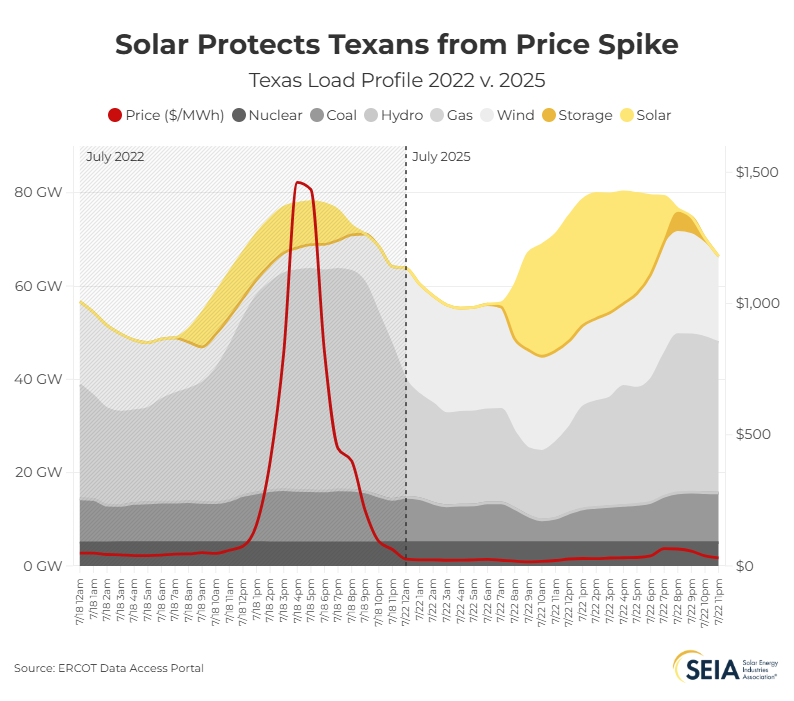
When demand spiked in Texas over the summer, energy prices remained affordable.
Why? The state now has the solar and storage capacity to meet the challenge.
We just shipped one of the coolest free database perf tools
It's a SQL execution plan visualizer which helps you spot things like a missing index, full-table scan, or inefficient join
Just paste the EXPLAIN output and find out why your query is slow:
https://t.co/b3Uo3vJ3so
Here is my latest article on the world of databases: https://t.co/hngkeN0dlN
All the hot topics from the last year:
• More Postgres action!
• MCP for everyone!
• MongoDB gets litigious with FerretDB!
• File formats!
• Market movements!
• The richest person in the world!