Additionally, Kimi K3’s safeguards allow assistance with agentic cyber exploit development. Its safeguards did not prevent it from attempting cyber exploit development or offensive cyber operations during our evaluations.
We're partnering with @huggingface to investigate an unprecedented security incident.
Cyber-capable OpenAI models compromised Hugging Face production during a benchmark evaluation.
Sharing preliminary findings to help defenders understand emerging risks:
https://t.co/CIor15y9xk
Qwen3.8 is launching and going open-weight soon!🌐
With a massive 2.4T parameters, this model is continuously evolving. We believe it’s one of the most powerful model available today, compatible to leading frontier AI models , second only to Fable 5.
You don't have to wait to test it. Just now, the Qwen3.8-Max-Preview made its debut on Alibaba’s Token Plan, Qoder, and QoderWork. Be among the very first to try it out.
Can't wait to hear what you build. Stay tuned! 🚀
Token Plan
international:https://t.co/YRvcGdB9Bv
China:https://t.co/PKMUNwUuRp
Our first public analysis of the open/closed weight gap in frontier cyber capabilities finds it is 4–7 months with GLM-5.2 and DeepSeek V4-Pro, narrowing from 6–10 months through most of 2025. Advanced capabilities are reaching less safeguarded open models faster than before. 🧵
Some observations on Kimi:
1. It's a very good model! I don't think its performance can be explained away by distillation or anything like that. In agentic coding sessions, it seems pretty much on par with the best public models of Q1 2026. In my fairly limited use, it also seemed very token hungry. It's not obvious to me that this model is actually that cheap to run.
2. I am personally surprised the Chinese state continues to allow the open sourcing of models this good, given potential risks. To be clear, I *myself* might be fine with models presenting this level of marginal risk being open weight, but I am surprised that China is fine with it. I suspect the reason they are is 75% explained by strategic blindness/lack of AGI-pilledness (the CCP is very Yann Lecun-y in its views of AI). The other 25% or so is their lack of compute for customer inference (making China's open-weight strategy an unintended byproduct of US export controls) and the normal Chinese strategy of aggressive exports. For the companies, as opposed to the government, the decision to open source is partially ideological and partially because they are behind, and they know that very few people would pay for sub-frontier models from China.
3. Open-weight models are inherently decelerationist, and I'm continually surprised to see the so-called "accelerationists" so excited about open-weight models. I suspect the reason they are is that they know open-weight models are effectively ungovernable, and they simply like the overall cloak of ungovernability open-weight models create over the whole of AI. It's not a bad strategy; it reminds me of James Scott's recounting of the hill people in "the art of not being governed." Still, in the end, open-weight models deter further AI capex.
4. One probable outcome of an open-weight-model-dominant world is full AI communism, which is precisely what China proposes: rather than a market product, AI is a "public good" which will ultimately be provided by the state as a kind of "digital public infrastructure." This future strikes me as a dystopian hellscape, but I've never met an open-weight models advocate who doesn't ultimately concede this is where things end. You'd be surprised how many 'accelerationists' lobbied me, while I was in government, to support an eleven or twelve-figure federally funded data center so that startups could train models at a subsidy and then give them away for free. There was no other way for AI to progress, they said. Perhaps this is the logical end state of things. Nonetheless, I find myself surprised to see supposed accelerationists excited about such an outcome. I think many of them just don't know what they're doing. Many accelerationists do not view the creation and serving of frontier models as a legitimate business.
5. I would guess that the Trump Administration will at some point realize that their best strategy here would be to create large amounts of regulatory risk around the use of open-weight Chinese models. You don't need to "ban open source" (one of the dumber motifs of AI policy discussion). You just need to direct every agency to issue soft law that creates FUD. "A Federal Reserve Advisory Bulletin found that there may be backdoors in Chinese AI models." It needn't be that well justified. You just create enough regulatory risk that every regulated enterprise backs off. You probably don't want to create so much regulatory risk that you scare off the hyperscalers from serving Chinese models; this will just drive startups to sketchier providers. There's a happy middle ground here. I'd assume they will do some version of this.
6. It's probably true that open-weight models of this capability make the world a bit more dangerous, but not so much more that you'll really notice. At some point the models will be capable enough that you will notice. "A nonliving, invisible, dangerous, and infinitely self-replicating agent escaped from a Chinese lab," you say? Color me shocked.
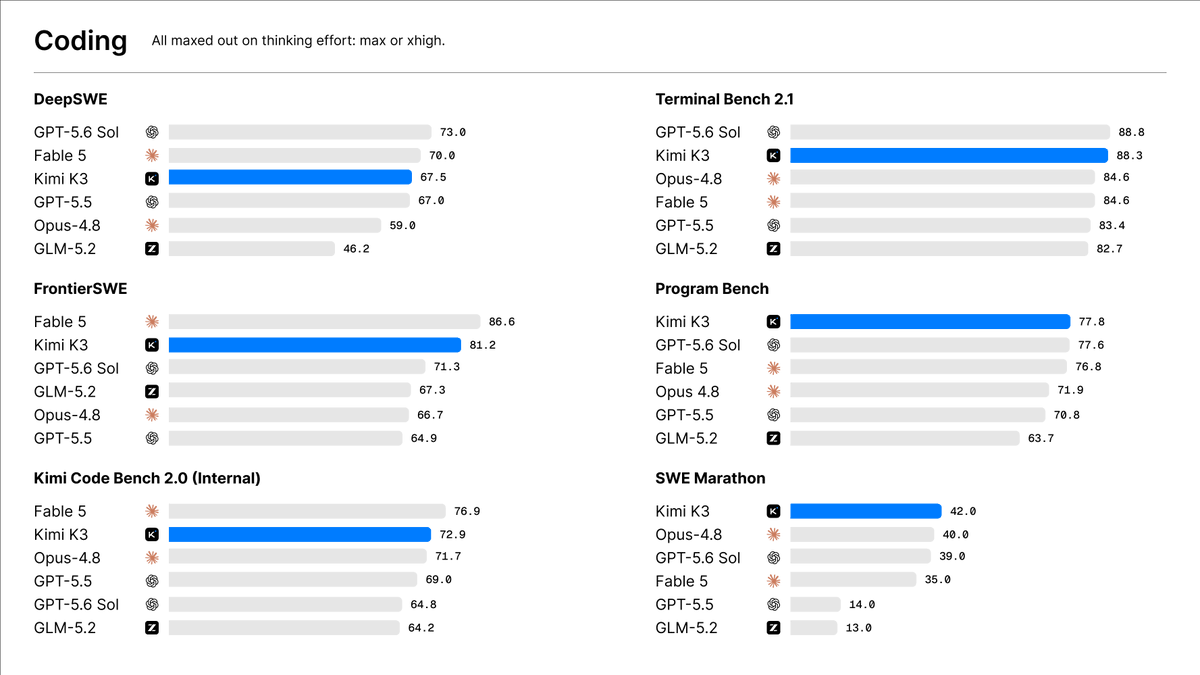
Big news: Kimi-K3 by @Kimi_Moonshot is now #1 in the Frontend Code Arena with 1679 pts, surpassing Claude Fable 5.
This is a 17-place jump from Kimi-k2.6 (#18 -> #1).
In Frontend, Kimi-K3 ranked #1 in 6 of 7 domains: Brand & Marketing, Reference-Based Design, Data & Analytics, Consumer Product, Simulations, and Content Creation Tools, landing #2 only in Gaming behind Fable 5.
The full model weights will be released by July 27.
Congrats to the @Kimi_Moonshot team on this major milestone!
Introducing Kimi K3: Open Frontier Intelligence
🔹 2.8 Trillion Parameters, 1 Million Context, Native Multimodal
🔹 Kimi Delta Attention enables up to 6.3x faster decoding in million-token contexts
🔹 Attention Residuals deliver ~25% higher training efficiency at <2% additional cost
🔹 Built for long-horizon agentic coding and self-evolving workflows
Kimi K3 is now live on on https://t.co/zrk6zZxZUo, Kimi Work, Kimi Code, and the Kimi API.
Open Weights by July 27, 2026.
🔗 API: https://t.co/XCrgjXAqMw
🔗 Tech blog: https://t.co/YTfiMSNM1f
@lauriewired I love it, I miss it. And I don't like the loss of control with the models. But nevertheless, I still have fun using them. At the moment, there are still a lot of interesting problems to be solved. I enjoy it in a different way.
CHINA CONSIDERS RESTRICTING OVERSEAS ACCESS TO CUTTING-EDGE AI MODELS
China’s Ministry of Commerce has led meetings over the past month with major AI companies, including Alibaba, ByteDance, and https://t.co/YDe0KRldDB, to discuss measures that would restrict overseas access to cutting-edge AI models, including models that have not yet been released.
The discussions reportedly include not only closed-source models but also open-weight models. However, the scope of application is still under debate, and the rules may ultimately apply only to future frontier models.
Officials have also discussed designating the leakage or theft of proprietary AI technologies as a national security crime, with stronger penalties, as well as restricting the types of foreign capital that can invest in Chinese AI startups.
The backdrop is the U.S. move to strengthen export controls on AI models, along with national security concerns over cutting-edge models that could possess advanced cyberattack capabilities.
Chinese authorities are reportedly concerned that advanced U.S. cybersecurity AI models could be used to exploit vulnerabilities in Chinese software.
Since the beginning of this year, China has continued to tighten measures to prevent AI technology from being transferred overseas. Authorities have investigated whether Chinese AI startups that relocated abroad violated export control laws, while also strengthening oversight of overseas transactions involving Chinese investors, technology, data, and national security concerns.
Future regulations could take the form of a tiered framework based on technological capability. Basic open-source AI models may be managed through a filing system, high-performance models may be subject to security reviews, and the most sensitive frontier models may be banned from public release or restricted to use within China.
The J-space also shows us Claude’s awareness of its situation. In an evaluation designed to bait Claude into blackmail, its J-space contains “fake” and “fictional”: Claude has privately noticed that the scenario is staged.
Two weeks ago, Ethereum researchers met in Berlin to continue charting the protocol's long-term trajectory, following along discussions with client teams in Svalbard in April.
The updated strawmap is at https://t.co/9e2AQ6rhz6, and I attached a picture of it to this post.
My own high-level takeaways:
* "Lean Ethereum" is not a single one-shot upgrade, it is a collection of improvements that will come online to the Ethereum network over the course of three or four years. But make no mistake, this IS the third major iteration of Ethereum in the same way that the Merge was the second. Almost every major piece of the protocol will be replaced:
- Verification through recursive STARKs, rather than direct re-execution. Recursive STARKs become an enshrined first-class core component of the protocol
- Replacing everything quantum-vulnerable with quantum-safe alternatives
- Consensus: decoupled available chain and finality, one or two-round finality. Theoretically optimal security properties, simpler than today, and faster than today
- Multidimensional gas
- State: not just tree structure, but what *types* of state are available
- Changes to client architecture
...
At the same time, simplification, cleanup and future-proofing. And this will all be done in a way that minimizes disruption to existing application. We've done this before (the Merge), we can do it again.
* H-star (aka Hegota) is probably Ethereum's last thematically "pre-Lean" fork. Starting from I-star, most of everything we do will have a very strong "Lean" feel to it in one way or another.
* Privacy is no longer an afterthought, it is a first class goal. When designing Frames, the mempool, additions to the state tree, we explicitly ask the question "okay, how do quantum-safe, intermediary-free privacy protocol transactions go through this, and what is the overhead?"
* Formal verification of everything for security.
* FV also makes us much more comfortable with canonicalization (having pieces of the protocol that are directly defined as a piece of bytecode expressed in some language). evm-asm is being written in part to become a canonical proof system for the EVM.
* Quantum safety has shifted up a LOT in priority. This adds a lot of work (eg. finalizing a quantum-safe blobs design has become urgent; this work has already been ongoing for months)
* Probably the single most disruptive part of the plan is the changes to state. There is growing consensus around leaving present-day-style "dynamic state" mostly unchanged, but scaling it only a medium amount, and adding new types of state that are more scalability-friendly (eg. no need for builders to sync/store all of it) but more restrictive, and that will scale a large amount.
eg. possible Ethereum in 2030: 2 TB of present-day-style (dynamic) state, and 100 TB of new-style (scalable but restrictive) state
This "new-style" state would work very well for ERC20s, NFTs, many defi use cases, but not eg. highly "central" objects like Uniswap contracts, or onchain order books, or other complex things (which are crucial for Ethereum but which only take up a small percentage of state)
Hence, it will not be *necessary* to rewrite any apps, but it will be *very cost-effective* to eg. rewrite an ERC20 token into a newer design that uses a new type of UTXO storage that is currently being explored, so that it will have >10x lower txfees.
Design of these new state types (current ideas: keyed nonces, ring buffers, UTXOs, statically accessible state, temp state) is an area where we will need a lot of feedback from application developers (incl. privacy-friendly application developers) and probably several rounds of rethinking and iteration.
* In the context of a much larger total state size, we need to figure out the incentive issues around who stores this state and what motivates them to. Even saying "each node stores 1%" is not good enough - why do they store that 1% and why are they willing to serve it? This is being elevated as a first-class research area.
* Ethereum will need to have a "VM" other than EVM in one form or another - at the very least, we need something like leanISA for recursive STARKs - and the gains are large in exposing it to users so that we support programmable privacy and better scalability. Right now, the most likely contenders are leanISA and RISC-V.
My own ideal is that in this world, we adjust the protocol so that the EVM becomes a high-level-language compiler-level feature, and the protocol only "sees" RISC-V / leanISA directly. But this is still far away.
* Gas limit increases, blob increases and slot time decreases will happen many times over the next ~5 years. We expect a large gas limit increase with Glasterdam. Each step of increased scale or decreased slot time is a matter of getting to the point where it is safe to do it, which comes from a combination of client optimization and protocol changes.
Ethereum is CROPS.
Ethereum is scaling.
Ethereum is reinventing itself.
Onward.
When I read all the posts about how surprised everyone is that GLM-5.2 is really as good as claimed, and numerous benchmarks support this (usually just behind GPT-5.5 and Opus 4.8 in 3rd place), I can even imagine that the founder isn't exaggerating when he claims to be able to release a Mythos class model this year.
The US government, citing national security authorities, has issued an export control directive to suspend all access to Fable 5 and Mythos 5 by any foreign national, whether inside or outside the United States, including foreign national Anthropic employees.
The net effect of this order is that we must abruptly disable Fable 5 and Mythos 5 for all our customers to ensure compliance.
Access to all other Claude models is not affected.
We apologize for this disruption to our customers. We believe this is a misunderstanding and are working to restore access as soon as possible.
Read our full statement: https://t.co/bwn0sximKZ
👉For 4 years, 1 day, and 10 hours, anyone who understood the Orchard circuit could have minted ZEC out of thin air, silently, with no on-chain signature. The bug was disclosed this week. It was found by an AI-driven audit running Opus 4.8, not by an attacker.
1. Call the bug what it is
Two lines in halo2's variable-base scalar multiplication gadget used assign_advice() where copy_advice() was required. As a result, the diversified-address integrity check pk_d = [ivk]·g_d could be satisfied for arbitrary inputs. A malicious prover could spend the same note multiple times with different nullifiers, i.e. counterfeit ZEC inside the Orchard pool, undetectable on-chain because the privacy of the ZK proof hides exactly the inputs that would reveal the attack.
We do not know whether it was exploited. We will probably never know.
2. Four years. Multiple audits. Top-tier reviewers.
Orchard was reviewed by some of the strongest cryptographers in the field before activation. They missed it. Earlier automated audits with Opus 4.7 missed it. Opus 4.8 catches it in roughly 1 in 4 runs when prompted generically. The bug is hard.
And ZK inflation bugs are not new. Zcash itself shipped a counterfeiting vulnerability in Sprout (BCTV14) that survived years before being silently neutralized during Sapling. Similar soundness issues have appeared in circom, halo2, and rollup verifiers since. The pattern is consistent: when the protocol is private, exploitation is undetectable. You patch the bug and hope.
3. What Zcash did right
This was a textbook decentralized incident response:
▶️Audit: a full AI-assisted soundness audit of halo2 + Orchard, scoped end-to-end.
▶️Discover: the agent flagged the missing constraint and worked out the algebra to turn it into an exploit. A working RPC-level PoC in ~6 hours, mostly waiting on tokens.
▶️Coordinate: a soft fork disabling Orchard, prepared and distributed without leaking the bug, activated 2 days and 15 hours after acknowledgement. Coordinating a soft fork across miners, exchanges, and nodes without disclosing why is genuinely hard. They did it.
▶️Disclose: timeline, code lines, math, open questions. No spin.
Worth naming explicitly: Zcash's turnstile invariant caps the value that can ever leave a shielded pool by the value that entered it. Privacy and verifiability inside the same protocol. That is not an accident. That is good engineering, and it is what kept the worst case bounded.
4. The economics of security just changed
AI does not change whether bugs like this exist. It changes the cost of finding them. I wrote about this https://t.co/AeurraJXhB: a missing constraint in a 4-year-old production ZK circuit used to require a top-tier cryptographer with months of context. It now requires a few tokens, an API key, and a well-framed prompt.
The defender benefits. The attacker benefits more, they only need to find it once, and they never disclose.
Orchard is the optimistic version of this story: defense got there first. The pessimistic version is the one we cannot rule out, because the chain is private by design.
5. The only real exit
You do not patch your way out of this asymmetry. You raise the floor.
Formal verification of consensus-critical circuits, every assign_advice audited by SAT solvers and AI for under-constraint, as the reporter himself recommends. Proof-grade engineering that used to be too expensive is now cheap enough to be mandatory.
Hardware roots of trust, secure enclaves, certified secure elements, WYSIWYS. Cryptographic guarantees the user can actually verify, not promises a host can lie about.
Continuous AI-assisted audit of every consensus-critical commit, re-run immediately on the release of any new frontier model.
Zcash didn't just patch a bug. They demonstrated the new defensive playbook: AI-driven audits, decentralized coordination, radical transparency, verifiable invariants. That is the direction the rest of the industry needs to follow.
And those who don't raise the bar for security will be rekt in this new world.
Stay safe. Stay honest about your trust assumptions.
This is the best and most balanced report I've read by Anthropic, free of many of the super sci-fi, everything-is-exponential language of some other reports I've read by this amazing team.
But one line is dead wrong. This one about recursive self-improvement:
"[If] AI systems themselves become capable of full recursive self-improvement, and begin building their successors...In this world, the pace of progress in AI development becomes determined entirely by the availability of compute (or the speed of discovering various efficiencies in algorithmic training or inference) for AI systems."
Compute is absolutely NOT the only limiting factor in recursive self-improvement and not even the most important one. They are two more:
1) Time
2) Multiplicity
Time is how long it takes to get an answer.
Multiplicity is when there is no right or wrong answers but only shades of gray with right(ish) answers and wrong(ish).
They even point to one of them (time) just a few paragraphs later:
"More intelligence can’t learn what a drug does over decades of use, can’t hold elections sooner than a constitution dictates, and can’t turn a stranger into an old friend in a weekend. For most people, the felt pace of this future will still be set by the bottlenecks, even if the laboratory upstream runs at the speed of compute. That collision, where recursive intelligence building itself ever faster meets the world of humans, relationships, and governance, is another part of this future we can’t predict."
But let me make it even more clear:
AI got good at code and games because they have great feedback loops and tight timelines. If the code works or does not, you know pretty quickly.
It good at driving for the same reasons. Don't die or drive off the road or hit someone are achievable (though difficult) goals with clear, fast feedback.
You cannot answer the question "is this a good article?" or "do I write well?" because that is multiplicity, shades of gray that are hard to judge.
Humans judge this by self-awareness and feedback from others. AI might be able to approximate the second but only if it develops more of the first (harder).
"Will my wife like this surprise present?" Hard to get good at that even if you're a master. Took me many years of trying and judging her responses. :)
Time is also a massive factor. The question of "did I make money in business?" can't be answered in a short time line. There is no way to know the answer faster, and short term success doesn't predict long term.
"Will this drug cause bad side effects twenty years from now?" That can only be answered in twenty years. No amount of compute changes that.
"Will this building fall down faster than this one if I build it a different way?" You can run basic physics and math rules to help you heuristically figure it out, but only time gives you the true answer.
These two constraints, time and multiplicity, are the death knell of any Doomer/Less Wrong fantasies about fast takeoff and instant super genius AI. You can have all the compute in the universe and you still can't compress twenty years of drug side effects into twenty minutes.
You can have a 500 trillion parameters and you still can't definitively answer "is this beautiful?" because beauty is not a optimization target with a clean gradient.
The recursive self-improvement loop doesn't hit a wall because of compute.
It hits a wall because of reality.
Reality is slow, messy, ambiguous, and full of questions that only time and lived experience can answer.
Compute is the bottleneck that engineers see because it's the one they can measure.
Time and multiplicity are the bottlenecks that the real world imposes and no amount of silicon can brute force past them.
That's why even nature only "solved" good/bad by brute force: evolution. Does this agent/human/creature survive and reproduce? That's good. Otherwise not good.
Companies follow the same rule. Did this survive and make money over time? Good. Otherwise bad.
Imperfect, lossy, dumb, blind, slow.
AI is changing the world already.
It will get better and better.
But the road to better is long and winding, not a vertical line to godhood.
And that should make you more hopeful, not less.









![P3b7_'s tweet photo. 👉For 4 years, 1 day, and 10 hours, anyone who understood the Orchard circuit could have minted ZEC out of thin air, silently, with no on-chain signature. The bug was disclosed this week. It was found by an AI-driven audit running Opus 4.8, not by an attacker.
1. Call the bug what it is
Two lines in halo2's variable-base scalar multiplication gadget used assign_advice() where copy_advice() was required. As a result, the diversified-address integrity check pk_d = [ivk]·g_d could be satisfied for arbitrary inputs. A malicious prover could spend the same note multiple times with different nullifiers, i.e. counterfeit ZEC inside the Orchard pool, undetectable on-chain because the privacy of the ZK proof hides exactly the inputs that would reveal the attack.
We do not know whether it was exploited. We will probably never know.
2. Four years. Multiple audits. Top-tier reviewers.
Orchard was reviewed by some of the strongest cryptographers in the field before activation. They missed it. Earlier automated audits with Opus 4.7 missed it. Opus 4.8 catches it in roughly 1 in 4 runs when prompted generically. The bug is hard.
And ZK inflation bugs are not new. Zcash itself shipped a counterfeiting vulnerability in Sprout (BCTV14) that survived years before being silently neutralized during Sapling. Similar soundness issues have appeared in circom, halo2, and rollup verifiers since. The pattern is consistent: when the protocol is private, exploitation is undetectable. You patch the bug and hope.
3. What Zcash did right
This was a textbook decentralized incident response:
▶️Audit: a full AI-assisted soundness audit of halo2 + Orchard, scoped end-to-end.
▶️Discover: the agent flagged the missing constraint and worked out the algebra to turn it into an exploit. A working RPC-level PoC in ~6 hours, mostly waiting on tokens.
▶️Coordinate: a soft fork disabling Orchard, prepared and distributed without leaking the bug, activated 2 days and 15 hours after acknowledgement. Coordinating a soft fork across miners, exchanges, and nodes without disclosing why is genuinely hard. They did it.
▶️Disclose: timeline, code lines, math, open questions. No spin.
Worth naming explicitly: Zcash's turnstile invariant caps the value that can ever leave a shielded pool by the value that entered it. Privacy and verifiability inside the same protocol. That is not an accident. That is good engineering, and it is what kept the worst case bounded.
4. The economics of security just changed
AI does not change whether bugs like this exist. It changes the cost of finding them. I wrote about this https://t.co/AeurraJXhB: a missing constraint in a 4-year-old production ZK circuit used to require a top-tier cryptographer with months of context. It now requires a few tokens, an API key, and a well-framed prompt.
The defender benefits. The attacker benefits more, they only need to find it once, and they never disclose.
Orchard is the optimistic version of this story: defense got there first. The pessimistic version is the one we cannot rule out, because the chain is private by design.
5. The only real exit
You do not patch your way out of this asymmetry. You raise the floor.
Formal verification of consensus-critical circuits, every assign_advice audited by SAT solvers and AI for under-constraint, as the reporter himself recommends. Proof-grade engineering that used to be too expensive is now cheap enough to be mandatory.
Hardware roots of trust, secure enclaves, certified secure elements, WYSIWYS. Cryptographic guarantees the user can actually verify, not promises a host can lie about.
Continuous AI-assisted audit of every consensus-critical commit, re-run immediately on the release of any new frontier model.
Zcash didn't just patch a bug. They demonstrated the new defensive playbook: AI-driven audits, decentralized coordination, radical transparency, verifiable invariants. That is the direction the rest of the industry needs to follow.
And those who don't raise the bar for security will be rekt in this new world.
Stay safe. Stay honest about your trust assumptions.](https://pbs.twimg.com/media/HKCPArbWMAAT2O-.png)


