Ben Horowitz: “Do not expect life to be fair. It will only defeat you.”
The Andreessen Horowitz co-founder is asked for advice that he has found useful in his own life. Ben responds:
“The thing that I would say has had the biggest effect on me is something my father said to me years ago: ‘Life isn’t fair.’ That advice seems really simple, but the thing I’ve seen that defeats people more than any other thing in life is the expectation of some fairness.”
He continues:
“There are all kinds of things that are going to happen to you that don’t happen to other people and are completely unfair. But it doesn’t matter because that’s the way it is. And as soon as you can get that idea out of your mind [that life should be fair], you can just deal with it… ‘What should I do now?’ is the real question — not ‘How do I go back and get people to be fair?’… Life’s not fair. That’s the nature of it. If you think about it more than five seconds, you’ll realize that… As an individual, do not expect anything to be fair. It will only defeat you.”
Source: @lennysan (Sep 2025)
1/n
A physical book is a real object, anchored. If you read a particular edition, you remember not only the contents but the object itself: its cover, typography, smell, even where a passage sat on the page.
Books organize themselves in memory by place --the ancient method of loci.
Digital text does not exist.
Today, we’re launching pgGraph: an Apache open-source graph traversal engine for Postgres, written in Rust 🦀
When we started Evokoa, we kept running into the same wall every serious agent team eventually hits:
> Agents need to reason across relationships.
> But graph DBs are expensive AF, and suck to use.
So, we built pgGraph around a simple, single idea:
Postgres should stay the source of truth, and the graph engine should live beside it.
pgGraph does something different.
> It keeps the rows in Postgres,
> Compiles the topology around them,
> Creates a virtual graph layer using CSR-style adjacency arrays.
We're making your existing postgres database graph-traversable for agents without any of the usual BS.
> No recursive join hell.
> No ETL pipeline.
> No second source of truth.
> Blazing fast performance
pgGraph is already live in production workflows across RevOps, healthcare, and visa services.
We’re open-sourcing it because graph traversal should become a default primitive in the agent stack, not an enterprise migration project.
Treat Postgres as a graph.
Zero data migration.
This is what Apache AGE should have been.
Docs + Repo below.
you need to be delusionally optimistic
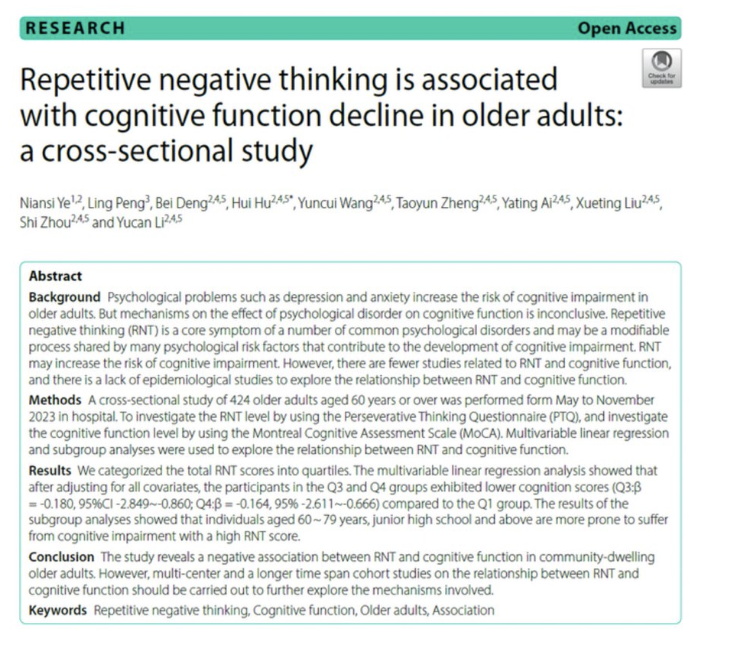
negative thinking poisons your brain and leads to congitive decline
whereas positive thinking, and gaslighting yourself into thinking everything is amazing, ACTUALLY makes your life amazing too.
you must be a silly goose
As AI systems move closer to real-world reasoning, success may depend less on memorizing language and more on building internal models of how the world actually works.
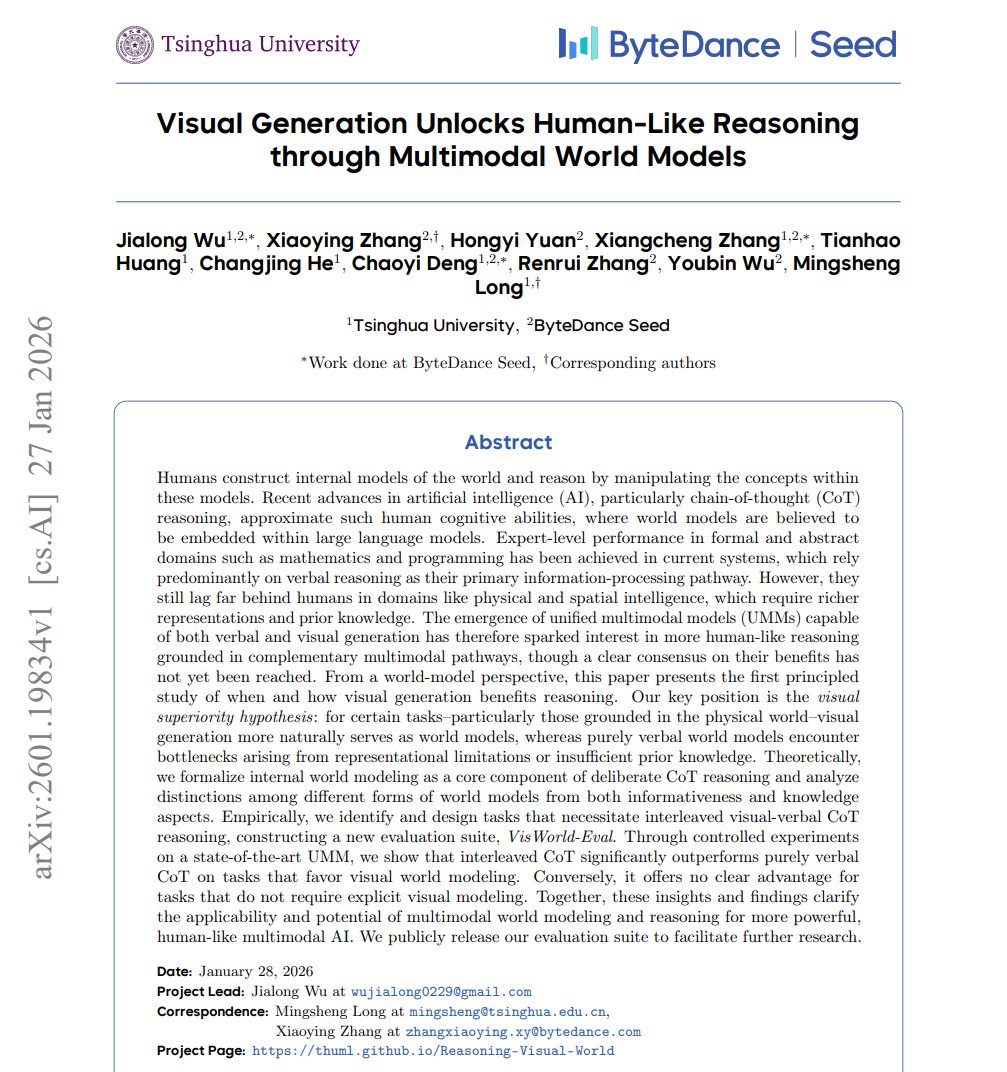
🚨 BREAKING: Tsinghua University researchers find that AI reasons more like humans when it can imagine visually instead of thinking only through text.
The study found that multimodal systems perform better when they internally generate visual representations while reasoning.
The paper, "Visual Generation Unlocks Human-Like Reasoning through Multimodal World Models" studies how visual generation changes the way AI solves problems.
It identifies a critical shift:
- Text-only reasoning works well for abstract tasks
- But physical and spatial problems require richer internal representations
- Visual generation helps AI build better “world models”
This creates a major advantage.
Instead of only describing the world with language…
AI can now internally simulate and reason through visual structures more like humans do.
The research shows that combining visual and verbal reasoning significantly improves performance on tasks involving:
- physical understanding
- spatial reasoning
- real-world interactions
This directly highlights one of the biggest limitations in current AI systems:
Language alone is not enough for true world understanding.
The researchers built a new benchmark called VisWorld-Eval to test these capabilities.
Results showed that interleaved visual-verbal reasoning consistently outperformed text-only reasoning on tasks that required deeper world modeling.
This is a major shift from how AI is usually designed today.
Most systems still reason mainly through text.
This work suggests that future AI may need to:
- generate visuals
- simulate environments
- reason across multiple modalities simultaneously
The bigger implication is not just intelligence, it’s perception.
As AI systems move closer to real-world reasoning, success may depend less on memorizing language and more on building internal models of how the world actually works.
This points toward a deeper shift in AI:
From predicting words
to simulating reality
article link below:
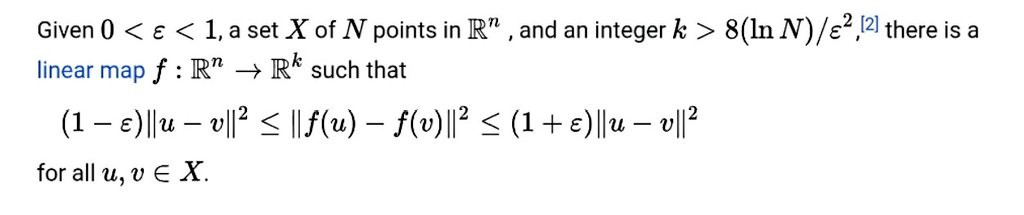
One theorem every ML engineer should know:
The Johnson–Lindenstrauss Lemma.
It states that high-dimensional data can be projected into a much lower-dimensional space while approximately preserving pairwise distances.
Why it matters:
• Explains why random projections work
• Enables scalable learning in high dimensions
• Used in embeddings, compressed learning, and ANN search
• Helps fight the curse of dimensionality
The surprising part:
You can reduce dimensions dramatically without destroying the geometry of the data.
That’s why many ML systems can operate efficiently even with massive feature spaces.
Modern representation learning is deeply connected to this idea:
Good embeddings preserve structure while compressing information.
In ML, compression is often not loss of intelligence —
it’s removal of redundancy.
They have nobody to call when something is wrong. They have nobody who would, on a Tuesday afternoon for no reason, ask how they are actually doing. The interior of their life, the part that needs witnessing, has no audience.
https://t.co/RO4hU9hIFx
People who are usually private and reserved, even with their friends, end up sharing all manner of personal details on a long flight with a stranger they will never meet again.
In 2016, a man with no CS degree quit his job to study for a Google interview.
He was an English major.
A self-taught web developer.
A former Korean translator in the US military.
He studied 8 to 12 hours a day. For 8 months straight.
Algorithms. Data structures. System design. Operating systems. Networking. Every topic Google asks.
He tracked every minute of it on GitHub. He called the repo "Google Interview University."
Then he applied to Google.
Google never called him back.
Here's the wildest part:
The repo he left behind became one of the most-starred projects on GitHub. Over 343,000 stars. Used by thousands of devs to break into FAANG.
He got hired at Amazon as a Software Engineer.
His name is John Washam. The repo is now called coding-interview-university.
Inside you get:
- A multi-month study plan, week by week
- Every CS topic Google, Amazon, Meta and Microsoft actually ask
- Algorithm patterns with worked examples
- System design from zero to senior
- Big-O, data structures, trees, graphs, recursion, dynamic programming
- Behavioral interview prep
- Mock interview drills
- Book and lecture recommendations he personally used
- Flashcards, video resources, and a coding question practice plan
Self-paced. Free. No course. No paywall. No upsell.
Just one engineer's 8-month study log, open for anyone who wants to follow it.
If you are preparing for a tech interview, this is the most complete free roadmap on the internet.
100% Open Source.
(Link in the comments)
“ An injury-free year of moderate training beats 4 months of aggressive training interrupted by three months of rehab.
Every single time. ”
Consistency eats Intensity for breakfast.
Age-related muscle loss (sarcopenia), reduced circulation, and reduced tissue repair capacity all contribute to slower recovery. Unless training… muscle mass continues to decline with age, and deconditioning following injuries or illness can happen quickly.
This creates a cruel paradox: It takes us longer to build fitness, but we lose it just as fast - maybe faster - when we stop. A few weeks off due to injury sets you back months from where you were. Then you’re older than when you started, so rebuilding takes even longer.🤦♂️
This is why protecting training time matters more than maximizing training volume.
Consistency»» Intensity.
An injury-free year of moderate training beats 4 months of aggressive training interrupted by three months of rehab. Every single time.
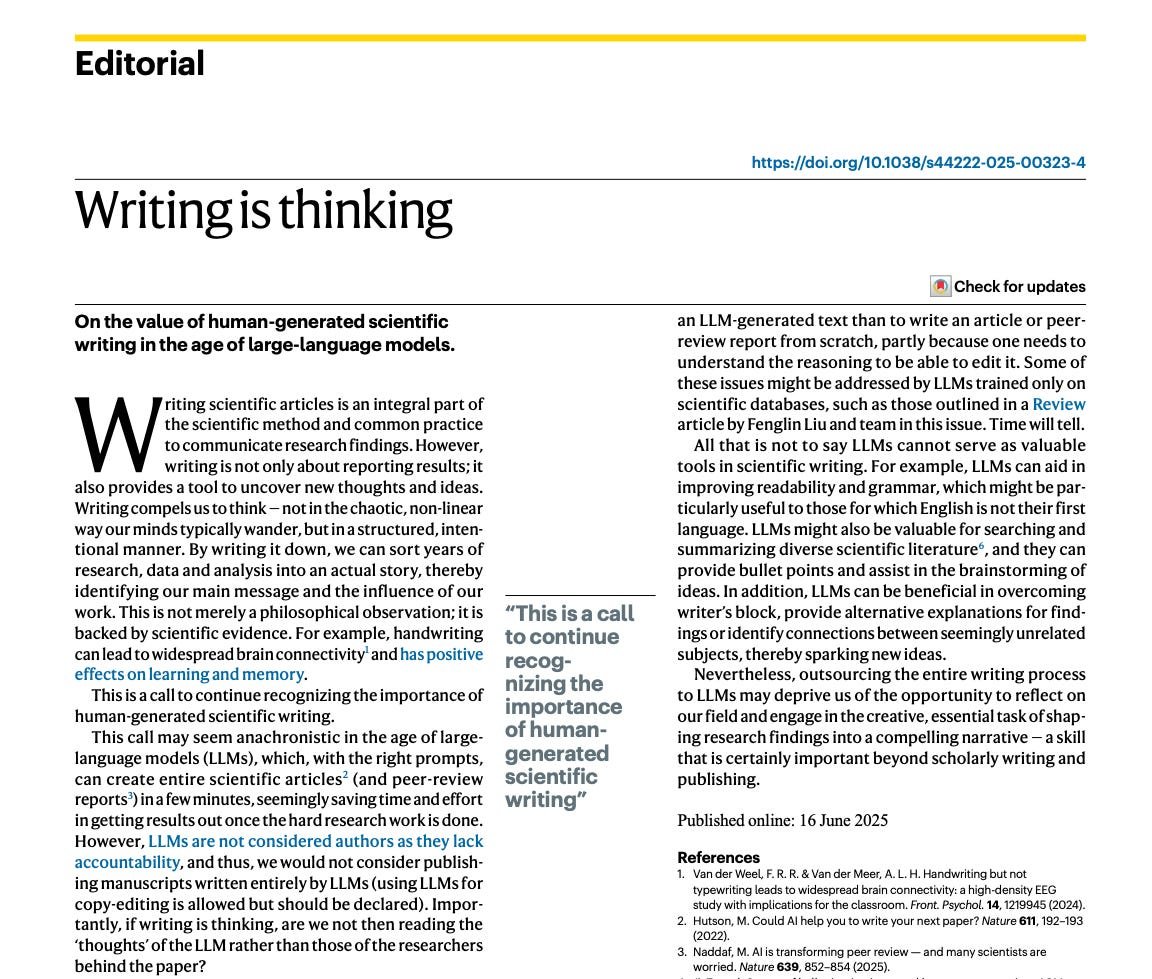
So it turns out that writing is thinking. It's the same process.
"Writing compels us to think — not in the chaotic, non-linear way our minds typically wander, but in a structured, intentional manner."
Outsourcing writing to LLMs is THE SAME THING as outsourcing thinking.
Be on the lookout for your thought patterns, which often lead to self-sabotage. As soon as you observe any one of them, keep in mind to remember to look at the sky. As the Prophet Muhammed (sav) said, there is peace of mind up there.