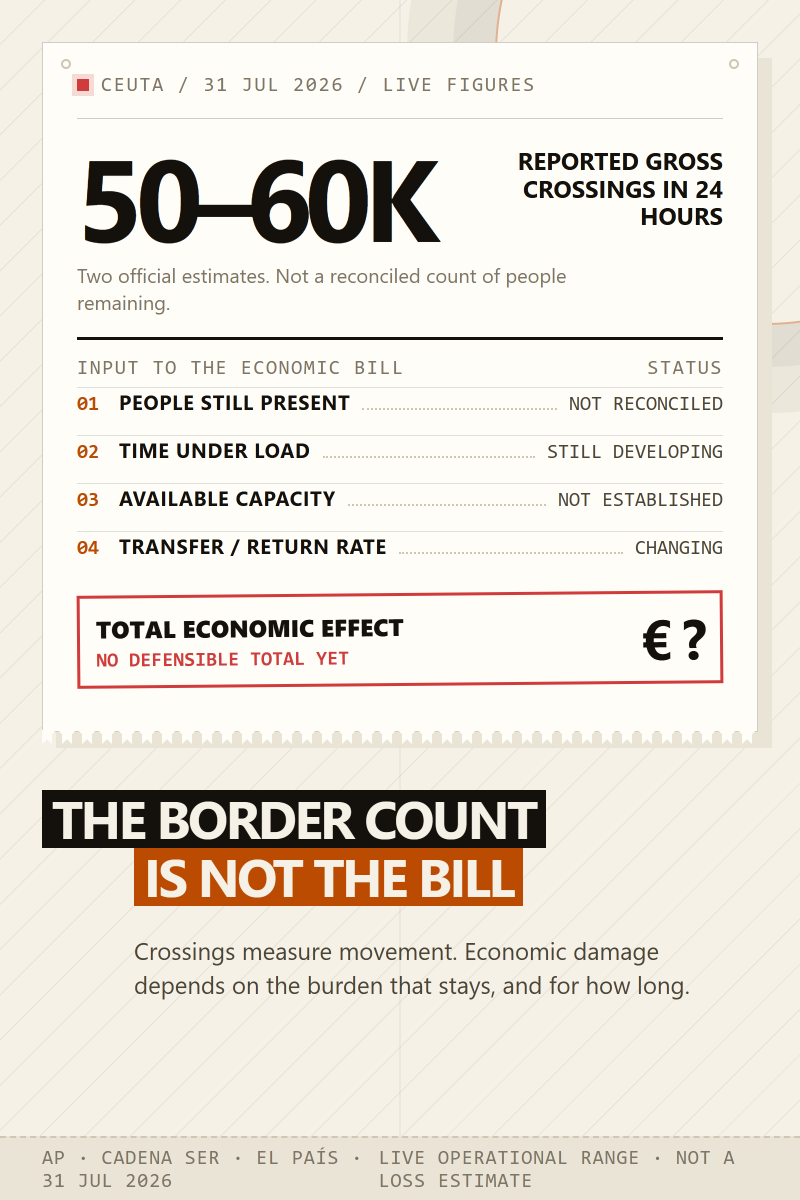
50,000 people crossed into Ceuta in 24 hours. The city has 83,595 residents. Shops pulled down shutters, bread ran short, public events were cancelled and troops entered the streets. By the next evening, Madrid said 48,300 had returned.
So the crisis disappeared? No. It showed that the real economic limit of a border city is not annual GDP. It is how much pressure its fixed systems can absorb in one hour.
Ceuta's migrant reception centre has 512 places. The headline inflow equalled almost 100 such centres arriving at once.
This was less like normal immigration and more like a bank run on urban infrastructure. A bank can be solvent and still fail if every depositor wants cash at once. A city can have a working budget and still stop functioning when tens of thousands of people simultaneously need food, shelter, policing and medical assistance.
Ceuta is roughly 90% services. Normally, more people can mean more demand. Not this time. Thousands arrived with no shelter and little money to support ordinary commerce. Shops closed instead of selling more. Reports of thefts and attempted forced entries added inventory losses for some merchants. The rest became lost trading hours, cancelled events and emergency logistics.
Even if almost everyone returned, the economic damage did not follow them back. Ceuta's businesses lost the day. Spain keeps the bill for troops, police, rescue operations, identification, medical care and returns. The total is still unknown, but the payer is not.
For Spain, this will probably remain a fiscal and political shock rather than a macroeconomic one. For the EU, the direct cost is smaller still because almost nobody reached the mainland. But the event immediately produced threats of new internal border controls, pressure on Schengen and calls for more Frontex support.
That is the larger economic consequence. Europe's southern border depends on Moroccan cooperation. Whether Rabat deliberately relaxed control remains unproven, but the balance sheet does not depend on intent. If that cooperation fails, Europe pays through emergency deployments, trade disruption, diplomatic bargaining and more friction inside its own market.
Ceuta stabilized because the flow reversed quickly. Next time it may not.
Europe's southern border is not an asset it owns. It is a service it rents.
The volume of arrivals is more than five times the daily peak of the 2015 migration crisis, when hundreds of thousands of refugees entered Europe via Turkey, mainly from Syria and Afghanistan. https://t.co/6lIRpty7qi
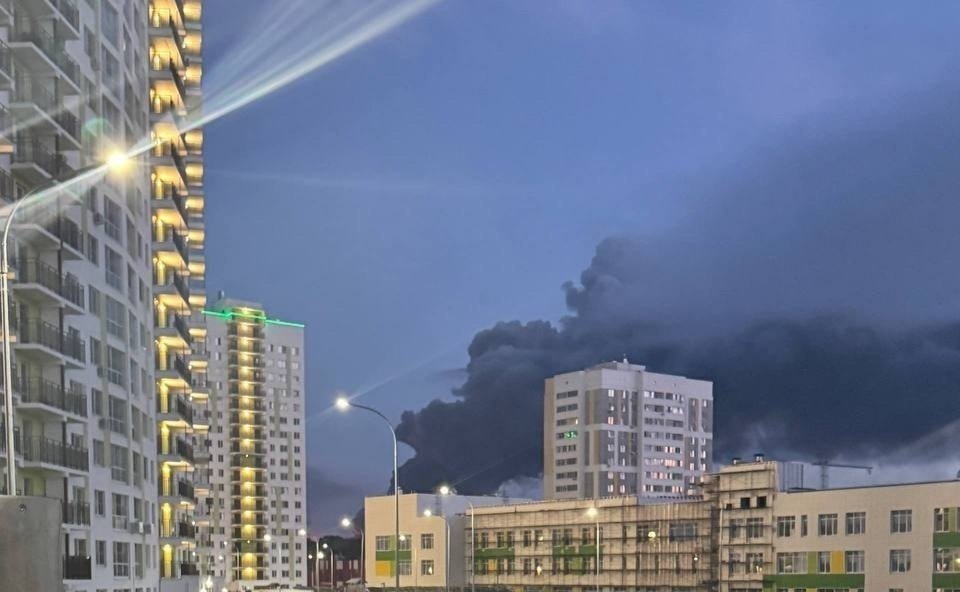
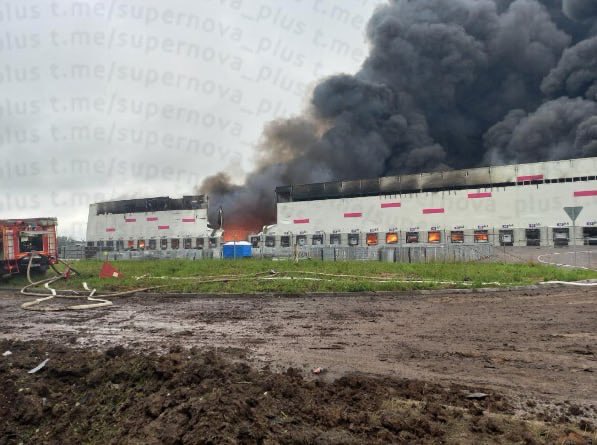
Fifteen Wildberries warehouses hit since July 17. Roughly 10 percent of the company's logistics space damaged, about 550 thousand square meters. Rebuild estimate: 35.8 billion rubles. The farthest hit landed in Yekaterinburg, some 1,700 km from the border.
Here is the number that explains the campaign better than any map. The most consequential document was not written by the military on either side. It was written by Wildberries itself on July 7, eleven days before the first strike: an amendment to the seller contract making drone damage force majeure. The platform saw the risk coming and moved it off its own books before the first warehouse burned.
Who ended up holding it, and for how much, is in the article. The one-line answer: the smallest balance sheets in the chain.
Eleven days before the first strike (Jul 7) Wildberries made drones force majeure. Sellers lost 150-235B₽ (5× WB’s ~60B), got only 5-10 % back. Insurance excludes UAVs. Ozon fell 20% unhit. Efficiency became the target list.
Full numbers & sources ↓ https://t.co/qZtkqkmRGy
Volgograd update: the Wildberries logistics hub is reported fully burned out after last night’s drone strike.
Another node offline. The southern and Volga network keeps thinning.
Overnight into 31 July the map kept expanding.
Volgograd: monitoring channels and local footage show a large fire at a Wildberries warehouse (alongside a nearby industrial/energy site). Governor confirmed BPLA hits on industrial and warehouse facilities; five people injured.
Vladivostok: major fire at a DNS warehouse (~5,000 m²). Cause still unconfirmed (drone or other).
Tatarstan: reported attempt on the Wildberries site in Zelenodolsk: drones intercepted on approach. Separate drone activity and shootdowns also reported around Kazan.
The pattern holds. Successful hits keep taking capacity offline while failed or partial attempts force air-defence saturation and temporary shutdowns across a widening geography. From the western hubs to the Volga and now further east, the logistics network is being stress-tested in real time.
Overnight into 31 July the map kept expanding.
Volgograd: monitoring channels and local footage show a large fire at a Wildberries warehouse (alongside a nearby industrial/energy site). Governor confirmed BPLA hits on industrial and warehouse facilities; five people injured.
Vladivostok: major fire at a DNS warehouse (~5,000 m²). Cause still unconfirmed (drone or other).
Tatarstan: reported attempt on the Wildberries site in Zelenodolsk: drones intercepted on approach. Separate drone activity and shootdowns also reported around Kazan.
The pattern holds. Successful hits keep taking capacity offline while failed or partial attempts force air-defence saturation and temporary shutdowns across a widening geography. From the western hubs to the Volga and now further east, the logistics network is being stress-tested in real time.
@KShevchenkoReal@Reuters Interesting update. I recently published an article covering exactly this development in China’s domestic immersion DUV lithograp
Five Chinese lithography machines nobody has seen took $1T off US stocks. Not because they rival ASML: they don't. But China already stockpiled 400+ machines, and the only lever left was a servicing ban.
Read full article below ↓ https://t.co/2B4BUOtYpz
Five Chinese lithography machines nobody has seen took $1T off US stocks. Not because they rival ASML: they don't. But China already stockpiled 400+ machines, and the only lever left was a servicing ban.
Read full article below ↓ https://t.co/2B4BUOtYpz
Penza just now.
Another Wildberries sorting hub (≈90,000 m², one of the newer regional ones) is on fire after a drone strike. One injured, ~200 staff evacuated.
The map keeps expanding.
Elektrostal, Kotovsk, Krasnodar, Nevinnomyssk, Ryazan… now Penza.
Capacity keeps coming offline while repair crews and insurers fall further behind.
Same mechanic: each new hit lands on a network already under stress.
Sellers still carry most of the inventory risk. Landlords are already refusing to underwrite it.
The campaign is compounding in real time.
Eleven days before the first strike (Jul 7) Wildberries made drones force majeure. Sellers lost 150-235B₽ (5× WB’s ~60B), got only 5-10 % back. Insurance excludes UAVs. Ozon fell 20% unhit. Efficiency became the target list.
Full numbers & sources ↓ https://t.co/qZtkqkmRGy
Moonshot just published Kimi K3's full weights, and buried in the license is the most consequential clause in open-source AI this year. Any company reselling the model as a service with over $20 million in annual revenue must sign a separate commercial agreement with Moonshot first. Twenty million is a comically low bar. AWS, Google Cloud, CoreWeave, Fireworks, Together, Baseten: everyone who matters clears it.
This answers the question I raised about the OpenRouter chart. Chinese open models win tokens but not money. On Vercel's gateway, open-weight models carry 29% of tokens and under 4% of spend, while Anthropic takes 61% of spend on 32% of tokens. The labs pay for frontier training, the inference platforms harvest the serving revenue. Kimi's license is the first serious attempt to tax that gap: keep the weights public, charge the resellers. Not closed like Qwen, not pure MIT like DeepSeek. A franchise.
The twist is legal, and it cuts against Moonshot. Free weights were nearly impossible to ban: a downloaded file is arguably just information. A revenue-sharing contract between a US cloud and a Chinese lab is a transaction, and transactions are exactly what sanctions and the ICTS rules are built to block. As one analyst put it, with revenue comes regulability. Moonshot chose this days after the Treasury Secretary threatened sanctions on Chinese labs over distillation.
So watch which US providers actually sign. Either the open-weight economy quietly grows a licensed tier, or those contracts become the choke point Washington was looking for. Both ways, free Chinese models were a phase, not an equilibrium.
Releasing the model weights and technical report of Kimi K3.
Kimi K3 is our most capable model: a 2.8T MoE model with native visual understanding and a 1M-token context window.
New model architecture: 2.5x the intelligence per unit of compute, not just more params.
Alongside Kimi K3, we're opening up more of the stack behind it — high-performance attention kernels, MoE communication library, and infrastructure for running agent environments at scale.
Model weights: https://t.co/7m7eEg6Y0B
Tech report: https://t.co/yeu6cjpMCT
Tech blog: https://t.co/YTfiMSNM1f
@business They're reaping the fruits of the hype. Moonshot after the license change is a completely different model, mimicking true open-source non-profit vibes, just like DeepSeek.
@business Ryazan was already offline after May, and the new strike hit before the backlog had cleared.
Repair crews, insurers and logistics can’t keep up. The damage stops adding up and starts multiplying.
Ryazan this morning is my whole thesis in one city.
Drones hit the Rosneft refinery (company’s largest) and the Wildberries warehouse in Rybnoe next door. Fuel and freight, same night.
The refinery detail matters most. It was already offline/under repairs and got hit again before the backlog cleared. That’s the compounding mechanic: each strike lands on infrastructure still queued for the last one. Repair crews, insurers and trucks never catch up. Damage stops adding and starts multiplying.
Yesterday I broke down who actually pays for the warehouse half. Short version: not the platform. Sellers carry 150–235 bn ₽ vs ~60 bn for WB itself. First compensation 5–10 %. Drone risk is in the exclusion clauses of almost every policy.
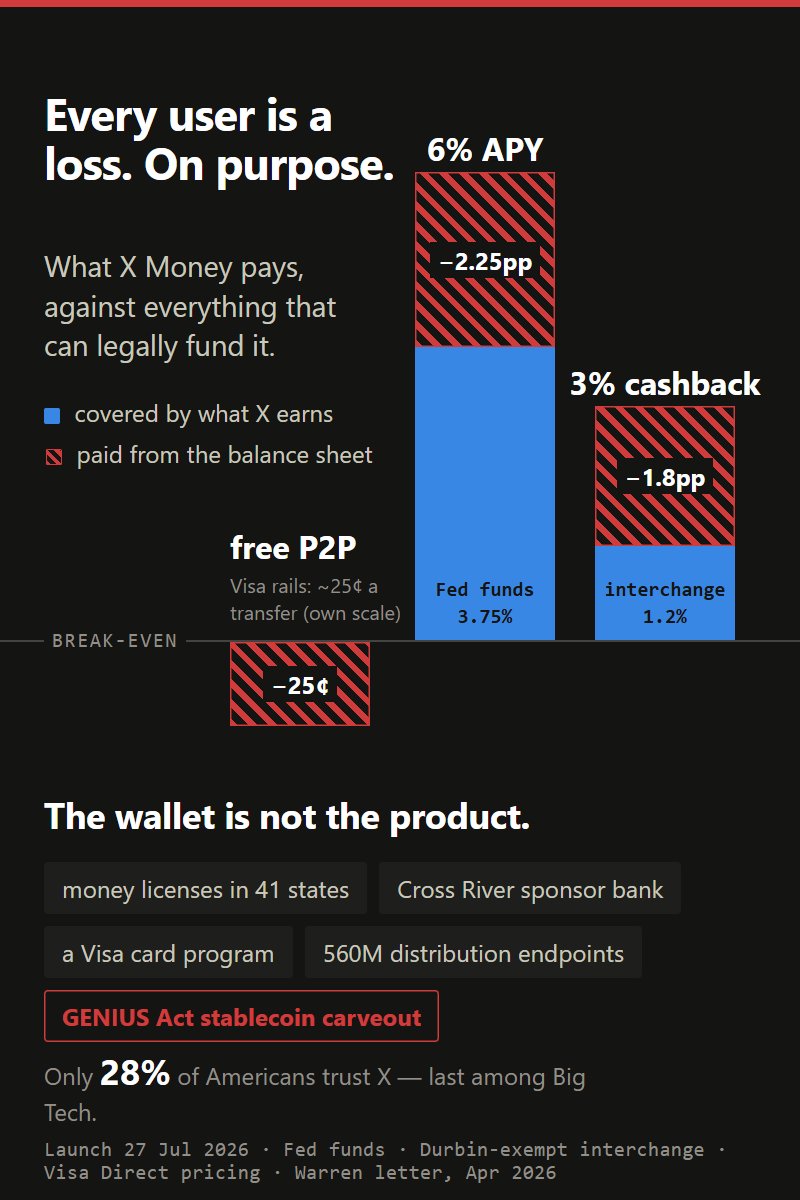
X Money went nationwide yesterday, and the two headline numbers are both economically impossible. The 6% APY sits about 225 basis points above the Fed funds rate. The 3% cashback is funded by roughly 1.2% of debit interchange, which is all a card on a small partner bank can legally earn. Free P2P runs on Visa rails that charge per transfer. Every active user loses X money.
That only makes sense if the wallet is not the product. Look at what X actually assembled: money transmitter licenses in 41 states, a sponsor bank, a Visa card program, and 560 million distribution endpoints. And look at the timing: the CFPB, the regulator that was supposed to supervise big payment apps like banks, was effectively dismantled last year. Senator Warren's letter asks the right question: what exactly funds a 6% yield, and she points at the answer too, a carveout in the GENIUS Act that lets a private company like X issue its own stablecoin without the approvals a public company would need.
That is the endgame worth watching. A stablecoin at social network scale means X keeps the Treasury yield on every dollar in the system and payments start leaving the card networks entirely. Visa and Mastercard are already hedging: one runs stablecoin settlement, the other just bought a stablecoin infrastructure firm.
The obstacle is not technology. Surveys put trust in X at 28%, tied with the US government and last among Big Tech. PayPal, Zelle, Venmo and Cash App already clear three trillion dollars a year. Musk is not competing on features. He is betting that a subsidy plus a regulatory window beats trust. Payment history says trust usually wins.
❗Perm just now.
Lukoil-Permnefteorgsintez (one of Russia’s largest, 13.1 mtpa) is on fire again after a drone strike.
Same pattern: facility gets repaired, comes back online, gets hit before the backlog clears.
Compounding in real time.
This morning Ryazan. Now Perm.
The repair queue keeps growing.
Ryazan this morning is my whole thesis in one city.
Drones hit the Rosneft refinery (company’s largest) and the Wildberries warehouse in Rybnoe next door. Fuel and freight, same night.
The refinery detail matters most. It was already offline/under repairs and got hit again before the backlog cleared. That’s the compounding mechanic: each strike lands on infrastructure still queued for the last one. Repair crews, insurers and trucks never catch up. Damage stops adding and starts multiplying.
Yesterday I broke down who actually pays for the warehouse half. Short version: not the platform. Sellers carry 150–235 bn ₽ vs ~60 bn for WB itself. First compensation 5–10 %. Drone risk is in the exclusion clauses of almost every policy.
❗NEW: Wildberries is now looking to move capacity outside Russia entirely.
Per Kommersant, RWB has started hunting warehouse space in Kazakhstan, considering up to 100,000 m² and reportedly willing to take essentially all available quality capacity in the country. Per TV Rain, it is also pushing new complexes in Almaty (100k+ m²) and Astana (160k m²).
Why: domestic landlords are refusing to lease to WB. Drone-strike risk is now being priced by Russian commercial real estate itself, not just by the company’s own balance sheet.
A company shifting warehouse capacity across a border because domestic landlords will no longer underwrite the risk is a genuinely unusual data point for how “war risk” is now being priced into Russian commercial real estate.
Eleven days before the first strike (Jul 7) Wildberries made drones force majeure. Sellers lost 150-235B₽ (5× WB’s ~60B), got only 5-10 % back. Insurance excludes UAVs. Ozon fell 20% unhit. Efficiency became the target list.
Full numbers & sources ↓ https://t.co/qZtkqkmRGy
Eleven days before the first strike (Jul 7) Wildberries made drones force majeure. Sellers lost 150-235B₽ (5× WB’s ~60B), got only 5-10 % back. Insurance excludes UAVs. Ozon fell 20% unhit. Efficiency became the target list.
Full numbers & sources ↓ https://t.co/qZtkqkmRGy
Ryazan this morning is my whole thesis in one city.
Drones hit the Rosneft refinery (company’s largest) and the Wildberries warehouse in Rybnoe next door. Fuel and freight, same night.
The refinery detail matters most. It was already offline/under repairs and got hit again before the backlog cleared. That’s the compounding mechanic: each strike lands on infrastructure still queued for the last one. Repair crews, insurers and trucks never catch up. Damage stops adding and starts multiplying.
Yesterday I broke down who actually pays for the warehouse half. Short version: not the platform. Sellers carry 150–235 bn ₽ vs ~60 bn for WB itself. First compensation 5–10 %. Drone risk is in the exclusion clauses of almost every policy.
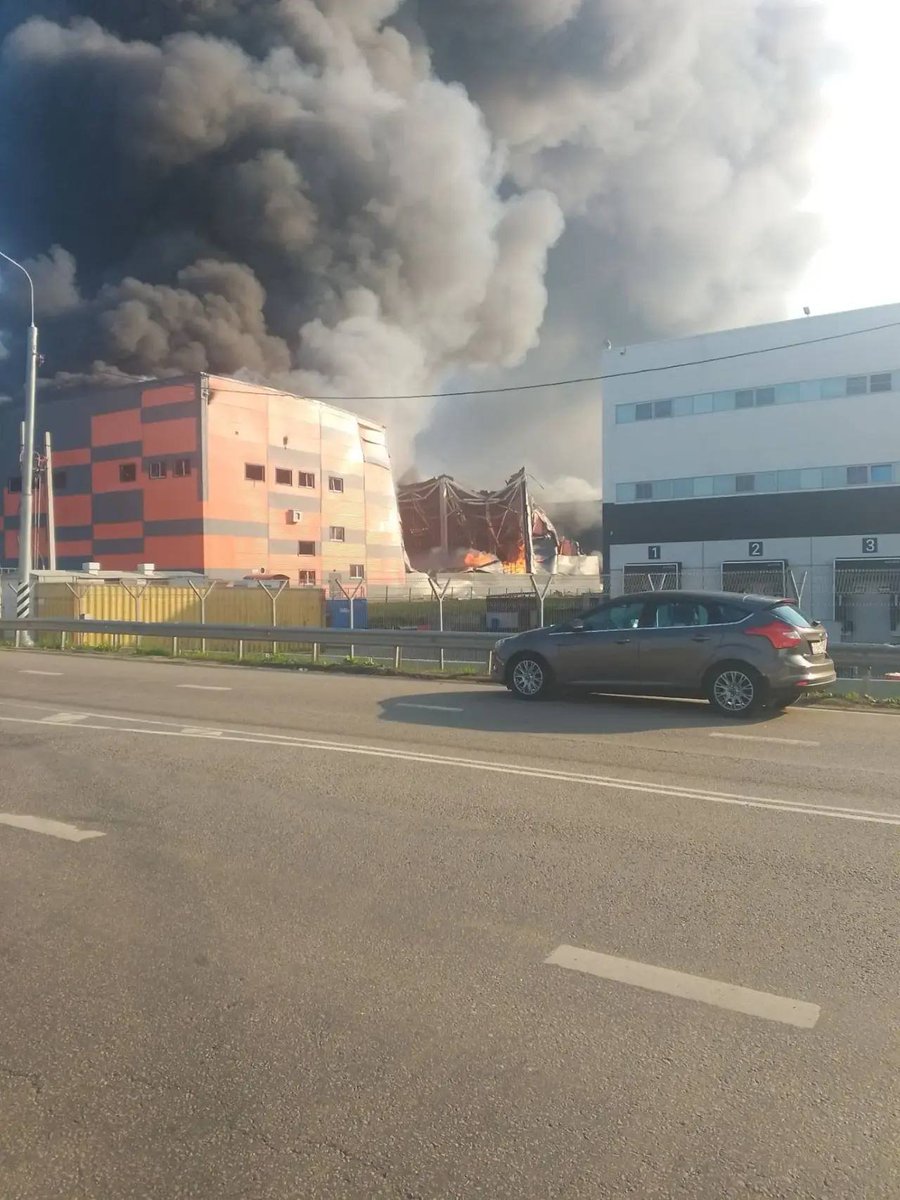
Russia’s Ryazan Wildberries distribution center has suffered catastrophic damage from a Ukrainian drone strike this morning, with the warehouse partially collapsed and ablaze.
Eleven days before the first strike (Jul 7) Wildberries made drones force majeure. Sellers lost 150-235B₽ (5× WB’s ~60B), got only 5-10 % back. Insurance excludes UAVs. Ozon fell 20% unhit. Efficiency became the target list.
Full numbers & sources ↓ https://t.co/qZtkqkmRGy
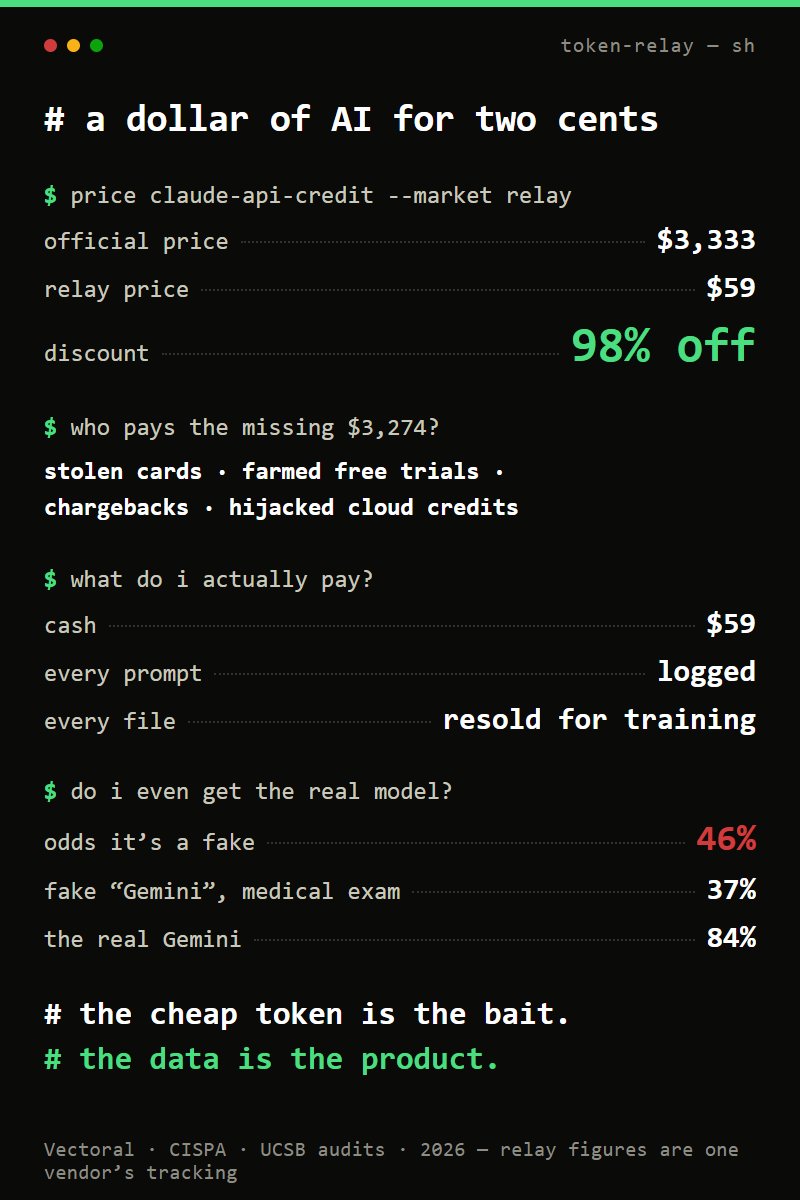
There is a gray market in China that sells Claude and GPT access at 98% off. It has price comparison sites, daily key lotteries, and 3.6 million monthly visits across its top 10 storefronts. The obvious question is how anyone sells a dollar of computing for 2 cents.
The answer is that the seller never pays for the goods. The supply chain runs on stolen credit cards, chargeback scams, farmed free trials and hijacked cloud credits. The model provider or some defrauded cardholder eats the real bill. And the buyer pays a second price they don't see: every prompt, every line of code, every reasoning trace gets logged by the reseller and sold on as training data. The cheap token is the bait. The data is the product.
It gets worse for the buyers. Independent audits found that 46% of these endpoints don't even run the model they advertise. A "GPT-5" that is actually a small open model. A fake Gemini scoring 37% on a medical test where the real one scores 84%. Some inject malware, some quietly steal AWS credentials. Over a hundred peer-reviewed papers unknowingly ran their experiments through fake endpoints.
The uncomfortable part is who built the incentive. A $100 Claude subscription can deliver about $1,300 worth of API usage. When list price sits that far above cost, resale markets appear as reliably as ticket scalpers at an underpriced concert. The labs are now responding with ID checks and spending caps, which mostly inconvenience honest users. The fraud has already moved on. In this market everyone is both predator and prey.
Chinese models now dominate OpenRouter: in July, 6 of the top 10 were Chinese.
But OpenRouter is only ~1% of global AI token volume. It’s a developer marketplace optimized for cost-sensitive & agentic traffic, where cheap open-weight Chinese models win hard.
Trump administration is actively weighing restrictions (Entity List, sanctions, procurement rules) on Chinese open-weight models after Kimi K3 and distillation allegations. Nvidia, Microsoft, Meta, Palantir and ~200 startups just signed letters urging them not to, warning it would kill US builders and hand a monopoly to closed labs.
For frontier US models (Anthropic, OpenAI) most serious users still go direct PAYG.
Price war is real. Full market picture is bigger.
Koledino again.
Today’s fire is in Novokoledino, a village in the Podolsk urban district (formerly part of the Lagovskoye rural settlement) that also hosts a large logistics complex.
According to fresh video and reports, this is the site where Wildberries is said to have consolidated the inventory that survived the July 20 fire at its main Koledino hub — the company’s single largest facility (over 200,000 m²).
The claim has not yet been independently confirmed, but it matches the pattern Wildberries followed after the July 24 strike in St. Petersburg, when salvaged stock from Utkina Zavod was redistributed the same way.
If accurate, this is not simply “another warehouse.” It would be a second hit on inventory that had already survived one strike — concentrating the loss rather than dispersing it.
No official confirmation yet on the scale of damage, casualties, or any statement from the company.
DAY 9, new region: explosions and air-defense activity reported tonight near Wildberries' logistics hub in Sarapul, Udmurt Republic: evacuation reported underway. The facility is ~75,000 m², one of WB's larger regional hubs. No word yet on damage.
What's actually notable isn't this one site: it's the map. In nine days the campaign has moved from Moscow region and Tambov, to the south (Krasnodar, Stavropol), to St. Petersburg and Crimea, and now to the Volga region, a spread covering nearly the width of European Russia. At least 9 WB facilities were hit as of a few days ago; that count is now higher.
A network built around a handful of mega-hubs is efficient because it's concentrated. That's exactly what makes it a wide, legible target list once someone works through it systematically.
UPD:
Fresh video now circulating of the evacuation at Wildberries’ logistics warehouse in Yekaterinburg (after the first strike).
The map keeps expanding: from the Volga region earlier tonight to the Urals.