Robots the size of a pencil tip could one day deliver antibiotics straight to an infected heart, with no open-heart surgery needed.
Johns Hopkins engineers built wirelessly steered magnetic millirobots that could cut treatment time from weeks to hours. https://t.co/rmCfQVjAlu
Two research teams of Hopkins engineers will collaborate with @Philips North America and @Kitware on newly-funded @ARPA_H projects to create, test and validate #AutonomousRobot solutions for #stroke.
https://t.co/870HMZxLNI
Johns Hopkins scientists helped reconstruct the first complete genome of a real person, with full sets of chromosomes from each parent. 🧬 This breakthrough is expected to advance research, improve the diagnosis of genetic diseases, and make personalized genomics routine in medical care. https://t.co/bkxUZ5IJ2o
Johns Hopkins University is excited to announce its new tuition promise program will offer free tuition for undergraduate students from families earning up to $200,000 and tuition plus living expenses for families earning up to $100,000.
As a result of the change, students from more than 85% of American households will be able to attend Johns Hopkins without paying tuition.
Learn more at https://t.co/iqrzhqqj0T.
Want to join @GoogleDeepMind as a Student Researcher for 6 months starting in January (PhD students)?
🧬 The project will be focused on AI for Science and AI for Cancer!
Send me a DM and also apply below👇
For the first time, a #robot has performed a lifelike #surgery without human help. Designed by researchers at @JohnsHopkins it can adapt to complexities on the fly. Hear from the researchers themselves about creating a realistic surgical robot. https://t.co/TpWDvsB4dz
Introducing Hierarchical Surgical Robot Transformer (SRT-H), a language-guided policy for autonomous surgery🤖🏥
On the da Vinci robot, we perform a real surgical procedure on animal tissue.
Collaboration b/w @JohnsHopkins & @Stanford
Robot watches how-to videos and becomes an expert surgeon: The team from Johns Hopkins and Stanford Universities harnessed imitation learning. https://t.co/7Ftt5DwcH3
Johns Hopkins researchers trained surgical robots through video-based imitation learning to match human surgeon skill levels
Their system enables faster robot training and could reduce medical errors, moving closer to autonomous surgical procedures
Enhancing Surgical Precision in Autonomous Robotic Incisions via Physics-Based Tissue Cutting Simulation - Jiawei Ge†, Ethan Kilmer†, Leila J. Mady, Justin D. Opfermann, and Axel Krieger.
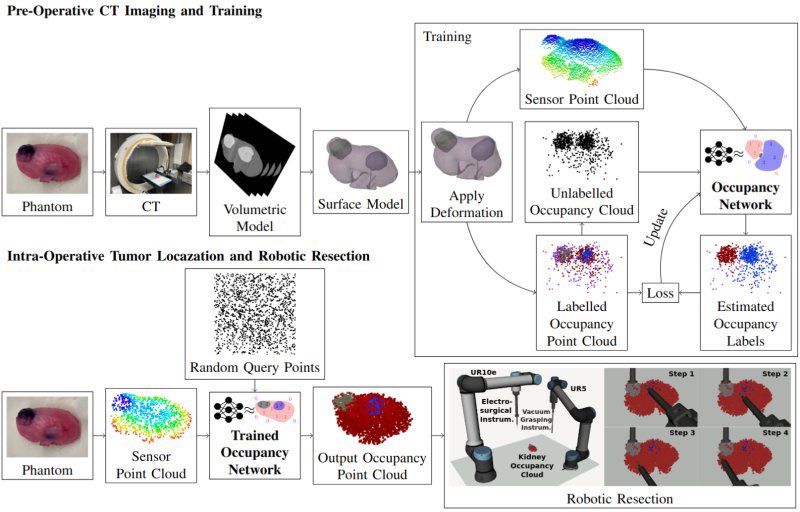
Tracking tumors under Deformation from Partial Point Clouds using Occupancy Networks - Pit Henrich †, Jiawei Liu †, Jiawei Ge, Samuel Schmidgall, Lauren Shepard, Ahmed Ezzat Ghazi, Franziska Mathis-Ullrich, and Axel Krieger.
Take a look at Lydia Al-Zogbi, who is working on a robotic system capable of autonomously initiating diagnostics and performing life-saving procedures to stabilize patients with hemorrhagic emergencies during transport to the ER
Full article: https://t.co/Mlom7sdVWd