I think the IPO should be more characterized as the beginning of the end than an actual top.
Paul Tudor Jones put it best in the video i've attached: the dilution from the 3 megaIPOs this year will begin to be felt by retail by Q3 and worsen throughout Q4 26 and q1 27. This will act as a liquidity vacuum as indices which are forced into passive flow absorb losses from IPO cash outs/unlocks.
To wit, the Mega IPOs in 2026 are :
-SpaceX - $2 Trillion val : S1 link = https://t.co/XAXZTYVYZ8
-Anthropic - $800 Billion val
-OpenAI - $1 Trillion val
NEW POST (Let The Bubble Wash Over You)
some thoughts on market structure and what the new financial regime looks like including:
> convective weather systems
> the reality of rolling bubbles
> how did we end up here
> what does it mean for the future
link to full piece below
Unfathomably bad takes around this this morning and a good reminder of why 13F digging is mostly a waste of time.
- March 31st we were in the heat of the Iran war, makes sense to put on hedges at the time.
- Options exposure on 13F’s get quoted notionally, so as if it were 100 delta i.e all 100 shares per contract.
- We have no way of knowing whether these were 5 delta convexity hedges and represented a fraction of what people are saying were billions in puts or whether they were ITM puts.
- Further, outright shorts don’t get reported either.
Too much noise associated with things that happened back in March that aren’t relevant now, we have no idea about his turnover in assets of trade frequency.
A lot happened in the months of April and May, his positioning could be completely different. Making investment decisions for 80 vol assets based on data from months ago sounds like a good way to burn money.
So don’t idolize people and develop
Your own thesis for why you sell and own things.
It seems like everything to do with AI rn has an absurdly wide distribution of outcomes, and the variance of those outcomes is equally massive. Small tweaks to assumptions, or small forks in the path today, lead to wildly different worlds tomorrow.
This isn’t isolated to the obvious compute and infrastructure stuff, though it’s certainly true there. For example, you can build an equally compelling cases for a decade-long memory shortage as you can for demand destruction triggering innovations that route around the bottleneck. But that uncertainty extends to the consumer side and to the very shape of the AI market itself.
It feels just as plausible that Anthropic ends up owning everything from infrastructure through the application layer as it does that the labs commoditize and value accrues further up the stack. So where do the gains actually land? Labs? Hyperscalers? Implementers? The yet-to-be-known innovators sitting on top of the whole thing?
Maybe every technological cycle looks like this from the inside? When I became a true believer in early 2023, I opted to focus on picks and shovels precisely because I knew I had no shot at predicting what AI would look like ten years out. The infrastructure thesis didn’t require that prediction. We were going to need more of the stuff that makes AI work, full stop. I assumed the picture would sharpen as things played out and better opportunities would surface beyond pure compute growth.
If anything, it’s gotten more opaque.
That’s not to say nothing else has worked. Agentic AI enablers have been solid. But where the AI market actually settles in five years? Genuinely anyone’s guess.
Don’t get me wrong, I’m happy that’s the case. It means there’s still opportunity in being mentally flexible enough to react to new developments as they happen. And there are areas I have very strong opinions about what the future looks like. But I’d be lying if I said I thought, three years ago, that the path would still be this uncertain today.
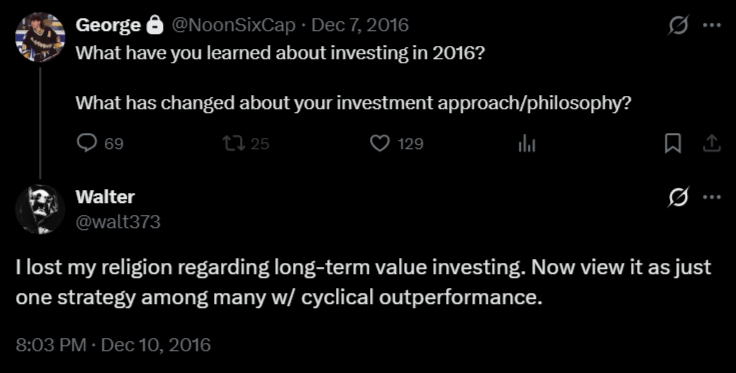
This was almost ten years ago, and probably the single most important decision for my returns. Opened my mind to the possibility that most of what I read in books was wrong.
The Internet boom and bust - a story part 3. Like all things there are similarities to today and differences.
My own experience during 1995-2002 year by year with highlights.
In this Part I will finish up with the 1998 panic easing and then get into specific 1999-2000 stuff
"Memory is cyclical, everyone knows that, and the recent run up in memory names is an obvious bubble."
That's the easy, reflexive view. But I think the people who hold it are missing the simple scale of what AI is doing to memory demand.
The first clue that there might be more to the memory story came in January of this year when it came out that NVDA's next gen Rubin platform would require 16 TB of NAND per GPU, or 1152 TB per rack, and that required HBM bandwidth for the system would be 70% higher than what had been previously reported.
That was the first time it became obvious to outside observers that memory would need to scale exponentially to keep up with already-known GPU demand.
One under-appreciated fact is that while GPU compute has largely scaled with Moore's Law (doubling in compute ~every 2 years), memory density and speed hasn't. As GPU compute continues to scale, existing memory manufacturers must produce exponentially more chips.
These chips will also need to be faster than ever, which introduces an incredible technical challenge: how can memory manufacturers find the required speed improvements that have eluded them for decades?
When you combine this added technical complexity with an exponentially expanding demand for the product, memory starts to look less like the "commodity" everyone knows it to be, and much more like a high-margin proprietary chip.
This hasn't even touched on memory's role in inference (compute needed for inference is expanding exponentially as well, and is highly memory-dependent), long context, etc.
Agentic AI requires agents to pull massive amounts of data into their context, which increases the number of tokens per "turn" and also the amount of memory required to run them. True agentic systems will require both dramatically higher context, and also many more "turns" or iterations of each task (as they improve an output over and over until it reaches a target quality level). Longer context = more memory per workload, and more "turns" = more workload per output.
To put a specific number on that, Micron SVP Jeremy Werner said recently on The Circuit that agentic AI is causing context length to grow 30x a year.
Michael Dell recently framed the problem in extremely simple terms: H100 had 80GB of HBM; by 2028, accelerators could carry ~2TB. That is 25x more memory per accelerator. Over the same period, he expects roughly 25x more accelerators deployed.
That's 25 x 25 = 625x more accelerator memory demand by 2028.
Everyone knows memory stocks are cyclical, and they always look cheap right before the bubble bursts. But what if there are structural changes happening in the memory markets that could prove the consensus wrong?
Does anyone remember another traditionally cyclical company that has rerated to a growth story due to the demand from AI? Hint: It's now the most valuable company in the world.
Reminder: this is not a recommendation to buy or sell any securities. It's a framework for thinking about how the AI buildout may be changing the memory market.
People keep confusing a bubble with “stocks go up and get overvalued”. A bubble is when when a prevailing trend and a prevailing misconception about that trend interact reflexively, each reinforcing the other until the gap between perception and reality becomes unsustainable.
A bubble is not when everyone realizes that right now every iota of AI demand eventually, at some point upstream, must move through memory OEMs. Nor is it when estimates continue rising because things are better than expected. And it’s not just when stocks trade expensive to historical valuations.
The reason behind the moves in the AI infrastructure layer so far have been simply that we don’t have enough. They’ve been driven by the fundamental reality more than the perception of the future. It’s why the bulk of the most bullish parts of this cycle have been lumpy and centered around earnings season when companies uniformly come out and confirm there’s still not enough. In the bubble, the reality is driven by the market - not the other way around.
Everyone keeps saying “people are gonna freak out if it’s not a bubble!”. I think that’s silly, we have a transformative new technology that needs crazy capital to fuel it coming to fruition, that has and always will result in a bubble as long as we have financial markets.
But if you want to call the top in a bubble, you need a much stronger view on what the misconception is and what negative catalyst forces broad perception to align with realizing it than you do on valuation.
New Investors are wildly underestimating the scale of Dotcom vs AI
LLMs may do $100B ARR in 2026. AI capex ~$700B
In 2000, adjusted for inflation, end users spent >$700b on PC/IT Hardware alone…software $200B; Telco services ~$2T; infrastructure >$300B
It was cataclysmic
Update. All positions the same. Though i bought some more gold for beta
DSAlpha up 90bp underperforming its target return by 350bp YTD.
DSSmartbeta up 7% YTD outperfoming its 10% YoY target and set at 72% of risk target so doing quite well on Risk Adjusted basis.
Total portfolio callled DSAlphaBeta up 7.9% still just beating SPX (not its benchmark) at dramatically lower risk and drawdown.
My call on going max short stocks has failed and as the puts are now far out of the money with 5-18 weeks to go the delta is basically equal to my equity delta in SmartBeta. So from a pnl standpoint basically neutral equities here. (no more pain trade to the upside 😂).
My view is that we are in a bubble and I have no edge on equities. See thread in feed.
For alpha I think there are substantial opportunities in rates, stir, currency, gold and oil which I am trading both tactically and strategically. Equities can f%ck off for now.
SP500 isn’t a fixed set of companies if that was the case it already crashed ages ago
SP is rotating companies of the 500 best pulled up by inflation and innovation
If they print money overtime SP has to go up because companies are valued on multiples of sales and the sales are higher
Look at every country with fiat and their index goes up when their country currency dies not down ie Argentina, Turkey
Not worth owning as you hold worthless currency then but no fiat index ends down it ends going up in nominal fiat terms if you lose in real terms
In companies Investing is usuallg a matter of dcf
If forward PE is 10 but trailing PE is 40 it makes sense to look at the 10 when the contracts are in commit
A bubble like tulip bubble, Dotcom bubble are pricked based on external matters as the internals are already divorced
Booms bust on fundamentals - everyone is looking at the profit and growth
Yeh there is always some crazy ones
An the difference as mentioned based on growth is what limits the downside ie no growth or little revenue but high pe is a 90% crash for eg a high growth high pe after one year growth is a 50% drop
Its not the same otherwise we wouldn’t have different words for bubbles and booms
Anyway this does unfortunately get into semantics which I’m not a fan of - you have to broadly consider an OPs perspective and intent and see from that view otherwise I can just reply an argue definitions with you too and it helps no one
First principles are better but I sometimes like analogies when people think broadly one way and it helps create a different perspective
Most stocks are not that overvalued - its just the extremes in AI pulling it up
But even then the growth rates and forward PEs make a number of the AI stocks not so crazy
Whats crazy isnt the values but the legitimacy of the moats and business models long term and their ability to sustain that growth for multiple reasons - whether its competition/margin compression/selling dollars for 90cents (lot of ai usage is free users) etc
Its not a dotcom bubble at all - its more like a olden days gold town boom. There really is gold there and its a legit boom which deserves the growth rate and multiples but then it busts from downgrades in growth and profits not because its not real like dotcom bubble
US and Iran cease fires are valid during Monday - Friday. 9:30 am to 4:00 pm
Any engagement that happens after trading hours MUST come with an announcement of a peace deal within one hour of markets opening
any escalatory comments should be reserved for weekends
If you worship money this will help you disassociate
Think of money like a job title
A ceo makes up job titles like VP, manager etc to make people feel achievement and create motivation when it’s really a made up thing and you work to gain new levels of made up
Money is a human made concept.
Xi Xinping, Putin, Saudi leaders etc they don’t care about money - they sit above money. They can wipe out any billionaire in their system and make people do whatever they want
Money to them is just a tool like a job title to motivate and move people.
Their real currency is power and influence. They use money like made up theme park coupons
Would it make sense to worship coupons? Would be idiotic
It’s useful and a tool but not the goal
Don’t set your life up to accumulate coupons as the goal
What if we are in the foothills of the greatest bubble in history?
I see a strong case that we are. We have the convergence of three powerful factors.
The first is passive flows. This has been the biggest shift in financial markets over recent decades. We have roughly $6-7bn entering the US equity markets every day in the form of passive flows, through retirement accounts, corporate buybacks, and other sources. This transformative force has added an upward bias to the equity markets, which also means lower downside sensitivity to negative events such as geopolitical issues, economic weakness, or monetary tightening.
This broader theme is well known but the incremental thesis here is it also drives a cumulative snowball effect. Passive flows eventually crowd out the free float, as any equities absorbed by passive flows have left the market permanently (other than specific conditions, such as mass job loss). A smaller free float reduces liquidity and makes price more sensitive to discretionary flows.
The shrinking free float combined with an upward sloping character increases the odds of a parabolic blowoff in equity indices. The trading liquidity in the largest stocks (such as Mag7) has not proportionally increased with their market caps. As they get larger, the stocks get more sensitive to flows on a % basis, and price-agnostic passive flows continually jam more capital into them as they get progressively less liquid and more inelastic, which then further increases concentration and strengthens these effects in a loop.
The second is behavioral training. As the passive flows paradigm has continued over time, equity market participants have become increasingly relaxed, more convicted in the idea of continual upside, and reluctant to sell in response to volatility or exogenous negative events. Naturally, this behavior shifts begets more upside-biased price action, which further shifts behavior, in a reflexive loop. This has to break at some point, but leading up to the apex, you could see how this would encourage a complete lack of selling and thus vertical price action on any incoming flows.
The idea of a central bank put, in addition to a Trump put where he will find ways to influence the market higher, are key pillars of the market’s conviction to never sell equities. Many investors sold and got left behind during the tariff saga last year, and that traumatic memory was evident in the way the market has reacted to the Iran war. Despite a lack of resolution, the markets have powered higher and are now meaningfully above where they were sitting before the conflict. This is driven by the fear of missing out being greater than the fear of losing. This episode was instructive in that memetic consensus around buying every dip and never selling is only strengthening.
It is easy to assume that any given amount of flows entering the market will have equal impact. One of my variant views is that this is highly untrue. The price impact of any given flows is highly connected to the psychology of those incremental participants: how urgently the buyer is trying to buy, and how convicted the potential sellers are. If the sellers have no motivation to sell, and will only part with their shares for a much higher price, and meanwhile the buyer is desperate to buy, then those flows can have a massive price impact, multiples of what it would be in a more relaxed scenario. When you combine this market training, with the shrinking free float, you have an evolving market structure that has greater odds of explosive upside.
Now, take this highly leveraged market structure, and throw in the most transformative technology cycle the world has ever seen. The potential upside from AI is inherently non-linear as it will be applied to itself to recursively self-improve. I believe there are many ways AI can create value that we cannot comprehend and dimension yet.
For a while I had been more ambivalent of the impact of AI on equities due to the potential for mass layoffs negatively impacting passive flows and disrupting aggregate economic demand, but it is now looking more likely that we see gradual job loss as businesses focus on holding headcount flat and harvesting productivity enhancements to capture more revenue.
This increases the odds of a goldilocks scenario, where we see significant earnings growth as AI drives increases economic activity (both from AI capex and by increasing the capacity of all business), while disinflation allows rate cuts. These factors create a scenario where we get a late 90s-like bubble in the equity market. Why wouldn’t we? We have created the god machine, the greatest technology ever, and it is starting to drive real and tangible benefits to businesses today – why wouldn’t we get a huge move higher in the equity markets?
This right tail outcome looks significantly mispriced in the QQQ LEAPS market, where favored strikes with Dec 2028 deep OTM expirations would 17x if the Nasdaq would double by the end of 2027. The asymmetry here comes from the market pricing in a normal distribution of outcomes. Given what I know and believe about AI and the evolving market structure, a normal distribution is not possible.
These 3 factors above coming together to drive an explosive bubble upwards is not a guaranteed outcome, but I believe the odds are much greater than what is being currently priced into these LEAPS.
A double in the Nasdaq is not necessary to get paid on these LEAPS, but it wouldn't be as crazy as it sounds. One way would be aggregate earnings going up by 50% over 2 years, which at +22.5% per year is what it already has been doing, and then multiple going up by 30%. This is arguably conservative on earnings given the thesis, and assumes a multiple around 31x, which is the range high over the last few regimes, and about half of the 60x+ at the peak of the dotcom bubble.
The missing ingredient is monetary easing. You may ask, how can we get a crazy bubble without liquidity expansion? I would characterize the current liquidity environment as being in the middle, certainly not abundant. One answer would be that equities have shifted character to need less liquidity to move higher, because of the passive flow dynamics described above. Equities used to trade more like crypto does now, as a direct expression of liquidity conditions.
Another would be that I believe liquidity will eventually expand, one way or another. I don't think it is imminent, but we have good odds of it happening at some point within the next 2 years, and that is what kicks off the vertical phase.
Given Trump’s appointment of Kevin Warsh and the certainty that he extracted a promise to cut rates, there are forces brewing in that direction. Kevin will still have to convince the rest of the FOMC, and given the inflationary pressures created by the Hormuz closure, no easing is likely in the near term. What is more likely is that post-Hormuz the inflationary impact gradually eases, we start lapping the tariff headwinds from last year, and the disinflationary impact from AI starts coming in as well. In the goldilocks scenario, we could see employment being flattish and preventing wage growth, while the capacity of the economy expands from the use of AI.
We also have had meaningful banking deregulation already, with more to come. This is mostly within Trump's power and doesn't necessarily require full control of the Fed, up to a point. This has already had some impact, and there is a lot of upside still, it's an underrated driver for more liquidity.
There are also left tail outcomes possible, such as an explosion of job loss and unwind of passive flows. In these scenarios, the market structure described above offers leverage to the downside, it cuts both ways. I view the right tail outcome as much more likely than the left tail, as history shows that when productivity improvements are made, usually businesses will still hold onto employees until a recession forces their hand.
This divergence in outcomes is why I am focused on owning the right tail upside through leaps, instead of simply getting levered long stocks and holding them for a couple of years. There will also be significant volatility along the way. I believe these LEAPS to be the best risk/reward way to express this view.
While semiconductors/SOXX would be a more levered and direct view on the AI bubble, as passive flows are a key pillar of the thesis, I want to align my expression with the flows. I also like that the broader Nasdaq contains many businesses that will be able to enhance their margins and accelerate earnings growth through the use of AI. It is harder to bet on individual companies for this thesis, and the ideal expression is through the index as I believe AI will be a tailwind on broader earnings growth for many companies, not just direct beneficiaries. Given the nature of the thesis, I want to isolate my bet to as few variables as possible. I prefer QQQ LEAPS over NQ due to tax reasons (QQQ get full LTCG after a year vs. NQ would have 60/40 LTCG/STCG treatment for any time horizon, and also gets marked-to-market for tax purposes at year end) as I intend on holding these for a long time, and want to encourage myself to stick with this trade.
I usually don't like to pitch specific trades because it can influence my level of objectivity and attachment. In this case, I am trying to psyop myself into holding these no matter what, so thought that sharing it publicly would be beneficial. Do your own research, this is not financial advice, etc.
My guest today is Paul Tudor Jones (@ptj_official), one of the greatest macro traders of all time.
He correctly predicted the 1987 stock market crash and shorted the Japanese bubble in 1990. For over 40 years, his flagship fund has had a negative correlation to the S&P 500. 100% of his returns are alpha.
He says today's market has so many similarities to 2000, "the easiest bear market I've ever seen in my whole life."
He makes the case for going long dollar-yen, why Bitcoin beats gold as an inflation hedge, and why he was wrong about Warren Buffett.
But what I'll remember most from this conversation is Paul's zest for life. He's 71 and still wakes at 2:30 every morning to trade the London open. He works out for two hours a day. He walks with his wife every evening. He travels the country chasing peak spring and peak fall. He's so excited about the songs picked for his funeral that he wishes he could be there to hear them.
Paul has lived five lifetimes in one. He's one of the most entertaining and interesting people I've met, and the conversation will leave you searching to be as passionate about what you do as he is about what he does.
Enjoy!
Timestamps:
0:00 Intro
1:00 The Kindest Thing
13:19 Trading vs. Investing
17:33 Lessons from Warren Buffet
22:24 The Existential Risks of AI
29:54 The Nature of Trading
31:46 Bitcoin
35:55 Bubbles
42:08 A Day in the Life of PTJ
46:00 Information Overload
47:07 Passion for Markets
50:49 The Robin Hood Foundation
54:18 The Workless World
56:03 Journalism
1:00:00 Principal Components of a Great Life
1:05:06 Kill Them With Kindness