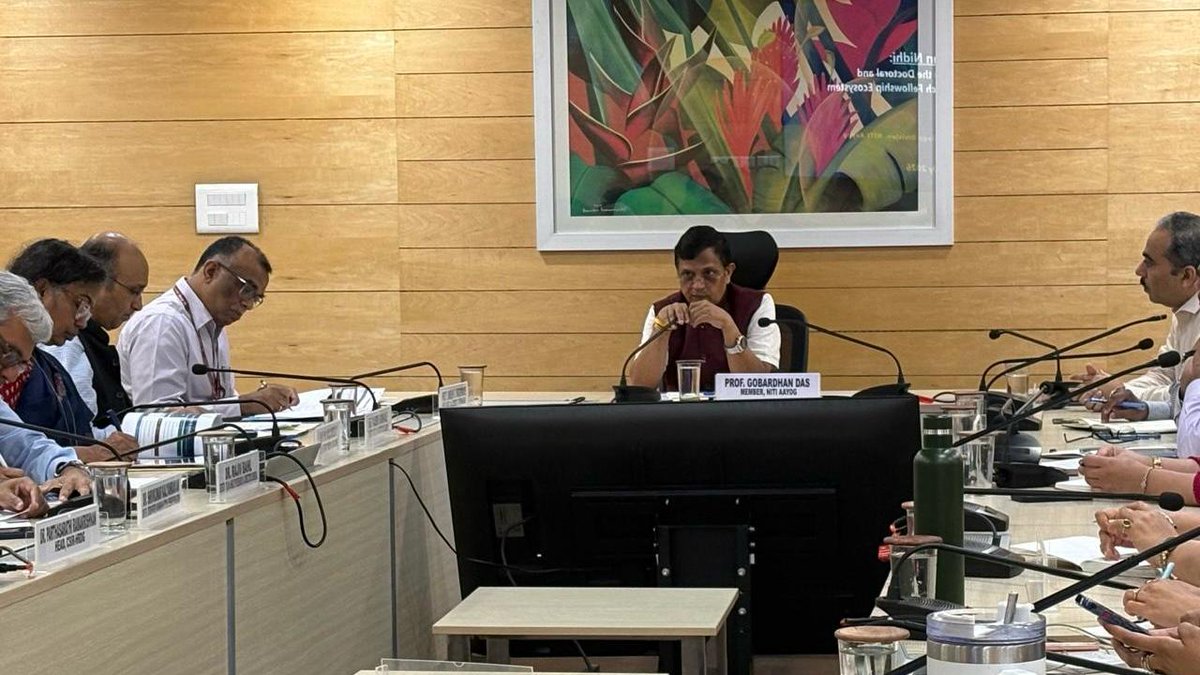
Chaired a meeting with Secretaries of major scientific ministries and departments, along with the Department of Higher Education, UGC, and other key stakeholders, to deliberate on strengthening India's doctoral and post-doctoral research fellowship ecosystem.
The discussions focused on the urgent need to build a more robust research ecosystem that supports talent, addresses brain drain, and empowers young researchers through timely and transparent fellowship support. We also explored the concept of Vigyan Nidhi—a unified, technology-enabled framework to streamline fellowship disbursal and strengthen India's research capacity.
Investing in researchers is an investment in India's future. A strong, well-supported scientific community will be instrumental in driving innovation and realizing the vision of Viksit Bharat.
#Research #HigherEducation #Innovation #Science #DoctoralResearch #PostdoctoralResearch #VigyanNidhi #NITIAayog #ViksitBharat
Appropriate fellowships and their timely disbursement are the biggest challenges our young researchers face today. By bringing all agencies under a single umbrella, you have taken the right step to streamline the process, which will benefit the research ecosystem. Vigyan Nidhi is a good way forward. @PMOIndia@narendramodi@AmitShah
VIDEO | The Bihar government on Friday approved a proposal to rename Gaya city as 'Gaya Jee', an official said. The decision was taken at a meeting of the state cabinet, chaired by Chief Minister Nitish Kumar.
(Full video available on PTI Videos - https://t.co/n147TvqRQz)
What they earn goes for #terror funding. We need to cut their economic space. As a responsible citizen, this is the least we can do towards the fight against terror.
Those who try to divide us using #caste and #language are terror sympathisers. We also must kick them out of the electoral space. #PahalgamTerroristAttack #IslamicTerrorists
🧵~Kayasthas in Tibet: Shaping the religious landscape of the region~
In this thread we will explore the role of Kayastha missionaries from early mediaeval eastern India in Tibetan Buddhism.
Pandita Gayadhara, a Kayastha from eastern India, brought the Lamdre teachings to Tibet in the 11th century. He belonged to the Sakya school of Tibetan Buddhism.
The lamdre method, a meditative system, introduced by Pandita Gayadhara is considered to be the ultimate goal of Sakya school of Tibetan Buddhism.
Pictured: Thangka of Pandita Gayadhara from Tibet. 1/n
Another remarkable site in Bihar is the Cyclopean Wall of Rajgir. 40KM in length it encircled the ancient city protecting it from invaders. Cyclopean architecture is more commonly associated with ancient Greece but this example is perhaps older & well preserved.
@biharfoundation
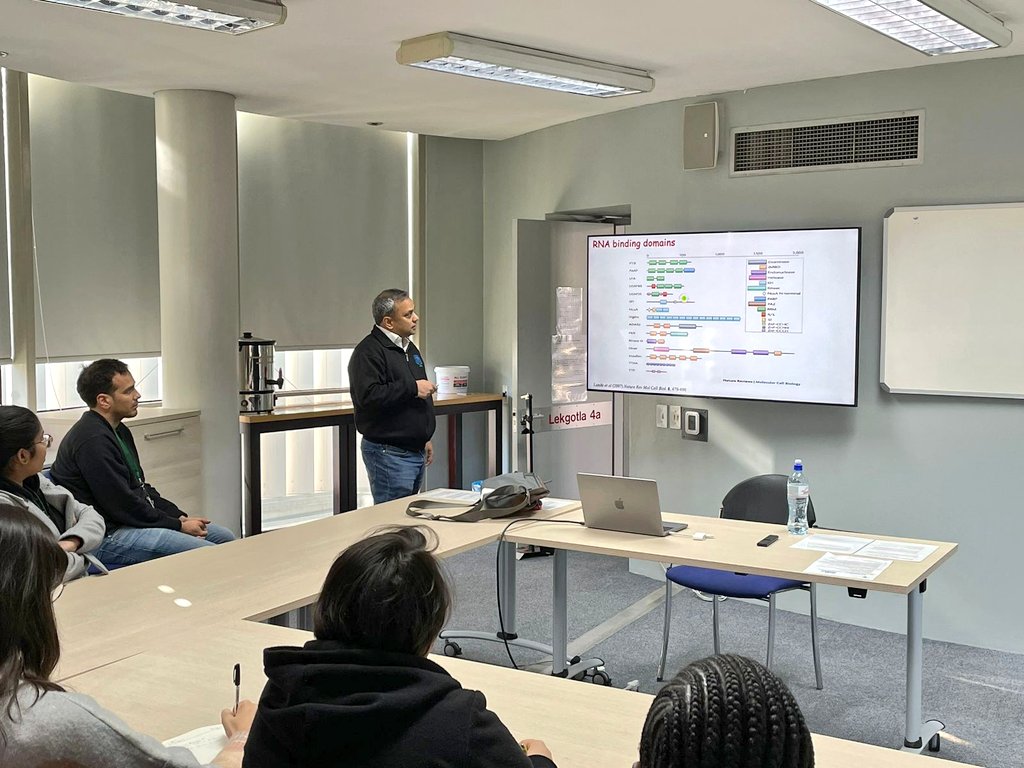
This week at #ICGEBCapeTown we are thrilled to host @ICGEBNewDelhi Group Leader Dr Neel Sarovar Bhavesh @neelbs also having @ICGEB special seminar on Choosing partners RRM Way 🇮🇳🇿🇦
#Patna - #Purnea Expressway
#Buxar-#Bhagalpur Expressway
#Thermal#power plant in Bhagalpur
#Gaya is to be developed as an Industrial node. #Vishnupad Mandir and #Mahabodhi temple corridor.
#Jain temple complex development in #Rajgir#Nalanda dvelopment as a tourist centre.
#Flood control measures in Nepal for controlling floods in Bihar.
More capital investments, medical and sports facilities also
Overall good budget for #Bihar. #UnionBudget2024
यत्र योगेश्वरः कृष्णो यत्र पार्थो धनुर्धरः।
तत्र श्रीर्विजयो भूतिर्ध्रुवा नीतिर्मतिर्मम।।१८.७८।।
In the last shloka of the Srimad Bhagavad #Gita, Maharishi Ved Vyāsa concludes with conviction that wherever there is a #Guru like Yogeshwar Krishna, and wherever there is a disciple like Archer Arjuna, there will also certainly be prosperity, victory, happiness, and sound policy.
𝐓𝐨𝐝𝐚𝐲'𝐬 𝐝𝐢𝐬𝐜𝐢𝐩𝐥𝐞 𝐢𝐬 '𝐦𝐨𝐫𝐫𝐨𝐰'𝐬 𝐆𝐮𝐫𝐮, a process going on for ages, and good things are bound to come whenever both are devoted to each other.
#GuruPurnima2024 #GuruPurnima #गुरु_पूर्णिमा
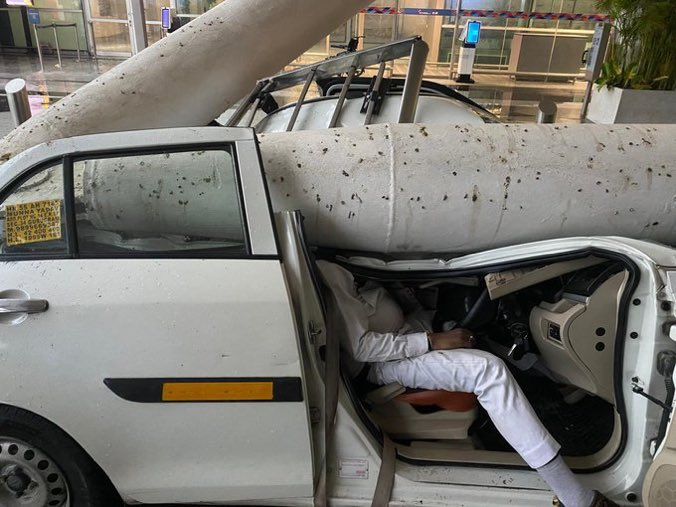
It does not matter when the terminal roof was inaugurated. The agency that is responsible for its maintenance is responsible for this murder (rankly to call it an accident). They must be brought to justice and given stringent punishment at the earliest.
Opposition blaming centre, centre blaming opposition, centre blaming state, and vice versa, one agency blaming another agency....in this political game, it is the public that suffers. This picture should not be used for politics by any side.
#DelhiAirportRoofCollapse #DelhiAirportAccident
On Dr. #RajendraPrasad’s punyatithi, sharing the First Day Cover #stamp from Papa's collection. This was the first stamp issued on Rajen Babu.
Papa was the first to obtain #PhD in the Faculty of Education in #Bihar. He had received a fellowship from President Dr. Prasad to complete some of his PhD work, which required a mainframe computer, which was available at NCERT then.
Prof. Ramakrishna V. Hosur has lent his voice to the composition. He did it within a couple of hours. I am speechless....Sir, You are great.....
@ShriRamTeerth#RamMandirPranPrathistha
In 1924, the Indian physicist Satyendra Nath Bose wrote a paper on the quantum statistics of light quanta (now called photons), in which he derived Planck's quantum radiation law without any reference to classical physics. He sent his paper to Albert Einstein, who was impressed by his work and translated it from English to German and submitted it to the Zeitschrift für Physik, a prestigious physics journal.
Einstein then extended Bose's ideas to matter, and predicted that atoms with even spins (called bosons) would coalesce into a single quantum state at very low temperatures, forming a new state of matter that he called Bose-Einstein condensation. However, for decades, no one was able to create a Bose-Einstein condensate (BEC) in a laboratory, because the required temperatures were too low and the interactions between atoms were too strong.
It was not until 1995 that Eric Cornell and Carl Wieman of JILA, a joint institute of the University of Colorado Boulder and the National Institute of Standards and Technology (NIST), achieved the first atomic BEC using rubidium atoms. They cooled the atoms to 1.7 × 10⁻⁷ K above absolute zero, which is about -273.15 °C or -459.67 °F.
Later that year, Wolfgang Ketterle of the Massachusetts Institute of Technology (MIT) produced a BEC using sodium atoms. He also demonstrated that BECs could exhibit superfluidity, which is a phenomenon where fluids flow without friction or viscosity. In 2001, Cornell, Wieman and Ketterle shared the Nobel Prize in Physics for their achievement of Bose-Einstein condensation in dilute gases of alkali atoms, and for their early fundamental studies of the properties of the condensates. Since then, research on BECs has expanded the understanding of quantum physics and has led to the discovery of new physical effects, such as vortices, solitons, quantum interference, atom lasers, and quasiparticle condensates.
जो 'शाश्वत' अथवा 'हमेशा बना रहने वाला' उसे #सनातन कहते हैं….इसका ना आरंभ है ना ही अंत। यह सदा रहेगा, यही सनातन है।
हर युग में #राक्षसों ने इसे समाप्त करने के विषय में सोचा था, परंतु ये सनातन जो वे ना तब समझे थे, ना ही अब