Co-founder & CEO @ Rever. 20 years running finance operations. I write about the checks that protect profit, the product decisions, and what goes wrong.
In December, TMF Group bought JSS Pro, the finance-operations firm I co-founded in 2013. About 500 people. Twelve years. Today, Rever is live. Here's how one led to the other.
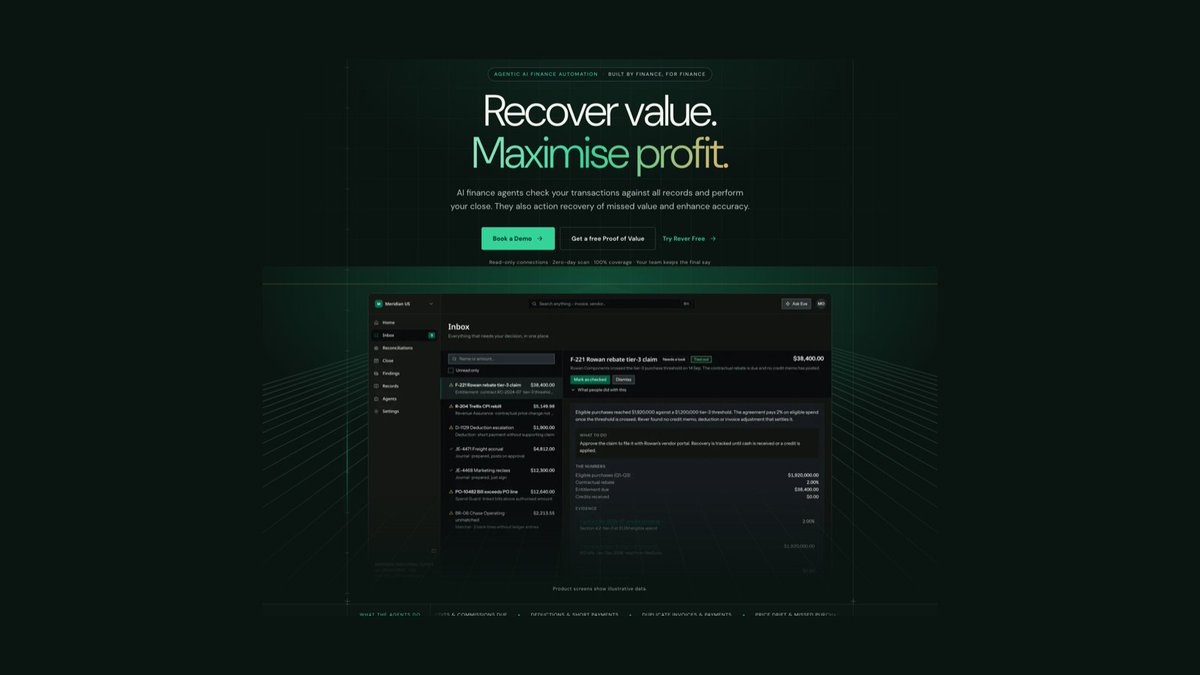
One rebate tier, one claim, two approvers: 60 seconds of Recover. Connect read-only, run the zero-day scan, see the entitlement gap, approve and file the claim.
It ends at 'claim filed'; recovered means cash received or a credit applied. Sample data on screen.
Rever build log, week 2.
Shipped: Zoho, Xero and Sage connectors (promised for 10 Oct, landed this week); sector contexts for manufacturing, SaaS and services; the Inventory agent.
Fixed: Inventory's first-week bugs, and the zero-day scan from ~4 hours to ~1 hour.
7 sets of books so far: leakage identified at [1.5]–3% of gross transaction value. One example: $1.3M in $120M. Identified, not recovered; recovered is $0 until it lands.
Next: the month-end items, then the five-company findings on 22 Oct. One hire in, five roles open.
You closed four quarters. Find out what leaked.
Its checks on a read-only connection, including duplicates, price drift, unclaimed rebates, short-pays, unmatched bank items, three-way exceptions.
Rever is hiring.
The main qualification: telling an agent it is wrong, with the evidence attached.
Engineering, marketing, sales, and finance experts to define and test the work.
First step: one paragraph, no CV, using the prompt for your role. [email protected]
Then: the first findings with the evidence behind each.
The duplicate payment, the rebate nobody claimed, the price that drifted from the contract. Eve answers questions about what it found.
Cost: nothing.
For twelve years my firm's success fee was earned only when recovered cash reached the client's bank.
A free scan is the same bet, in software.
Finds nothing: you lost nothing.
Finds something: you decide. Link below.
It does not bring back cash that left, or undo a payment to a changed bank account.
This points us to segregation of duties rules written long ago in Finance. How can agentic finance be any different?
@Reveragents carries a charter that defines:
Read: permitted sources only.
Prepare: with the evidence attached.
Propose: amount, source, what is uncertain.
Post: never without a person's approval.
What may your finance agent do on its own, and who decided?
I use Claude Code and Codex every day. Both ask me how much they may do on their own: what they can read, what they can change, when they must stop and ask.
For a finance agent, I want that written into its job description. Here's why.
In code, a bad autonomous action usually costs a revert. In finance, a reversing entry fixes the books.
Five outcomes tracked separately, identified through corrected, and the honesty ratio: recovered divided by found.
Screens on the site are illustrative.
Real numbers on 22 October.
Start with the scan: link below.
https://t.co/elavzqnV9m
@Reveragents
We rebuilt https://t.co/elavzqnV9m. It now leads with the thing I would have wanted as a controller: a scan you can run yourself before anyone calls you. What is on the site now, in four posts.
3. Fifteen agents in five work groups, each with a published scope: what starts its work, what it checks, who it hands off to, what it files, what stays with your team.
4. Pricing in the open, ten use cases with a page each, and the security page with the report on request.