I put an LLM in the boot sector of my PC. Now it wakes up and dreams a Linux boot log before any OS exists
510 bytes of asm, 11.5 KB of weights, 16-bit real mode. A 386 would do
What happens after the keypress: the sector hands control back to the bios with a single int 19h, the disk boots again, the sampler reseeds from the pit timer, and since there is no os anywhere on this disk the machine can only fall into a new dream
I put an LLM in the boot sector of my PC. Now it wakes up and dreams a Linux boot log before any OS exists
510 bytes of asm, 11.5 KB of weights, 16-bit real mode. A 386 would do
@sakurayukiai Saw this while researching prior art for my own take on the genre: the whole engine now fits inside the 510-byte MBR itself, and the model is trained for one thing, dreaming this machine's own boot log
https://t.co/W8OuOXbVfy
Repo: https://t.co/W8OuOXct56
Chess, an OS and a C compiler fit in 512 bytes. sectorlisp-nn ran a net during boot, sectorllm boots llama2 from ~1.2 KB
This one keeps the whole engine in the 510-byte MBR, trained for one job: dreaming this machine's own boot log
Trained on synthetic dmesg where every boot has one kernel version and one disk. Real boot logs repeat themselves, that repetition is what makes a tiny model look sane. 8 chars of context, one hidden layer, 96 units
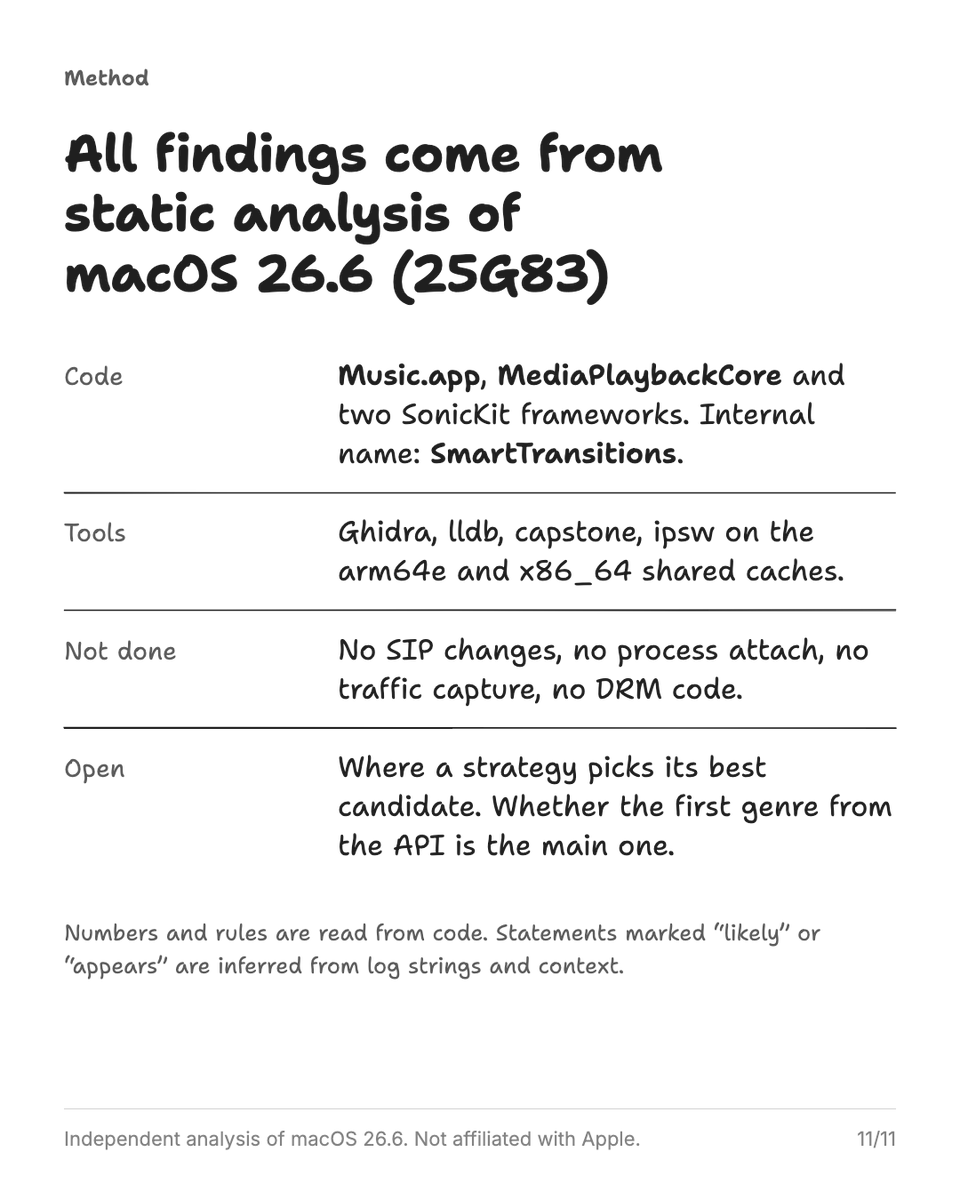
Method: static analysis of the macOS 26.6 (25G83) arm64e and x86_64 shared caches with Ghidra, lldb, capstone and ipsw. No SIP changes, no process attach, no traffic capture, no DRM code. Two questions remain open. Corrections welcome.
The outgoing song can start its transition up to 60 s before the end. At least 30 s of each song stays transition-free. Songs under 60 s get transitions of 2 s or less.