My Trading Process, Tools, Routine, and Core Beliefs
A 60 pages of experience-based lessons and insights curated from 15 years of my tweets.
1. Glossary – Terms and Expressions I Use
2. Charting – My Approach Using TradingView
3. My Screeners – Workflow of Finviz & Tradingview
4. Process & Routine – Moving Ideas to the Focus List
5. Pre-Market Routine – Situational Awareness
6. Proficient Execution– Trade Design, Stops, % Risk
7. Post-Execution – Trade Management
8. Journaling – Fine-Tuning to Improve YoY % Return
9. Conviction – Internalizing These 6 Graphics
10. Full-Time Trading – What Does It Takes
11. Five Books I Highly Recommend To Everyone
12. Free Productivity Tools & Websites I Rely On
13. How I Delayed My Own Progress by 3 Years
14. Reflections and Experiences for You to Relate To
15. Closing Remarks – A Call to Inspiration
16. FAQ, Paired with Thought-Provoking Questions
17. Subtle Strategies to Attract Institutional Attention
https://t.co/0F5tgGM49z
Managed to finish this project early as a Christmas gift🎄for everyone — enjoy!
How to Trade with a Full-time Job
Trading with a full-time job isn't easy, but it's manageable. I can trade my methodology in about 30 mins per session, while giving me the flexibility to manage all my other responsibilities. I'm a full-time engineer, a father of 4, a PhD student, fitness enthusiast, and have a range of hobbies I enjoy. I thrive on efficiency and effectiveness to juggle all of these things.
What's described below is a general process that can be used to get organized and get efficient. This method combines the thorough preparation of an anticipatory watchlist with the efficiency of automated alerts. Here’s a detailed plan to optimize your trading strategy while balancing your full-time job:
Step-by-Step Approach
1. Focused Scanning Process
Objective: Narrow down the universe of stocks to a manageable watchlist with the best potential setups based on specific criteria.
Define Your Criteria:
Volatility: Look for stocks with significant price movements to capture profitable trades.
Liquidity: Ensure stocks have enough trading volume to enter and exit positions easily.
Relative Strength: Identify stocks outperforming the broader market or their sector.
Momentum: Focus on stocks with strong upward or downward trends.
Linearity: Choose stocks with smooth, predictable price trends.
Price/Volume Action: Look for consistent patterns in price and volume that indicate potential breakouts or reversals.
Set Up Scanners: Use trading software or platforms that allow you to automate this scanning process. Configure scanners to filter stocks based on your defined criteria. Popular platforms like TradeStation, Thinkorswim, or TradingView have advanced scanning capabilities.
Create a Watchlist: After scanning, create a watchlist of stocks that meet your criteria or let your scanners narrow this list for you. Keep this list manageable by focusing on the top candidates. Knowing what you're looking for is critical to this step. If you have no idea what you're looking for, go back to studying the market and finding your top setups: https://t.co/hDO7wGBmzM
2. Implement Alerts
Objective: Automate the monitoring of your watchlist to notify you of potential trading opportunities without constant manual checking.
Set Alert Conditions:
Price Levels: Alerts for when a stock reaches key support or resistance levels.
Technical Indicators: Alerts for signals from indicators like moving averages, trendlines, etc.
Volume Spikes: Alerts for unusual volume activity, which often precedes significant price moves.
Breakouts/Bollinger Bands: Alerts for when a stock enters the “BO Zone” between the 60-min and 30-min upper Bollinger Bands.
Configure Alerts on Your Platform: Use your trading platform to set these alerts. Ensure the alerts are sent to your preferred device (e.g., smartphone, email) to stay informed in real-time.
3. Execute Trades Efficiently
Objective: Execute trades based on your alerts while managing risk effectively, given your time constraints.
Pre-Plan Your Trades:
Entry Points: Define your entry points based on alert criteria.
Position Sizing: Determine the size of each position according to your risk tolerance (0.25%-2% of your trading capital).
Stop-Loss Orders: Set stop-loss orders at levels such as recent hourly pivot lows or lower Bollinger Bands.
Profit Targets: Establish profit targets to lock in gains.
Use Stop-Market or Market Orders: I don't like setting stops at breakout point, personally, but some ppl have no choice. There are trade-offs to this approach. For significant breakouts where speed is crucial, market orders can ensure you enter the trade quickly. Don't miss trades trying to count nickels. We trade sufficiently liquid stocks to begin with.
Monitor and Adjust: Even with alerts, check in periodically (e.g., during lunch breaks or after work) to review your positions and adjust as necessary.
Tips for Success
Stay Disciplined: Stick to your predefined criteria and avoid impulsive trades.
Review and Refine: Regularly review your watchlist, scanning criteria, and alert settings to ensure they remain effective.
Leverage Technology: Utilize mobile trading apps to stay connected and responsive to alerts.
Time Management: Dedicate specific times during the day to review your trades and make necessary adjustments.
Example Routine
Morning (Pre-Market)
Run your scanner to update your watchlist.
Set or adjust alerts based on the latest scan results.
During Work
Monitor alerts on your phone or email.
Execute trades as alerts trigger, using pre-planned criteria.
Evening (Post-Market)
Review trades executed during the day.
Analyze performance and adjust the watchlist if necessary.
Prepare for the next day by reviewing news and market updates.
Conclusion
By combining a focused scanning process with automated alerts, you can manage your trades efficiently while balancing a full-time job. This hybrid approach allows you to capitalize on high-probability setups without the need for constant monitoring. Stay disciplined, leverage technology, and continuously refine your process to maintain a successful trading routine.
No one knows when the next big bull market will start, but there is one thing I am sure of: things won't look good when they do! The news will be bleak, stocks will look scary, and the future will seem uncertain. It is always this way, and I have proof. Inflation and war are not new, and the 1970s had traits similar to today's.
Take a look at the following 1970s/80s Time Magazine covers and where they occurred relative to the S&P 500.
When each bull market started, it did not feel "good" to buy stocks. No one was confident, and the market surprised everyone.
Be cautious, but have an investing process that is objective so you can effectively react to pertinent data. Lastly, as hard as it may be at times, be optimistic that the future will be bright. Bad times tend to spur people and governments to fix the problems.
Charts and Magazine covers👇👇
Your trading strategy is not your edge! It’s not unique, there’ll be many who use the same strategy.
Your edge is your ability to apply your strategy effectively.
Since very few can do this, that’s what truly makes a trader unique and successful.
This is your true edge💰
#TradingTips
If you cannot replicate a Trade/Investment for rest of your trading career, then you have no business taking that trade
Can you make a Trade a repeatable setup for rest of your life.
Ask urself before pressing button.Secret to Longevity! No "gut" feeling trades!
Learning how to identify good setup is easy and you can do it in a few months with enough effort.
Knowing when to push that setup and when to take a step back is hard and took me many years to be able to identify the clues the market gives constantly.
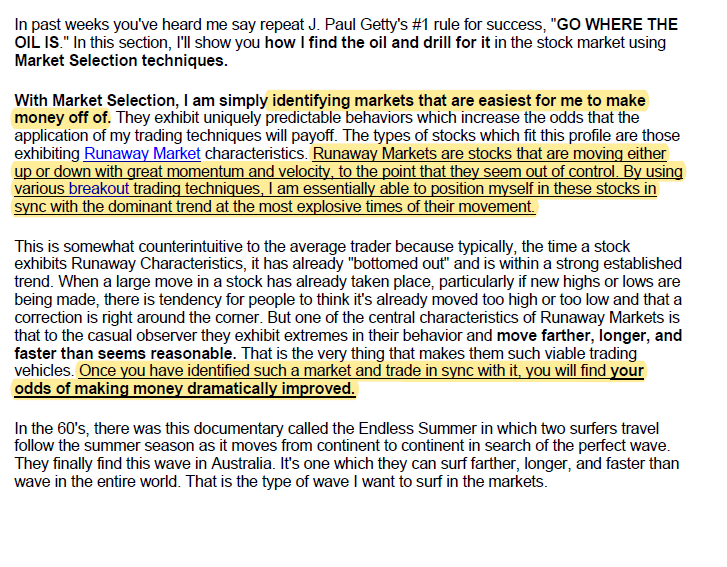
Read this section from Mark Boucher until it's burned in your brain. While most traders hyperfocus on tactics and indicators, the first order of business is identifying runaway "markets" (stocks). Only after you've found the strongest, fastest horses should you even consider looking at indicators and tactics. To do the opposite doesn't make sense. Imagine putting the best saddle and horseshoes on the slowest horse and then being upset when he isn't very fast. "But he has the best equipment, the best nutrition, the best XYZ". Ok, he's still the slowest horse and he'll never beat the fastest horse. It's the same way with stocks. Focus on the strongest trends and most explosive markup phases.