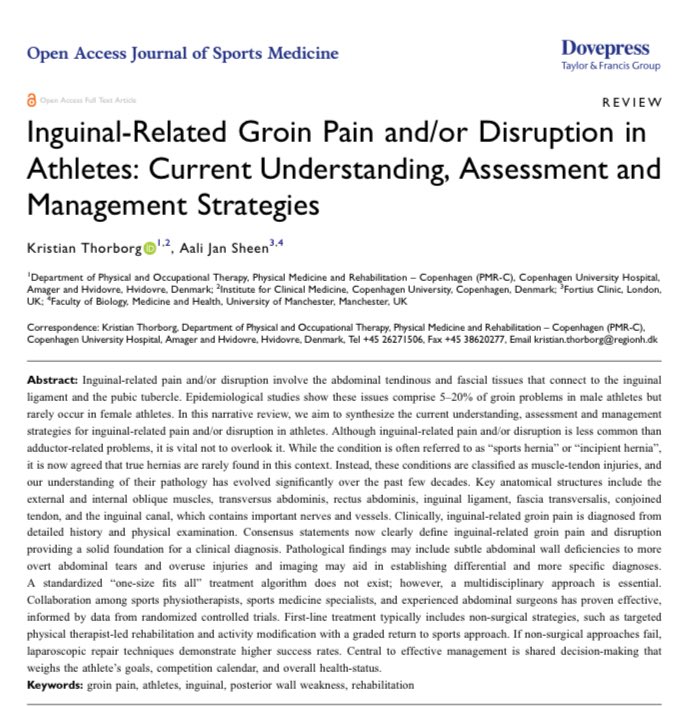
In great collaboration with Top-world expert on Inguinal-Related Groin Problems - Professor Aali Sheen - and I, have written an updated review on “Inguinal-Related Groin Pain and/or Disruption”
Covering aspects of anatomy, pathology, terminology, assessment, treatment pathways outcome and RTP.
We are very happy for it to be OPEN ACCESS and we hope that the sports physio/medicine community find it useful:
Download it FREE from here:
https://t.co/t57zsvInfX
Always learning🤩 - thanks Aali❤️ and all the great contributors in this space🏆
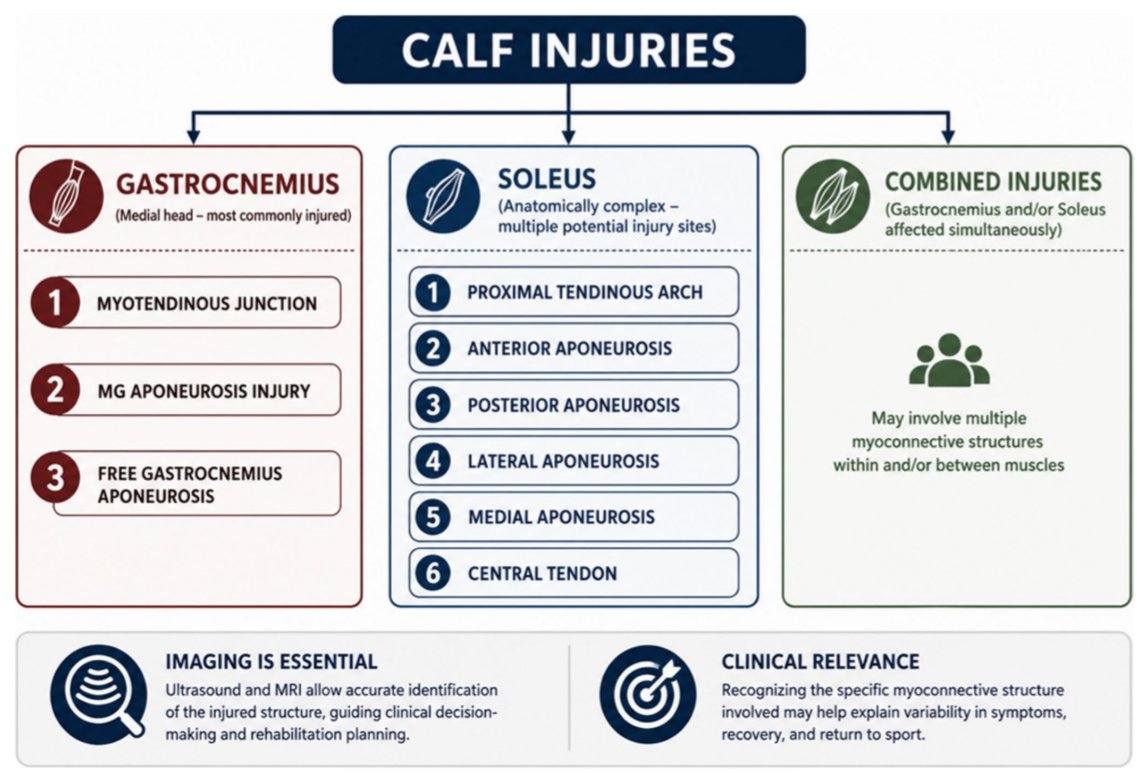
Calf Injuries: An Anatomy-Based Approach to #Diagnosis, Management and Return to #Sport
Current Reviews in Musculoskeletal Medicine ( fresh 2026)
Free online access here 👇
https://t.co/fVRdbQgplA
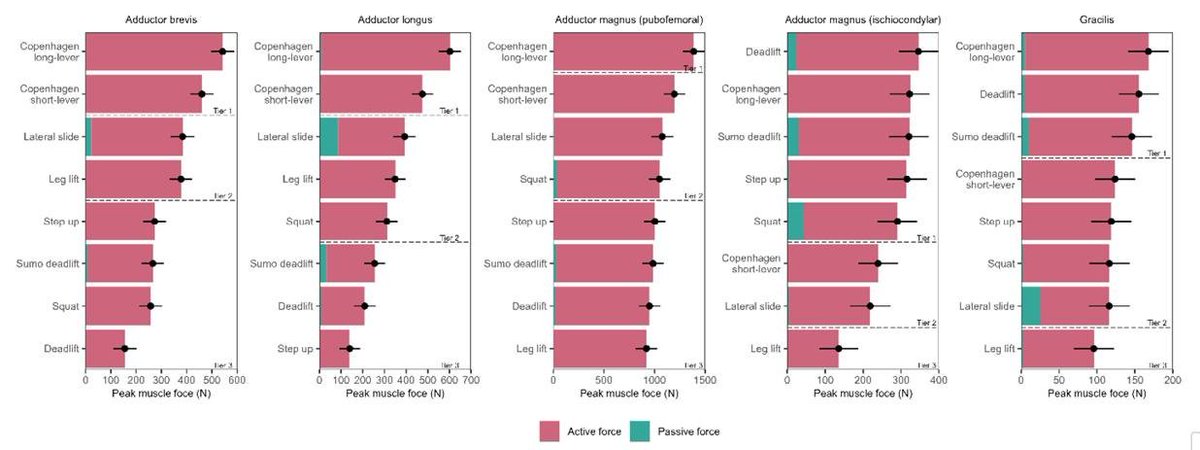
These results are also relevant as hip adduction strength is a modifiable risk factor for groin injuries and pain.
📊We hope this gives objective data to inform monitoring strategies and microcycle planning.
What are your thoughts on groin strength monitoring in your environment and have you noticed similar patterns with your players?
Looking forward to hearing your experiences! 👇
"Do fast players stay fast & slow players stay slow."
It's one of the most common assumptions in youth sport.
A recent study tracked 475 players from U12 to U19 over 8 years to test it.
The answer is more complicated than you might think. 🧵
New work by @TylerCollings3 and colleagues 🔥
Hip Adductor Muscle Forces During Strength Training and Rehabilitation Exercises 🏋️
https://t.co/UcqJtjRRbF
📢 To all healthcare professionals seeing patients with NCDs
Here’s a set of recommendations from our ACTIVATE consensus for how to assess, prescribe and promote #physicalactivity in clinical practice.
Link of paper https://t.co/9tKTlBWdw2
🌟 Symposium spotlight 🔦
“Social and psychological burden of knee injury”
When a child or adolescent sustains a knee injury, the injured knee may not be the only challenge. They may feel they miss out on being with friends and being part of a team. Their life is on pause.
🚨FINAL CALL📣
SECURE YOUR TICKET TODAY‼️
Register with early bird prices before the offer terminates today (10.12.2025) at 23:59 CET
📆 #Sportskongres2026 29th-31st of January 2026
“ACL rehabilitation in 2030”
This symposium aims to provide clinicians, researchers, and healthcare professionals with state-of-the-art insights into evolving trends, methodologies, and clinical considerations in anterior cruciate ligament (ACL) rehabilitation.
❔Want to know a bit more about our key note speaker and get inspired to go to this session?
🎧 Listen to the lastest episode of the Sportskongres Podcast.
https://t.co/aTfPsTYnsb
🔑 KEYNOTE 🔦
During this key note lecture Joanne Kemp will provide the latest evidence for researchers and clinicians on how to improve short- and long-term health for young athletes with hip and groin pain via best practice rehabilitation.
🗓️COUNT DOWN 3️⃣
Only three weeks till we will see you in Copenhagen for brilliant sessions, lots of great discussions and sharing of knowledge.
If you haven’t secured your spot, do not hesitate as we are close to the limitation of attendees.
👉🏻Register now!
Those who believe in “psychological pain”, “brain pain”, “conditioned pain”, “pain without nociception” etc., are not realizing that their main premises are based on the appeal to ignorance fallacy. Or in other words - “abscence of evidence is not evidence of abscence”. Just because we cannot identify sources of nociception doesn’t mean they are not there and that the pain is “psychological”. Another implicit assumption they make is to assume that our imaging modalities are finite and are capable of capturing all possible nociceptive states which is far from true.
"How is your thesis going?”–Ph.D. students’ perspectives on mental health and stress in academia
- 1 in 3 students above depression/anxiety thresholds
- Self-doubt + job insecurity = biggest predictors of poor mental health
- Bad supervision significantly worsens well-being
- Part-time work while doing PhD = burnout risk
The PhD mental health crisis isn't about weak students.
It's about systemic problems: exploitative labor conditions, poor supervision, job insecurity, and institutional neglect.
If you're struggling with your PhD, it's not your fault. These are predictable responses to broken systems.