AI can now generate scientific ideas at scale. But we need to know if the current state of the art can bridge the gap to physical validation – the phase constrained by what can be tested, how fast, and at what cost. To find out, we have doubled our investment in the AI Scientist programme to £6m.
We're backing 12 projects to see if autonomous systems can reason, plan, and run experiments in the real world. These teams are testing the limits of automation on deliberately unforgiving problems: Alzheimer’s and cancer therapeutics, material discovery, and understanding the mechanisms behind battery degradation.
Instead of looking for best-case scenarios, we’re looking for limits. Can these systems recover when experiments fail? Can they reason across disciplines? Can they decide what not to try?
By doing this, we are learning what happens when machines are asked to do science, and exploring what that means for the future of discovery.
Discover the projects: https://t.co/vixRFglooL
Postdoc opportunity in my lab in London. Two positions available to work on programming of novel plant traits:
🪴Plant Biologist and Synthetic Biologist! 🪴
Deadline soon — 3 August 2025.
Please share with suitable candidates!
@SynBioUK@ImperialBioeng@TheSainsburyLab@camplantsci@JohnInnesCentre
Our first partnership – with @brieflybio! It enables liquid handling for scientists with zero automation experience.
We decided to partner after seeing their demo, where it only took a molecular biologist 1-2 minutes (not days!) to set up a liquid handling block.
Spending a lot of time translating scientists' workflows into automated ones?
Check out @brieflybio's interface that flexibly converts text-based protocols into automation-ready ones. Here's an example for the @Biosero ecosystem.
Come see us at @SLAS_Org for a demo!
Can't figure out what changed between experiments?
Happened to me so many times... including in my own experiments 🫠
If you too struggle with this type of detective work, we'll be demoing this new feature at @SLAS_Org.
Booth 1252
Postdoc opportunity. Two positions available in my lab in London to work on engineering of plant traits:
🪴Plant Biologist and Synthetic Biologist 🪴
Deadline: 6 January 2025.
Please share with suitable candidates! 🙏
#synbio#biotech@ImperialCollege@MRC_LMS@SynBioUK
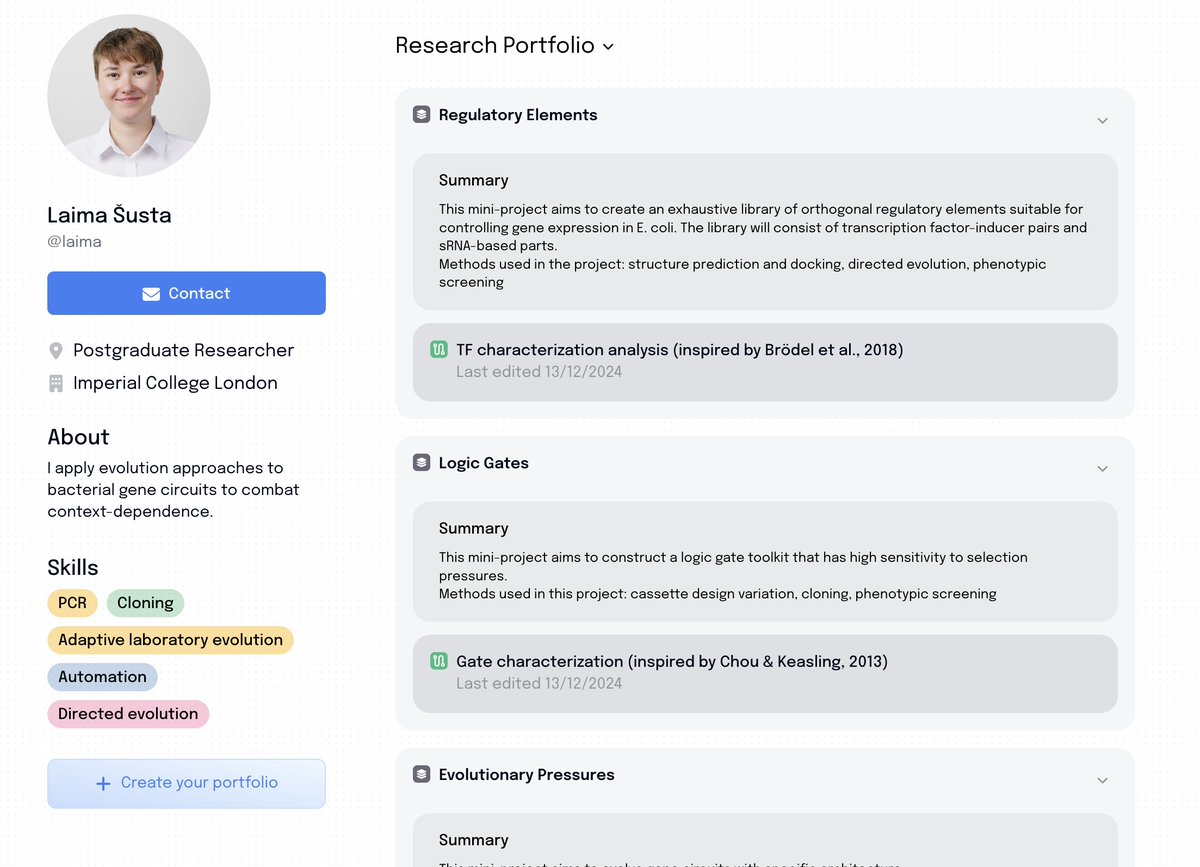
Meet Laima Šusta, Synbio PhD at @imperialcollege .
Laima is just starting out. She plans to harness evolution to develop more robust bacterial gene circuits, that have less context dependence than those built with rational approaches. 🧫
Rather than only sharing her work through journals, Laima is using her @brieflybio Portfolio to share her plans and update it as she starts her research. 🧐
You can take a look at these plans, as well as some of the protocols she's considering adapting.
Looking for a job in research ain’t easy.
It’s scary, especially early in your career when you don’t have many publications.
How do you show your skills?
We added a feature to @brieflybio to help scientists do just that.
Package up all the relevant lab-work in one place, your Research Portfolio.
Then, simply add the link to your job application.
Academics go free 😉
https://t.co/0QT22P1EfG
Doing sc-RNA sequencing? As part of his research, Nikolay Zolotarev has developed and optimised a number of protocols for nuclei isolation and RNA extraction.
Check them out on his @brieflybio portfolio – they're open for the community re-use, and adapt. Link below👇
Gotta extract some PBMCs?
Or run a Seahorse cell metabolic analysis?
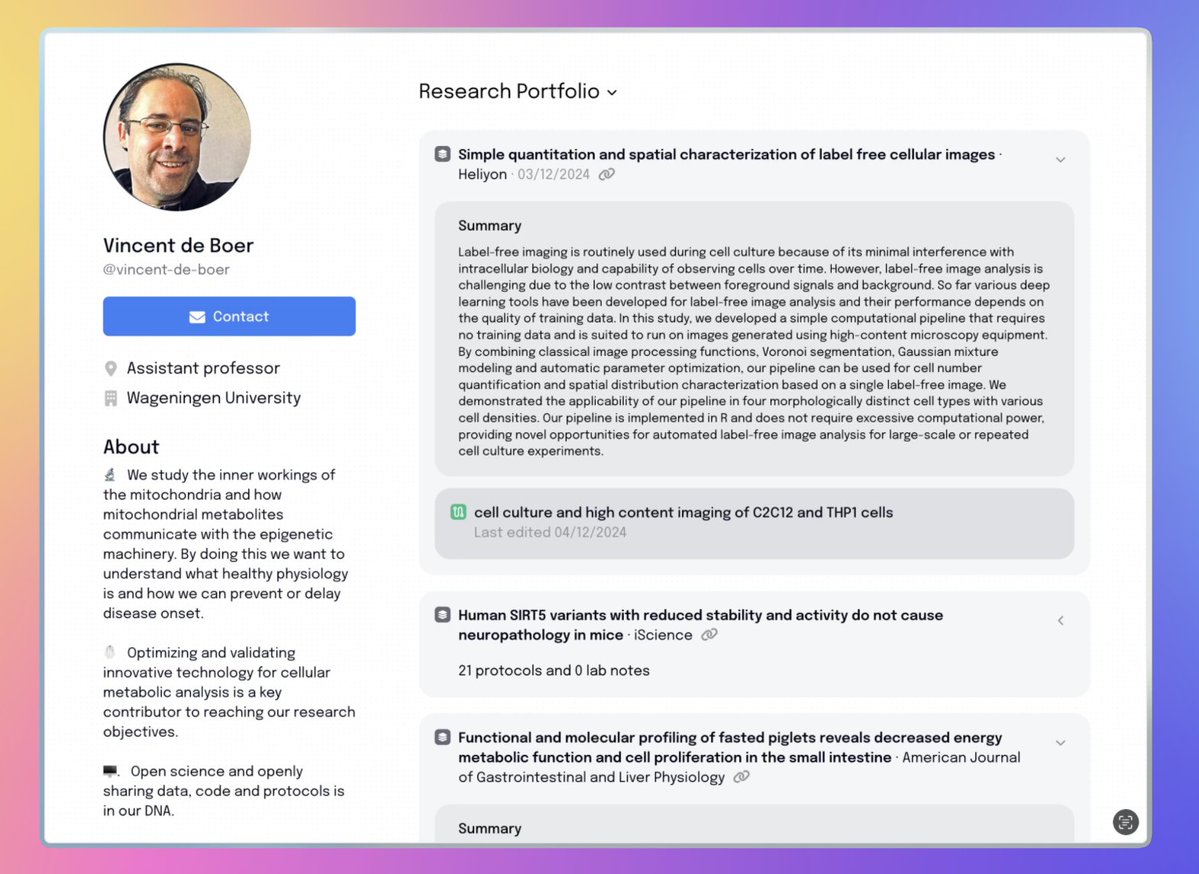
@vcjdeboer lab’s Portfolio is a goldmine of protocols 🔥
Based at 🇳🇱 Wageningen University, they study the inner workings of mitochondria and how mitochondrial metabolites communicate with epigenetic machinery.
Check it out here 👇https://t.co/ywH6kJ80EU