In 2016, a man with no CS degree quit his job to study for a Google interview.
He was an English major.
A self-taught web developer.
A former Korean translator in the US military.
He studied 8 to 12 hours a day. For 8 months straight.
Algorithms. Data structures. System design. Operating systems. Networking. Every topic Google asks.
He tracked every minute of it on GitHub. He called the repo "Google Interview University."
Then he applied to Google.
Google never called him back.
Here's the wildest part:
The repo he left behind became one of the most-starred projects on GitHub. Over 343,000 stars. Used by thousands of devs to break into FAANG.
He got hired at Amazon as a Software Engineer.
His name is John Washam. The repo is now called coding-interview-university.
Inside you get:
- A multi-month study plan, week by week
- Every CS topic Google, Amazon, Meta and Microsoft actually ask
- Algorithm patterns with worked examples
- System design from zero to senior
- Big-O, data structures, trees, graphs, recursion, dynamic programming
- Behavioral interview prep
- Mock interview drills
- Book and lecture recommendations he personally used
- Flashcards, video resources, and a coding question practice plan
Self-paced. Free. No course. No paywall. No upsell.
Just one engineer's 8-month study log, open for anyone who wants to follow it.
If you are preparing for a tech interview, this is the most complete free roadmap on the internet.
100% Open Source.
(Link in the comments)
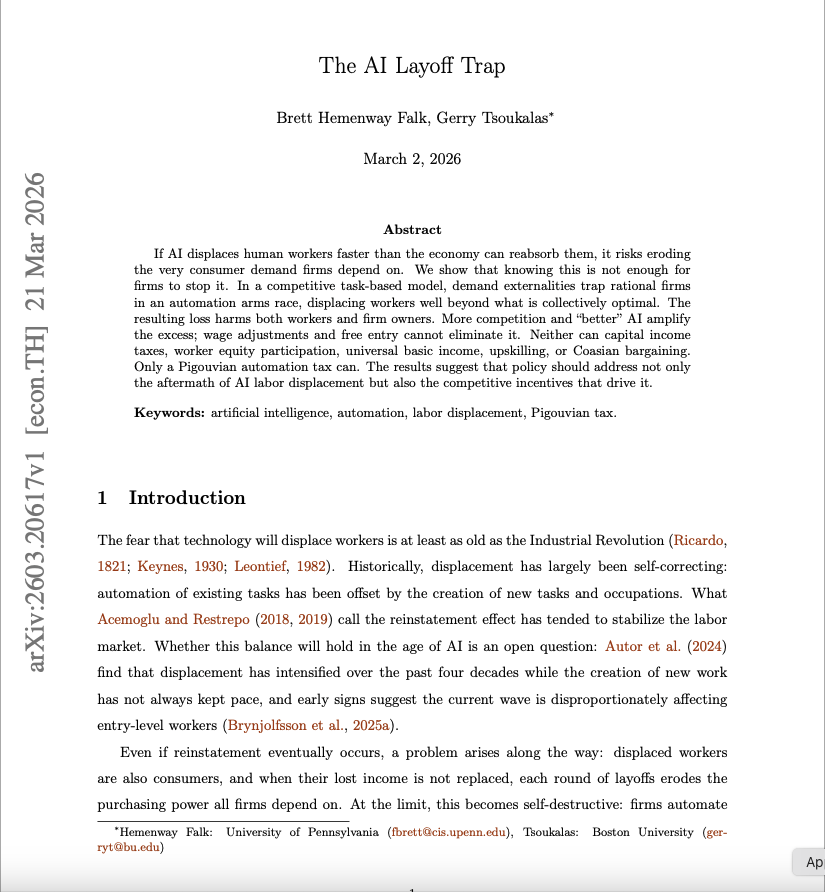
Two economists just published a mathematical proof that AI will destroy the economy.
Not might. Not could. Will — if nothing changes.
The paper is called "The AI Layoff Trap." Published March 2, 2026. Wharton School, University of Pennsylvania. Boston University. Peer reviewed. Mathematically modeled.
The conclusion is one sentence.
"At the limit, firms automate their way to boundless productivity and zero demand."
An economy that produces everything. And sells it to nobody.
Here is how you get there.
A company fires 500 workers and replaces them with AI. A competitor fires 700 to keep up. Another fires 1,000. Every company is behaving rationally. Every company is following the incentives correctly. And every company is building a trap for itself.
Because the workers who were fired were also customers.
When they lose their jobs faster than the economy can absorb them, they stop spending. Consumer demand falls. Companies respond by cutting costs — which means automating more workers — which means less spending — which means more falling demand — which means more automation.
The loop has no natural exit.
The researchers tested every proposed solution. Universal basic income. Capital income taxes. Worker equity participation. Upskilling programs. Corporate coordination agreements.
Every single one failed in the model.
The only intervention that worked: a Pigouvian automation tax — a per-task levy charged every time a company replaces a human with AI, forcing them to price in the demand they are destroying before they pull the trigger.
No government has implemented this. No major economy is seriously discussing it.
Meanwhile the numbers are already tracking the curve. 100,000 tech workers laid off in 2025. 92,000 more in the first months of 2026. Jack Dorsey fired half of Block's workforce and said publicly: "Within the next year, the majority of companies will reach the same conclusion."
Nobody is doing anything wrong. Companies are following their incentives perfectly. That is exactly the problem.
Rational behavior. At scale. Simultaneously. With no mechanism to stop it.
Two economists built the math. The math leads to one place.
Source: Falk & Tsoukalas · Wharton School + Boston University ·
https://t.co/4m8E9jQNYm