Technology Strategist| Principal Programme Officer| Scientific Transformer| Projects Director| AI Safety Research Fellow| Mentor-21st Century STEM Skills
Building Partnerships for Africa’s Shared Prosperity
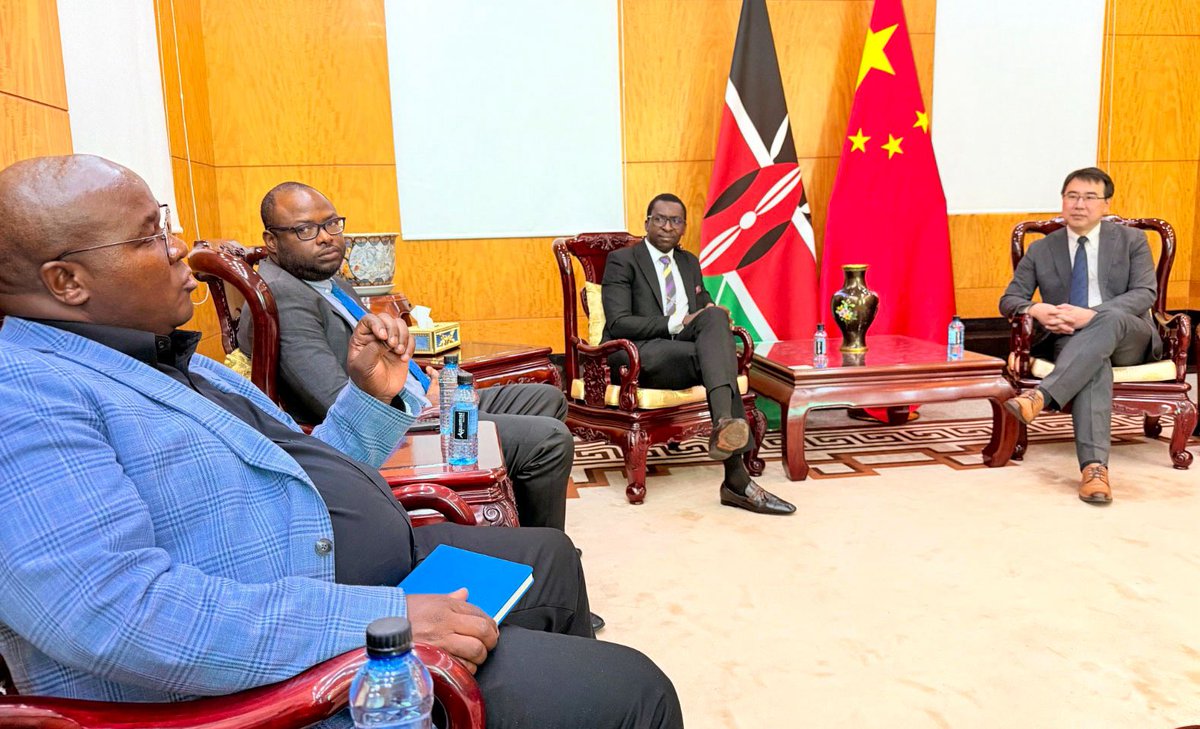
Today, our AUDA-NEPAD delegation, led by HCID Director @SymerreGrey, met with H.E. Counsellor Qui Zhongyi of the Embassy of the People’s Republic of China in South Africa, represented on X by Ambassador @AmbWuPeng.
The discussions advanced our shared commitment to South-South Cooperation and Development under the Forum on China-Africa Cooperation (#FOCAC) and the Belt and Road Initiative (#BRI).
This engagement builds on the high-level work championed by our CEO, H.E. Madam @nardosbthomas, including her visit to Beijing in April 2026; July engagements with the Ministry of Commerce of China @MOFCOM_China, the China International Development Cooperation Agency @cidcaofficial, AIBO, the International Cooperation Centre, @PKU1898 and @NNU_China; the Joint Presidential Roundtable co-hosted with the International Cooperation Centre of China during #UNGA81 in New York; engagements with Chinese missions across Africa; and site visits in Kenya for the Continental Centre of Excellence for HCID, including @TechnopolisKE at Konza.
At the heart of our discussions was Africa’s health workforce. Phase 1 of the Strengthening Africa’s Nursing and Midwifery Workforce programme, supported by China and other development partners, trained more than 200 nurses, midwives and Master Trainers, while contributing to the harmonisation of nursing curricula across the continent.
We also discussed China’s support for the Continental Centre of Excellence, with land committed by Kenya at Konza, as well as opportunities for cooperation in TVET, green mining, industrial skills development and local pharmaceutical manufacturing all aligned with #FOCAC, #Agenda2063 and Africa’s development priorities.
Our conversation also looked ahead to AFESTACC & ISWA 2026, taking place in Accra, Ghana, from 9–12 December. The event is expected to welcome 4,000 day delegates and 35,000 evening delegates, alongside exhibitions showcasing industrial products, solutions and investment opportunities. China has confirmed its participation.
We also value the engagement of China’s diplomatic missions across the continent, including @ChineseZimbabwe , @ChinaEmbinRW and @ChineseEmbKenya, as we continue to strengthen Africa–China cooperation.
The next step is to co-create a clear way forward, including Phase 2 of the Nursing and Midwifery Workforce programme, while leveraging South-South Cooperation under #FOCAC and the #BRI, together with South Africa’s experience as host of our AUDA-NEPAD.
These discussions are more than diplomacy. They are about building lasting partnerships that strengthen people, institutions and shared prosperity across Africa.
@kudadandaz
#AUDANEPAD #SouthSouthCooperation #HealthWorkforce #NursingAndMidwifery #HumanCapitalDevelopment #AfricaRising #AFESTACC2026 #ISWA2026 #ChinaAfricaRelations #SharedProsperity
Building the Nursing and Midwifery Workforce Africa Needs
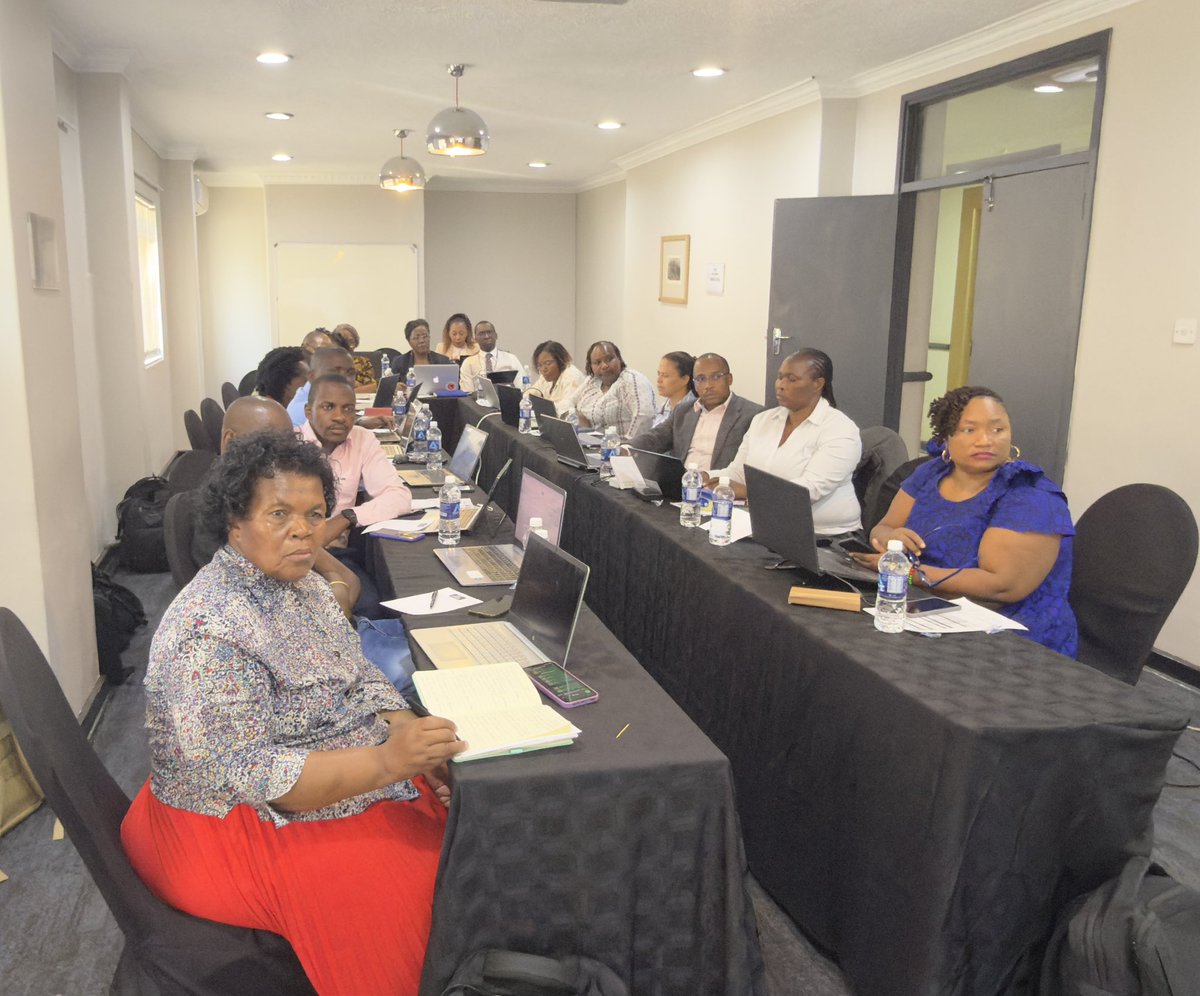
Today, we concluded the Training of Master Trainers under the Strengthening Africa’s Nursing and Midwifery Workforce (SANMW) Programme.
Twenty participants from different countries including Heads of Faculties, Registrars and Committee Chairscame together with a shared understanding: Africa needs a coordinated strategy to strengthen its nursing and midwifery workforce.
The message was clear. Human capacity development must be at the centre of every intervention designed to improve nursing and midwifery across the continent.
With the leadership of our AUDA-NEPAD CEO @nardosbthomas and the Director of Human Capital and Institutional Development, @SymerreGrey, the next phase of SANMW must place the development of competent, confident and well-supported nurses and midwives front and centre.
The upcoming seminar in Ghana will provide an important opportunity for stakeholders to participate in shaping Phase 2—co-designing practical interventions that respond to the realities of nursing and midwifery education, training, mentorship and service delivery.
The vision is bigger than a training programme.
It is about building a stronger health workforce capable of delivering better health and wellbeing outcomes for Africa’s people, especially mothers and newborns.
By investing in nursing and midwifery capacity, we are investing in safer pregnancies, healthier births and stronger communities.
Together, we can help reduce maternal and newborn mortality and build the Africa we want, one supported by a competent, empowered and resilient nursing and midwifery workforce.
@MOFCOM_China@ChineseZimbabwe@AmbWuPeng@ChineseEmbKenya@ChinatoAU@WHO@ChnConsulateJhb@kudadandaz@Sgegede
#SANMW #NursingAndMidwifery #HealthWorkforce #MaternalHealth #NewbornHealth #TrainingOfTrainers #HealthcareInAfrica #Agenda2063 #TheAfricaWeWant
In Harare, Zimbabwe, a new chapter for Africa’s nursing and midwifery workforce began today.
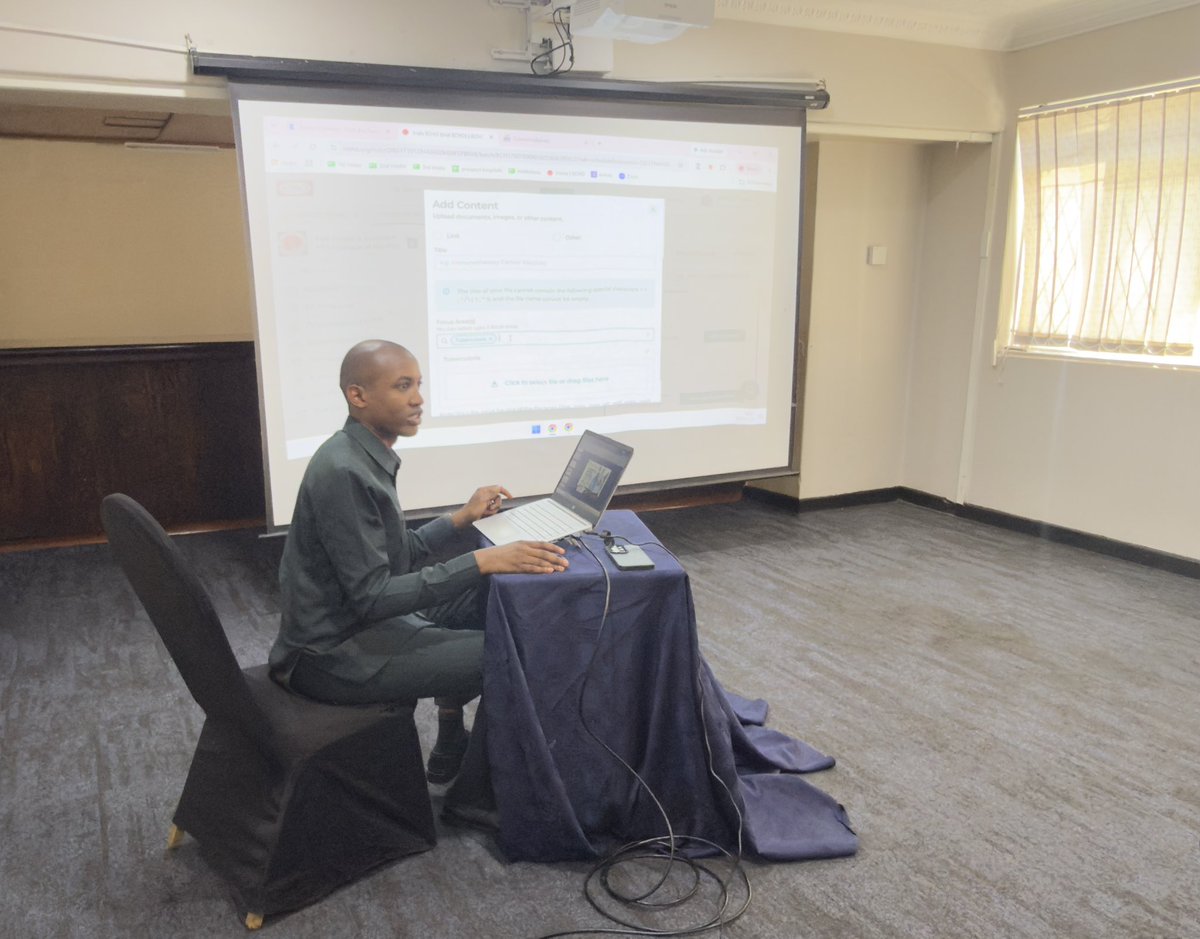
Representing our Director for Human Capital, Social and Institutional Development, Mr Symerre Grey-Johnson (@SymerreGrey), Dr Kudakwashe Dandajena (@kudadandaz) opened the Master Trainers Training, bringing together nurse and midwife educators from 20 African countries.
Across specialist fellowships in midwifery, advanced neonatal nursing, critical care, perioperative care, nurse anaesthesia, oncology, mental health, chronic disease management, and nursing leadership, participants are preparing to become programme directors, mentors and preceptors who can multiply knowledge across their countries.
Under the Strengthening Africa’s Nursing and Midwifery Workforce Programme, the evidence-based Training of Trainers model combines digital clinical supervision, preceptorship, virtual and blended learning, and supervised clinical placements. Through iECHO and Zoom, educators will connect across borders for case-based telementoring and specialist learning.
The targets are clear: certify at least 95% of Master Trainers, achieve a minimum 20% average gain in knowledge, complete 20 country cascade plans, and train at least 150 mentors and preceptors within 12 months.
Speaking on behalf of AUDA-NEPAD CEO H.E. Madame Nardos Bekele-Thomas (@nardosbthomas), Dr Dandajena said the programme is expanding into Phase 2 to reach more AU Member States. The lessons emerging from Harare will help shape the Phase 2 framework and inform a dedicated side event at AFESTACC and ISWA 2026 in Accra, Ghana, from 9–12 December.
With the support of @ECSA_HC, @ecsacon, the @MoHCCZim and the Government of the People’s Republic of China through South-South Cooperation and Development, Africa is investing in the educators who shape the caregivers of tomorrow.
Stronger clinical teaching and mentorship enabled by digital innovation mean safer care, more person-centred services, and better intrapartum and neonatal outcomes. Ultimately, they can help prevent maternal and newborn deaths.
@MOFCOM_China@ChineseZimbabwe@AmbWuPeng@ChineseEmbKenya@ChinatoAU@WHO@ChnConsulateJhb
#SANMW #Nursing #Midwifery #DigitalHealth #AfricaHealth #SouthSouthCooperation #MaternalHealth #NewbornHealth
AI is ready. The question is: how do we turn it into real-world human benefit?
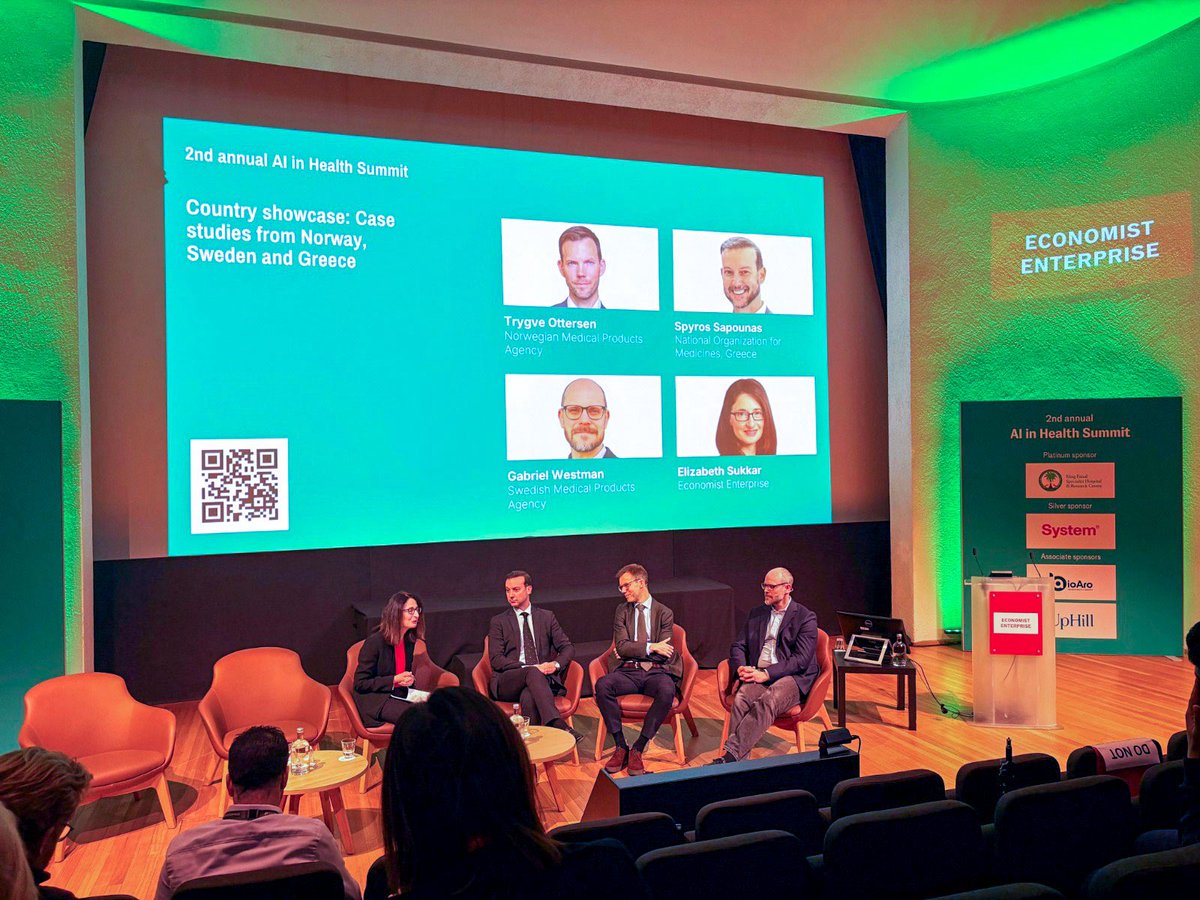
This week, representing Mr @SymerreGrey, our Director of AUDA-NEPAD’s Human Capital, Social and Institutional Development (HCID), Dr @kudadandaz is participating in the Future of Health and 2nd Annual AI in Health Summit at the Royal College of Physicians in London.
The Global Summit brought together more than 300 health leaders, policymakers, clinicians, innovators, researchers and investors from over 50 countries. Across 60 speakers and more than 20 sessions, participants explored the opportunities and challenges of moving artificial intelligence in health from promising pilots to practical, scalable solutions.
Dr Dandajena shared our AUDA-NEPAD’s vision for a healthy, educated, skilled and empowered Africa, underpinned by evidence, health intelligence and data-driven decision-making.
He highlighted how AI and digital health can help advance Africa’s three health imperatives:
Access. Availability. Affordability.
Achieving these goals will require more than technology alone. It will depend on interoperable systems, health information exchange, clinical decision support, predictive analytics and responsible AI designed with the realities of low-resource settings in mind.
The summit’s message was clear: the world must move urgently from isolated experiments to validated solutions at scale. That means investing in quality coded data, interoperable digital public infrastructure, digitally skilled health workers, strong governance and sustainable financing with patients at the centre of every decision.
These priorities closely align with our AUDA-NEPAD’s work in health and wellbeing, health data, applied digital systems, innovation and workforce transformation, guided by the AU Continental AI Strategy** and STISA-2034.
Engagements such as this strengthen Africa’s voice in global conversations on AI and health. They also create pathways for new partnerships, knowledge exchange and investment in the continent’s digital health future.
Africa is not only part of the conversation on the future of health. Africa is helping shape it.
#AUDA #NEPAD #DigitalHealth #AIinHealth #HealthInnovation #AfricaRising #HealthSystems #ArtificialIntelligence #STISA2034 #ContinentalAIStrategy
Turning Investment into Opportunity Through Human Capital Development
Under the leadership of our CEO H.E. @nardosbthomas, and on behalf of Director Mr. @SymerreGrey, our delegation led by Dr. @kudadandaz met with Mr. Zhang Zhizhong, Minister Counsellor and Deputy Head of Mission at the Chinese Embassy in Kenya.
The engagement built on the CEO’s diplomatic outreach in New York during UNGA81, Beijing, Pretoria, Addis Ababa, Kigali, Harare and other key centres advancing the proposed Continental Centre of Excellence for Human Capital and Institutional Development.
With the Government of Kenya having offered three potential sites to host the Centre, discussions focused on the next steps. China reaffirmed its willingness to support the initiative, noting its alignment with President Xi Jinping’s three proposals announced at the 2023 BRICS Summit on African industrialisation, agricultural modernisation and China–Africa talent development.
One message stood out clearly: investments in Africa’s technology, construction, mining and manufacturing sectors must be matched by a skilled workforce ready to operate, maintain and advance modern technologies.
This is where Technical and Vocational Education and Training (TVET) becomes transformative, bridging the skills gap, strengthening productive capacity and turning investment into opportunity for Africa’s young people.
Following this Nairobi engagement between our agency, the Governments of Kenya and China, and AU Member States including Zimbabwe, attention now turns to completing the technical evaluation of the proposed sites and accelerating preparations for Phase I construction.
The Continental Centre of Excellence for HCID is more than a facility. It is a flagship African South-South Cooperation and Development project designed to build the human capital and institutions that will power Africa’s future.
@NEPAD_Agency@GovtOfKenya@WilliamsRuto@ChineseEmbKenya@AmbWuPeng@ChinatoAU@MOFCOM_China@cidcaofficial
#AUDANEPAD #HumanCapital #InstitutionalDevelopment #TVET #SkillsForAfrica #AfricaChina #SouthSouthCooperation #Agenda2063 #Kenya #Zimbabwe #AfricaRising
At Konza Technopolis, Africa’s human-capital story is already taking shape.
The proposed sites we visited bring together a growing ecosystem of institutions working across education, research, innovation, technology and skills development: @OpenUniKenya, @Kenya_aist, @RiaraUniversity, @ACTSNET and the National Data Centre, under the leadership of @TechnopolisKE.
The envisioned AUDA-NEPAD HCID Continental Centre of Excellence would build on these foundations and connect them to expertise and innovation ecosystems across Africa.
Its purpose is clear: turn knowledge into scalable solutions, strengthen collaboration across the continent and accelerate the development of Africa’s human capital.
From Konza to the wider continent, the future is being designed through partnerships, institutions and bold ideas.
#HCID #AfricaRising #HumanCapital #Innovation #Agenda2063 #KonzaTechnopolis #AUDA_NEPAD
🇰🇪🌍 OUR DELEGATION BEGINS SITE VISITS
The vision for Africa’s Continental Centre of Excellence for Human Capital and Institutional Development (HCID) is taking shape on the ground.
The Government of Kenya, represented by @StateHouseKenya and under the leadership of President William Ruto @WilliamsRuto, is advancing its commitment to host this landmark continental initiative.
This morning, our delegation representing CEO H.E. @nardosbthomas, and led by @SymerreGrey, Director of Human Capital and Institutional Development, visited Konza Technopolis City.
The visit focused on the Technopolis Development Authority @TechnopolisKE, one of three proposed sites for the Centre, and explored its integrated infrastructure and enabling systems.
Together with the@NepadAprmKenya, representatives of the Government of Zimbabwe @zimbabwe_of, and academia, the delegation assessed Konza’s potential to support the establishment and operationalisation of this continental centre.
The engagement builds on strategic discussions held in Beijing, during HCID Week and at the 81st United Nations General Assembly in New York.
From international engagements to site-level assessment, the vision is moving from dialogue to delivery.
The Continental Centre of Excellence for HCID will help strengthen Africa’s human capital, build effective institutions and accelerate the implementation of Agenda 2063.
A shared vision. A continental ambition. A stronger Africa.
#AUDANEPAD #HCID #Agenda2063 #Kenya #KonzaTechnopolis #HumanCapital #InstitutionalDevelopment #AfricaWeWant #NEPADAPRM
The question is not merely what we can achieve by 2045, but what Africa must become by 2063.
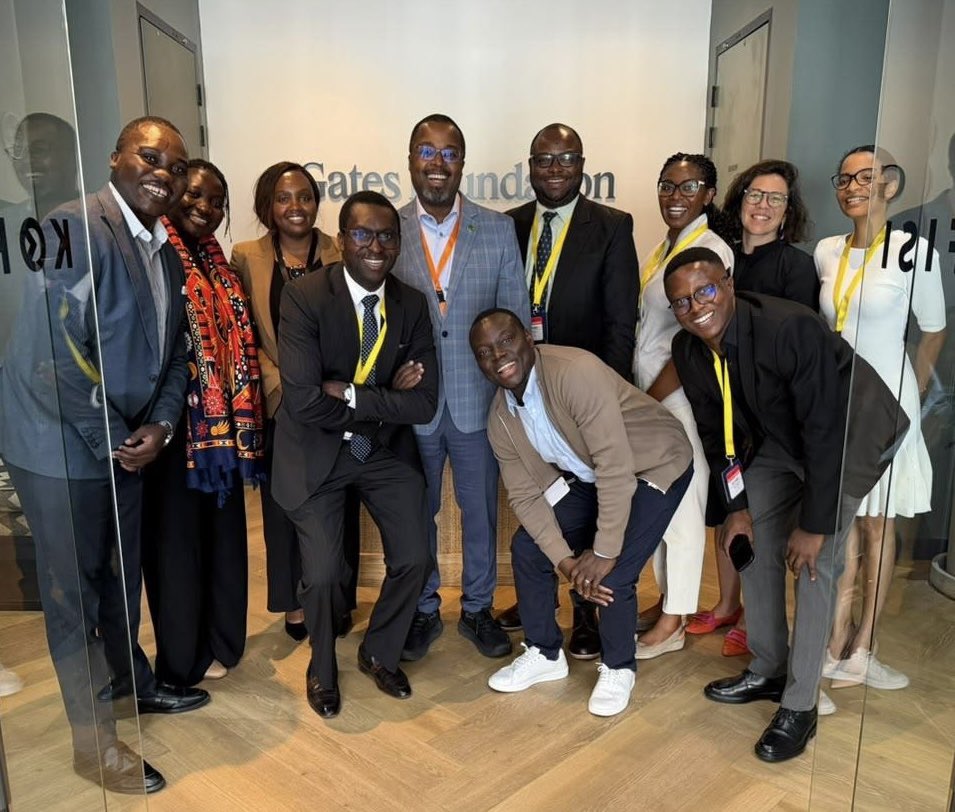
Today, our technical engagement with the @GatesAfrica in Nairobi, Kenya, explored how our institutions can maximise their collective impact.
Guided by the leadership of our CEO H.E. @nardosbthomas, represented by Director @SymerreGrey, we reflected on a sobering timeline: approximately 19 years remain until the Gates Foundation’s planned closure in 2045, while Agenda 2063 has approximately 37 years remaining.
These are not simply dates on a calendar. They are a critical window to transform collaboration and partnerships into tangible, sustainable and resilient African capabilities—capabilities that endure beyond institutional and funding cycles.
Our AUDA-NEPAD and the Gates Foundation share a commitment to improving lives. Our challenge is to align our distinct mandates, harness artificial intelligence to sharpen decision-making, avoid duplication and measure partnership by its tangible impact on African people.
Our discussions focused on health security and the local manufacturing of health products, @_AfricanUnion inter-agency coordination, health investment and financing, health and nutrition standards, nursing and midwifery, digital health innovation, and the Africa Critical Skills Bank.
The imperative is clear: mobilise resources, improve spending efficiency and translate these priorities into investments that strengthen Africa’s health economy.
At the centre of it all is human capital.
What does development mean if it cannot give a child a healthier beginning, equip a nurse to save lives, empower young people with meaningful opportunities and enable Africa to shape its own future?
History will not measure our legacy by the institutions we preserve, but by the lives transformed, the capabilities built and the opportunities secured for generations we may never meet.
The next step is decisive implementation: turning the priority actions identified into measurable progress before our next engagements, ahead of the African Festival of Arts, Culture and Creatives (AFESTACC) and Industrial Skills Week Africa.
Africa’s future will not be inherited. It will be built deliberately, collectively and with urgency.
@RockefellerFdn
#Agenda2063 #AfricaRising #HealthSecurity #HumanCapital #LocalManufacturing #DigitalHealth #AUDANEPAD #PartnershipForImpact #AfricaHealthEconomy
In Nairobi, the work to shape Africa’s future took another important step forward.
Our AUDA-NEPAD and @NepadAprmKenya technical teams finalised preparations for the planned assessment of three proposed sites for the Continental Centre of Excellence for Human Capital and Institutional Development (HCID).
Beyond assessing locations, the mission is about laying the foundation for a continental institution that can strengthen Africa’s human capital, support capable institutions and accelerate development driven by African knowledge, skills and leadership.
The teams focused on defining the technical assessment criteria, coordinating high-level engagements with the Government of Kenya and key stakeholders, and clarifying roles and responsibilities to support informed strategic decision-making by the leadership.
The meeting established a shared understanding of the mission’s expected outcomes, together with a coordinated roadmap, clear responsibilities and timelines.
The next phase is about turning preparation into action and action into a Centre that contributes meaningfully to Africa’s development journey.
Step by step, partnership by partnership, we are building the capabilities Africa needs to realise the promise of Agenda 2063.
#Agenda2063 #HumanCapital #InstitutionalDevelopment #AUDANEPAD #NEPADAPRM #AfricaRising #PartnershipForDevelopment
Building on investments. Deepening partnerships. Advancing Africa’s development.
This week in Nairobi, our delegation representing our CEO H.E. @nardosbthomas, led by Director of Human Capital and Institutional Development, @SymerreGrey, is engaging with the @GatesAfrica Office to reflect on progress, draw lessons from investments to date and shape strategic priorities for 2027 and beyond.
The discussions are grounded in a shared understanding: resilient African health systems require strong institutions, skilled people, local manufacturing, frontier digital innovation and sustainable financing.
Mr. Grey-Johnson recognised the Gates Foundation’s contribution to continental health development, including support for the African Medicines Regulatory Harmonisation and AU-3S programmes - important foundations for the establishment of the @AU_AMA_.
The dialogue also spotlighted Kenya’s commitment to hosting the proposed Continental Centre of Excellence for Human Capital and Institutional Development, following the @GovtOfKenya’s commitment of land under the leadership of H.E. @WilliamsRuto. The Centre will help strengthen Africa’s capacity to adapt technology, build institutional capabilities and advance African-led development through South-South cooperation.
As we continue to mobilise investment, advance continental priorities and deepen our presence across Member States through the CEO’s country footprint initiative, the objective is clear:
To build on what has been achieved, learn from experience and forge deeper collaboration for Africa’s health security, human capital development and institutional transformation.
#AUDANEPAD #AfricaRising #HealthSecurity #HumanCapitalDevelopment #InstitutionalTransformation #AfricanLedDevelopment #PartnershipsForDevelopment #AfricaHealth #Innovation #SustainableDevelopment
5/8 From Cooperation to Industrial Capability
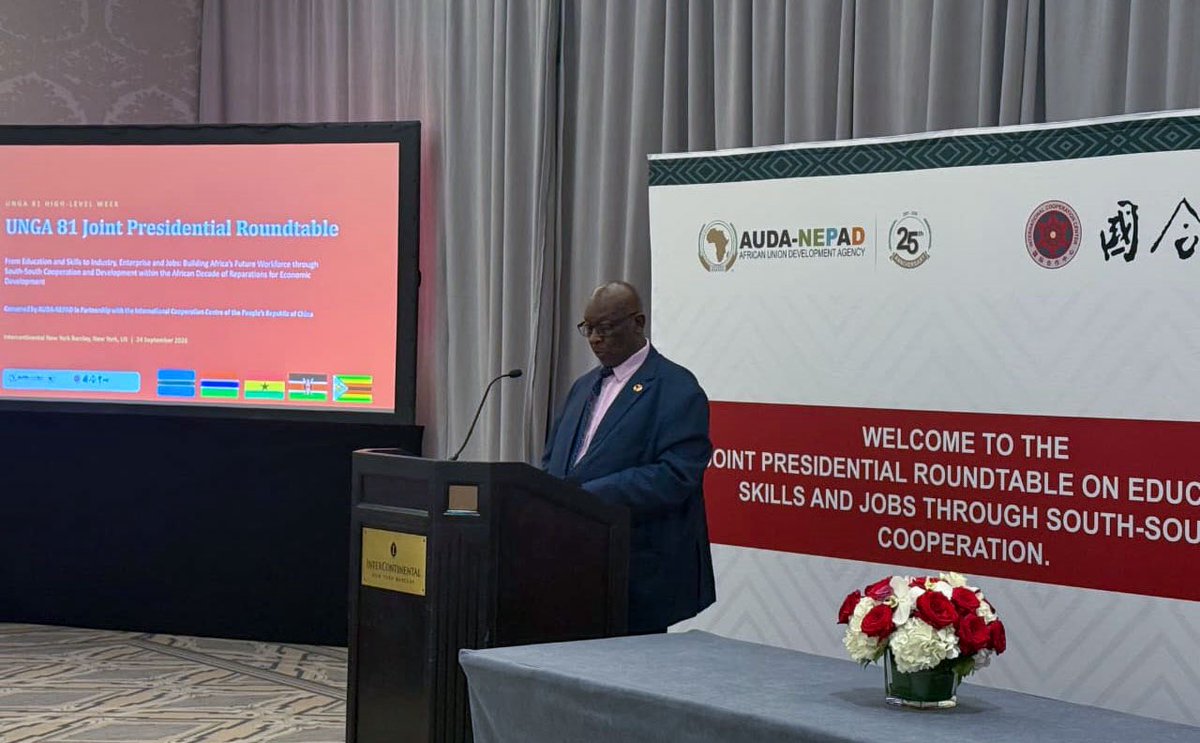
Zimbabwe brought a concrete industrialisation story to the #UNGA81 Joint Presidential Roundtable.
Representing H.E. President @edmnangagwa, Dr Willard Manungo shared how South-South Cooperation is supporting infrastructure, productive capacity and industrial transformation—from power generation and transport to digital infrastructure and high-performance computing.
But he also made an essential point:
Infrastructure and capital alone cannot sustain industrialisation.
Industrialisation needs engineers, scientists, technicians, artisans, entrepreneurs, researchers, managers and innovators.
That is the thinking behind Zimbabwe’s Heritage-Based Education 5.0 approach, which connects education and research directly to innovation and industry.
As Dr Manungo put it:
“Our universities must not only produce graduates who seek employment; they must produce knowledge, technologies, innovations and enterprises that create employment.”
This means moving research beyond laboratories into factories, farms, mines, communities and markets and building a connected ecosystem between universities, government, research institutions and industry.
It also raises a more demanding question for development cooperation:
What can African institutions, enterprises and people do now that they could not do before?
That is the true measure of lasting partnership: not only what was funded, but what capabilities remain.
@edmnangagwa@MICTPCS_ZW@Chinamission2un@ChinaAmbUN@CHN_UN_NY@GSMA@GSMAm4d@RealSmartAfrica@DeepIndaba@Googleorg@Microsoft@Meta@OpenAl@Cisco@PKU1898@AfDB_Group@IFC_org@IFCAfrica@nardosbthomas@SymerreGrey@kudadandaz@BarbsGlover
#Industrialisation #SouthSouthCooperation #Innovation #HumanCapital #Education #AfricaRising #UNGA81
4/8 From Commitments to Results
Africa does not lack ambitious policies.
Agenda 2063, AfCFTA, CESA, STISA 2034 and national development plans all set out a clear vision for the continent’s future.
The harder question is: What happens between agreement and implementation?
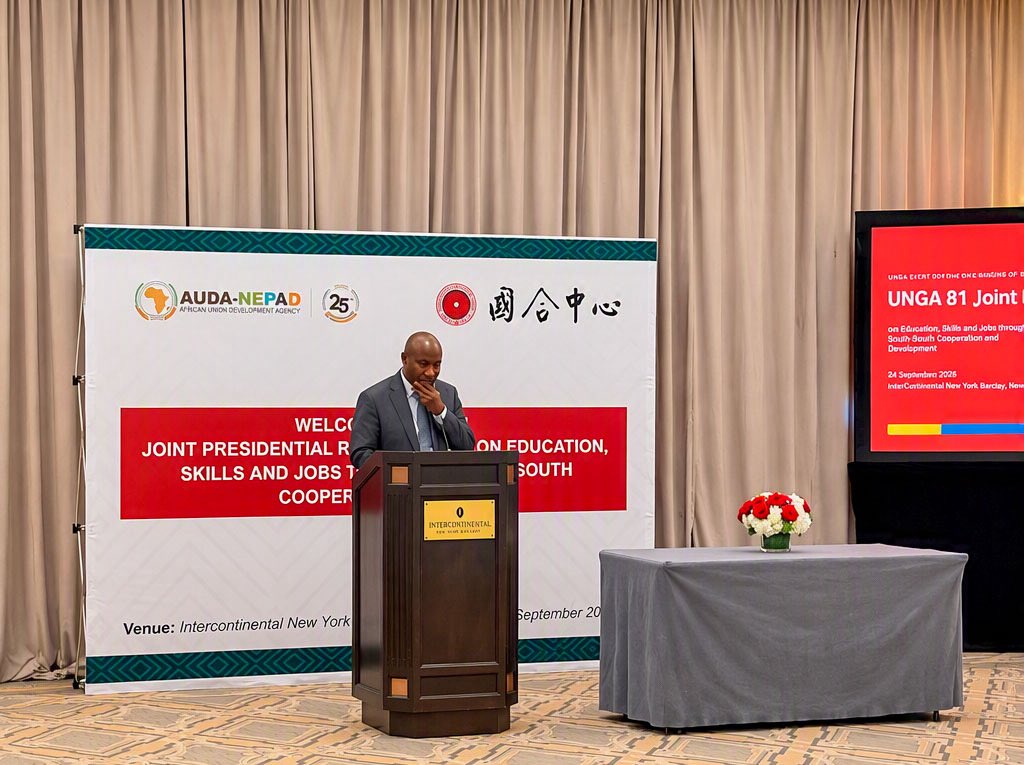
Representing H.E. President @WilliamsRuto, Kenya’s Cabinet Secretary for the National Treasury and Economic Planning, Honourable John Mbadi, brought this challenge to the Roundtable alongside a proposed solution: a Continental Centre of Excellence for Human Capital and Institutional Development.
The Centre would help Member States turn commitments into results by connecting political leadership, technical expertise, research, knowledge exchange and catalytic financing.
Because investing in people requires the same seriousness and long-term financing as investing in roads, ports and power.
But skills systems cannot work in isolation. They must connect with industries, value chains and job-creating enterprises, supported by institutions that can coordinate, finance and deliver.
A country can train thousands of young people while employers still report skills shortages. It can produce excellent research while innovation remains locked inside universities.
The lesson is clear:
Implementation is not what happens after strategy. Implementation is a capability that must be built.
@StateHouseKenya@WilliamsRuto@EduMinKenya@AfDB_Group@KfW_FZ_int@MastercardFdn@IFC_org@IFCAfrica@IDRC_CRDI@WitsUniversity@Wits_WSG@PKU1898@Chinamission2un@nardosbthomas@SymerreGrey@kudadandaz@BarbsGlover
#HumanCapital #SkillsDevelopment #PolicyImplementation #InstitutionBuilding #AfricaRising #UNGA81
1/8 What if education, skills and jobs were never separate conversations?
A young person can have an education and still struggle to find work.
A country can train thousands of graduates and still import the skills, technology and products its economy needs.
A continent can be rich in talent and resources, yet watch much of the value they generate created elsewhere.
That is the gap Africa must close.
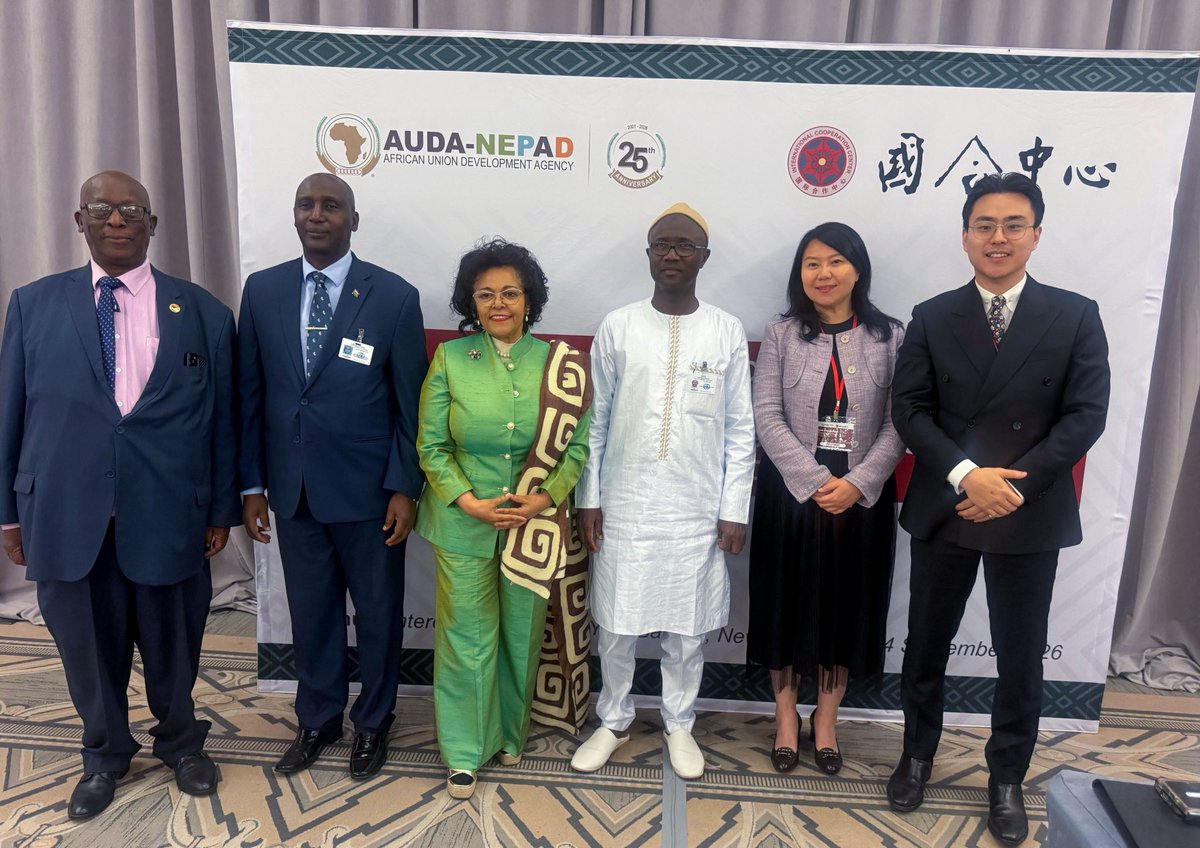
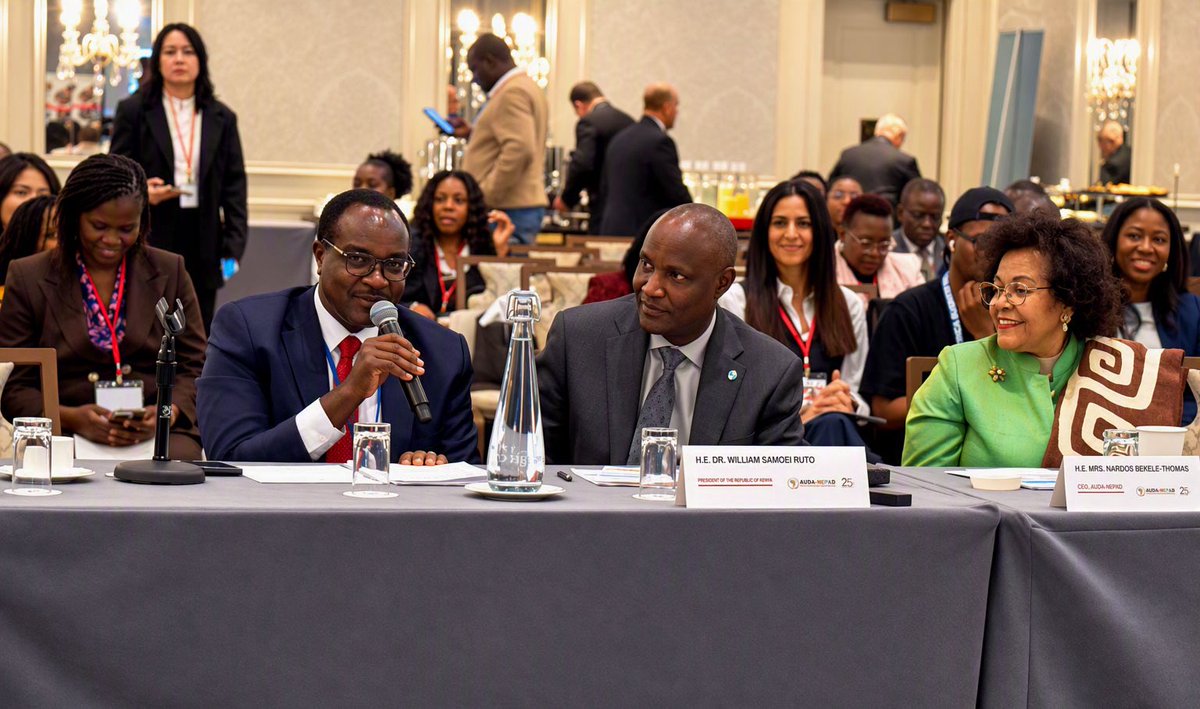
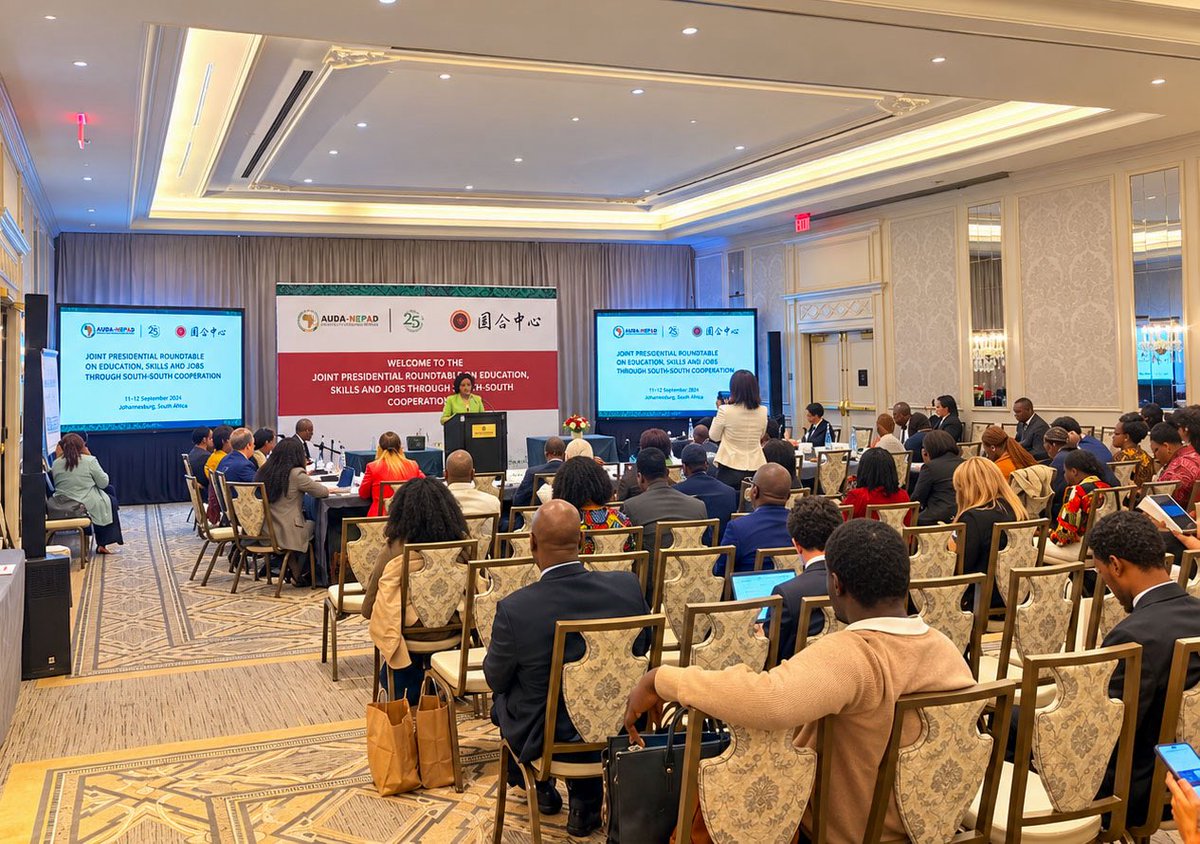
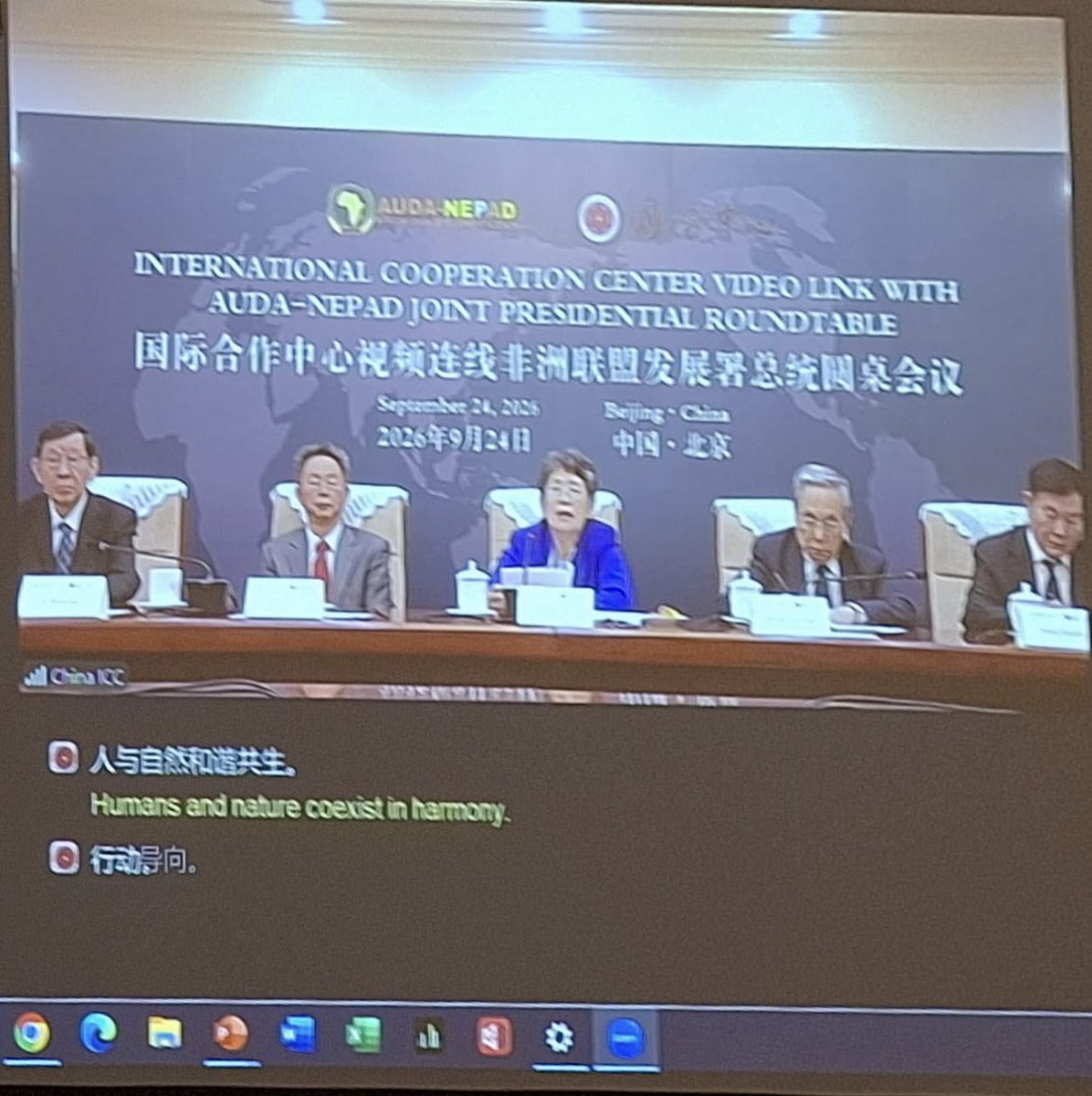
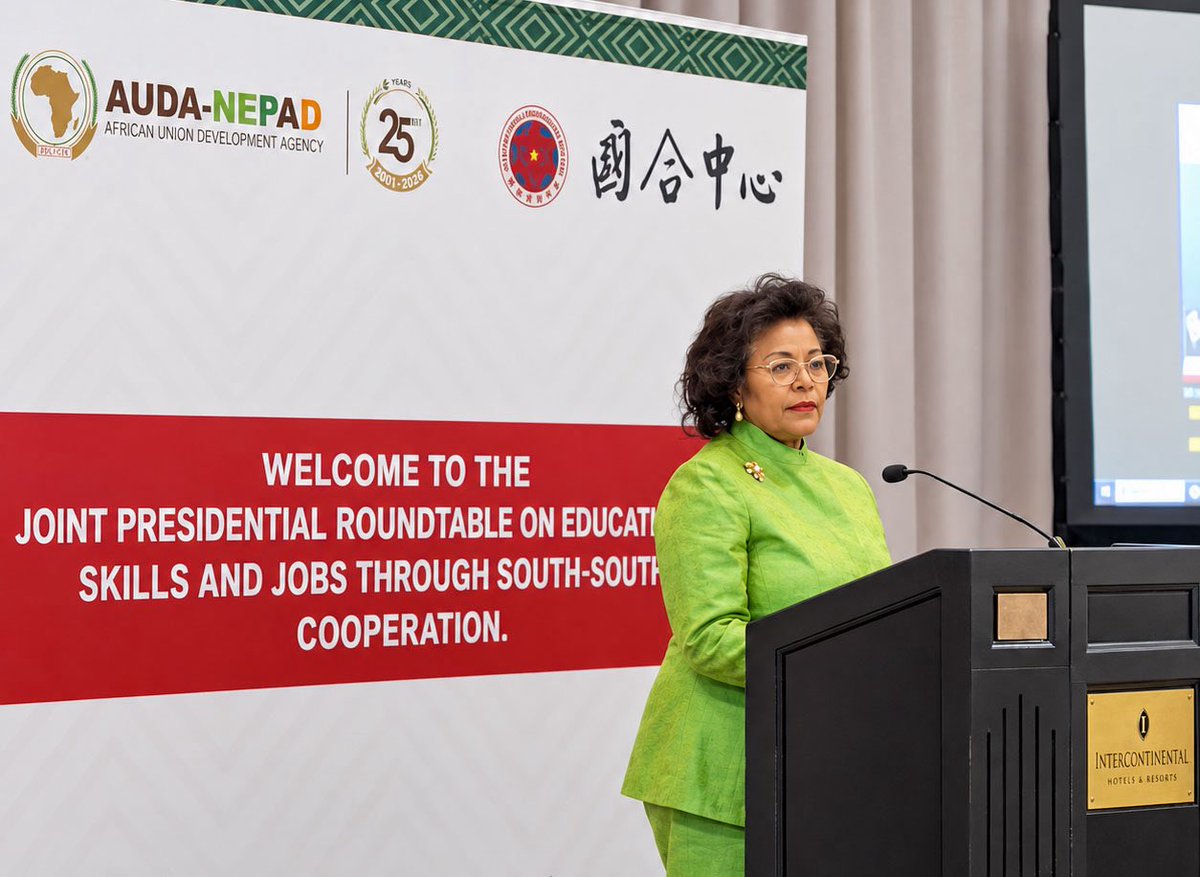
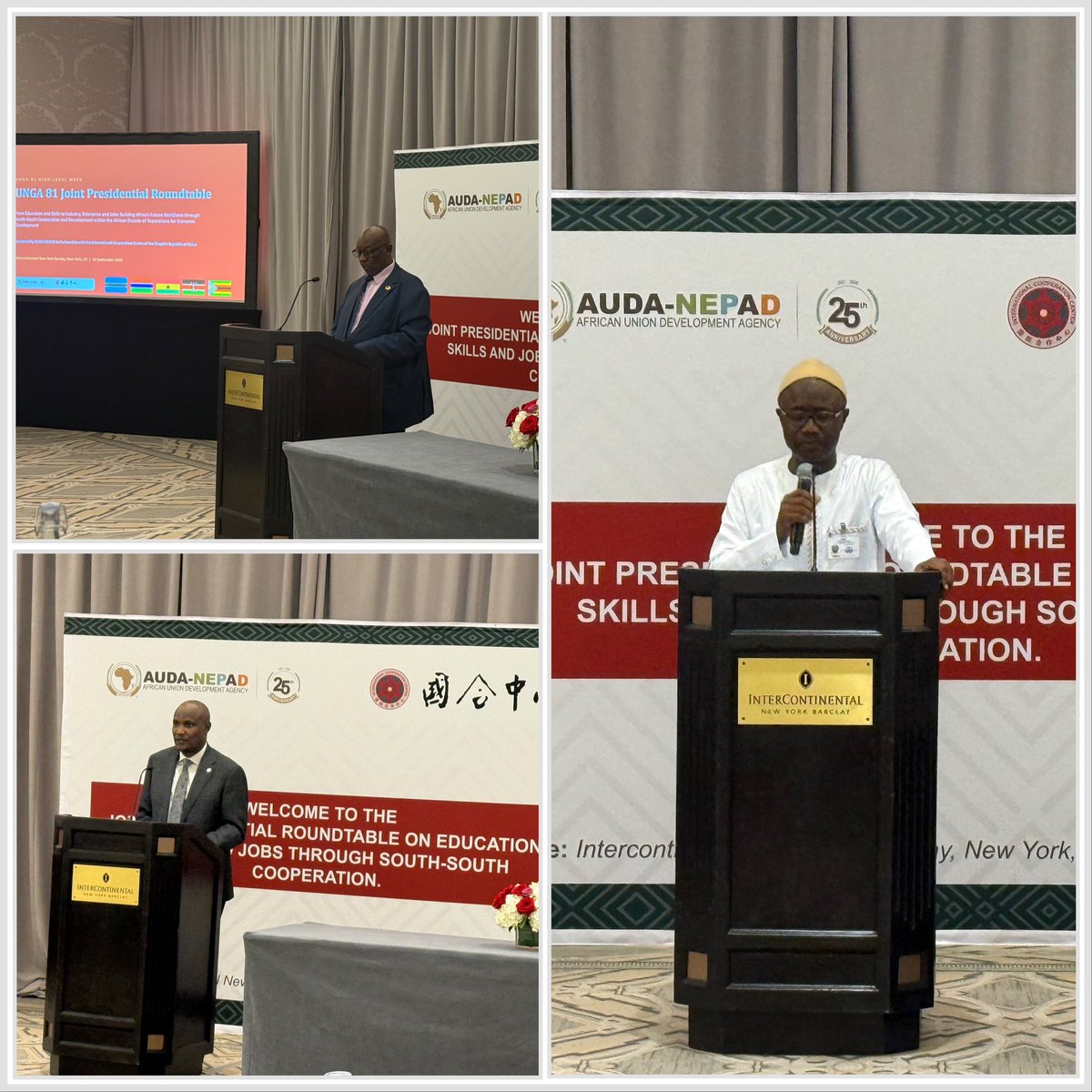
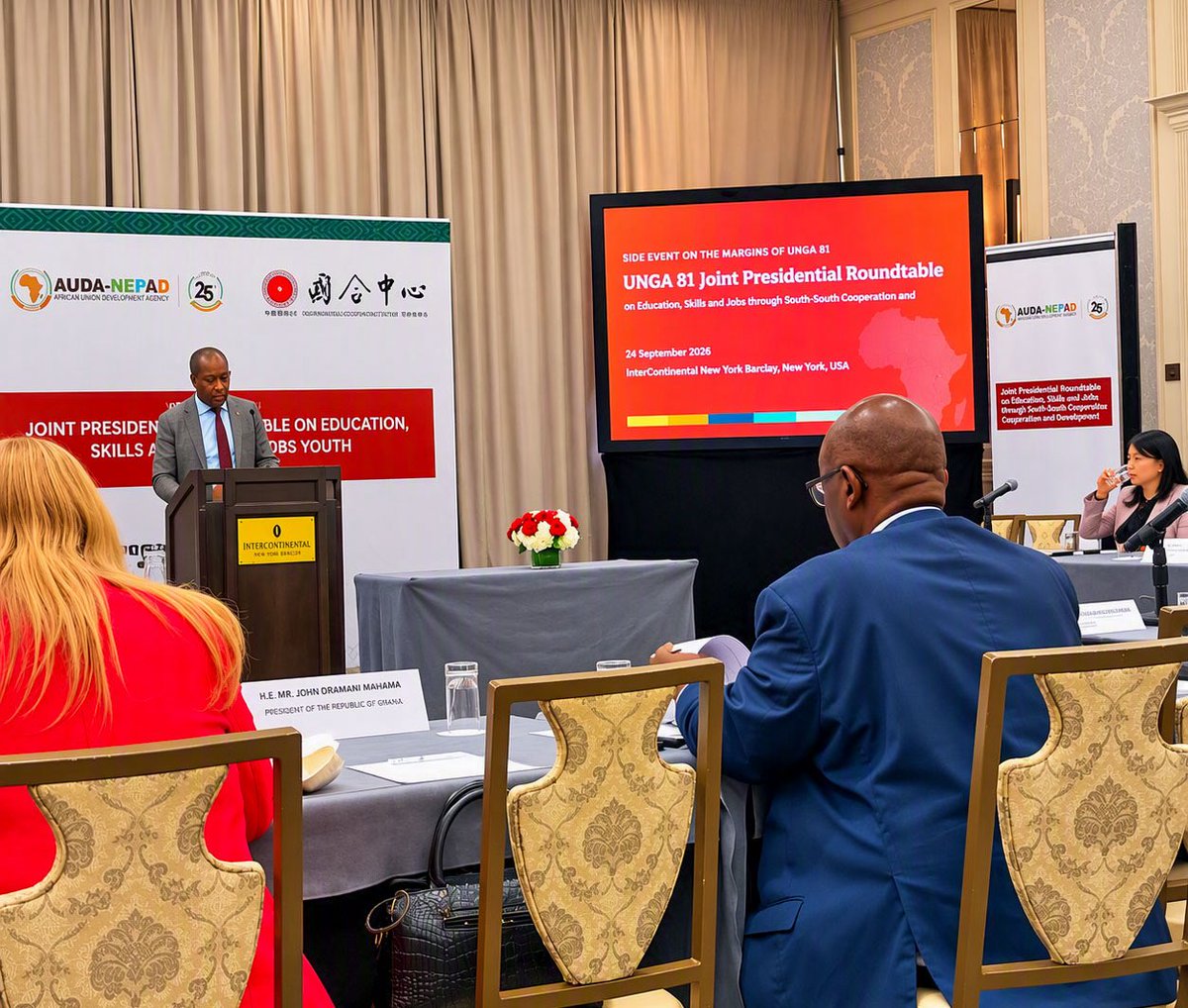
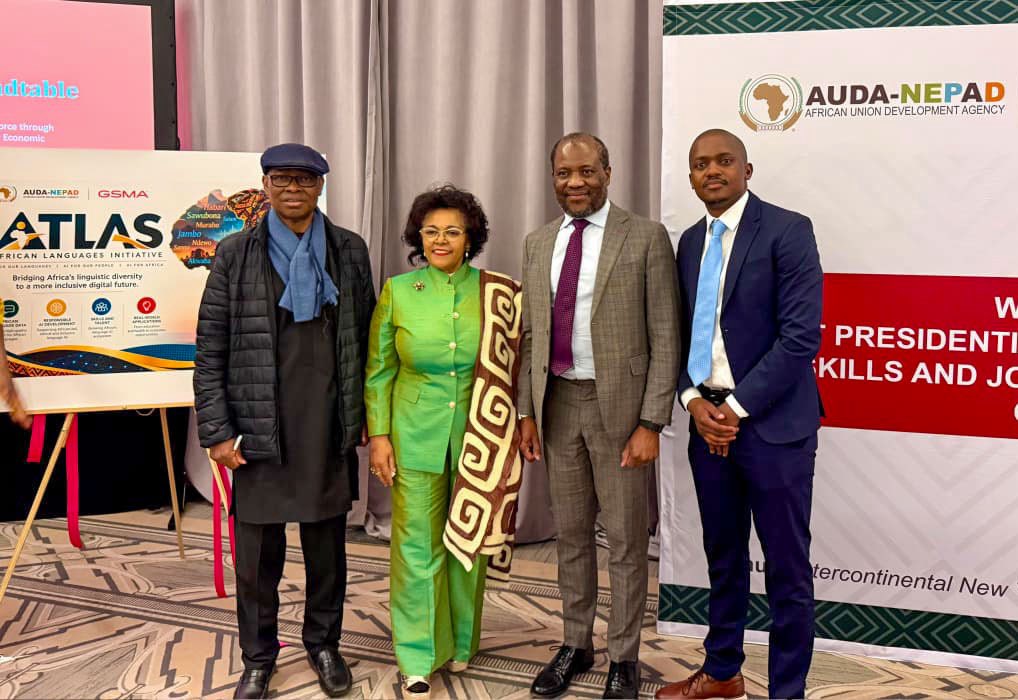
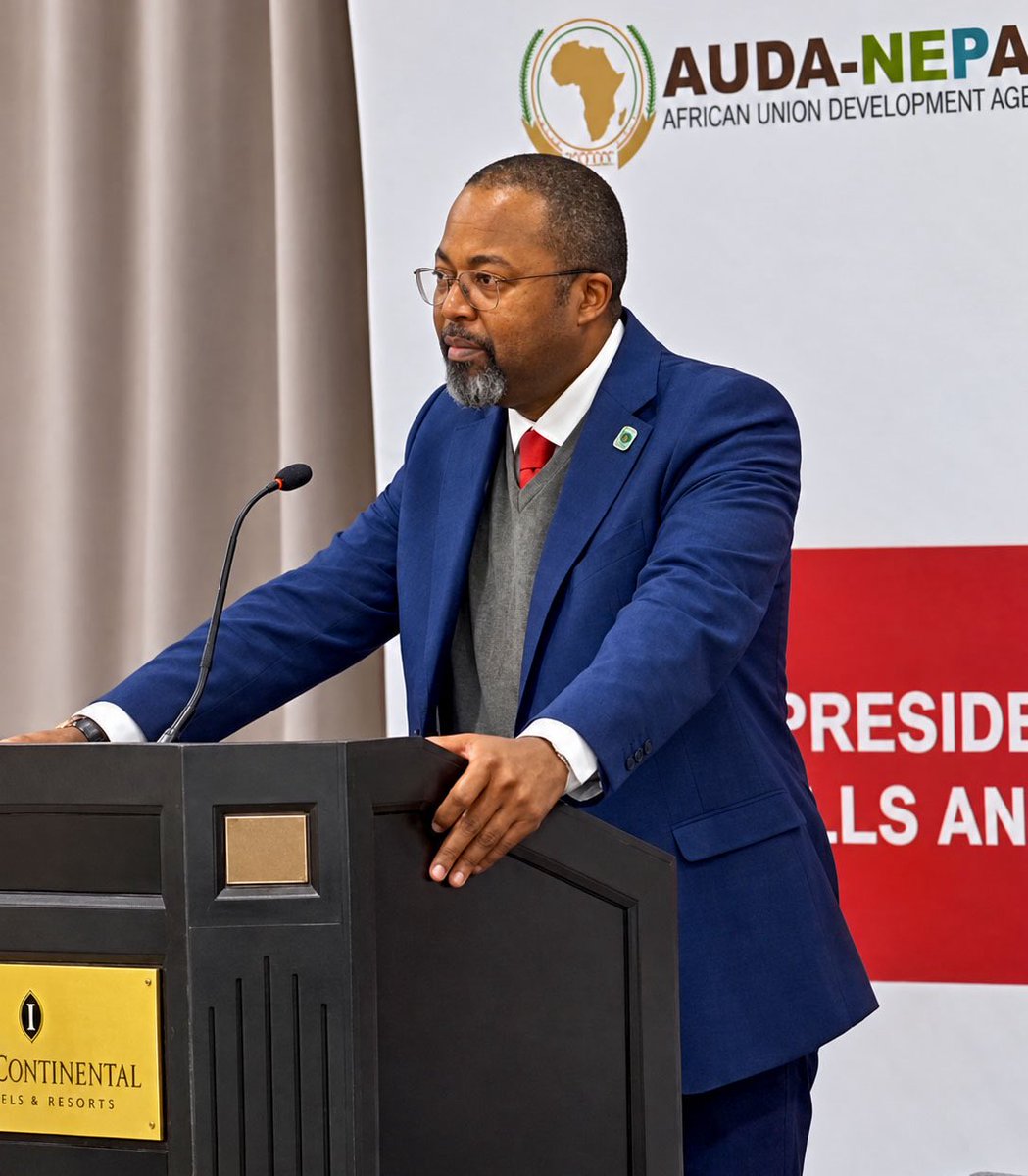
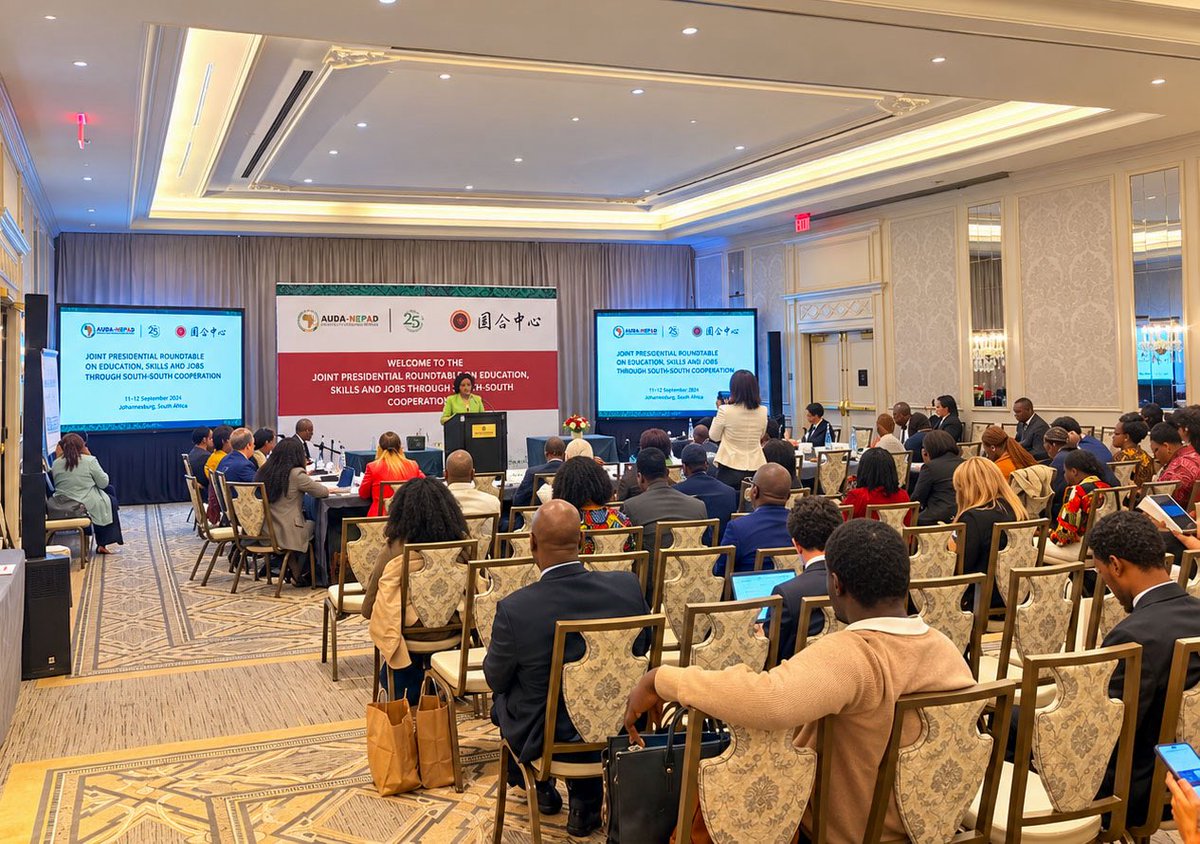
On the margins of the 81st Session of the United Nations General Assembly in New York, our AUDA-NEPAD under the leadership of @nardosbthomas and the International Cooperation Center of the People’s Republic of China (Virtual) brought together African governments, Chinese partners, academia, industry and development institutions for a Joint Presidential Roundtable on Education, Skills and Jobs through South-South Cooperation and Development.
The conversation began with a simple but powerful proposition:
Education. Skills. Enterprise. Industrialisation. Jobs.
These are not separate agendas. They are part of the same development journey.
And when the links between them are weak, young people are the ones who fall through the gaps.
Africa is confronting these questions at a pivotal moment. Its youth population is growing rapidly. Technology is changing faster than many education systems can adapt. And qualifications do not always translate into the skills economies need.
The Roundtable therefore moved the conversation beyond access alone.
Not simply: How do we educate more young Africans?
But also:
How do we turn learning into capability? Capability into production? Production into African enterprises? And enterprise into decent, sustainable jobs?
@BarrowPresident@OVP_gm@StateHouseKenya@WilliamsRuto@EduMinKenya@edmnangagwa@MICTPCS_ZW@Chinamission2un@ChinaAmbUN@CHN_UN_NY@BWGovernment@WitsUniversity@Wits_WSG@PKU1898@SpixFoundation@mEducation_A@nardosbthomas@SymerreGrey@BarbsGlover@kudadandaz
#UNGA81 #AUDANEPAD #SouthSouthCooperation #Education #SkillsDevelopment #YouthEmployment #Industrialisation #DigitalTransformation #Jobs #AfricaWeWant
2/8 The conversation began with a difficult question: How much value does Africa retain from what it produces?
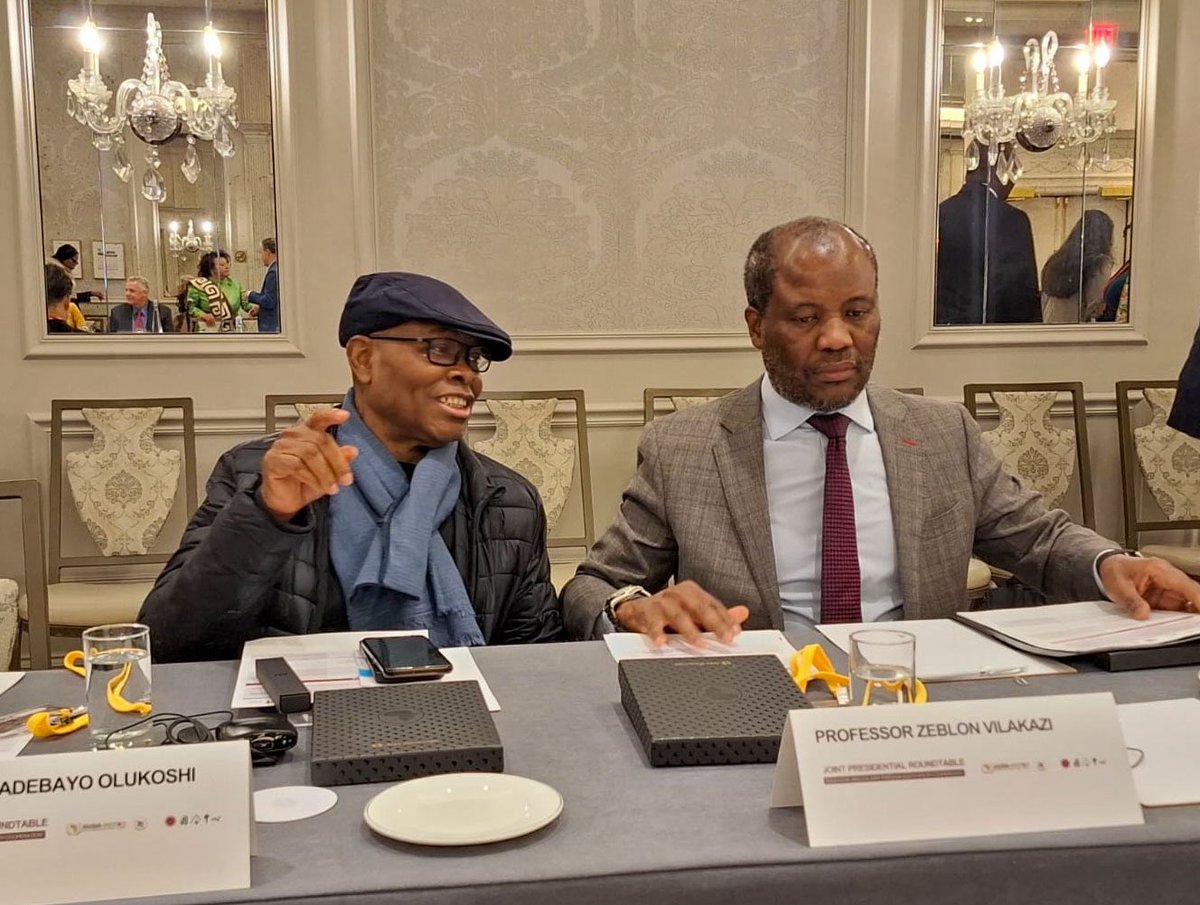
In her keynote, Professor Jia Yu challenged the traditional development model, calling for a shift from financing gaps to building productive capacity, from isolated projects to industrial clusters, and from education alone to skills matched with industry.
Professor Zeblon Vilakazi then connected that challenge to Johannesburg’s own history: a city built on mineral wealth, yet marked by the unequal distribution of the prosperity that wealth created.
His message was clear: Africa has long supplied the world with raw materials and talent, while too much of the value, technology and high-value work has been created elsewhere.
Changing this equation requires more than local processing. It requires engineers, researchers, technicians, entrepreneurs, manufacturers and institutions capable of moving economies up the value chain.
Industrialisation begins long before a factory is built. It begins in classrooms, universities, laboratories and businesses and in decisions about who develops the capabilities, owns the enterprises and controls the technology.
Economic sovereignty is ultimately a question of capability.
@BarrowPresident@OVP_gm@StateHouseKenya@WilliamsRuto@EduMinKenya@edmnangagwa@MICTPCS_ZW@Chinamission2un@ChinaAmbUN@CHN_UN_NY@BWGovernment@WitsUniversity@Wits_WSG@PKU1898@SpixFoundation@mEducation_A@nardosbthomas@SymerreGrey@BarbsGlover@kudadandaz
#AfricaRising #Industrialisation #SkillsDevelopment #EconomicSovereignty #UNGA81
Turning ambition into action requires leadership, expertise and strong partnerships.
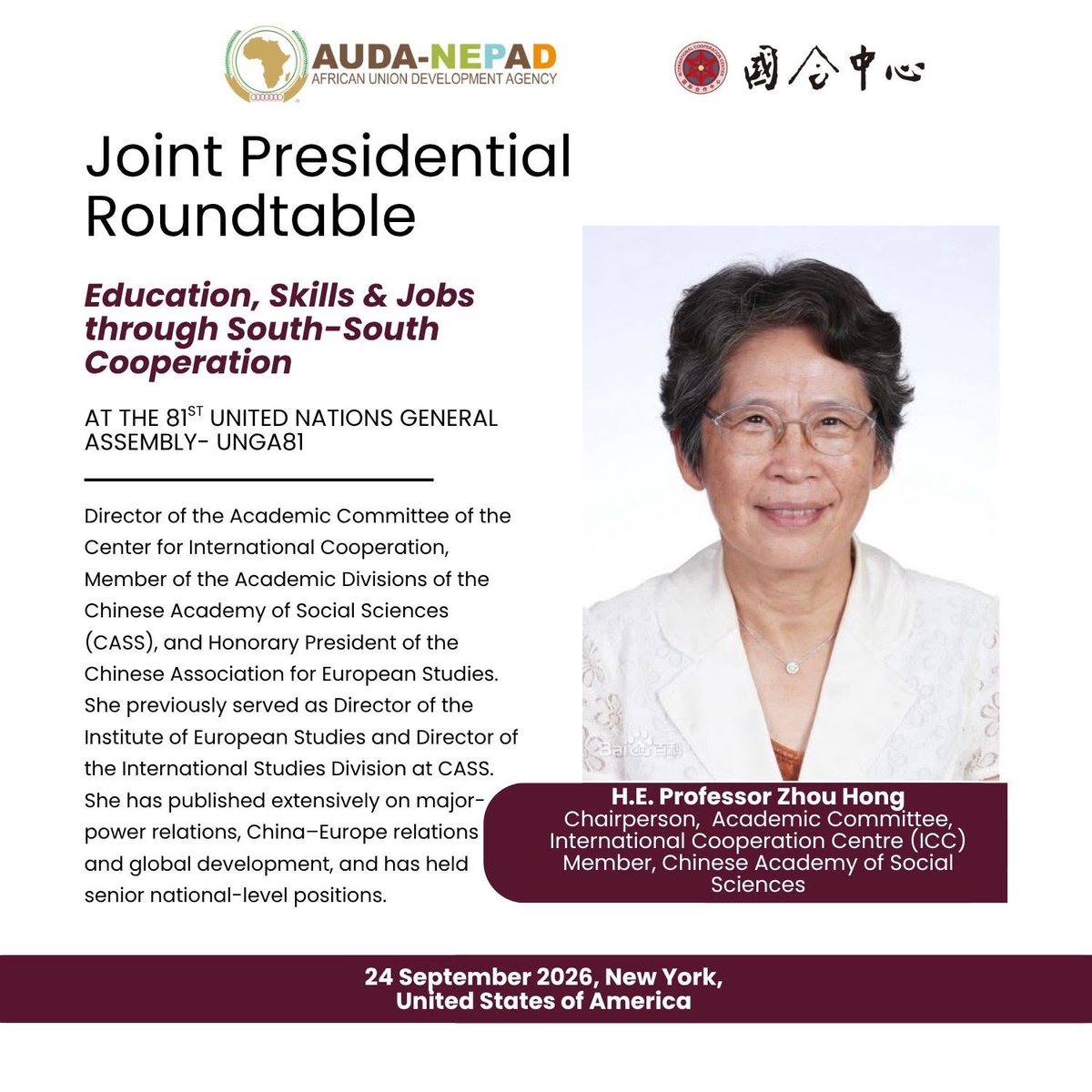
As we count down to the Joint Presidential Roundtable on Education, Skills and Jobs through South-South Cooperation at #UNGA81, we spotlight H.E. @nardosbthomas, our Chief Executive Officer, and H.E. Professor Zhou Hong, Chairperson of the Academic Committee of the International Cooperation Center (ICC).
Their participation brings together continental leadership and international cooperation as we take forward a critical conversation: how can South-South cooperation help build stronger pathways from education to skills, enterprise, decent jobs and shared prosperity?
With Africa’s young and growing population at the centre of this ambition, the Roundtable will bring together leadership, knowledge and partnerships to explore practical approaches that can strengthen skills development, productive sectors and employment opportunities across the continent.
On 24 September in New York, the focus is on moving from dialogue to delivery — and from Africa’s demographic potential to economic opportunity.
Register here: https://t.co/vtuJWiHJf8
#UNGA81 #AUDANEPAD #SouthSouthCooperation #Education #Skills #Jobs #Agenda2063 #AfricaRising #youthemployment
@cidcaofficial@MOFCOM_China@_AfricanUnion@duma_boko@JDMahama@BarrowPresident@WilliamsRuto@ChineseEmbKenya@ChineseEmbTZ@ChineseEmb_Uga@ChinaEmbAddis @ChineseEmbSA @nardosbthomas@SymerreGrey@BarbsGlover@edmnangagwa@ChinatoAU@ChinaEmbinRW@kudadandaz@Sgegede
What if Africa’s AI story is not about the jobs technology replaces but the opportunities it creates?
At the inaugural LSE Global Forum for AI and the Social Sciences, we brought a distinctly African continental perspective to the global conversation on AI and labour-market transformation.
As the only African continental agency participating in this first edition of the Forum, our Director for Human Capital and Institutional Development, @SymerreGrey, delivered a clear message: Africa’s AI transition must be fair, inclusive and productive with technology serving as a driver of jobs, enterprise and human development.
The stakes are enormous. Between 2025 and 2050, more than 620 million people are projected to enter Africa’s labour force. The question, therefore, is not simply what AI may automate. It is how Africa can harness AI to expand opportunity, raise productivity and empower a new generation to create the jobs, enterprises and industries of the future.
We are advancing this agenda through initiatives such as the Programme for Inclusive and Productive Use of the Internet in Africa (PIPIA) and the Africa Critical Skills Bank (ACSB) - connecting productive digital use with labour-market intelligence, skills development and pathways into employment and enterprise.
Building on this work, the Agency is also developing a new programme at the intersection of AI, green skills and green jobs. This responds to a defining reality of the future: many of the opportunities Africa’s Gen Z will pursue will be technology-enabled and will emerge where the digital and green transitions converge.
The conversations at LSE build on our ongoing engagements in London with the UK Foreign, Commonwealth & Development Office and the Commonwealth Secretariat, exploring collaboration on responsible AI, productive digital use, skills intelligence, youth enterprise and green employment pathways.
The message is clear:
Africa must not simply adapt to the AI transition. It must help shape it, building the capabilities to benefit from it and ensuring that it creates meaningful economic opportunity for African people.
@Finnfund@noradno@googleafrica@IDRC_CRDI@EAA_Foundation@COL4D@FCDOGovUK@norfun@AECID_es@commonwealthsec@macfound@LSEnews@nardosbthomas@BarbsGlover@kudadandaz@Sgegede
#AUDANEPAD #LSEGlobalForum #ArtificialIntelligence #FutureOfWork #GreenJobs #Skills #DigitalTransformation #Africa
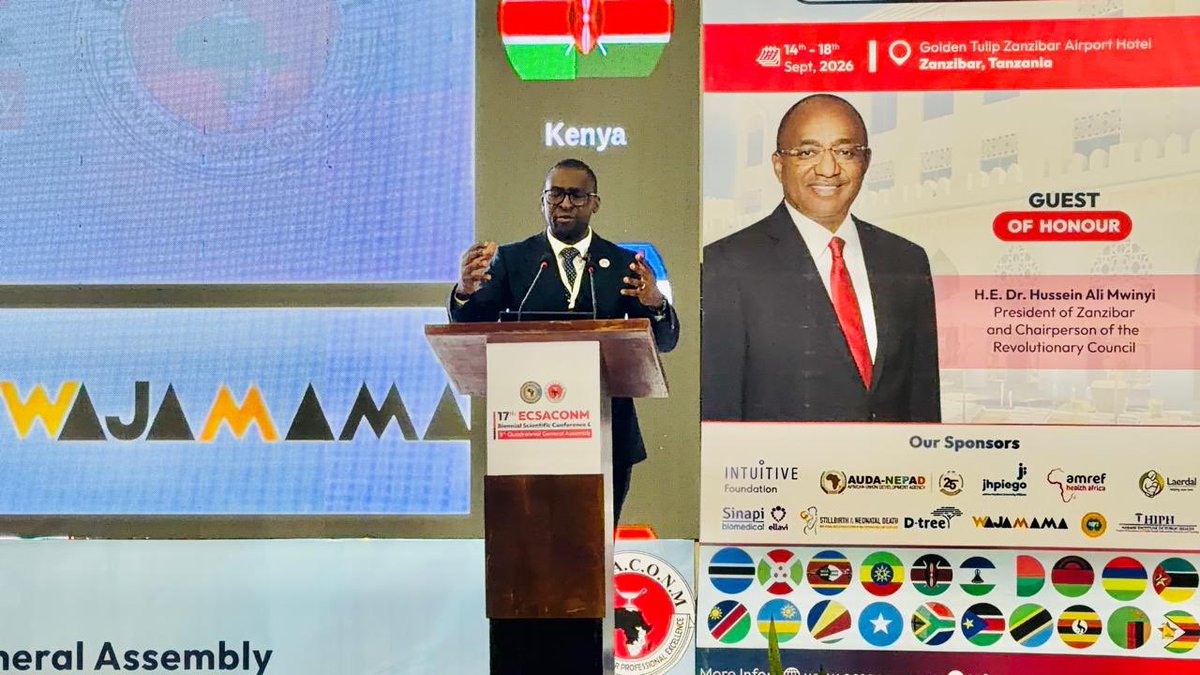
Building Africa’s Health Workforce: Nurses and Midwives as Agents of Development
In Zanzibar, a powerful message resonated: Africa’s nurses and midwives are not only healthcare workers they are agents of development.
Delivering keynote remarks on behalf of our @NEPAD_Agency leadership, Dr. Kudakwashe Dandajena said Africa’s health-workforce challenge demands more than good intentions: it requires a resourced, sequenced and measurable continental approach.
From the workforce dialogue in Kigali to clinical training-site assessments across 10 African countries, progress is taking shape and curricula are being harmonised, partnerships strengthened and Africa’s health systems reinforced.
This is South–South Cooperation in action, connecting African priorities with global partners including @ecsacon, @ECSA_HC, @MOFCOM_China, @AUMission_China and @WHO.
The journey continues from Tanzania to Kigali, from Beijing to the continent toward a stronger, more skilled and more resilient health workforce.
@SymerreGrey@nardosbthomas@ChinatoAU@ChineseEmbKenya@ChineseEmbTZ@ChinaEmbinRW@ChineseEmb_Uga@ChinaEmbAddis@MOFCOM_China
#Nursing #Midwifery #HealthWorkforce #AfricaRising #SouthSouthCooperation
From planning to implementation, from implementation to scale, and from scale to measurable results, this is the imperative driving our continental health-development agenda.
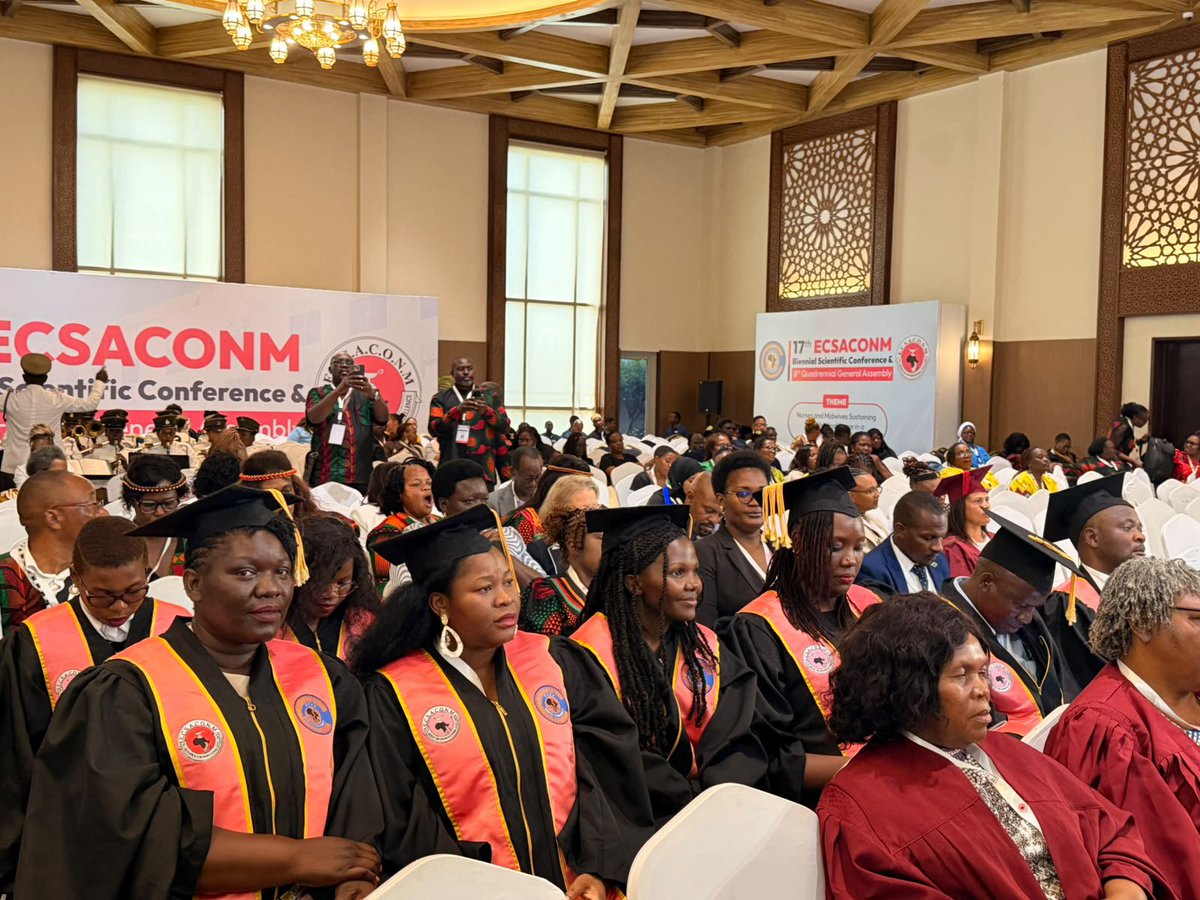
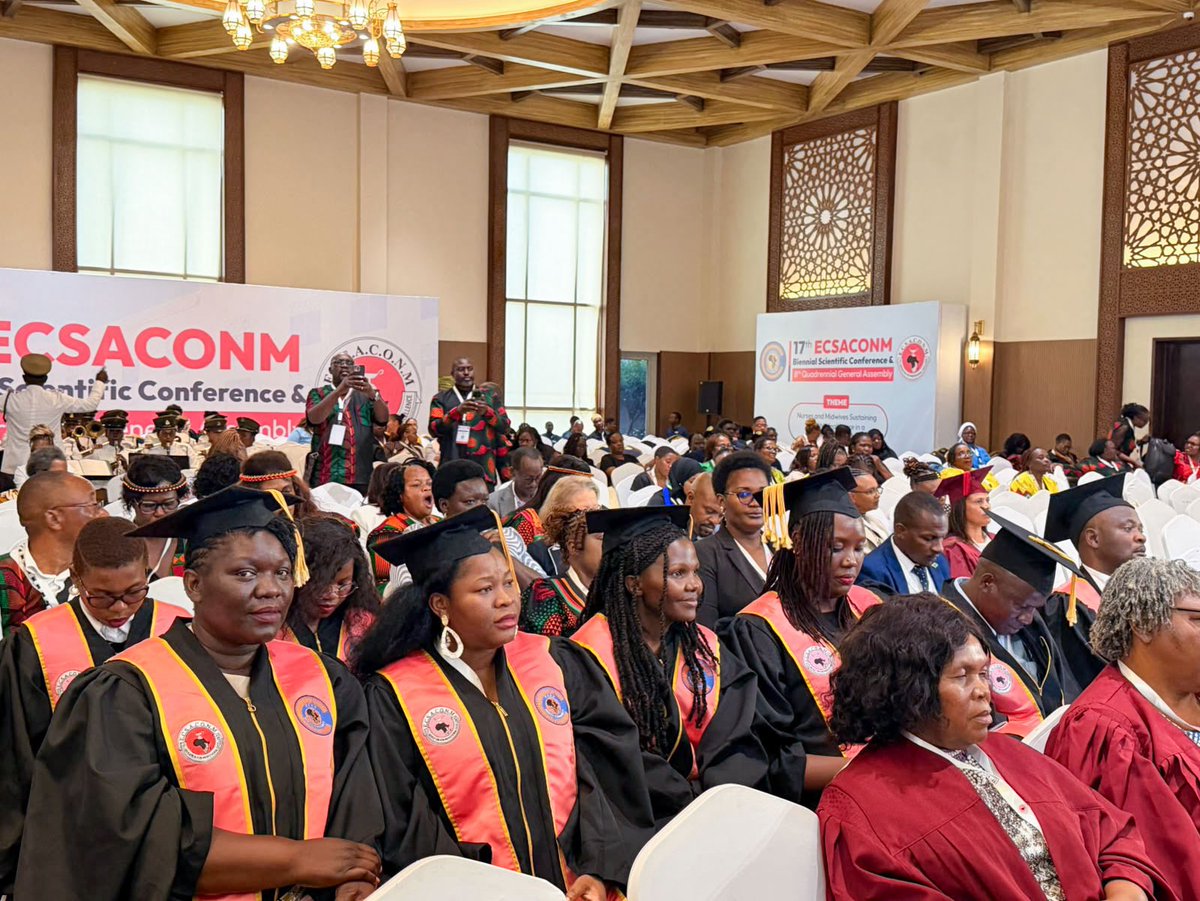
At the 17th #ECSACONM Biennial Scientific Conference, we reaffirmed our commitment to strengthening health systems at every level.
The journey begins with institutional capacity. It advances through investment in nurses and midwives, stronger clinical training, rigorous quality assurance and expanded access to care. It gains momentum when evidence is translated into action across countries, institutions and communities.
Through the Strengthening Africa’s Nursing and Midwifery Workforce programme, continental ambition is becoming practical progress, building skills, strengthening institutions and supporting Centres of Excellence that can deliver lasting improvements.
And through South–South Cooperation and Development, expertise, knowledge and innovation are being connected across the Global South to build resilient and sustainable health systems capable of delivering inclusive, quality care.
The goal is clear: better-trained health professionals, stronger systems and measurable results for communities across Africa.
#AssessmentAndAccreditation #NursingAndMidwifery #ECSACONM #ECSAHealthCommunity #AUDANEPAD #SouthSouthCooperation #ClinicalEducation #CentresOfExcellence #QualityImprovement #AfricaHealth
@SymerreGrey@nardosbthomas @ChinaICC @ChinatoAU@ChineseEmbKenya@ChineseEmbTZ@ChinaEmbinRW@ChineseEmb_Uga@ChinaEmbAddis @ChineseEmbSA @MOFCOM_China