Shakira’s performance today was nothing short of legendary. The aura, the moves, the vocals, she turned the opening ceremony into her own concert. Simply epic.
Same People. Same Struggle. Different Side.
Dr. Jane Ruth Aceng and Dr. Chris Baryomunsi were once medical interns and leaders of intern advocacy in Uganda.
As highlighted in the image, Dr. Aceng, as an intern leader in 1994, protested over poor food provided to interns, while Dr. Baryomunsi, as an intern leader in 1995, led a strike demanding better pay for medical interns.
At the time, medical interns enjoyed several benefits, including government-facilitated deployment to internship sites, free accommodation, meals, and a monthly allowance. Following the 1995 intern strike, intern remuneration was reportedly increased for the subsequent cohort.
Today, both leaders sit at the highest levels of health-sector decision-making. Yet, the same system they once challenged now appears determined to remove the very incentives and allowances that supported them during internship. Current policy proposals suggest a future where medical interns may be required to work without pay.
It is difficult for many young doctors to understand this contradiction. How can leaders who once fought for better welfare now defend policies that strip away those same protections for the next generation?
Medical internship is not a classroom exercise. It is full-time service delivery under supervision, often involving long hours, night calls, emergency care, and significant responsibility for patient lives. Expecting interns to provide this essential service without remuneration raises serious questions about fairness, workforce motivation, and the value placed on young health professionals.
Yesterday they protested. Today they write the policy.
The question many young doctors are asking is simple: If these incentives were necessary for interns in 1994 and 1995, why are they considered unnecessary for interns in 2026?
#PayAllMedicalInterns #SaveLives
Dr. Mirembe Joel
X: @MirembeDr@eddympuuga@bbstvug@newvisionwire@cbsfm_ug
“It should be noted that in 1995 the Hon.@CHRISBARYOMUNS1 led a strike for medical interns that lead to increase of the pay of medical interns from 90,000 UgX to 180,000 UgX.” Dr.Asiimwe R Frank.
Now he is the minister of health and defending the position of government not to pay medical interns
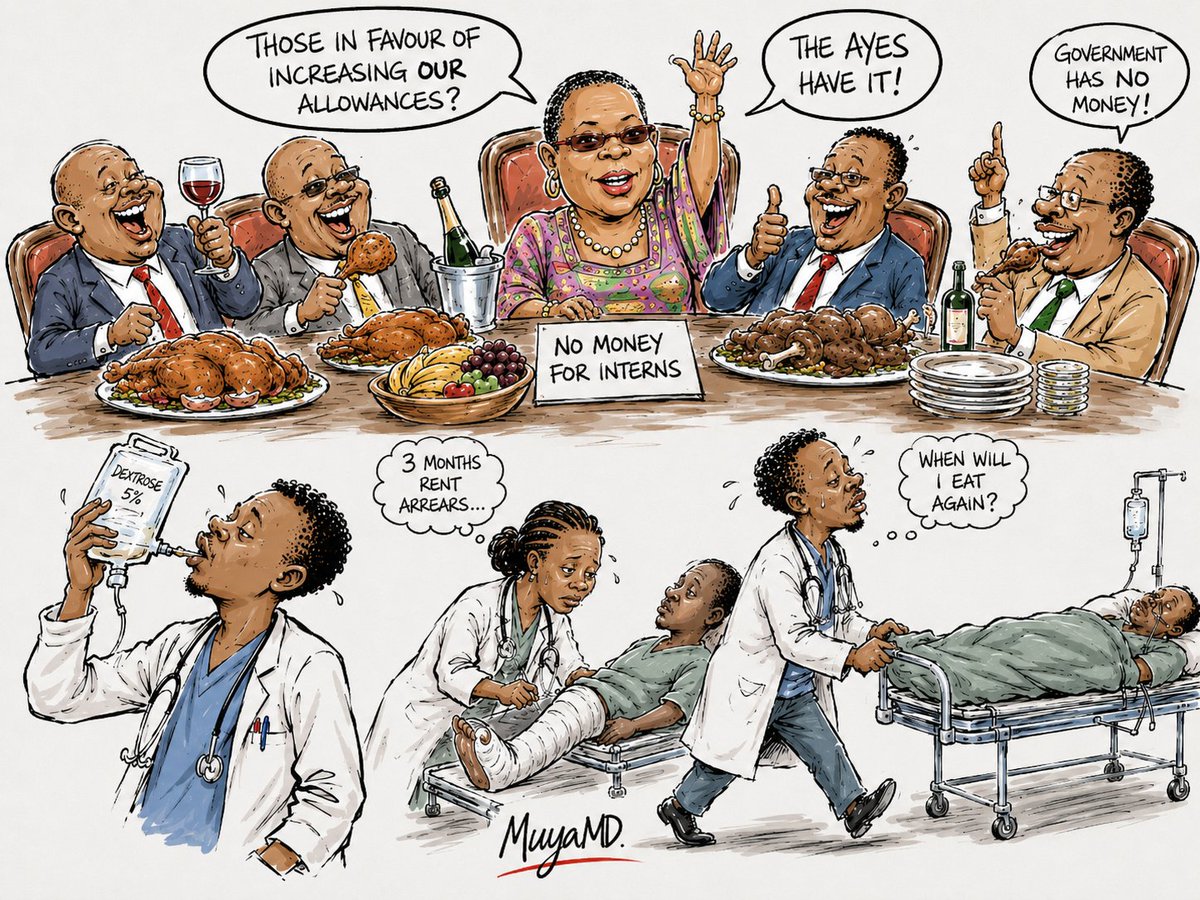
Uganda Govt owes medical interns UGX 23bn. Yet by July,l 2026, UGX 189bn will go to MPs' cars & UGX 120bn to ministers' cars. Some political class doesn't use public hospitals; so they don't feel this crisis. My ailing auntie in Kyemamba does. #PayMedicalInterns#InternsNotSlaves
Let us be honest: the issue is not that medical interns are too many.
It is not that Uganda has no money.
It is that medical interns are not being treated as a priority.
Consider the choices being made:
• Parliament keeps growing.
Parliament’s budget reportedly doubled to about 𝗦𝗵𝘀 𝟭. 𝟮 𝘁𝗿𝗶𝗹𝗹𝗶𝗼𝗻. The money going to 529 MPs rose from about 𝗦𝗵𝘀 𝟰𝟬𝟬𝗯 in 2020/21 to 𝗦𝗵𝘀 𝟳𝟰𝟰.𝟰𝗯 in 2026/27, an increase of about 𝗦𝗵𝘀 𝟯𝟰𝟰.𝟰𝗯.
What direct return does this give the common Ugandan in a crowded hospital?
• Two offices alone tell the story.
The Speaker and Deputy Speaker offices had about 𝗦𝗵𝘀 𝟳.𝟭𝗯 combined in 2020/21. In 2026/27, they stand at about 𝗦𝗵𝘀 𝟱𝟬.𝟮𝗯 , an increase of about 𝗦𝗵𝘀 𝟰𝟯.𝟭𝗯 for only two offices.
That increase alone can pay 𝟯𝟬𝟬𝟬 interns 𝗦𝗵𝘀 𝟭𝗺 𝗽𝗲𝗿 𝗺𝗼𝗻𝘁𝗵 𝗳𝗼𝗿 𝗮 𝗳𝘂𝗹𝗹 𝘆𝗲𝗮𝗿, with money left.
• Questionable spending continues.
In 2025/26, selected Speaker’s office lines reportedly included 𝗦𝗵𝘀 𝟮.𝟰𝗯 for foreign travel, 𝗦𝗵𝘀 𝟵𝟲𝟲𝗺 for fuel, 𝗦𝗵𝘀 𝟰.𝟴𝗯 for incapacity, death benefits and funeral expenses, and 𝗦𝗵𝘀 𝟱.𝟮𝗯 for donations. Total: about 𝗦𝗵𝘀 𝟭𝟰.𝟮𝗯. What lasting public health return does this produce compared with doctors on wards?
• RDC structures are being funded.
Uganda reportedly has 146 RDCs, 170 Deputy RDCs and 432 Assistant RDCs, total 748 officials. Their proposed salary enhancement requires an extra 𝗦𝗵𝘀 𝟮𝟵.𝟬𝟳𝟵𝗯 every year.
Add the reported 𝗦𝗵𝘀 𝟯𝟬𝗯 for LC I to LC V political leader facilitation, and that is about 𝗦𝗵𝘀 𝟱𝟵𝗯. In what way does this benefit the common Ugandan?
• Donations are funded.
State House donations reportedly consumed 𝗦𝗵𝘀 𝟳𝟱𝟭𝗯 over seven financial years. In 2023/24 alone, donations were budgeted at 𝗦𝗵𝘀 𝟭𝟴.𝟭𝗯, but actual spending reached 𝗦𝗵𝘀 𝟴𝟬.𝟭𝟴𝗯. If tens and hundreds of billions can be found for donations, how does 𝗦𝗵𝘀 𝟮𝟰𝗯 to 𝗦𝗵𝘀 𝟯𝟲𝗯 for over 2,000 medical interns become impossible?
• Health was not protected with the same urgency.
The Ministry of Health vote fell from about 𝗦𝗵𝘀 𝟭. 𝟲𝟵𝟯 𝘁𝗿𝗶𝗹𝗹𝗶𝗼𝗻 in FY2023/24 to about 𝗦𝗵𝘀 𝟭. 𝟯𝟰𝟰 𝘁𝗿𝗶𝗹𝗹𝗶𝗼𝗻 in FY2024/25, a reduction of about 𝗦𝗵𝘀 𝟯𝟰𝟵𝗯. Even the 2025/26 estimate of 𝗦𝗵𝘀 𝟭.𝟱𝟲𝟰 𝘁𝗿𝗶𝗹𝗹𝗶𝗼𝗻 remains below the 2023/24 level. Yet health is the sector that directly touches mothers in labour, accident victims, children with malaria, emergency patients and families in public hospitals.
Now compare:
• 2,000 interns × Shs1m × 12 months = 𝗦𝗵𝘀 𝟮𝟰𝗯 per year
• 2,500 interns × Shs1m × 12 months = 𝗦𝗵𝘀 𝟯𝟬𝗯 per year
• 3,000 interns × Shs1m × 12 months = 𝗦𝗵𝘀 𝟯𝟲𝗯 per year
Even using the Ministry of Health’s own gross figure of Shs15.6m per intern per year, the reported 2,706 eligible interns would require about Shs42.2b. That is still small compared with what is being found for political comfort and administrative expansion.
That money is not a handout.
✨ It avails doctors on wards.
✨ It keeps emergency units covered.
✨ It supports maternity care.
✨ It fills staffing gaps in regional referrals.
✨ It protects patients.
So let us stop pretending.
This is not a numbers problem.
This is not a money problem.
It is a priority problem.
Medical interns are doctors under apprenticeship, not free labour!
#InternsNotSlaves