India was the cradle of civilisation. Not one of several.
Several people have replied to my recent essay by saying there is no single cradle of civilisation. Civilisation developed independently in Mesopotamia, Egypt, India, China and South America. Why make it a competition?
This sounds like humility, but it is the same evasive move that propped up the Aryan invasion theory for a century: when the evidence becomes inconvenient, redraw the question so no evidence can ever settle it.
Consider what would have to be true for independent emergence to hold. Indus-Sarasvati merchant seals would not appear across Sumerian cities. An Akkadian cylinder seal would not name its owner as an interpreter of the Meluhhan language. Bead necklaces manufactured at Lothal would not turn up in Queen Puabi's tomb at Ur around 2450 BC. Pre-dynastic Egyptian graves at Nakada would not contain mud brick-lined pits in Sumerian and Indus-Sarasvati style, alongside cylinder seals and lapis lazuli from the northernmost Indus-Sarasvati settlement. The Sumerian scribes would not record ships arriving from Meluhha carrying timber, copper, carnelian and cotton.
All of those things happened, and they are in the archaeological record. They have been for decades.
The "independent emergence" position has a convenient feature. No evidence can ever dislodge it. Merchant seals from one civilisation found inside another become "evidence of trade, not dependency." Identical brick ratios become "convergent development." A professional interpreter role for a foreign language becomes "contact, but not influence." At every point the conclusion is decided in advance, and the evidence is arranged around it.
Others have argued that even if the civilisations were connected, Mesopotamia was still earlier. Earliest attested writing. Earliest cities. Earliest legal codes. The crucial word is "attested," which means found and recorded by archaeologists. Mesopotamia was excavated intensively from the 1840s. Mohenjo-daro was not discovered until 1922. The site at Bhirrana, dated to 7570-6200 BC, with planned streets, drainage, standardised weights and bronze metallurgy millennia before it appears elsewhere, was identified only recently. Mehrgarh, around 7000 BC, supported 20,000 people growing wheat, barley and cotton, and trading lapis lazuli and copper beads. "Earliest attested" tells you where archaeologists chose to dig, but it does not tell you what existed first.
So at what point does evidence of connection actually count? When one civilisation's merchants are living in another's cities, boring beads with their own technology and maintaining a permanent enclave at Lagash? When the Sumerian texts record ships from Meluhha bringing wealth but never once mention Sumerian ships sailing east? When Indus-Sarasvati seals are found throughout Mesopotamia but no Mesopotamian seal has ever been found in Indus-Sarasvati lands?
And that is before the underwater evidence from the Gulf of Cambay and the Tamil coast, where sonar readings suggest ports thousands of years older than anything in Mesopotamia. If those dates hold, the question of independent emergence becomes redundant.
Treating every civilisation as equally primary, whichever direction the evidence actually points, is a kind of participation trophy for entire fields of study, not open-mindedness.
Independent emergence is where one lands once you’ve already decided not to look at what moved between the geographical boxes, or in which direction. It kept the Aryan invasion theory standing for a hundred years, and it's propping up the same evasion today.
More Indian soldiers have died at Siachen from extreme weather and terrain than from enemy fire. The world's highest battlefield, at -50°C and altitudes where oxygen is half that at sea level, is as lethal as any adversary. Three mechatronics engineers from SRM University in Chennai who skipped their campus placements are building the machine designed to change what soldiers have to carry into those conditions.
Vignesh M, Vibhakar Senthil, and Karthikeyan B enrolled in a robotics programme at SRM in their first year that asked them to identify real problems and engineer solutions. They built miniature surveillance robots, designed a single-seat solar-powered vehicle, and won competitions. They graduated with a shared conviction about where they wanted to direct their engineering: not toward IT, but toward the Indian armed forces. They turned down placement offers and kept building.
In 2019, after three years of research, field visits, and rigorous interactions with Indian Armed Forces officers and the Army Design Bureau to understand real operational requirements, they registered Torus Robotics in Chennai. They each invested personally and built entirely from the ground up.
At Siachen, soldiers routinely carry more than 60 kilograms in those conditions. The machine Torus built for those environments is the MARS UGV: fully electric, operating autonomously with a six-degree-of-freedom robotic arm for detecting and disposing of explosive devices, controllable from a kilometre away. Under an MoU with BEML, they are developing a logistics version designed to carry the equivalent payload of ten soldiers across high-altitude terrain.
Their indigenous motors are 50% lighter, 15% more efficient, and 10% more cost-effective than imported alternatives. India's powertrain dependence on China is among its most acute supply vulnerabilities in both defence and EVs. Torus is building the indigenous answer.
The company has delivered the MARS UGV to DRDO, received innovation grants from the Indian and Tamil Nadu governments, and was recognised as a Pioneer Defence Innovator by IDEX, which specifically cited them as the youngest defence startup to deliver an indigenous UGV to the Indian Defence. They won the Birla Global Innovation Challenge 2020.
Three engineers. SRM University. No corporate pedigree. A combat-ready unmanned ground vehicle delivered to the Indian Army.
At Siachen, a Jawan still carries 60 kilograms.
The machine Torus is building is designed to change that. One soldier at a time.
This amazing website, called "Worse on Purpose," is cataloguing all the ways companies are deliberately and secretively degrading their own products
As usual, in most cases the culprit is private equity extracting enormous sums while everyone else is left worse off.
Ask any Indian on the street who gave us our national cry, ‘Jai Hind!’, & 9 out of 10 will say Subhash Chandra Bose. But decades before Netaji marched with the INA, 2 simple, electrifying words were uttered in the cold streets of Berlin by a teenage fugitive from Kerala.
A man who fled British spies, forged an alliance with the German Kaiser, commanded a warship that set colonial Madras ablaze & stood up to Adolf Hitler himself.
Born in 1891 in Trivandrum, Chempakaraman Pillai grew up under the heavy shadow of the British Raj. While other children played, young Pillai was already organizing schoolboys, printing anti colonial pamphlets & leading secret meetings under the banner of the Dharma Poshani Assembly.
By 1908, he was just 17 yrs old & his name was circled in red on British Intelligence watchlists. Colonial officers were closing in to arrest the young rebel.
In a plot straight out of an espionage thriller, a friendly foreign traveler named Sir Walter Strickland smuggled Pillai out of India disguised as a servant. Pursued across international waters, Pillai made it to Europe, eventually settling in Zurich & later Berlin.
He enrolled at the ETH Zurich in Switzerland, studied engineering, chemistry & economics, all while running an underground anti-imperial network.
When World War I broke out in 1914, Pillai saw his window. He established the International Pro-India Committee in Berlin & walked straight into the offices of the German High Command.
He convinced Kaiser Wilhelm II that Britain’s weakness lay in its colonies & that Germany should back an Indian revolution.
On the night of 22nd Sep, 1914, a sleek German light cruiser, the SMS Emden, stealthed through the pitch-black waters of the Bay of Bengal, creeping within range of the Madras coast.
In a lightning naval strike, the Emden opened fire on the massive fuel reserves of the Burmah Oil Company.
Towering walls of orange flame roared into the night sky, destroying 340000+ gallons of oil & sending shockwaves of panic through the British administration. It was the only time during World War I that enemy fire struck the mainland of British India & an Indian revolutionary was at the helm.
During those intense years in Berlin, coordinating b/w Indian activists, German military officers & global revolutionaries, Pillai grew tired of formal, colonial greetings. He needed a battle cry that transcended regional languages and religious lines.
In 1907, he had already coined 2 words: "Jai Hind" (Victory to India).
It became the official greeting of his Berlin committee. Decades later, when Netaji Subhash Chandra Bose visited Germany to form the Indian Legion, he heard Pillai's battle cry, embraced it & made it the formal salute of the Indian National Army.
Pillai’s fierce independence did not end with the British. In the late 1920s & early 1930s, as Adolf Hitler rose to power in Germany, Hitler made derogatory remarks about Indians in a public speech, claiming Indians were meant to be ruled by superior races.
Pillai did not flinch. He wrote a sharp, uncompromising letter directly to Hitler, demanding a written apology. Shockingly, the pressure worked, Hitler was forced to issue a written apology to Pillai.
Standing up to the Nazi regime came at a deadly cost. Soon after the confrontation, Pillai fell mysteriously, violently ill, symptoms consistent with slow poison. On 26th May, 1934, far away from the homeland he fought his entire life to liberate, Chempakaraman Pillai closed his eyes forever at the age of 42.
Before he died, he left behind 1 final wish: that his ashes be brought back to a free India & scattered over the fields of his native Kerala.
It took 30+ yrs after his death, in 1966, for his widow, Lakshmi Bai, to finally bring his ashes home on an Indian Navy warship, fulfilling the final promise to a ghost hero.
The Next Time You Say "Jai Hind"...Remember that those 2 words were not written by a comfortable politician in a quiet office.. They were forged in the fires of World War I, carried on the decks of warships & spoken by a fearless Indian rebel who made emperors and dictators bow.
"If you ask a fish where it belongs, it will not point to an ocean. It will point to a mountain stream, where the current is violent enough to crush bones, yet gentle enough to give life."
In the quiet, dusty archives of global science, there sits a name that every top ichthyologist in London, Berlin & Washington speaks with reverence. He was a scientist so brilliant that he redefined how the world understands fish evolution, river geography & animal adaptation.
Yet, walk down his old neighborhood today, ask his modern descendants/local scholars & you will likely be met with a blank stare.
He was not a politician. He did not build empires. He spent his life listening to the silent whisper of wild Indian rivers.
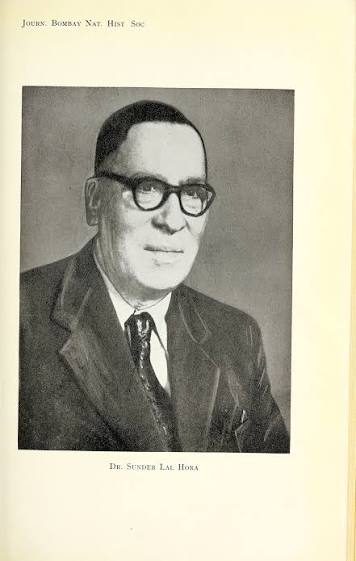
His name was Dr. Sunder Lal Hora, India’s greatest zoologist, the father of modern Indian ichthyology & the ghost pioneer whose groundbreaking Satpura Hypothesis stunned the global scientific community.
Born in 1896 in Hafizabad, Sunder Lal Hora was captivated not by textbooks, but by the furious mountain streams of the North-West. While other children saw rushing water, young Hora saw a battleground: How do tiny, fragile creatures survive in rapids that can wash away boulder-sized rocks?
Driven by an insatiable curiosity, he joined the Zoological Survey of India (ZSI) at a remarkably young age. Under the mentorship of British naturalists, Hora revolutionized zoology.
Equipped with basic nets, notebooks & relentless grit, he waded through the treacherous, malaria-dense torrents of the Western Ghats, Assam & the Himalayas. While others collected dead specimens for jars, Hora studied life in motion.
Dr. Hora made a discovery that blew the minds of biological oceanographers & evolutionary scientists worldwide: He mapped how stream-dwelling fish developed specialized adhesive suckers, flattened bodies & unique fins to lock themselves onto smooth underwater rocks against raging torrents. His anatomical studies were so precise they became benchmark references in European textbooks.
While studying hill-stream fishes in the Western Ghats (South India) & the Khasi Hills (Northeast India), Hora noticed something impossible: the exact same species of freshwater fish lived 1000s of KMs apart, separated by vast dry plains.
How could a tiny freshwater fish cross 1000s of miles of arid land w/o dying?
In 1937, Hora proposed the revolutionary "Satpura Hypothesis." He argued that millions of years ago, a continuous, humid, high-altitude mountain range: the Satpura line connected the Eastern Himalayas directly to the Western Ghats, serving as a wet, flowing bridge for aquatic life.
At a time when continental drift & plate tectonics were still fiercely debated, Hora used the humble anatomy of tiny fish to map the ancient geological climate of the Indian subcontinent!
Dr. Hora went on to become the Director of the Zoological Survey of India, authored 100+ research papers, discovered dozens of new species & earned accolades from the Linnean Society of London. He was consulted internationally on inland fisheries, ecology & wildlife conservation.
Yet, as decades passed, his name faded into obscurity within his own homeland. The textbooks forgot him, the mainstream media moved on & today, 1 of the greatest naturalists Asia ever produced rests quietly in the forgotten corners of history.
The Next Time You Stand Near a Mountain Stream...Look closely at the fast water beneath your feet. Beneath that foaming surface, tiny creatures are still clinging to the rocks using the exact mechanisms mapped out by an Indian genius nearly a century ago.
Empires rise & fall, names are forgotten by neighbors, but as long as India's rivers flow from the mountains to the sea, the silent legacy of Dr. Sunder Lal Hora lives on.
The Irish once called themselves the Tuatha de Danaan.
Children of Danu.
The same Danu appears in the Rig Veda as the mother goddess of the flowing waters. She is where the Danube gets its name. And the Dniester, the Dnieper, the Don and the Donau. And Denmark. And Greek Demeter. Northern Greeks called themselves Dannuni.
Two hills in southwest Ireland are still known as the Paps of Danu. At Beltane, fires were lit around them and cattle driven between the flames for protection and good harvest. The same ritual is described in the Vedas.
The oldest surviving Irish text, the Book of Invasions, records a tribe called Erainn, from Arya, arriving from the south by sea and making its way inland to the Hill of Tara. The Persians took the same name for themselves. Iran means the land of the Aryas.
These Vedic influences arrived in pulses. The Iranian is the oldest. A landward pulse followed the river valleys of the Dniester, the Dnieper, the Donau and on into Denmark, leaving the mother goddess's name behind at each stage.
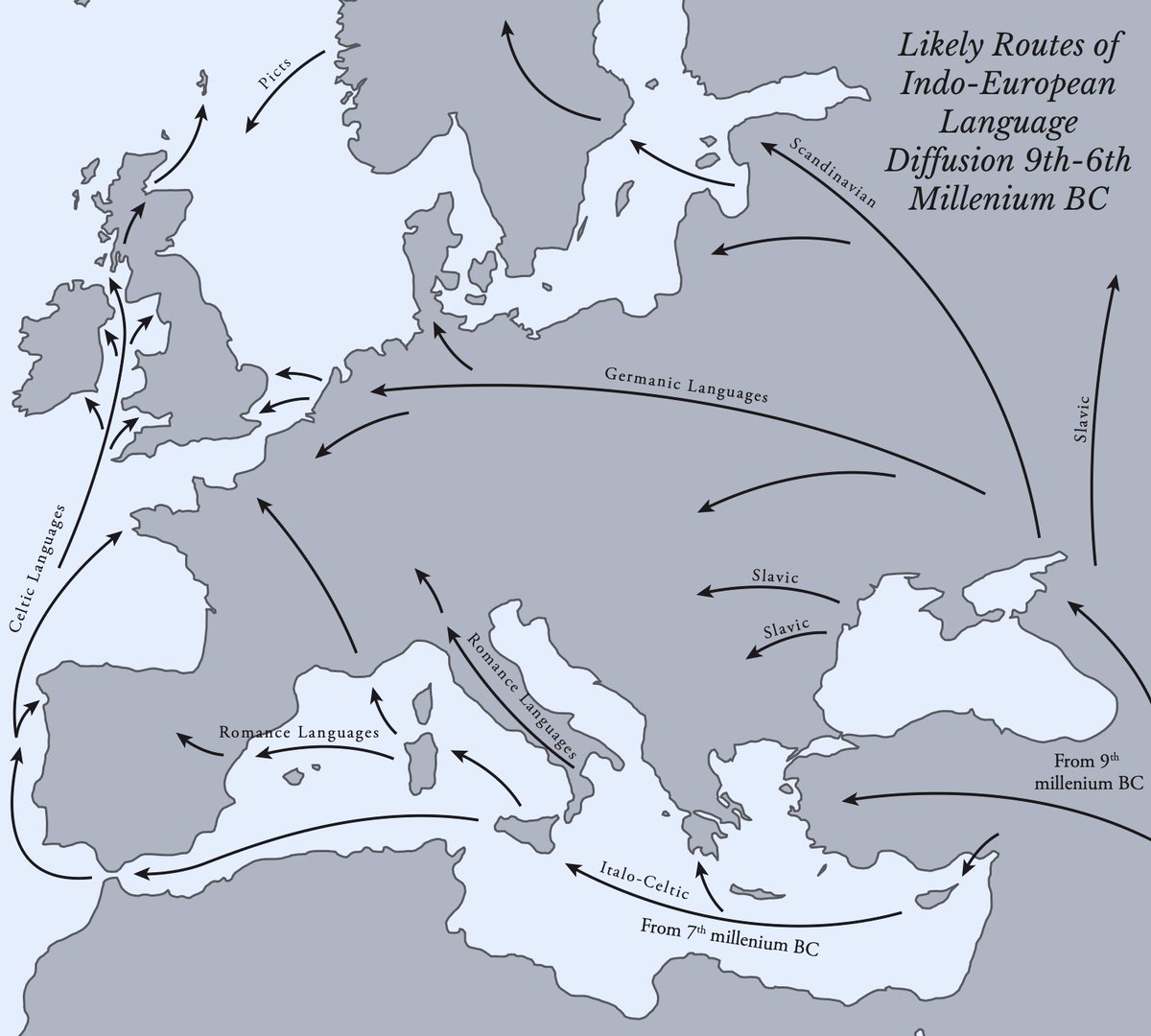
The Celtic pulse came after 5,600 BC. The Celtic branch had by then separated from Italo-Celtic in the Mediterranean and continued up the Atlantic seaboard. The route is still readable on the map. Portugal. Galicia. Gaul. Pays de Galles. Cornwall. Galloway. Galway. The "gal" names trace the coast.
Ireland remembered its origin.
The old story of Aryan nomads riding into India from the steppe has no DNA support. Michel Danino reviewed nine large-sample genetic studies from 1999 to 2006 and found no invasion signal. The archaeological record shows no cultural break from prehistory. The outstanding character of ancient India is continuity.
The trails from Iran and from Ireland both lead back to India.
I set the full case out in "How Maritime Trade and the Indian Subcontinent Shaped the World."
More than 30,000 people packed Marvel Stadium in Melbourne yesterday to see Modi. Albanese was on the same stage. Anti-immigration protesters gathered outside. The usual commentary followed: Why are these people more loyal to India than Australia? Why is a foreign leader holding political rallies on our soil? Where is the assimilation?
Let us work through this with some numbers and some common sense.
First, the crowds. India has 1.4 billion people. The Indian diaspora is the world's largest, at over 32 million. People of Indian origin now make up more than 5% of Australia's population. India-born Australians have just overtaken England-born Australians as the largest overseas-born group in the country. When the Prime Minister of a nation of 1.4 billion visits a country where his diaspora numbers in the hundreds of thousands, large crowds are a base rate phenomenon, not a loyalty crisis. Modi is also genuinely popular. You do not have to like his politics to acknowledge that he draws crowds that most world leaders cannot.
Second, the "foreign leader holding a rally" framing. Every world leader engages with their diaspora abroad. Trump gets grand receptions in India. Obama addressed thousands in Kenya. Macron holds townhalls with French citizens overseas. Diaspora engagement is standard diplomacy. It builds people-to-people bridges, facilitates trade, and strengthens bilateral relationships. Albanese was standing right next to Modi at Marvel Stadium. He called Modi "the Boss" during the 2023 Sydney event. This is not a hostile foreign incursion. It is a jointly hosted diplomatic event that both governments wanted.
Third, and this is the uncomfortable part, let us talk about assimilation.
Those demanding assimilation rarely define it. What exactly do they mean? Language? Indian immigrants in Australia speak English. Rule of law? Indians in Australia have among the lowest crime rates of any immigrant group. Economic contribution? Indian Australians are disproportionately represented in medicine, engineering, IT, academia, and small business ownership. They are high-income, high-education, high-tax-paying residents. Family stability? Indian families in Australia have among the lowest divorce rates and strongest intergenerational support structures. Not being a burden on the state? Indian immigrants are net contributors to the Australian economy and social security systems.
So what is left? Is it religion? Skin color? Food? Festivals? The willingness to stop being visibly Indian?
That is not an assimilation argument. That is a racism argument wearing a policy hat.
Full cultural integration, including interracial marriages, deeper social mixing, and the gradual blending of traditions, happens over generations. It always has. The Italians in Australia were once considered unassimilable. So were the Greeks. So were the Vietnamese. Today they are "Australian" without anyone questioning it. The Indian community is earlier in that arc. Give it time. It is not something that can be forced or demanded. It happens naturally when people live alongside each other.
Finally, the economics. Australia runs a trade surplus of over $6.5 billion with India. Bilateral trade hit $24.1 billion last year. India's exports to Australia have more than doubled in four years. Since January 2026, all Indian exports enter Australia duty-free. India is the world's fastest-growing major economy. Australia is betting its economic diversification strategy on the India relationship to reduce dependence on China.
In this context, protesting the Indian Prime Minister's visit is not just xenophobic. It is economically illiterate.
Citizens of any country should put their country first. No one disputes that. But attending a diaspora event for the leader of your country of origin is not disloyalty. It is not an endorsement of a political party. These are not election rallies. They are cultural and diplomatic gatherings. An Indian Australian cheering Modi at Marvel Stadium and then going home to pay Australian taxes, follow Australian laws, raise Australian children, and contribute to the Australian economy is doing exactly what a good citizen does.
Unlike many modern nations that were founded on a constitutional idea, India is a civilizational state. Its people carry deep cultural, linguistic, and spiritual bonds that do not dissolve at immigration counters. That is not a threat. It is an asset. A diaspora that maintains strong ties to its roots while building a life in a new country creates the "living bridge" that both Modi and Albanese described. The alternative, a diaspora that severs all connection to its origins, is poorer for everyone.
The protesters outside Marvel Stadium had every right to be there. Free speech is non-negotiable. But their argument does not survive contact with the data.
It's a shame no major film has been made about Biju Patnaik. He lived a life that sounds almost fictional:
In 1938, he flew his entire wedding procession by aircraft to Rawalpindi for his marriage to Gyanwati Sethi (who became the first Indian woman to hold a commercial pilot’s license, and the couple later flew daring missions together.)
While serving in the Royal Indian Air Force (including as head of Air Transport Command), he secretly ferried freedom fighters like Jayaprakash Narayan, Ram Manohar Lohia, and Aruna Asaf Ali to their hideouts. He also airdropped 'Quit India' leaflets to Indian troops while evacuating British families.
The British once jailed him for transporting nationalist leaders and distributing anti-British literature but also honored him for bravery in evacuating civilians from Japanese-occupied Burma.
During WWII, he flew daring missions delivering arms and supplies to Soviet forces in Stalingrad, and over the treacherous 'Hump' route to China in
support of Chinese Nationalist forces against the Japanese.
In July 1947, he and his wife flew a Dakota into Indonesia, landed on an improvised airstrip while evading Dutch anti-aircraft fire, rescued Prime Minister Sutan Sjahrir, refuelled using abandoned Japanese fuel, and flew him safely to India via Singapore.
A couple of months later, during the Pakistani invasion of Kashmir, he airlifted one of the first Indian troops into Srinagar.
The same year he founded Kalinga Airlines, one of India's earliest private airlines.
As Odisha CM post-1962 India-China war, he secretly visited CIA headquarters at Langley to forge a covert India-US partnership against China, which led to the Aviation Research Centre (ARC) at Charbatia, which supported U-2 recon missions over Tibet.
He was also a legendary administrator and statesman, laying much of the foundation of Odisha's industrial empire (mines, ports, heavy industries etc).
When he passed away, Indonesia observed 7 days of state mourning. Russia observed 1 day. He remains the only person in Indian history whose body was draped in the national flags of 3 nations - India, Indonesia, and Russia.
Few public figures have left such a footprint.
His extraordinary life needs to be brought to the big screen.
5. Real fatigue is not a signal that you need new people, but that you need more honest connections.
You don't have to break off contacts; sometimes it's enough to stop pretending.
The psyche always chooses sincerity because it's more resource-efficient.
In 1821, Thomas Jefferson wrote that religious liberty in America must protect "the Hindoo" as much as anyone else. This America 250 story might surprise you.
The United States was born from the bold idea that we're all created equal, and our founding fathers were thinkers who looked to their furthest horizons in search of the meaning of freedom.
Jefferson envisioned a nation where ancient Eastern wisdom and Western ideals could live side by side. Alongside leaders like James Madison and John Adams, they shared a vision of many faiths and traditions living together in a land truly safe and free, drawing on the spiritual depth of humanity.
Two and a half centuries later, their vision is all around us. Today, the United States is a tapestry woven from threads from every corner of the world, and Hindus have been part of this nation's story from its earliest days.
Happy 250th, America! 🎆
Learn more about Hinduism's roots in American history 👉 https://t.co/U0WYyofGlL
The Indian Holocaust- This must go viral
Hitler did not come to India - Then who put 20000 Indian Army Soldiers in Gas Chambers??
The Britishers did- 1930 British Holocaust on Indians for 10 years suspected to have killed over 20000 soldiers
This story won’t give you goosebumps. 🇮🇳💔
It will leave you in silence.
History often speaks of wars, but stays silent about what happened behind closed doors.
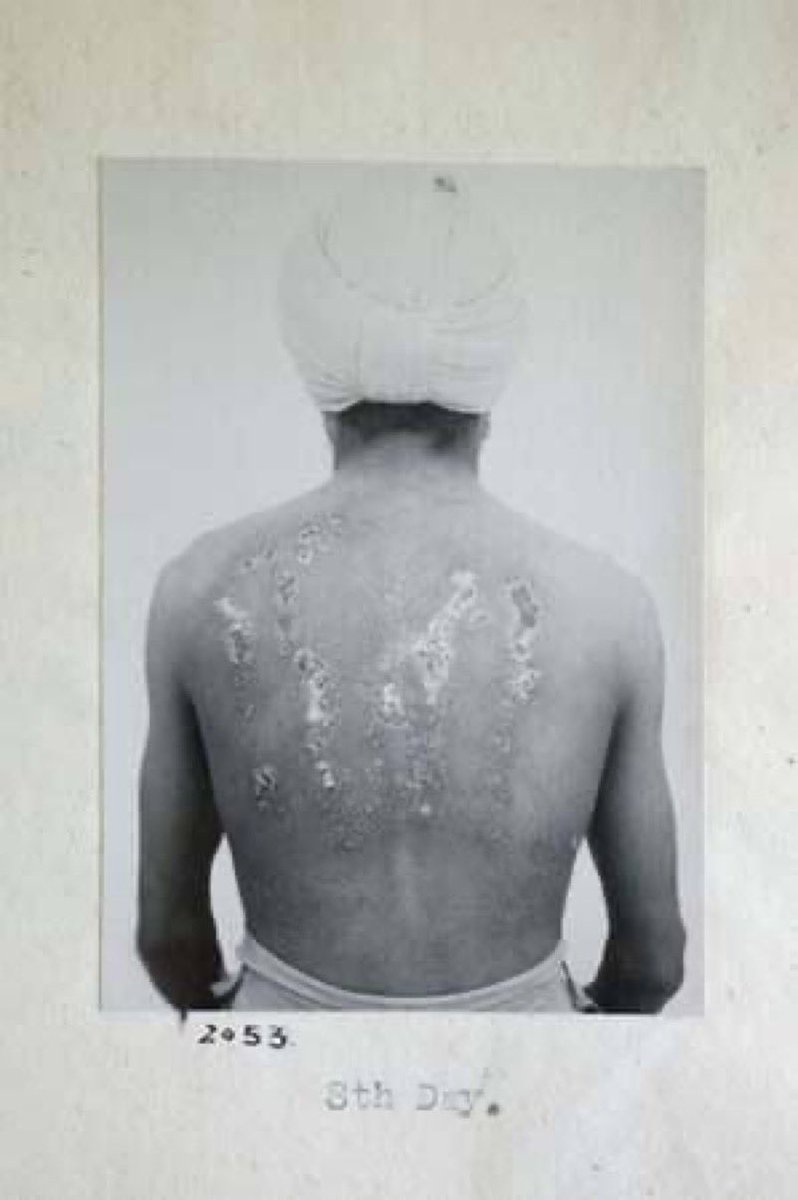
In the 1930s and 1940s, soldiers of the British Indian Army were taken to military testing programs linked to Porton Down.
Inside controlled gas chambers in Rawalpindi, Indian Army soldiers were exposed to mustard gas.
Not in battle.
In experiments.
They were made to stand inside sealed chambers wearing minimal clothing so the effects on skin, eyes, and lungs could be studied.
What they endured was not warfare it was observation.
Hundreds were exposed.
Many suffered severe burns. Many developed long-term respiratory and eye damage. Some were hospitalized for weeks.
Consent was not truly informed. Within the structure of colonial military authority, refusal was not realistically possible.
For years, this remained hidden from public view.
Later reporting, including by The Guardian, brought fragments of this truth into light.
This was not a battlefield.
This was controlled human experimentation done in the name of research.
And the people inside those chambers were Indian Army soldiers who had no real choice in what they were part of.
Some parts of history are not meant to give chills.
They are meant to leave you with silence.
A 15-year-old dream has come true today. I started a PhD with the dream of creating a system that chants any Sanskrit shloka perfectly.
And here I am opening sourcing 𝐕𝐚𝐠𝐝𝐡𝐞𝐧𝐮 - 𝐀 𝐯ṛ𝐭𝐭𝐚 (𝐦𝐞𝐭𝐞𝐫) 𝐚𝐰𝐚𝐫𝐞 ś𝐥𝐨𝐤𝐚-𝐭𝐨-𝐜𝐡𝐚𝐧𝐭 𝐭𝐞𝐱𝐭-𝐭𝐨-𝐬𝐩𝐞𝐞𝐜𝐡 (TTS) 𝐬𝐲𝐬𝐭𝐞𝐦 𝐟𝐨𝐫 𝐒𝐚𝐧𝐬𝐤𝐫𝐢𝐭. This is the world's first vrutta-aware, open-source TTS for Sanskrit Chanting.
This handle consistently exposes Brown Sepoys- a good start.
Time has come to name and shame these snakes openly.
There must be a total social boycott of these Brown Sepoys.
Let them feel the consequences of their betrayal.
Sheetali Pranayama - The breath technique Vedic sages prescribed to cool excess Mars energy (Pitta).
Curl your tongue. Inhale slowly. Hold 4 counts. Exhale through the nose. 10 rounds.
Before a difficult negotiation. Before a board confrontation. Before you pick up that call.
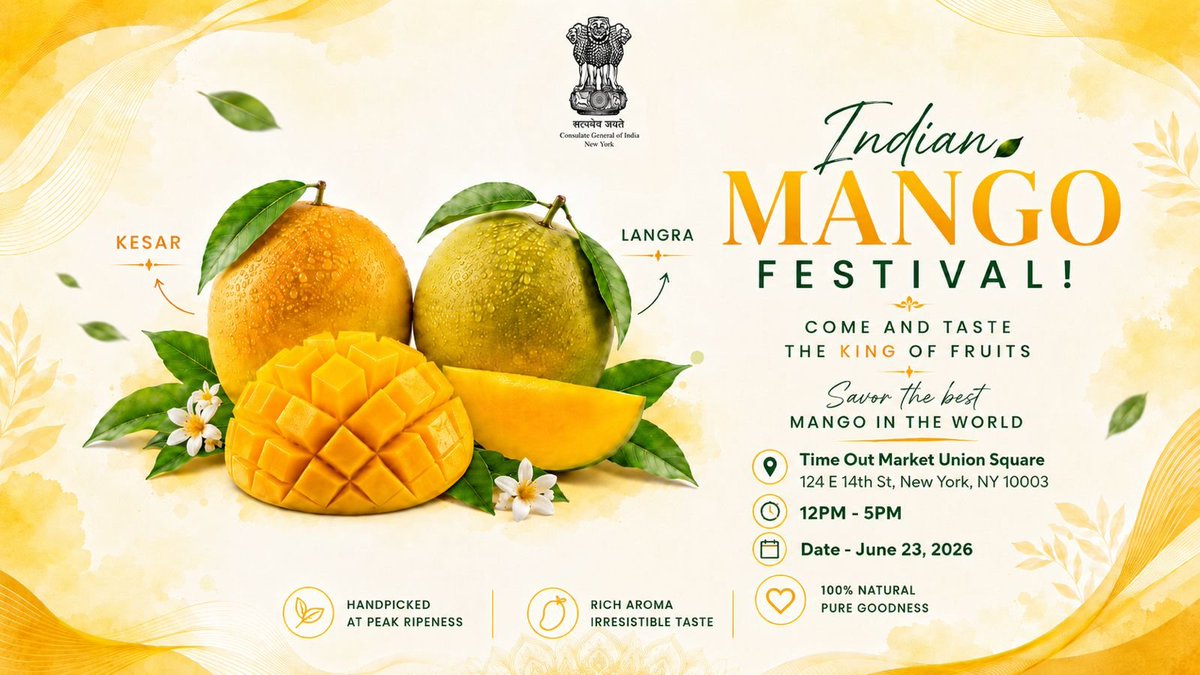
The Consulate General of India, New York, invites you to the Indian Mango Festival - a celebration of the King of Fruits.
Savor two of India’s finest varieties, Kesar & Langra, handpicked at peak ripeness.
Time Out Market, Union Square
June 23, 2026 | 12–5 PM
Come taste the best mangoes in the world.
@MEAIndia@IndianEmbassyUS@IndianDiplomacy
In the Ṛgveda, the Asuras are not demons.
They are the Anu. The Anavas.
And once you see this, the entire Indo-European story realigns.
In the Ṛgveda, the great civilizational divide is not “good vs evil”.
It is Anu vs Puru.
The Devas are the ancestral gods of the Puru / Pauravas.
They are the Ādityas, sons of Aditi, the mother of the gods, working under Tvāṣṭar, the divine architect.
Tvāṣṭar is not a marginal figure.
In the Ṛgveda he appears repeatedly as father-in-law to major god's wives, linking lineages.
He is the god of craft, metallurgy, design, and construction, the civilizational signature of the Harappan–Sarasvatī–Sindhu world of North-West India.
On the other side stand the Anu / Anava.
The Ṛgveda describes them with remarkable precision:
Anindra – those who reject Indra
Avrata – those who do not follow Vedic ritual norms
Vadhri-vācāḥ – those who speak different dialects
Not barbarians.
Linguistic cousins.
Proto-Avestan and other early Indo-European speech forms.
This is why the Anavas are consistently hostile to Indra because Indra is the tribal god of the Purus.
Now pause here.
The Anu are not a minor Vedic clan.
👉 Anu is the supreme god of the Sumerians.
That is not coincidence.
From the Anavas emerge two great branches remembered in Itihāsa-Purāṇas:
Daityas
Dānavas
The Daityas correspond to proto-Iranians.
Their sacred river is named Daityā in the Avestan text Vendidad —identified with the Jhelum.
The Dānavas correspond to proto-Greeks, Albanians, and wider Europeans.
Their sacred river is Danu, preserved as Danube, Don, Dnieper, and more.
Even Greek memory is explicit.
The heroes of the Iliad and Odyssey trace themselves to the Danaans.
And Ireland?
The Irish gods trace their divine ancestry to Danu, their great grandmother goddess.
Now return to the Ṛgveda.
Here, Dānu does not mean a demon queen.
It means dew, ice, flowing waters, rivers born from Himalayan glaciers.
Sapta Dānu = Seven Rivers = Sapta Sindhu.
Only later, in the Itihāsa-Purāṇas, do we see a theological reshuffle:
Aditi, Diti, and Danu are turned into wives of Kaśyapa Prajāpati.
But Kaśyapa is a Late Ṛgvedic figure, prominent mainly in the Late Ṛgveda, associated with Kashmir-region Ṛṣis.
The very concept of Prajāpati itself emerges only in the 10th Maṇḍala.
In effect: 👉 The cosmic role of Ṛgvedic Tvāṣṭar is retro-assigned to Kaśyapa.
👉 Older civilizational memory is reorganised into later genealogy.
So what we are seeing is not mythology, but layered historical memory:
Puru vs Anu
Indra-worshippers vs Indra-rejecters
Indo-Gangetic ritual core vs outward-moving Indo-European branches
Read literally, you get demons and gods.
Read historically, you get the Indo-European split preserved inside the Ṛgveda.
If this perspective is new to you, say YES in the comments.
If you want a deep dive into Anu > Danu > Daityas & Dānavas, react 🔥
If this reframes Indo-European history for you, share & retweet.
More threads coming, if people want them.
Fair question 🤔
When an Indian name pops up in a fraud case - true or not - the outrage machine screams nonstop.
But a Pakistani national allegedly orchestrating a **$650 MILLION** Arizona Medicaid fraud scheme?
Crickets from the groypers, @SaraGonzalesTX, and certain Fox News voices.
Farrukh Jarar Ali (operating from Pakistan) stands accused of billing taxpayers for fake addiction treatment services at 41+ clinics - targeting vulnerable patients including Native Americans. $650M in false claims.
Glad @RepDavid is shining a light on it.
Fraud is fraud. Enforce the law equally - or admit the selective outrage was never about protecting taxpayers.