⌘C ⌘V: Introducing Copy-Paste Language Models!
CPLMs learn to copy tokens better, improving downstream accuracy, CoT, long-context performance, and memory-efficiency for RAG at <3% overhead
PS: they (partially) mitigate the LM head bottleneck
Paper: https://t.co/lUY14CKmua
#NeurIPS2026 Spotlight
RL for diffusion and flow models often requires expensive rollouts.
We show that flow maps enable simulation-free RL finetuning.
Introducing Wasserstein-Tilted Flow Maps (WTF)! 🤩
The key is a transport-based alternative to KL regularization. 🧵
RaCo: Ranking and Covariance
for Practical Learned Keypoints(3DV 2026)
RaCo is a rotationally equivariant keypoint detector that identifies stable and repeatable keypoints in images. Refer the paper for a quantitative evaluation of its rotational equivariance.
📢🚀 Excited to share
AReA: Adaptive Receptive-Field Attention for Efficient High-Resolution Diffusion Transformers
Training-free, up to 6× the native resolution, up to 3.2× faster.
📄Paper: https://t.co/Hfallt6AJI
🌐Webpage: https://t.co/wbd0FZ4yHW
🤗HF: https://t.co/f4XEyRQM0h
Can diffusion models generate high-quality images without CFG?
Yes! We introduce ✨Correction Training for Diffusion Models✨, which significantly improves sample quality without relying on classifier-free guidance.
Project page: https://t.co/Ic8foxITJ0
🧵 (1/n)
With everyone busily using LLMs + Blender/Three.js to make 3D models, I thought I'd try a different geometric representation.
This dragon isn't a mesh, NeRF, 3DGS, or video model: it's 27kb of GLSL code (generated via LLM), defining a closed-form implicit surface. 🧵 [1/n]
1/8 Introducing Beckmann World Models (BWM): adapting Beckmann transport into fast, one-step action-conditioned world models.
Predicting the next video state from recent observations, proposed actions in one denoising step function call.
Our final RGB model predicts four PushT frames in 24.7 ms on one A800 GPU.
DINOv2 has never seen a caption, and Qwen3 has never seen an image. We still aligned their embedding spaces without a single image-caption pair.
It even works when the images and the captions come from different datasets.
Project page: https://t.co/2YHSkXVz1D
⬇️
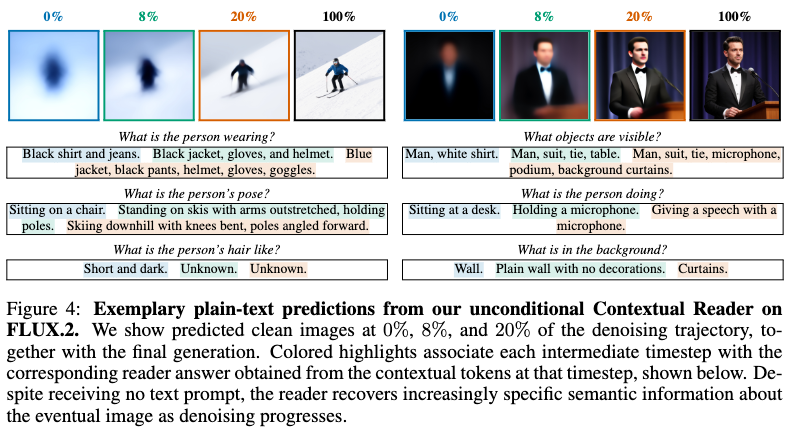
Dahary and Sella et al., "Learning to Read the Contextual Tokens in Diffusion Transformers"
Turns out you can already read out a LOT about the image that is being generated even before it becomes barely interpretable.
Compositional 3D reconstruction now feeds physics sim, but mostly with rigid bodies.
Real scenes are full of deformable and thin objects like cords & paper.
CoDimRecon reconstructs them as sim-ready curves, surfaces & volumes from multi-view photos 👇
https://t.co/xm31hP5dGu
Diffusion models spend the same compute on a blank wall as on a face. But you often know in advance where the detail will be.
Introducing Level-of-Token (LoT) Diffusion: we turn that knowledge into a multiresolution token layout, with fine tokens where detail is needed and coarse tokens elsewhere.
1/9🧵
LLMs can already build a Blender scene from a room video. So is 3D vision doomed?
We tried the opposite: hand the vision models to GPT-6 as tools (Pi3X for geometry, SAM3, GVHMR/Kimodo for people). It turns a room video into a better interactive sim.
👇
https://t.co/UhYUyNaNAS
1/ We introduce TrackEverything: a 3D point tracker that tracks all points across all frames of long videos (1000+ frames).
Our key idea is to tie computation to unique 3D scene content rather than redundant 2D pixels in a video.
https://t.co/NYHPTTg0Gr
What if you could turn any number of photos (3, 8, 15, or even 60) into one clean 3D surface (pts & mesh) with Flow Matching?
Check out our new work, Surflo: Consistent 3D Surface Flow Model with Global State. 🧵
1/n
🔗https://t.co/lBcJRgpfdg
3D models can look right and still fall apart.
Introducing Functionalization: graph completion adds missing structure and connectors to rectify motion and make models work.
SIGGRAPH Asia 2026
Paper, code, data available at: https://t.co/P5PYq6HFzU
AgentSTAR is an agentic method for both reconstruction and tracking of articulated objects from monocular videos.
We can now track through rapid motion, severe occlusion and thin objects! There’s no spoon but we can still track it 🥄
MotionVLA accepted at CoRL 2026! 🎉
VLAs should remember motion, not just frames.
We convert short video history into queryable trajectory tokens—no drift, no fragmentation.
📄 https://t.co/nPRre4CnAN
🌐 https://t.co/HCcajXVGCL
UniSim-SLAM: Feed-Forward SLAM with Unified Sim(3) Optimization(ECCV 2026)
https://t.co/fP92bB4kia
UniSim-SLAM applied to an image sequence captured with a mobile phone.