Since time immemorial, when a CEO asks a PM at Product Review, “what do you need to 10X users/revenue?”, “what will make you go faster?”, etc
The PM steadfastly responds “We need [N] more engineers”. The Eng Mgr nods approvingly
A story thread, with some hard truths to swallow:
As schools are open, kids has to walk besides Garbage dump having stinky smell, animals around. It’s become very difficult to pass through this area. Requesting BBPM team to look into and do the needful. Near Narayana co-Kaveri school (near Amrita college, Kasavanahalli) . Thanks
Yesterday, someone from a Life Insurance company called, insisting I should consider this plan. After three calls, I said fine, just tell me what it is.
Pay us 1 lakh per year for seven years, she said. In the eighth year, we'll give you back 11 lakh!
Now I have this number machine in my head, and this sounded quite good; I quickly put it in an excel sheet and voila: 11%.
Insurance has a shady thing where you pay at the start of the year, but they pay you at the end. Adjusting for that, 9%.
Who's guaranteeing 9%? I asked for the name of the plan.
"SBI Wealth Builder", she said.
I look it up.
"But it's a ULIP", I say aloud
"Yes, sir. You can take the bond fund option"
"How can you guarantee a ULIP", I ask, actually curious because who knows what has changed for insurers.
"You'll get that much, sir, Bond fund will give 9%"
"Have you gotten 9% in your bond fund?"
"Yes sir, but I'll get back to you with details"
*Click*
She never calls back.
I'm a nerd. So I look it up. Their own bond fund has, even over five years, given just 5.6%, before other charges.
Of course she lied, but the bigger lie was the guarantee. Saying that you will guaranteed receive 9% - in a ULIP - is just plain illegal, misleading and fraudulent. Beware and just say no.
NRI playbook is dead.
you can’t save money like NRIs were doing earlier so don’t come with hope of huge savings instead come for experience, clean air, less pollution, less population, culture and living a different lifestyle and see if this is something you wanted otherwise you’ll always have a chance to go back!
10 years before:
- Come to EU/Canada
- Earn $100K per year
- Mortgage below $2K
- Keep expenses below 5k/month
- Save 5K/month
- Buy 2-3 properties in India
This is no longer possible:
- Mortgage in EU/Canada is super high.
- Rental is super expensive.
- Property in India also super expensive.
You will barely save anything unless you eat “Parle G” and live a cheap life”
If you want to be save money, go to USA ( but always a constant struggle to get visa extensions and H1B visa is tough and your luck play a major role) or stay in India or build business but If you want to live a good enough lifestyle with some sacrifices ( food, away from friends and family, loneliness) come to Europe, get citizenship and build your life around EU passport + OCI.
and if both partners works in tech then EU is still a good option.
everyone has different circumstances so don’t get influenced by people who didn’t even took a chance!
many people come and stay for life but many people come and go back but with a better mindset and appreciate India more!
I used to rant about taxes in India but the freedom, services, food, people and vibe you get in India is something different. No comparison…
No land/ country is perfect in this world.
snow in April is depressing 😫
Some time back, I saw a young male in his 20s brought to me by his father in the opd.
The father was pretty distressed as the son had abruptly left a good job after a heated argument with his boss a couple of weeks ago. He told me that for the last 10-12 days, the boy had
A lot has been written about Bangalore's water crisis, so here's a story.
In January 2018, I found myself in Cape Town, and while waiting for my bags at the conveyor belt, this sign stared back at me.
This is a sad trend for people and society.
It’s been proven for many years now: building a committed relationship with one person and then raising children in that nuclear two-parent family contributes more to creating healthy, happy adults and a well functioning society than anything else (ie wealth vs poverty, health history, zip code, race).
So the implication of the trend below, if it doesn’t self correct are terrible for society as a whole:
1) there will be more and more promiscuity and, as a byproduct, less kids born
2) what few kids we do have will grow up in non two parent households
It may seem “fun” and “free” to be a 20/30 something with a roster, but many of these folks will wake up alone, too late to act on the simple truth that being in a committed relationship and having kids is not an indulgence of a thriving society but a requirement.
42 years old today & probably about halfway done with this ride (hopefully a bit less than half 😬)
Overall I’ve really enjoyed it
I’ve had hard times like anyone but overall I’m very grateful
Here are a few things I’ve learned
that I wish I knew when I was younger
When I was a kid, average kids dream was to be an astronaut, fighter pilot and scientist.
Today most kids dream to be an influencer, professional gamer and youtuber... where did we go wrong? 🤔
There is nothing wrong with Mr. Narayan Murthy saying that youngsters should work 70 hours a week.
Mr. Murthy practised it and achieved incredible success.
He never said that one should necessarily work for others. It can be for your own venture, idea or dream.
He is just trying to quantify work ethics. If you can do that kind of work in 40 hours - that's great.
There are smart workers and then you have hard workers. Everyone is not very smart, and they have to work hard to cover up for that.
I have done 100+ hr/weeks for over 20 years at a stretch. It definitely is a tall ask, but that's the only way many people with average intelligence can grow and achieve excellence.
So, let's not outright criticize someone who has been the epitome of hard work and ethics and gave India one of the finest software companies.
We can all agree to disagree, but personal attacks and trolling is in bad taste for sure.
𝗪𝗵𝗮𝘁 𝗶𝘀 𝗖𝗿𝗼𝘀𝘀-𝗢𝗿𝗶𝗴𝗶𝗻 𝗥𝗲𝘀𝗼𝘂𝗿𝗰𝗲 𝗦𝗵𝗮𝗿𝗶𝗻𝗴 (𝗖𝗢𝗥𝗦)?
Browsers use CORS to prevent websites from requesting data from different URLs. A request from a browser includes an origin header in the request message. The browser allows it if it gets to the server of the exact origin; if not, the browser blocks it.
We can deal with CORS issues on the backend. Cross-origin requests require that the values for origin and 𝗔𝗰𝗰𝗲𝘀𝘀-𝗖𝗼𝗻𝘁𝗿𝗼𝗹-𝗔𝗹𝗹𝗼𝘄-𝗢𝗿𝗶𝗴𝗶𝗻 in the response headers match and the server sets it. When you add an origin to the backend code, the CORS middleware only permits this URL to communicate with other origins and utilize it for cross-origin resource requests.
There are two ways to fix CORS issues:
𝟭. 𝗖𝗼𝗻𝗳𝗶𝗴𝘂𝗿𝗲 𝘁𝗵𝗲 𝗕𝗮𝗰𝗸𝗲𝗻𝗱 𝘁𝗼 𝗔𝗹𝗹𝗼𝘄 𝗖𝗢𝗥𝗦
The server can let all domains with 𝗔𝗰𝗰𝗲𝘀𝘀-𝗖𝗼𝗻𝘁𝗿𝗼𝗹-𝗔𝗹𝗹𝗼𝘄-𝗢𝗿𝗶𝗴𝗶𝗻: *. This turns off the same-origin policy, which is not recommended. Another option would be only to allow a particular domain, which is a better option, e.g., 𝗔𝗰𝗰𝗲𝘀𝘀-𝗖𝗼𝗻𝘁𝗿𝗼𝗹-𝗔𝗹𝗹𝗼𝘄-𝗢𝗿𝗶𝗴𝗶𝗻: 𝗵𝘁𝘁𝗽𝘀://𝘀𝗼𝗺𝗲𝗱𝗼𝗺𝗮𝗶𝗻.𝗰𝗼𝗺.
𝟮. 𝗨𝘀𝗲 𝗮 𝗣𝗿𝗼𝘅𝘆 𝗦𝗲𝗿𝘃𝗲𝗿
We can use a proxy server to call external API. It acts as a middleware between the client and the server. If the server doesn't return proper headers defined by CORS, we can add them to the proxy.
_______
If you like my posts, please follow me, @milan_milanovic, and hit the 🔔 on my profile to get a notification for all my new posts.
Learn something new every day 🚀!
#softwareengineering #programming #api #apidesign #techworldwithmilan
Creating a cache layer for a database query that takes 9 seconds will sure give the client a sub millisecond latency.
But that is just a duct tape.
Blindly and completely replacing the database on which the query takes 9 seconds for a database that takes 3 seconds, is just a more expensive duct tape.
It is a matter of time until the new database shows its own problems.
Understanding why the query takes 9 seconds in the first place and fixing it is the most effective path forward.
Even if the decision ends up replacing the database, at least now you know why exactly you are replacing the component, it is not a black box to you.
This understanding is not easy because tech is truly overwhelming. It takes time, effort and dedication to understand.
I’m not advocating to never change infrastructure. On the contrary, by understanding how languages, frameworks, databases and tools work, we may make informed design choices to replace the tool because of fundamental deficiencies.
Understand the system.
There are no shortcuts.
You can’t get rich quick.
Lately, tech twitters been depressing.
- bad job market
- layoffs
- engineers applying & not hearing back
- talk of things improving only in 2024
- even good brands like Dunzo struggling
Figured I'll share internal 📊 to cover the state of India tech hiring and add perspective
What happens when you get earn upwards of 75-80 lakhs per annum?
You leave India. Or you try to leave India. Not because you are any less patriotic but because it makes more sense to leave than stay. Hear me out.
I know about 20 people who have left India in last 1 decade. Why? Let us break it down. All these individuals earned about 80 lakhs to 1.2 crore per annum. When you are in that earning slab, you are crème-de-la crème of the workforce. Your skill set is better than an average joe and you are in demand world over. Unfortunately, we as a nation, are not doing enough to retain such great talent who are high earners and hence high spenders.
Highest tax bracket in India is 30%. Today, India has 48.3 lakh people who are in 30% tax slab. And the 30% tax slab starts at the earning of 15 lakhs per annum. Any decently talented fresher from a good college can command that. Any moderately above average hard working individual in 4-5 years of their experience can command this sum.
But does being in highest tax bracket and hence being the highest tax payers of the nation translate into leading a lavish life in a metro for a family? Unfortunately, no. Has the cost of living not increased exponentially? Try to find a decent flat for rent in Bangalore or Gurugram in a locality where you would want your children to grow up without paying exorbitant rents and security deposits.
Let's not go back 75 years. Let's just rewind 9 years. Since last 9 years the tax payer has only a limited avenues to save his tax. 1.5 lakhs in standard deduction and 50k in NPS. Thoda bohat home loan and insurance for parents. And no matter how much you increase your earning, this remains standard. Government can incentivize savings by increasing the limit in govt backed schemes like PPF or SSY or bonds but it refuses to budge. The system is designed for a time long gone.
The services that one gets in the country right now relative to the tax that they pay is very skewed. And this is likely to remain skewed for a while. For a lot of my friends who earn similar amounts, despite paying 30 lakhs per annum in direct taxes and almost paying the same in indirect taxes, the return they get in the short run is miniscule. Can they get good clean healthcare in any government hospital? Can they drive on roads which don't have potholes? Or can their kids get quality education in government schools? These are problems that will take some time to fix and I believe, as a nation, we are on the right track. But there must be an interim solution to plug the leak, so to speak.
In 2023, 6500 HNIs will leave India. 7500 HNIs left India in 2022. In 2018, India was third after Russia and China in terms of number of HNIs migrating to other countries. This is a disturbing trend.
For the longest time, I had disdain for people who left the country. Their was a popular term which every 90s kid must have heard of ; 'Brain Drain'. I could not understand why would anybody leave Bharat and go out to make a career. But, I guess with age comes perspective. And maybe, just maybe, I now understand.
@narendramodi@nsitharamanoffc
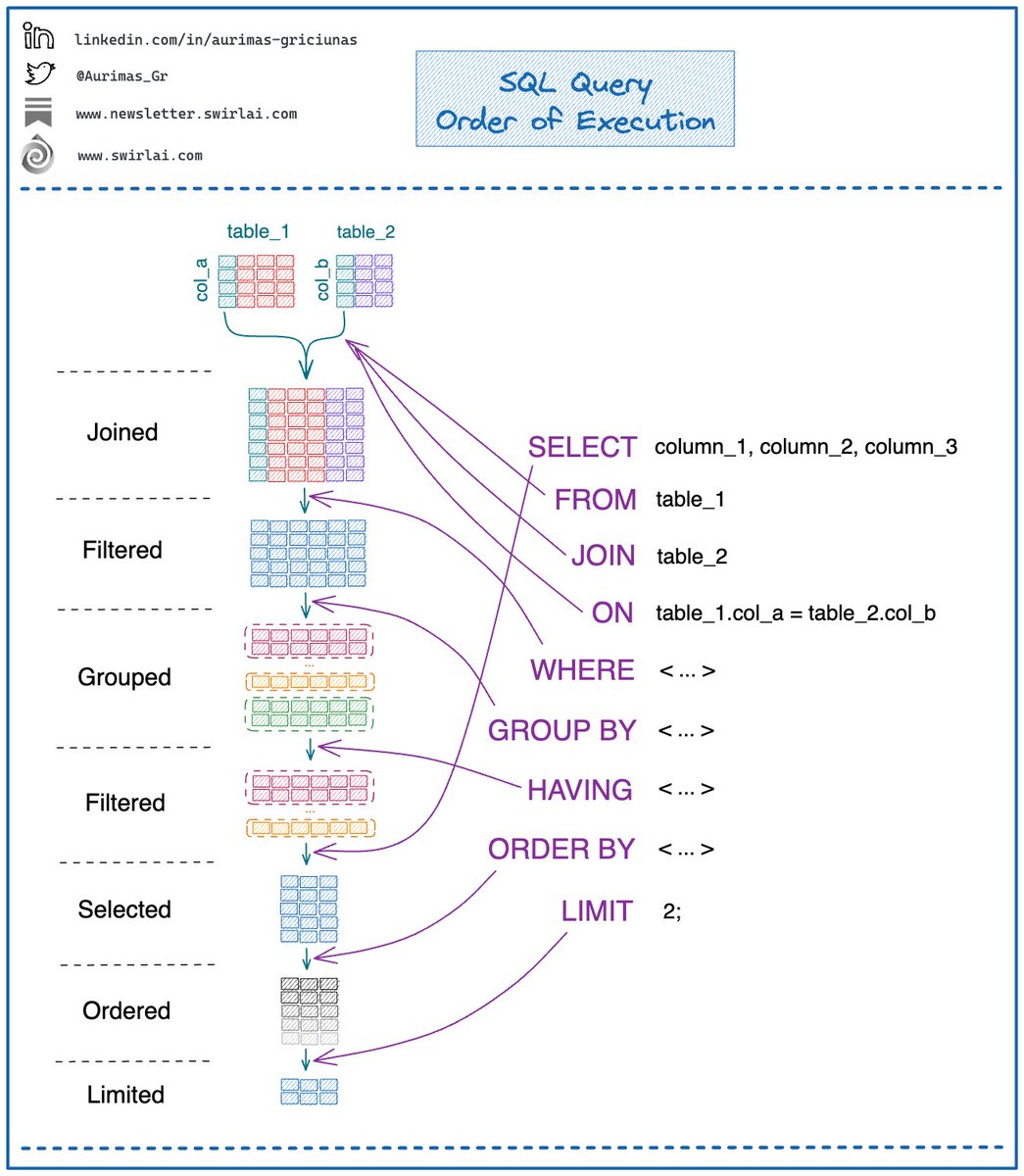
What is the 𝗦𝗤𝗟 𝗤𝘂𝗲𝗿𝘆 𝗼𝗿𝗱𝗲𝗿 𝗼𝗳 𝗘𝘅𝗲𝗰𝘂𝘁𝗶𝗼𝗻?
There are many steps involved in optimising your SQL Queries. It is helpful to understand the order of SQL Query Execution as we might have constructed a different picture mentally.
The actual order is as follows:
𝟭. 𝗙𝗥𝗢𝗠 𝗮𝗻𝗱 𝗝𝗢𝗜𝗡: determine the base data of interest.
𝟮. 𝗪𝗛𝗘𝗥𝗘: filter base data of interest to retain only the data that meets the where clause.
𝟯. 𝗚𝗥𝗢𝗨𝗣 𝗕𝗬: group the filtered data by a specific column or multiple columns. Groups are used to calculate aggregates for selected columns.
𝟰. 𝗛𝗔𝗩𝗜𝗡𝗚: filter data again by defining constraints on the columns that we grouped by.
𝟱. 𝗦𝗘𝗟𝗘𝗖𝗧: select a subset of columns from the filtered grouped result. This is also where 𝗪𝗜𝗡𝗗𝗢𝗪 𝗳𝘂𝗻𝗰𝘁𝗶𝗼𝗻 𝗮𝗴𝗴𝗿𝗲𝗴𝗮𝘁𝗶𝗼𝗻𝘀 happen.
𝟲. 𝗢𝗥𝗗𝗘𝗥 𝗕𝗬: order the result by one or multiple columns.
𝟳. 𝗟𝗜𝗠𝗜𝗧: only retain the top n rows from the ordered result.
Below is a nice way to visualise it.
What are your thoughts? Let me know in the comment section 👇
--------
Follow me to upskill in #MLOps, #MachineLearning, #DataEngineering, #DataScience and overall #Data space.
Also hit 🔔to stay notified about new content.
𝗗𝗼𝗻’𝘁 𝗳𝗼𝗿𝗴𝗲𝘁 𝘁𝗼 𝗹𝗶𝗸𝗲 💙, 𝘀𝗵𝗮𝗿𝗲 𝗮𝗻𝗱 𝗰𝗼𝗺𝗺𝗲𝗻𝘁!
Join a growing community of Data Professionals by subscribing to my 𝗡𝗲𝘄𝘀𝗹𝗲𝘁𝘁𝗲𝗿: https://t.co/qgNCnGtF4A
I met a friend recently, and he told me this:
In his company, more than 95% of customers are on Android, but engineers focus more on iPhones!
Why?
Because everyone in the leadership team uses iPhones :)
The best co-founder duo is a combo of a realist who constantly thinks about how to reduce business risk and of an optimist who constantly dreams of an ambitious future