Hey C++ Twitterverse! I'm looking for a full-time position in software engineering. If you have any hints, I'm all ears! See https://t.co/04xzavtYtU for my bio. #cplusplus#cpp
Hey, #gcc folks, is there a list of #UB that are "exploited" by the compiler in a particular version? Or a hint how to search for such behaviour changes? #cplusplus#cpp
Moving from gcc 9 to 10 in my case
@lunasorcery First of all you have `FormatTests` unit tests that you build and run (and they don't need the whole clang but some parts though). Second, you can run `bin/llvm-lit clang/test/Format`. Hope this helps.
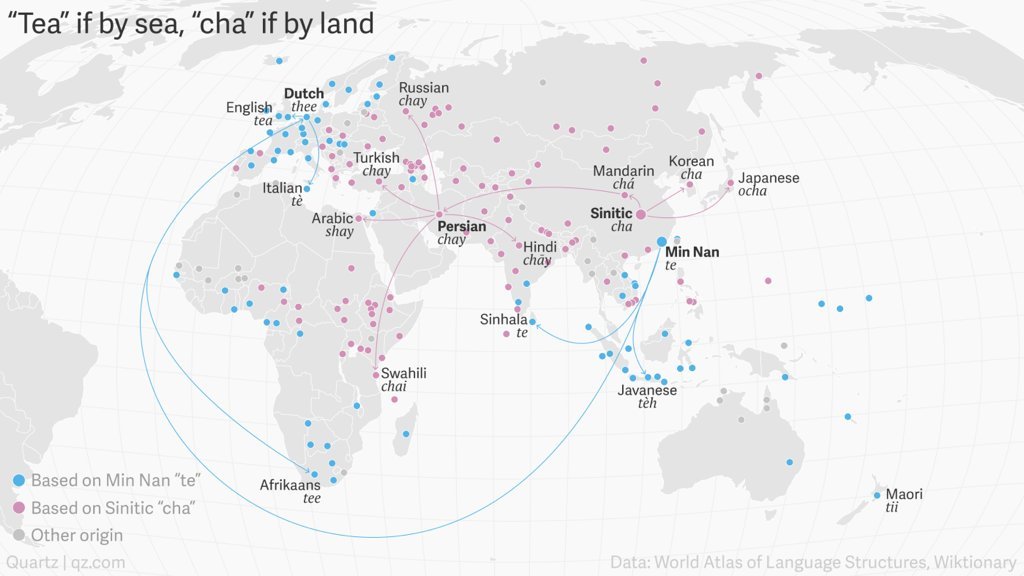
FYI, it seems to me that at least Polish (herbata) and Lithuanian (arbata) are incorrectly marked as "Other origin", where they really come from "te". Probably through Dutch thee. Cf. also hierba + té (ES), herbe + thé (FR).
A cool link between vocabulary and global trade: If your region first got tea by land, you call it something like “cha”/“chai”, from a Northern Chinese dialect. If by sea, you use a variation on “tea,” based on the pronunciation of the Fujianese who worked with overseas traders.
Today I discovered that you can fake up `if constexpr (requires ...)` in C++17 with fairly simple syntax:
```
auto check = [](auto &&x) -> decltype(x < x) {};
if constexpr(is_invocable_r_v<bool, decltype(check), T>)
```
Is this already a well-known technique?