Sam Altman says something interesting:
“You don’t need to write prompts anymore.”
At first, that sounds crazy.
But AI is moving toward a world where you give it a goal, and it figures out the steps, tools, and context needed to do it.
In a recent talk with Stanford students, Altman shared how to get more out of ChatGPT.
If you’re still using AI like a search box, you might be missing a lot.
Google Brain founder Andrew Ng:
"Prompting will be dead in 6 months"
"Loops and graphs are replacing it"
In just 2 hours, he shows how to build agents that work, learn, and improve on their own
LLMs → Agents → Loops → Graphs → Self-Improving Systems
The first 15 minutes alone are more valuable than most $500 AI courses
Most people are still learning prompts while AI engineering is already moving beyond them
Watch the lecture first
Then read the full guide to loops and graphs below ↓
🚨 Anthropic just released a 27-minute workshop showing you how to actually write better prompts for Claude.
Taught directly by the people who built it.
Free. No signup. No paywall.
I’ve seen $300 courses that don’t teach what Anthropic covers in the first 8 minutes.
Watch the full session.
Bookmark this video 🔖
Anthropic hired this engineer at $250K-$750K/year because he can build knowledge graphs for multi-agent systems
In this 15-minute workshop, he shows exactly how to build one with loops from scratch
step 1 → start with the Claude Agent SDK - loop, context, and sandbox are already handled
step 2 → split the brain from the hands - reasoning in one place, tools in a sandbox, ~60% faster to first token
step 3 → run it server-side and log every step - close your laptop and it keeps going, crashes resume from the log
step 4 → make failure cheap - retry dead sandboxes and replay lost context instead of starting over
step 5 → turn yesterday's logs into new memory and skills - it wakes up smarter
Anthropic calls this "dreaming"
Most people spend weeks wiring this by hand
You don't have to
Watch it, bookmark it, then read the full graph guide below ↓
Stanford AI engineering course:
"Anyone can build an AI agent in 60 minutes"
Prompt → Agent → Automation → Revenue
Stanford just released a course on building AI agents from scratch
00:00 - Build your first AI agent
48:17 - Create agents without coding
54:39 - Make $100K+ per month with agents
While you scroll, someone else is learning Anthropic's $750,000 skill
This free course is better than most paid AI agent courses
Bookmark and watch it today
Then read the article below
Anthropic pays $750,000+ a year for engineers who can build LLM architectures from scratch. Stanford taught the entire thing in 1 hour lecture & released it for free.
Bookmark & watch this today before someone takes it down and read this article below.
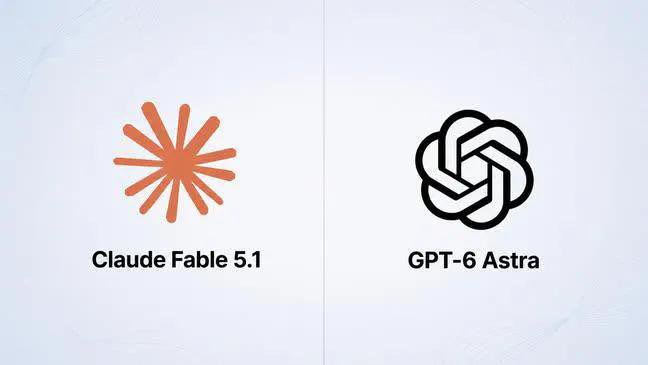
Now that GPT-6 Astra and Fable 5.1 are out, you need to know these prompt-writing steps.
They’ll completely change the way you use AI.
I really wish I knew them earlier.
The first step is:
where does all the VRAM go during LLM inference?
(4 ways GPU memory is used)
loading the model is only the first part of the memory story.
once inference starts, GPU memory gets divided across multiple components, and some of them keep growing as context length, batch size, and concurrency increase.
the graphic breaks it into four useful buckets:
→ model weights are the mostly fixed part. once the model is loaded, their memory footprint stays roughly constant. the biggest lever here is precision. moving from FP16/BF16 to INT8 or INT4 reduces the number of bytes needed to store each parameter.
→ KV cache grows as generation continues. for every previous token, the model stores key and value tensors so attention can reuse them instead of recomputing the entire sequence. longer contexts mean a larger KV cache, and more concurrent requests mean more active caches sitting in memory.
→ activations and workspace hold temporary intermediate values needed while running attention, MLP layers, kernels, and other computations. this memory is reused across inference steps, but its size can still change with sequence length, batch size, and the kernels being executed.
→ runtime overhead comes from everything around the model itself. CUDA kernels, memory allocators, metadata, serving-engine buffers, and other runtime structures all consume some VRAM. it is usually smaller than the other buckets, but it is never zero.
this is why “the model fits on the GPU” and “the workload fits on the GPU” are two different statements.
a model may load comfortably, then run out of memory when you increase the context window, serve more users simultaneously, or increase the batch size.
it also explains why quantization can help beyond simply fitting a larger model. shrinking the weight footprint creates room that can instead be used for larger KV caches, more concurrent requests, or bigger batches.
that is the broader GPU lesson too.
performance is not just about how much arithmetic a GPU can do. it is also about what data occupies memory, how much of it moves during inference, and how often that data can be reused.
i wrote the full breakdown of how GPUs actually work and why memory movement sits at the center of LLM inference performance.
the article is quoted below.
Sam Altman, CEO of OpenAI: “You don’t need to write prompts anymore.”
In just 27 minutes, he explains how to use ChatGPT in ways most people haven’t even explored yet.
This was a talk he gave to Stanford students. A friend sent me the recording last night.
After watching it, I realized I was barely using 15% of what ChatGPT can actually do.
Watch the full talk, then check out the guide below on how to build a system that can prompt itself.
She's 18 built an AI agent with Opus 5 and sold it to Anthropic for $3.2M - and came to Stanford to show how to do it from scratch:
00:34 - how Opus 5 builds a $3.2M agent in one evening
15:34 - 4 agents replaced 400 Anthropic engineers
34:47 - from first prompt to a $3.2M check from Anthropic
after watching I spent 60 minutes building my first agent - it cut my workday by 90% and a week later I got a $100k check from Anthropic:
save & watch - article below on how to go from one prompt in Claude Code to an agent people pay millions for.
INSTEAD OF WATCHING NETFLIX TONIGHT.
Spend 1 hour with this.
Claude AI FULL COURSE that teaches you how to BUILD and AUTOMATE anything.
The people who watch this tonight will wake up tomorrow with a new skill. Watch it and bookmark it now
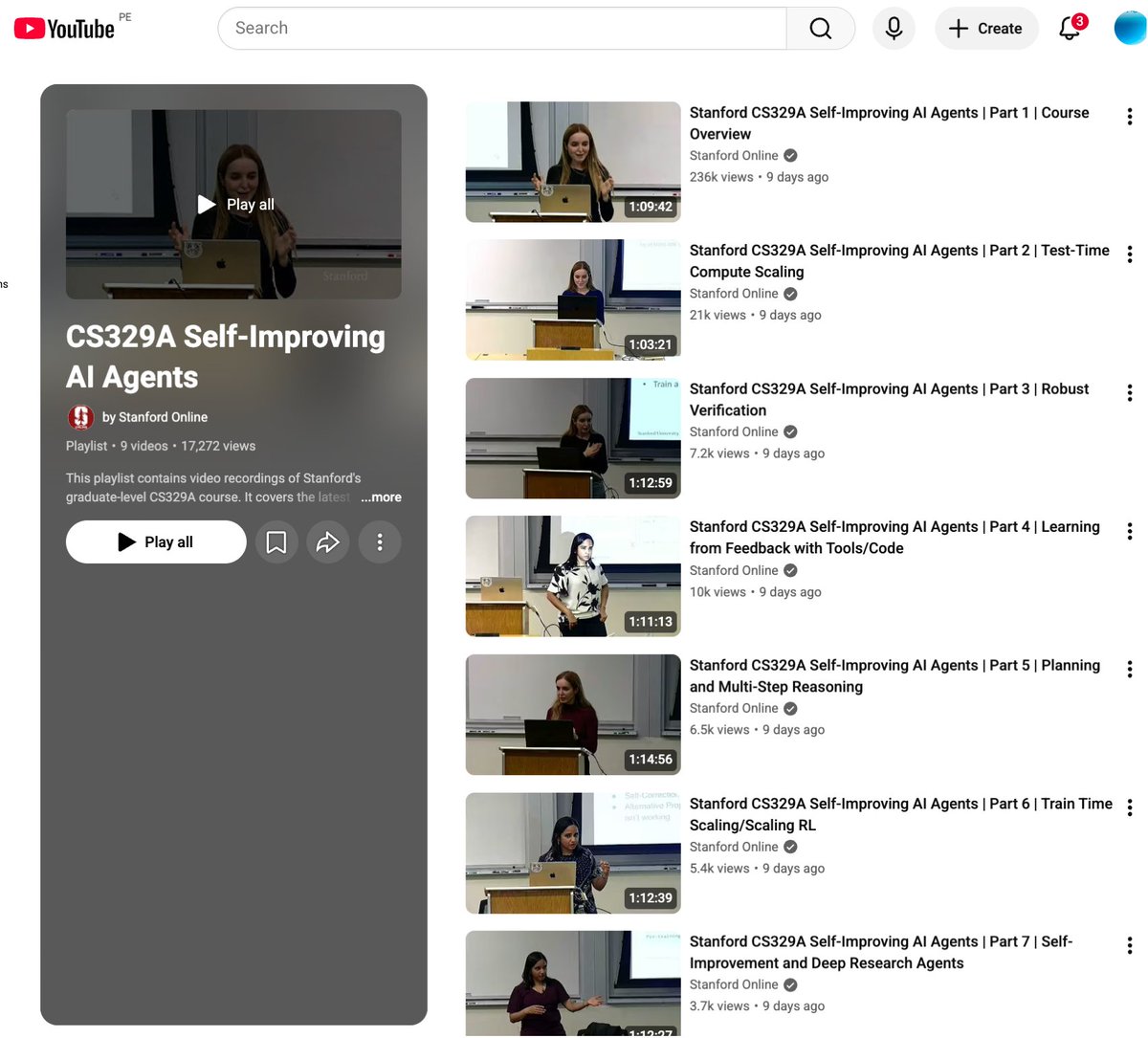
STANFORD JUST RELEASED A FREE COURSE ON ONE OF THE MOST CRITICAL SKILLS IN AI RIGHT NOW: BUILDING SELF-IMPROVING AGENTS.
The entire curriculum is focused on self-correction. It skips the basic API wrappers and gets straight into the mechanics of frontier reasoning.
If you want to understand how autonomous systems actually learn from their actions, the syllabus covers the exact stack being used today:
→ Test-time compute and verifiers
→ Constitutional AI and RL
→ Planning, memory, and tool execution
→ Architectures for deep research agents
It is highly project-based.
You watch the lectures, build alongside the researchers teaching them, and walk away with a functional self-improving architecture.
I've put the full playlist in the 🧵↓
Don't waste 2 years learning to become an AI agentic engineer in 2026.
Andrew Ng, the godfather of AI, gave the complete playbook to become one from scratch.
1 hour course. Free:
• 00:00 - AI agent basics
• 12:12 - AI Agentic workflows & design patterns
• 53:27 - Practical tips for building AI agents
• 1:20:30 - self-improving AI agent loops
• 1:30:19 - multi-agent AI systems
I watched it last night.
Halfway through, I realized I could get into Anthropic in weeks, not years.
Bookmark now. Watch it. Then build your own AI agent
Sam Altman (CEO of OpenAI):
"You no longer need to write prompts."
In just 38 minutes, he explains how to use ChatGPT at a level that most people can't even imagine.
It's a talk he gave to Stanford students. A friend sent me the recording last night.
After watching it, I realized I was only taking advantage of about 15% of what this tool can really do.
Watch it in full and then read the guide I leave below on how to create a system that prompts itself.
🔥𝐀𝐜𝐜𝐞𝐬𝐬 𝐭𝐨 𝐚𝐥𝐥 𝐀𝐈 𝐭𝐨𝐨𝐥𝐬 𝐢𝐧 𝐨𝐧𝐞 : https://t.co/zYXQBDVRg4
BREAKING NEWS!
The engineer who built Claude Code from scratch just released a 28-minute video that's pure gold: how to write prompts that deliver ridiculously good results.
I've seen $300 courses that don't even come close to what he explains in the first 10 minutes.
CLAUDE.md files, memory shortcuts, parallel sessions, and prompting patterns that almost no one uses...
All in one single video. Completely free. No fluff.
Whether you're a developer, just starting, or have already been using Claude for months, this changes the game for you starting today.
Save. Watch. Share.
5 FREE DATA ENGINEERING PROJECTS (1 MILLION+ VIEWS)
Just by doing these projects, you'll learn more about Data Engineering than any paid courses available in the market.
1. YouTube Data Analysis (End-To-End Data Engineering Project) - https://t.co/VoWVgzb614
What will you learn?
✅ Python and PySpark
✅ SQL
✅ How to understand the business problem
✅ AWS Services - Athena, Glue, Redshift, S3, IAM
✅ Building Data Pipeline and Scheduling it
2. Twitter Data Pipeline using Airflow - https://t.co/peLViDzonF
What will you learn?
✅ Python
✅ Basics of Airflow
✅ Working with Twitter Data and Package - Tweepy
✅ Python Package - Pandas
✅ Writing ETL job and storing data on S3
3. Stock Market Real-Time Data Analysis using Kafka, AWS, and Python - https://t.co/3H5rrBa4io
What will you learn?
✅ Build a Real-Time app using Python
✅ Understand the basics of Kafka
✅ Install Kafka on EC2
✅ Generate a real-time pipeline and
✅ Analyze Data in Real-Time
4. Uber Data Analytics Project On GCP
Video Link - https://t.co/H9jBKErD8i
Here's what you will learn:
✅ How to understand raw data
✅ Building Data Model (Lucid Chart)
✅ Writing ETL Script (Python)
✅ Modern Data Pipeline Tool (mage)
✅ SQL queries for analysis
5. Olympic Data Analytics | End-To-End Azure Data Engineering Project
Video Link - https://t.co/Y8bnAB5nae
Here's what you will learn:
✅ Extract Data from APIs
✅ Learn Azure Services DataBricks, DataFactory, and Synapse Analytics
✅ Writing Spark Code
✅ SQL queries for analysis