My first TEDx talk is now live.
In “Why Predicting the Future Is Not Enough,” I explore the limits of predictive models and why causal thinking is essential for addressing complex economic and societal challenges.
Watch the full talk on the official TEDx YouTube channel.
@tedxsauga@charlesssay
#IdeasWorthSharing #RippleEffect
https://t.co/P8rcfURuwQ
What a joy to spend Sunday celebrating the 90th birthday of @yudapearl, a true inspiration and a giant in our field(s). Judea revolutionized AI research twice, first with its probabilistic turn in the 80s (the field had been mired in side quests to develop alternative logics of uncertainty) and again in the 90s/00s with a systematic treatment of causal identification.
Judea is a hero for many reasons, not the least of which is his intellectual longevity. His probabilistic turn came in his 40s (and with it the invention of Bayes nets, d-separation, etc) and his second came towards his 60s, including the complete treatment of the do-calculus.
So many inspiring people came to pay their tribute, including @DaphneKoller@erichorvitz, with recorded messages sent in by nobel laureates and personal acquaintances alike, all under the careful curation of @eliasbareinboim.
Just like @yudapearl, the event could not be contained, with science, tragedy, joy, and raucous political debate sharing the stage (and occasionally wrestling for it). Throughout, I was awed both by Judea’s perseverance (he was once trapped under a bookshelf at 430a because he was still at the office during an earthquake!) and his pursuit of insights so crystalline that they could ripple across the entire canvas of human scholarship.
If the development of AI has profited from a generational struggle between the scruffies and the neats, then @yudapearl sits among our greatest neats, and while the scruffies may have the hot hand today, I hope that the next wave of neats (be they humans or machines) will take inspiration from Judea’s life’s work.
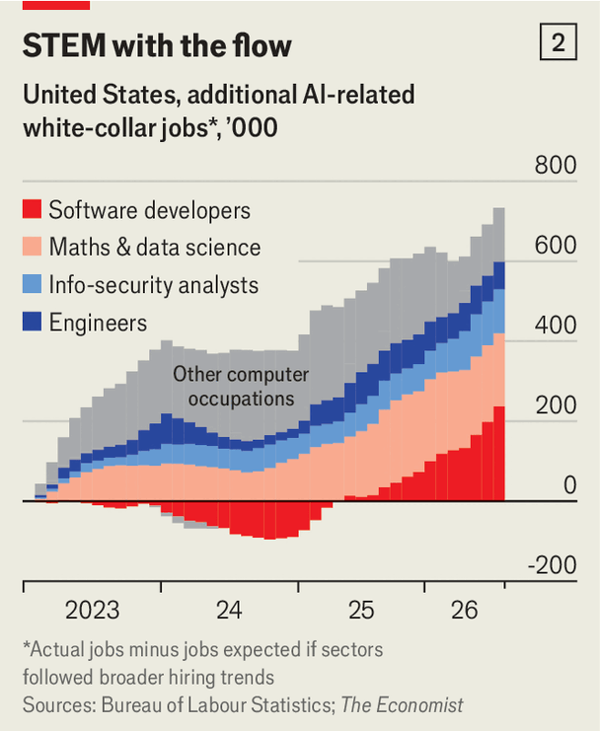
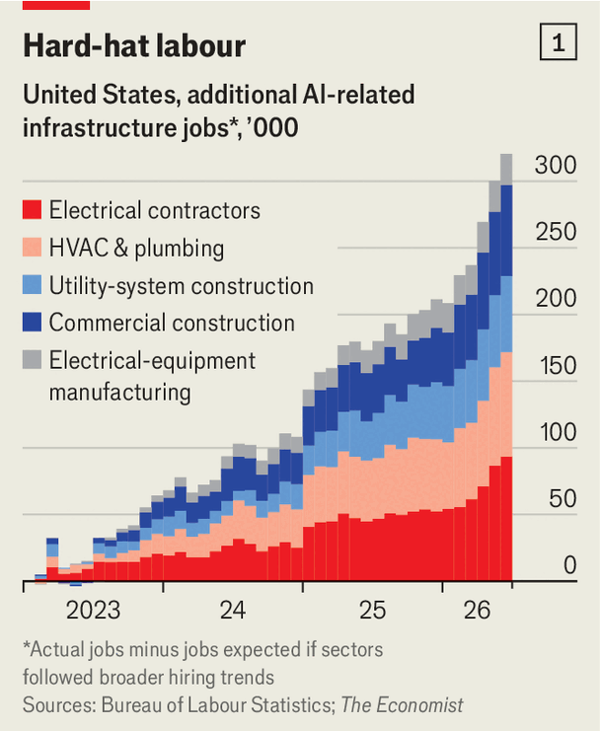
The AI jobs apocalypse may be arriving later than advertised.
The Economist points to a striking countertrend: AI is creating jobs as well as destroying them--from data-centre construction and infrastructure to AI engineering and deployment.
Yes, routine administrative and customer-service work is under pressure.
But the bigger story may be job transformation, not mass unemployment.
The labor market is proving more resilient than the headlines suggest.
https://t.co/Oe9OYmgN3h
President Kwame Nkrumah launched Ghana’s National Television (GTV) on July 31, 1965. The first official news bulletin was broadcast on the evening of the launch, 31 July 1965 at 7pm.
What did Ghanaians watch back then? The programming was heavily focused on education, local culture, and the promotion of the "African Personality," with 75% of content produced locally. Some of the programs were designed for schools and general education, covering topics like civics, hygiene and other topics of social interest. Early local drama groups were featured as well. Early children's content was often designed to fit within the educational mandate as well.
(The "African Personality" was a central Pan-Africanist ideology championed by President Kwame Nkrumah to redefine the global image of Africa and reclaim African identity, dignity, and culture. The "African Personality" was not purely traditionalist per se. Nkrumah envisioned it as a synthesis of the best elements of traditional African culture and global approaches.
Many felt inferior and insecure because of the colonial experience. The idea was to create a "new African" that was bold, confident, and ready to make an impact on development--not just of Ghana or even Africa, but around the world. For example, Nkrumah's decision to wear the fugu smock for his independence speech was meant to promote the African Personality concept.)
As Nkrumah intended to use television for development, early slots included documentaries.
Therefore, the early schedule was characterized by a high volume of local, educational, and pro-development content.
The Ghana Farmers' House was a national farmers institution uniting all farmers across ethnicities in the Kwame Nkrumah era, hosting the United Ghana Farmers' Council.
It was a radical idea. At the time, Ghana as a whole was a new concept, and the nation was competing with ethnic loyalties that many people were more connected to at the time.
An important conference was hosted by the Ghana Farmers' House with Nkrumah giving the keynote in 1962.
Thread.
Some are being paid to scare people about AI, while others are being paid to over-hype it.
This is basically the Cold War all over again: fear-mongering versus propaganda for competing systems.
But if either side truly believed it was right, why pay people to convince everyone?
They'd just convince them. Or it would be self-evident.
I call it the Colder War.
The AI jobs apocalypse may be arriving later than advertised.
The Economist points to a striking countertrend: AI is creating jobs as well as destroying them--from data-centre construction and infrastructure to AI engineering and deployment.
Yes, routine administrative and customer-service work is under pressure.
But the bigger story may be job transformation, not mass unemployment.
The labor market is proving more resilient than the headlines suggest.
https://t.co/Oe9OYmgN3h
modern travel is increasingly flying 10 hours to experience a slightly different version of the same globally optimized lifestyle.
same third wave coffee. same natural wine bar. same brutalist menu. same sourdough. same beige hotel. same tasteful ceramics. same instagram lighting.
what a ridiculous convergence.
8/ Values have not uniformly converged even as surface lifestyles have. The gap between Western emancipative norms and those elsewhere has widened in recent decades.
Steve Kerr says Roger Federer taught his Warriors team the secret to sustained success wasn’t outworking everyone, it was building a life around your craft you never want to escape from
“I’ll tell you a great story about Roger Federer. We were playing in China with the Warriors in 2017. Roger was in Shanghai for the Masters tournament, so we invited him to come speak to the team.”
“Draymond Green asked him, ‘How do you sustain success? How have you managed to win majors 20 years after you first won one?’ Everyone was expecting him to say, ‘I work harder than everybody,’ the will, all the clichés.”
“Roger Federer says, ‘I get up every morning and I make breakfast for my kids. Then I take them to school and drop them off. Then I go practice tennis for about two hours, and I’ve figured out a really good routine where I don’t destroy my body, but I can get all the work in I need.”
“‘Then I go have lunch with my wife. In the evening, we cook dinner together. The kids are all home from school. We ask them about school. There’s so much joy in the house. We put them to bed, and then I put my head on the pillow and go, “Man, that was just a great day.” And I’ve been doing that for 20 years.’”
“And it was like, yes. That’s it. That’s the formula. That’s what leads to sustained success. He loves tennis. He loves his family. He loves life. It’s not outworking everybody and banging your head against the wall, ‘I’m going to be better than everybody.’ It’s allowing your natural talent to shine through with a work ethic, with a great family life, with perspective, with peace, with mindfulness.”
“It’s perspective. It’s joy. It’s passion. It’s mindfulness. It’s an awareness that we are truly lucky. To get the most out of ourselves, it’s our daily rituals and experiences and love and joy.”