Claude Fable 5.2 just took the #1 spot on Artificial Analysis.
1,000 agents formalized Fermat’s Last Theorem in 30 hours.
It also leads on 3D scene generation and most agentic coding benchmarks.
Here’s what the numbers and demos actually show ↓ https://t.co/h5bo4YMAI8
Tracking 110 individual fibers under tension and showing the stages of jamming and progressive rupture turns the paper into something you can scrub and inspect. The cross-section and stress overlay mean the math is no longer something you only read. It is something you can watch fail fiber by fiber.
Real-time voice capture is useful when it stays on device and the transcript never leaves the phone. The moment the audio stream or the organized text is sent out for the model to process, the privacy cost is no longer theoretical. The feature only stays worth it if the user can see exactly where the data stops.
Google is expanding Gemini Intelligence across more Android devices and adding new practical features.
It’s moving beyond the phone into watches, cars, and custom widgets.
Here’s what’s new ↓
1/ More devices getting Gemini Intelligence
• Pixel 10, Pixel 10 Pro XL, and Pixel 10 Pro Fold are getting the latest features with today’s Pixel Drop
• Motorola is launching its first Gemini Intelligence phone: the motorola signature 27 (pre-order in the US on November 19)
Rambler (turns spoken thoughts into clean, organized text in real time) is rolling out to these Pixel 10 models and the new Motorola.
2/ Create My Widget
You can now design a personalized homescreen widget just by describing it in plain language.
Examples: a trip dashboard, monthly spending tracker, or race-day countdown. It pulls data from Gmail, Calendar, and Search.
Rolling out over the next few weeks. Coming to Pixel Watch soon too.
3/ Device Assistance
Ask your phone to clear storage, check which apps can access your location, or mute distractions while still letting important calls through.
Gemini acts as a personal device expert that understands your hardware.
4/ Proactive help in Android Auto
If you have a Pixel with Gemini Intelligence, it will soon surface suggestions in the car. Example: a friend texts asking where you’re meeting, and Gemini finds the confirmation email and offers to send the address with one tap.
Task automation (ordering food, booking rides, making reservations) is also expanding to the UK, India, and Japan.
Gemini Intelligence is gradually becoming less of a chat feature and more of a layer that works across your devices and apps.
Source: https://t.co/jxeJ4C9sra
Formalizing a proof of Fermat’s Last Theorem in Lean with about 1,000 agents in 30 hours is the clearest signal that the long-horizon agent loop is usable for real technical work. Cheaper and faster than 5.1 makes it practical to leave that loop running instead of babysitting every step.
Anthropic just launched Claude Meetings.
Claude can now join your video calls as a visible participant and start working on tasks while the conversation is still happening.
Here’s how it works ↓
1/ Real-time work during the call
When you add Claude to a meeting, it:
• Follows the discussion
• Drafts the plan being discussed
• Maps timelines on a whiteboard
• Answers questions in the chat
• Pulls information from connected apps (e.g. last year’s numbers)
After the call ends, the notes, action items, and anything Claude created are available in https://t.co/AwC7y2PEP9.
2/ Guardrails
Claude identifies itself as a participant and posts a notice in the chat. It won’t join meetings with external guests unless an admin allows it, and it automatically leaves if an external guest joins.
3/ Availability
Claude Meetings is launching in beta on Team and Enterprise plans. At launch it works with Google Meet, with more platforms expected later.
4/ Broader context
This comes alongside the Whiteboards, Sheets, and Data features Anthropic rolled out earlier today. The company is clearly trying to move Claude from a chat interface into the actual tools where work gets done.
OpenAI has been pushing in a similar direction with workplace tools, and Meta is experimenting with agent-built mini-apps. The race to own the next layer of productivity software is heating up.
Source: https://t.co/U3a6rDCHpK
Claude Fable 5.2 just took the #1 spot on Artificial Analysis.
1,000 agents formalized Fermat’s Last Theorem in 30 hours.
It also leads on 3D scene generation and most agentic coding benchmarks.
Here’s what the numbers and demos actually show ↓ https://t.co/h5bo4YMAI8
The girl covering her mouth is in the same shot as the figure on the wall, and the camera jerks at the end like the person filming flinched. Those two details keep it reading as a seat-level phone clip instead of a generated sequence. Once the sound hits the moment she leaves the screen, most people stop checking.
Fable got the glass case and the Apple-style labels on the first prompt. Opus needed the second round to surface the 19-turn coil and the battery math that matches the 8 h / 24 h claim. One model is already close enough for the look. The other is still the one you open when the numbers have to hold.
@yurshevv Pointing the swarm at OpenAI’s own homepage is the cleanest stress test. The agents crawl, extract, and rebuild in minutes while most people are still iterating in one chat window. The gap is already whether you can run the parallel setup or still type the next prompt by hand.
holy f*ck. same 1,000-agent setup. Opus 5.5 stalled at 26%. Fable 5.2 finished in 30 hours.
that's Anthropic's own Fermat's Last Theorem run, fully formalized in Lean. their first attempt took 11 days.
same harness, same agents. the only thing that changed was the model.
and you don't need Fable 5.2 in every seat. you need it in one: planning, routing, checking. Haiku, Sonnet and Opus do the typing.
I turned that into one copy-paste prompt for Claude Code. every step, every formula, all of it spelled out.
the crazy part is Fable 5.2 at High already scores about level with Opus 5.5 at Max on FrontierCode 2.0. for roughly half the cost per task.
99% of people will just swap the model ID and run Fable on grep.
bookmark it before this thread gets buried.
then read the full article below ↓
Announcing two open-source projects for building and operating managed Kubernetes services on GPU infrastructure: NVIDIA Kubernetes Engine (NVKE) and NVIDIA Kubernetes Recipes (NVKR).
Both are components of the NVIDIA DSX AI Factory Platform. NVKE is the control plane for running managed Kubernetes service and NVKR builds the OS images, container images, and packages the managed clusters depend on.
Available in public preview, get started: https://t.co/c1YuOc7Wjo
Introducing Security Factory: a new way for engineering teams to turn security findings into tested fixes by connecting investigation, remediation, and verification in one continuous workflow.
Now in Private Preview.
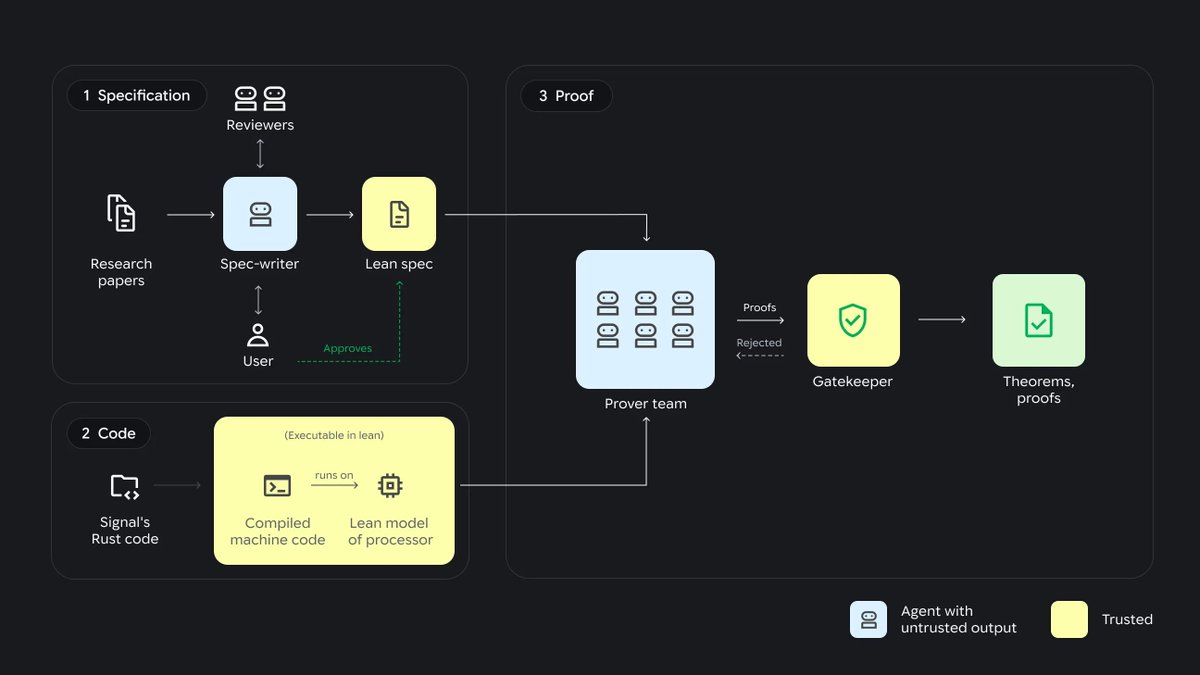
Our teams put Gemini 4 Carbon to work on a major security challenge: mathematically proving the code underlying the Signal protocol.
Using AlphaProof Code, @GoogleDeepMind researchers guided agents to verify the protocol down to compiled device code, closing the gap where real bugs hide. The result:
- Gemini 4 Carbon generated over 6M lines of machine-checked Lean proofs
- years of expert manual verification compressed to just weeks
~1% of the codebase required human review (Lean automatically checked the rest)
This is helping unlock scalable formal verification for building secure software, laying the groundwork to fundamentally shift the advantage to defenders. We’re open sourcing the results for the security community.
Six million lines of Lean proofs, years of expert work compressed to weeks, and only about one percent of the codebase still needing human review. Closing the gap all the way to compiled device code is the part that makes the verification usable for a real protocol instead of a simplified model.
@plutyou The ripped door flap stays in frame and the forest noise never drops. Those two continuous details do more work than the tiger itself. Once the girl hugs its head the sequence is already past the point where most people check whether any of it happened.
Google just added fully on-device voice to Gemma models in AI Edge Gallery.
You can now talk to Gemma offline — with real-time speech recognition and text-to-speech running entirely on your phone.
Here’s what they shipped ↓
1/ Voice in the main AI Chat
You can dictate live into the prompt box and hear Gemma’s replies spoken back with real-time sentence highlighting.
Everything runs offline. No cloud required.
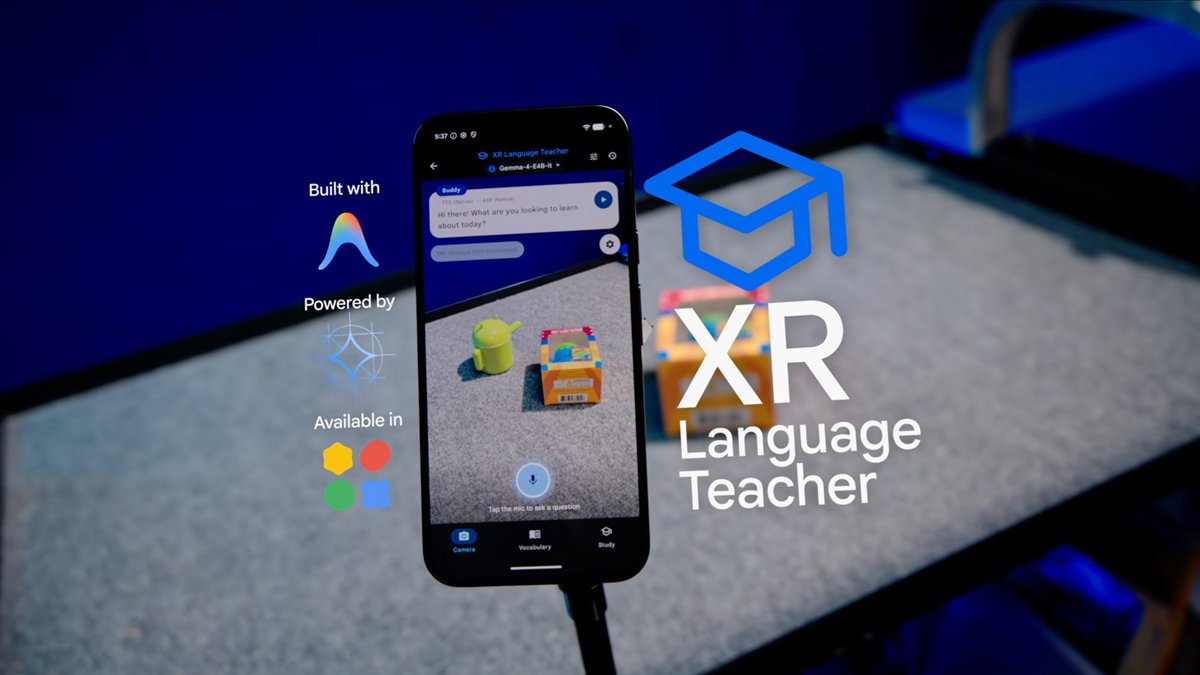
2/ XR Language Teacher demo
Point your camera at an object or menu, ask a question, and get a voice conversation with an AI tutor.
It uses on-device ASR + Gemma 4 + TTS. Built as a fully local multimodal loop (vision + voice).
3/ The underlying tech
• On-device ASR (ML Kit on Android, plus open models like Parakeet via LiteRT/MediaPipe)
• Fast TTS models (including lightweight options that start speaking in ~100 ms)
• Supports multiple languages and voices
• Available on Android and iOS via the Google AI Edge Gallery app
The code is open source. You can point tools like Antigravity at the Gallery repo and adapt the same voice + vision pipeline for other use cases (museum guide, cooking helper, etc.).
This is one of the cleaner examples of practical on-device multimodal interaction right now — speech and vision working together without needing a network connection.
Turn the world around you into an interactive, offline language classroom!
Point your camera and have a voice conversation with an AI tutor in XR Language Teacher on Google AI Edge Gallery, powered by Gemma 4 and built with @antigravity.
Read the blog: https://t.co/kSC0dSGMG4
Try it out: https://t.co/DCBgxEhUju
@googlegemma@antigravity Point the camera and have a voice conversation with a tutor that runs offline on device. The on-device ASR and TTS mean the loop stays local even when there is no signal. That is the part that turns a phone into a language classroom you can use on a train.
Claude is rolling out three new tools today that push it further into real workspace territory.
Whiteboards, Sheets, and Data are starting to land for paid users.
Here’s what they actually do ↓
1/ Claude Whiteboards
Talk through a messy plan and Claude lays it out on a shared board your team can keep editing.
It’s closer to a collaborative Miro-style surface than a pure chat response — ideas get structured visually while you discuss them.
2/ Claude Sheets
Ask for a tracker, budget, or simple model and you get a working spreadsheet with formulas and multiple tabs.
Teams can keep building on it together. Still in beta on paid plans.
3/ Claude Data (formerly Dashboards)
Now generally available on paid plans.
Connect data sources (Snowflake, Salesforce, etc.), use certified queries (beta), and turn metrics into dashboards, visual data stories, or short narrated videos for review before sharing. Live sharing is also in beta.
4/ Interactive connectors
You can now open the full version of certain tools inside Claude itself.
Work in Adobe, Atlassian, or Box right beside the conversation. Make changes yourself or have Claude help in the same interface.
Rolling out on web and desktop.
These features keep context across tools, so an idea can move from a whiteboard into a sheet and then into a data story without starting over.
Claude is slowly becoming less of a chat window and more of a place where the actual work happens.
New Fable 5.2 & Mythos 5.2 - https://t.co/Kz3a7np40a
Starting to roll out today: Claude Whiteboards, Claude Sheets and Claude Data.
Think a plan through on a board, build a tracker in a sheet, and tell a story with your data.
Google just made Gemini 4 Carbon generally available.
It’s positioned as their strongest model for the hardest, longest-horizon work — and it’s rolling out to AI Ultra subscribers and paying developers today.
Here’s the breakdown ↓
1/ What it’s built for
Carbon is meant for complex, multi-step tasks that test the limits of a model:
• Long-horizon agentic workflows
• Deep software engineering and debugging
• Scientific reasoning
• Cybersecurity (finding, exploiting, and patching vulnerabilities)
Google says Argon remains better for most everyday coding and knowledge work. Carbon is the one you bring in when the problem is open-ended and hard.
2/ Availability
• Google AI Ultra subscribers: Gemini app, AI Mode in Search, and Antigravity
• Developers & enterprises: Gemini API (AI Studio, Android Studio) and Gemini for business
• Introductory pricing: $2 / $10 per million input/output tokens (same as Argon’s launch price; rises to $4 / $20 after November 30)
Scientists can also apply for free high-tier access in Antigravity.
3/ Swarm preview
In Antigravity, Google is previewing `/swarm`.
One prompt becomes a coordinated team of agents you can watch in real time. Carbon handles high-level roles (architecture, coordination, auditing) while other agents build and test in parallel.
4/ Context
Carbon was first given to verified cyber defenders through the Fairwind Program two weeks ago. Today’s rollout opens it to a much wider audience.
Google is leaning into longer reasoning loops and multi-agent setups for the hardest problems, while keeping Argon as the more practical daily driver.
Gemini 4 Carbon is now available.
It’s our strongest model, built to dig deeper, handle long-horizon tasks, and multi-step reasoning.
If Argon is great for complex tasks, Carbon is the model you bring in for your hardest problems.
@Google@GoogleDeepMind Checking both the code and what is on screen while it builds is the difference on long projects. Flagging missing or flawed data instead of filling the gap is the part that keeps a multi-step build from drifting. Carbon is the model you hand the audit and coordination roles.