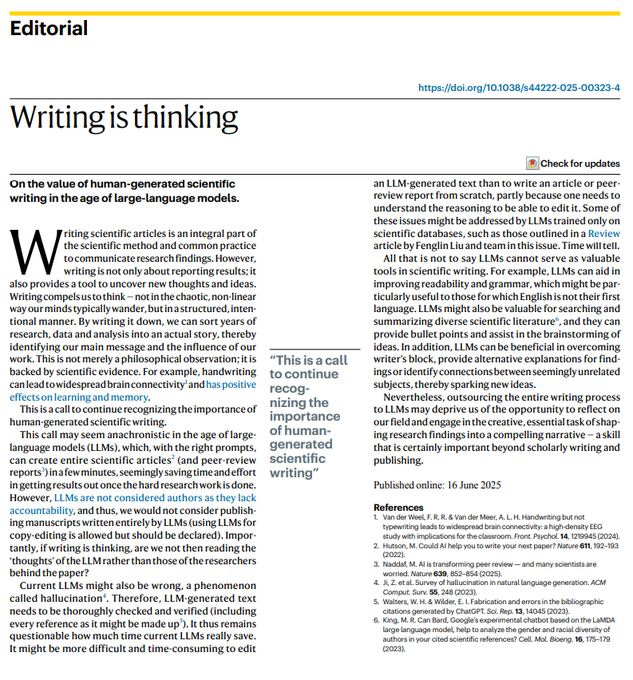
Writing is thinking
Outsourcing the entire task of writing to LLMs will deprive us of the essential creative task of interpreting our findings and generating a deeper theoretical understanding of the world.
Empiricism rarely disappoints when trying to tell apart hype and truth.
Look around you. If you work at a place where they have an IT department, do the IT projects get done faster?
Is Microsoft on the verge of release a version of Microsoft Teams that runs smoothly?
At this point, some people will reply « Daniel, try copilot, it is great... »
Friends. We all know about AI. We all know about vibe coding.
Well. Not everyone. The dustry old teacher who has been teaching that Java and UML are the future for 35 years doesn't know what is happening, but he missed everything else too.
AI can generate all these marvellous YAML scripts. It knows all the specs better than I do. It can program in any language, faster than I ever could.
Somehow, I still work 8 hours every day and I have an endless todo list that just does not get done on its own.
Ok. Maybe there are people out there who are setting their agents on autopilot and they have been on vacations for the last year. But if that is the case, we will soon know.
The first thing that will happen is that jobs will be disappearing *fast*. If I can build a software stack to compete against big tech just by letting my agents run free... I am never hiring another programmer.
I want to build a browser from scratch? I just ask my agents. They will put it together for me.
Yeah. I don't think so.
So why do we keep reading about AI making programming obselete?
I think that a sizeable fraction of these people are just so-so programmers. They don't know what they don't know. They never did the hard work so they can't even model it in their head.
"We won't reach AGI with LLMs."
Yann LeCun has been saying this for years. Now he's leaving Meta to prove it.
LeCun invented convolutional neural networks—the tech behind every smartphone camera and self-driving car today. He won the Turing Award in 2018, AI's Nobel Prize.
At 65, the leader of Meta's FAIR research lab is walking away from $600 billion in AI infrastructure, betting against the entire industry: Meta, OpenAI, Anthropic, xAI, Google.
Who is @ylecun? Why is he leaving, and why does his next move matter? Here's the story:
At Quantitative Medicine, we believe great science should be accessible to all. That’s why we offer reduced article processing charges, ISoP member discounts, and regional pricing to ensure equitable access for contributors worldwide.
🔗 https://t.co/8N0pIIJpda
#OpenAccess
Join us next week for the next webinar in the MIDD Webinar Series!
📅 Tuesday, October 14, 2025 at Noon ET
👤 Presenter: Eleni Caratzas, MSc, PhD
ISoP Members, register here | https://t.co/9su7gBgloo
#ISoP#MIDD
I live by the following rules.
1. Be responsible. When you make mistakes, fix them.
2. Be ambitious. Set your sights on the highest achievements you can imagine, and get to work. Don’t settle easily.
3. Be aloof. Train yourself to think differently. Avoid needless competition.
4. Speak the truth. Every time you lie, you get weaker.
5. Help others quietly. Never advertise your « goodness », it makes you weak.
6. Never be a victim. It makes you weak.
7. Never apologize defensively. Do not fall for the empathy trap. Only apologize when you have genuinely wronged someone.
8. Cultivate a network of like minded friends. Pick your friends carefully. It makes you strong.
9. Never tolerate unwarranted personal attacks, either against yourself or others.
10. Do useful work and tell others about it so that they may benefit.
Congratulations to Mark Lovern, Saroja Ramanujan, and Nieves Velez de Mendizabal for their appointment to the ISoP Board of Trustees!
ISoP would like to sincerely thank all of the candidates, nominees, nominators, and the Nominations Committee for their contributions.
I've expanded my tinyplot tutorial, adding more datasets and examples and inserting boxed Tips. Also, I've added guidance on how to make interpretable plots; those who are relatively new to statistical graphics may find this useful.
https://t.co/LPWsGiuMPO
🔔 Early-bird pricing for the 2025 American Conference on Pharmacometrics (ACoP 2025) ends August 3rd.
Register Now! https://t.co/gaI8ZhLoYv
#pharmacometrics#ISoP#ACoP
If the programming work you need to do is just 'established knowledge', the LLM can multiply your productivity by a factor of ten or more. So if you are working for an IT department and all they have for you is boring routine work, and you are teleworking... then you can pretty much either find a second job or just become really good at video games.
It is hard to tell how highly skilled programmers are impacted by LLMs. But I suspect that we are quite far from a revolution.
I always disliked and deactivated conventional autocomplete tools. I had long debates with fellow programmers telling that it saved them typing. Well, except that credible and extensive research indicates that it does no such thing. You feel like you are typing less, but that's not true. Autocompletion tools are akin to 'API tutorials'.
Myself, I prefer to read the documentation rather than learn from the available functions. I have seen people develop anti-patterns that are either unsafe or inefficient because they just grab whatever functions are present. It takes longer to read the documentation, but I would argue that you become a better programmer if you get in the habit of reading.
I have a theory that LLMs might help us go back to 'reading' because LLMs tend to be good at explaining, using prose, how to code with the caveat that they are often wrong.
What about Stack Overflow? It is losing its relevance today, but for a long time, copying and pasting from Stack Overflow was a dominant pattern. And if you copy/paste from ChatGPT, you might very well be doing just that since, obviously, LLMs learned from Stack Overflow.
Well. Stack Overflow might very well have sped up programming for some, but it also lead to many people just using code that they do not understand... with all the accompanying issues (such as security flaws).
There are two extremes derived from these observations. Code from memory using vi on a standard terminal. Or just vibe coding everything and hope for the best. Both are highly likely to be dead-ends.
My own stragegy so far is twofold:
1. Unimportant and trivial work: just vibe code it. If I need an SQL query to merge three tables using the particular SQL variant of database X... I just ask my favorite LLM. If I need a JavaScript snippet to validate a field, just vibe code it. I need some HTML code to create a good looking border: ask an LLM. I need a bash script to search files matching conditions: LLM. That is, I ask the tool to do it for me. I read it over. It is usually good or great... better than I would have done. Better because I am neither a bash, SQL or HTML/CSS expert. I can read the code and understand it, but it takes me effort to do it out of memory simply because that's not what I do all day long. Importantly, if there are bugs, the consequences are under control. Importantly, I would not trust an LLM for SQL code that updates an important database. But I would also not trust myself. I would double-check.
2. Otherwise, I just use LLMs as research assistants. If I am trying to do something I haven't done before, I will just ask the LLM to get me started. But I pretty much do not use it otherwise.
Here is a nice trick that works well and that I recommend you try. Suppose that you are programming in C++ but you are not quite aware of the recent (C++20) syntax. LLMs are great at this. Ask them how you can make your C++ syntax more modern.
If you combine these applications, you get an inkling that we are closer to an evolution compared to search engine + Stack Overflow, rather than some kind of revolution. You can already predict that LLMs will lead to security flaws because people will use code that they do not understand. You can already predict that it won't substantially reduce the amount of typing in a highly skilled coding.
Sure, you see people sketching a video game in a few hours. But I think you will find out that professional video game programmers can sketch a simple game in hours too!
Missed ACoP2024?
ISoP Members can now catch up on key recorded sessions in the ISoP Learning Center.
🔗 https://t.co/NUS4XuHtw8
Not a member? Join ISoP for instant access and ACoP2025 savings.
#ACoP#ISoP#Pharmacometrics
@Fastmail Thanks! From your support team, it looks like this feature doesn't recognize login using a Passkey; so it'll ask every time, no matter what! 😍
Nominations for the 2025 ISoP Awards and Fellows are now open! ISoP is excited to recognize innovative science and outstanding leadership in the field of pharmacometrics and related scientific areas.
Visit our nominations guide to learn more | https://t.co/StW3tXHEgL