It’s neither fair nor reciprocal to release such a lazy readout when the Chinese side provided a detailed readout of its version of the call. The State Dept team does a disservice to Rubio by allowing the Chinese to define the public narrative around the content of the exchange.
From today, customs duties apply to e-commerce parcels worth up to €150 entering the EU.
30 million Europeans work in retail; it's our our largest private-sector employer.
And the surge in low-value online imports has put our retailers at an unfair disadvantage.
Too many of these products also fail to meet EU safety standards, putting consumers at risk.
Today's change is about restoring fairness for European businesses and better protecting our consumers.
China Emerges as a Relative Winner From Strait of Hormuz Crisis…this is what happens when you fire your entire state dept staff that tracks energy markets. https://t.co/2RNNkq8OLX
I figured this would eventually happen, but not as quickly as it seems to be happening and, for this, Paul Krugman should get credit. For years mainstream economists were unable to understand how trade and globalization work because they were locked into trade models that implicitly assumed that trade was balanced (except, occasionally, over short time periods) and that capital flowed towards its most productive use. That is why their understanding of trade had no relevance to the actual world of trade that emerged in the 1970s and 1980s.
But this couldn't last. As the problem of unbalanced trade became more obvious , and as policymakers were increasingly forced to ignore the advice of their economists and respond to real problems, mainstream economists would eventually begin to recognize how, in an unevenly globalized world, countries that aggressively intervene in their domestic economies and externalize the costs through trade surpluses are also effectively intervening in the domestic economies of countries that supposedly remain committed to "free trade".
Most economists still don't understand trade. But with Krugman now acknowledging that tariffs and other forms of trade intervention can be expansionary under some conditions and contractionary under others (as Ragnar Nurkse explained as long ago as in his 1944 book), I suspect that younger economists will develop a completely different understanding of trade, and one that is perhaps a little more realistic.
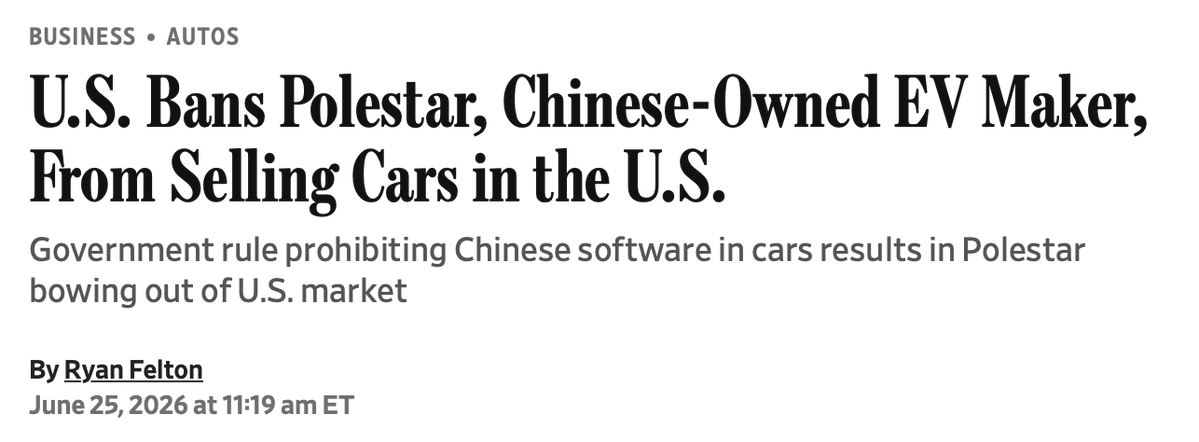
Misguided policy from the @BISgov. Let’s see how China responds. Can’t be good for US auto sector long term. OEMs need China for supply chain and electrifying passenger fleets.
@CommerceGov ban on Polestar under the "connected cars" rule signals continued managed decoupling in strategic sectors even against more stable overall US-China relations.
Also signals the continued role of tech controls, not just tariffs, in managing the econ relationship.
Reuters: Chinese cybersecurity firm 360 Security Technology has developed what it calls a domestic answer to Anthropic's Mythos, it said on Wednesday, casting the U.S. model as a strategic cyber capability that China could not afford to lack.
https://t.co/RGjaA6vSuy
Instead of complaining about Chinese subsidies fueling their tech advances, instead of blocking bilateral tech cooperation w/ the PRC, US govt should go big with federal funding in batteries and emerging tech. Only way to compete w/ China. https://t.co/4cOSuoO67x via @NYTimes
Huawei chairman thanks the US for export restrictions on chips, says it supercharged China’s semiconductor industry — Washington’s export controls encouraged Chinese firms to invest in R&D and build their own tech stack competing with American tech https://t.co/R7NAWmVDSr
American staff took everything Chinese officials handed out - credentials, burner phones from WH staff, pins for delegation - collected them before we got on AF1 and threw them in a bin at bottom at stairs.
Nothing from China allowed on the plane. We’re taking off shortly for America
With President Trump’s visit to Beijing, investors are having to ponder whether the US-China relationship is shifting to something less confrontational (obviously it is, since US attempts to isolate China have failed).
This is hardly the only consequential shift unfolding in China. Specifically:
- China is moving from deflation to inflation
- Chinese companies are no longer all about producing somewhat inferior goods at much cheaper prices. Instead, genuine global leaders like CATL, Hesai, BYD… have emerged in various industries.
- The Poliburo is no longer encouraging banks to send good money after bad in a bid to build up domestic self suffiency across industrial sectors. Instead, “anti involution” is now the key policy buzz word.
- instead of falling, the RMB is now rising. This encourages domestic savings to stay home.
- In a historical first, Chinese corporates are now returning more capital to shareholders (through buybacks and dividends) then taking from investors (through IPOs and rights issues)…
Any one of these shifts would be important.
Together, they make for a potent combination.
For more on this, here is a recently published Gavekal report. Constructive feedback (ie: not cheap cliches) welcomed…
https://t.co/6W1aEhDcDw
1/ Watching the opening statements by Trump and Xi just a moment ago was a reminder of their contrasts. Xi was scripted, focused on principles, had a binder of talking points in front of him, and expressed hope for stabilization and development of relations...(🧵).
So I was at a BYD dealership in Beijing on Monday afternoon to shoot a segment on China’s EV dominance with @NBCNightlyNews’s anchor Tom Llamas who had just touched down in China earlier in the day for the first time ever to cover @POTUS’s state visit. He took a spin in a Sealion 06 flash charging edition, his first time ever driving a Chinese EV, my first time in this particular model, and chatted about BYD and China EVs in general.
I left Tuesday afternoon Beijing time and touched down SFO Tuesday afternoon PDT just in time to see the program air.
Pretty cool! 😎
Here’s the segment that ran earlier tonight on the program.
Inside China’s battle for electric vehicle dominance:
https://t.co/VDJPZLPHNe
National Security Action, the group co-founded by Jake Sullivan, is dusting itself off and gearing up for 2028. But a lot of Dems just wish the Biden bros would just go away. As one Democrat told me, “They’re all canceled and they don’t realize it.”
https://t.co/CLkIdLCE79
US imposes sanctions on Chinese companies for allegedly helping Iran. Will be interesting to see how Beijing responds, which is a forgone conclusion. Both sides stockpiling leverage before Trump heads to China?
https://t.co/EsIseTmlDx
The U.S. government declined China’s invitation to organize industry-specific meetings between senior Chinese leaders and U.S. CEOs, thinking it could make American businesses appear too close to Beijing -- a U.S. executive with direct knowledge of the arrangements.
As of Tuesday, the White House had yet to formally invite executives to join Trump on the trip, and a proposed list of two dozen leaders could be halved, the person added.
Semafor: The Trump administration plans to invite CEOs from Nvidia, Apple, Exxon, Boeing, and other big companies to accompany the president on his trip to China next week, a person familiar with the matter said.