We have a new paper out in Cell Host & Microbe! We performed a microbiome passaging experiment to examine the interaction between host filtering and inter-host microbiome transmission. Here’s the TL;DR
https://t.co/bSPCb7m1U0
What up y'all! My latest album is up on bandcamp (also Spotify other streaming services starting tomorrow), check it out! Shout out to slow moving precipitation belts.
https://t.co/tls1Fj0gf3
It takes a plant village to raise a microbiome. @melissa_y_chen @Cara_Haney discuss @bkoskella work on host history & #plant#microbiome inheritance. Transmission from same vs diff plant species results in microbiota specialization vs host generalism https://t.co/rydxkbTSLm
Shaping of the phyllosphere microbiome: @bkoskella & Co manipulate plant #microbiome transmission over multiple generations to show how microbiome host specialization and generalism can arise without impacting plant fitness or gene expression https://t.co/vs9YqP7XMt
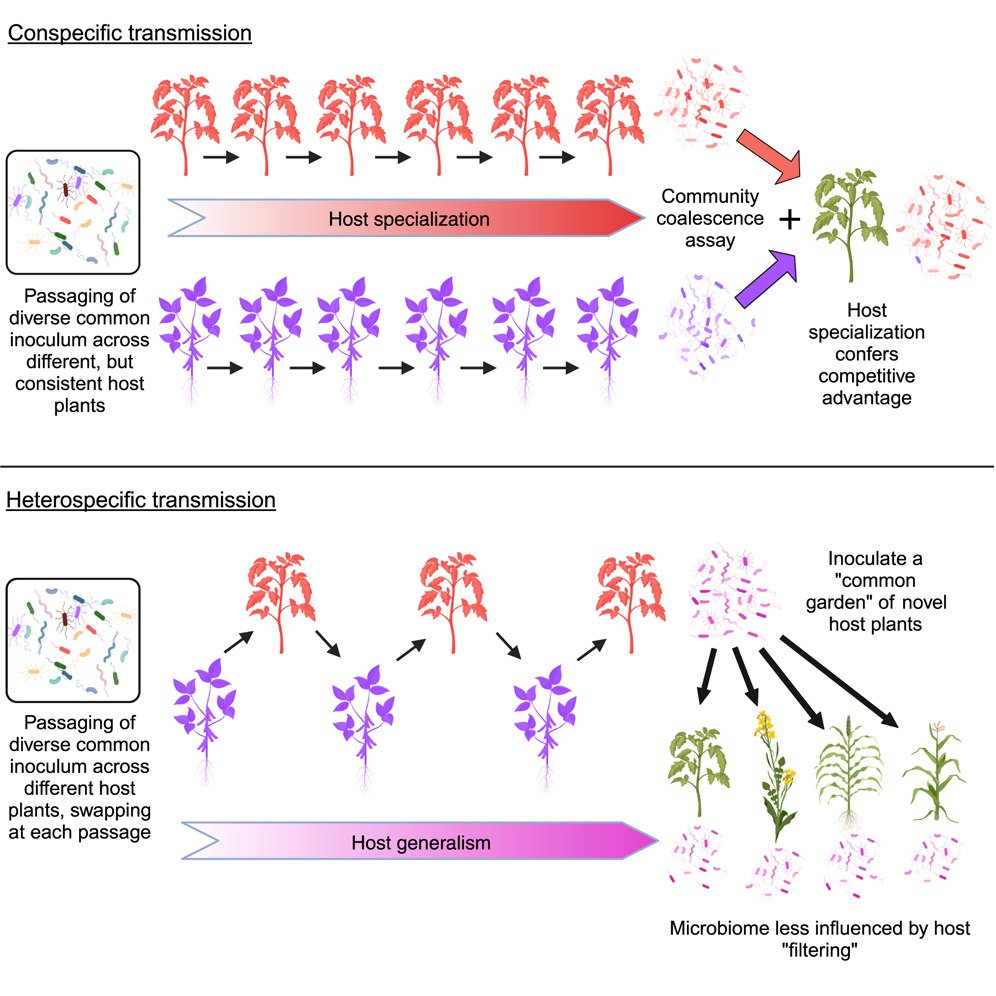
Thus it appears that transmission shapes host filtering by altering the species pool that selection acts on. Conspecific transmission reinforces host filtering, driving host specialization, while host swapping disrupts specialization by imposing a broader set of host filters
We have a new paper out in Cell Host & Microbe! We performed a microbiome passaging experiment to examine the interaction between host filtering and inter-host microbiome transmission. Here’s the TL;DR
https://t.co/bSPCb7m1U0
Thanks to @bkoskella , Steve, and @CJEMetcalf for their mentorship and help. And thanks to Isabella Muscettola, Ana Vasconcelos, and @SwimmerJulya27 for their commitment to getting this massive project pushed all the way across the finish line.
Next we inoculated the 3 host swapping lines and one conspecific line onto a set of novel plant species and found that the host swapping lines were all less impacted by host filtering relative to the conspecific line.
Interestingly, when we examine leaf transcriptional activity and plant health/fitness across treatments we found no differentially expressed genes and no differences in health or fitness, suggesting specialization of leaf microbiomes had no discernible impact on the hosts.
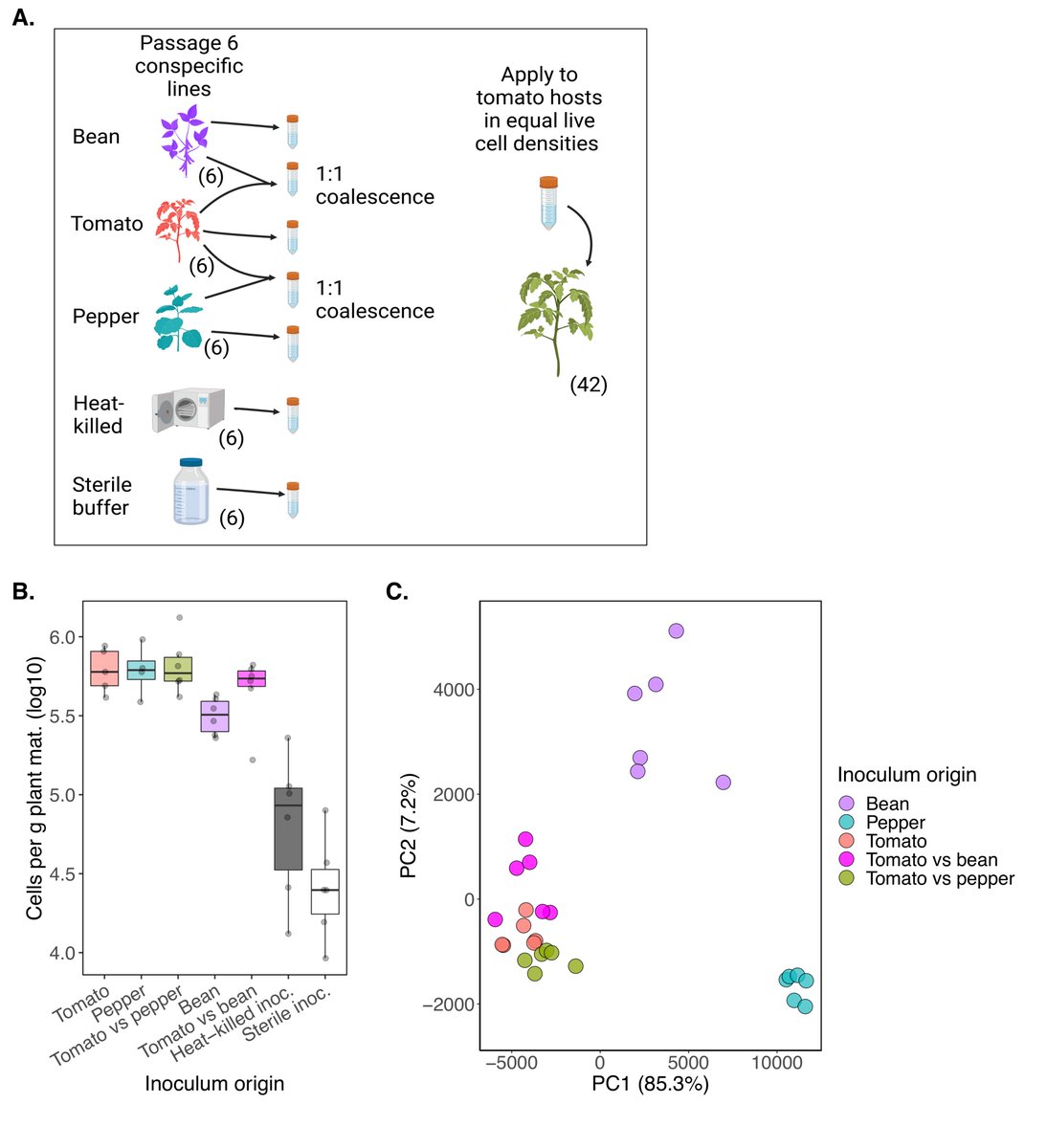
We next used community coalescence to show that microbiomes passaged on tomato have a ‘homefield advantage’ on tomato over those derived from bean or pepper. In other words, conspecific transmission allowed for local adaptation to tomato, resulting in a competitive advantage.
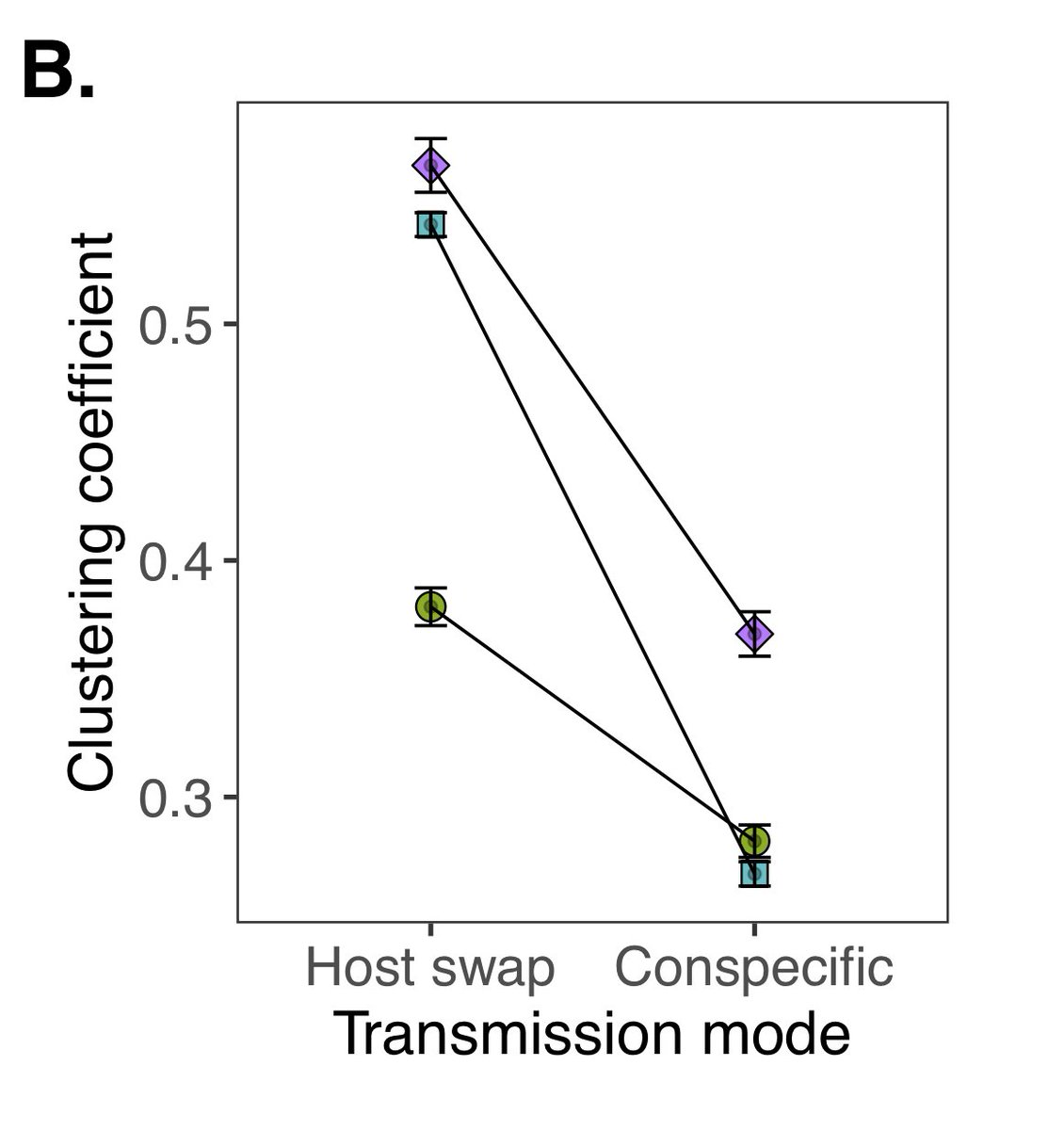
The microbiomes that underwent host swapping all exhibit a higher co-occurrence network clustering coefficient. One interpretation of this is that these networks may be more resilient (or disturbance tolerant), since the loss of any node would be less impactful on the network.
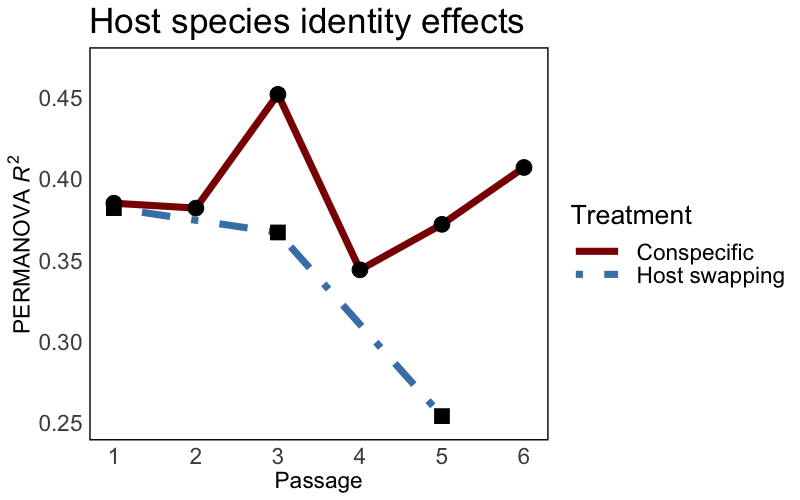
When we examine how distinguishable plant species are by their microbiomes we see that microbiomes passaged within a species maintain strong distinctions, while microbiomes that were swapped repeatedly between host species lose such distinctions, becoming more homogeneous.
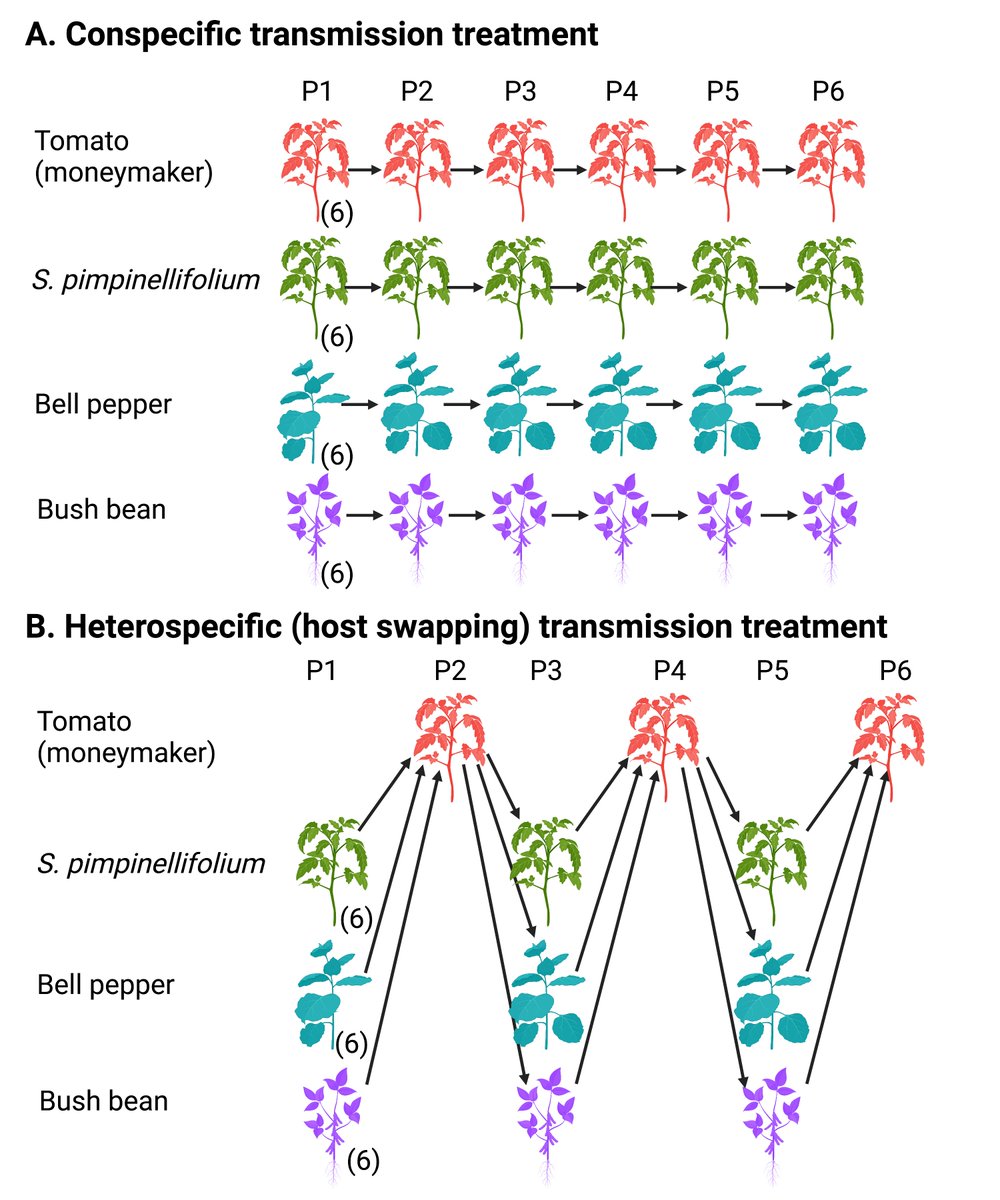
The main experiment consists of 6 passages across 4 replicated species of plants, and two transmission treatments: conspecific (within species) and heterospecific (between different species, aka host swapping).