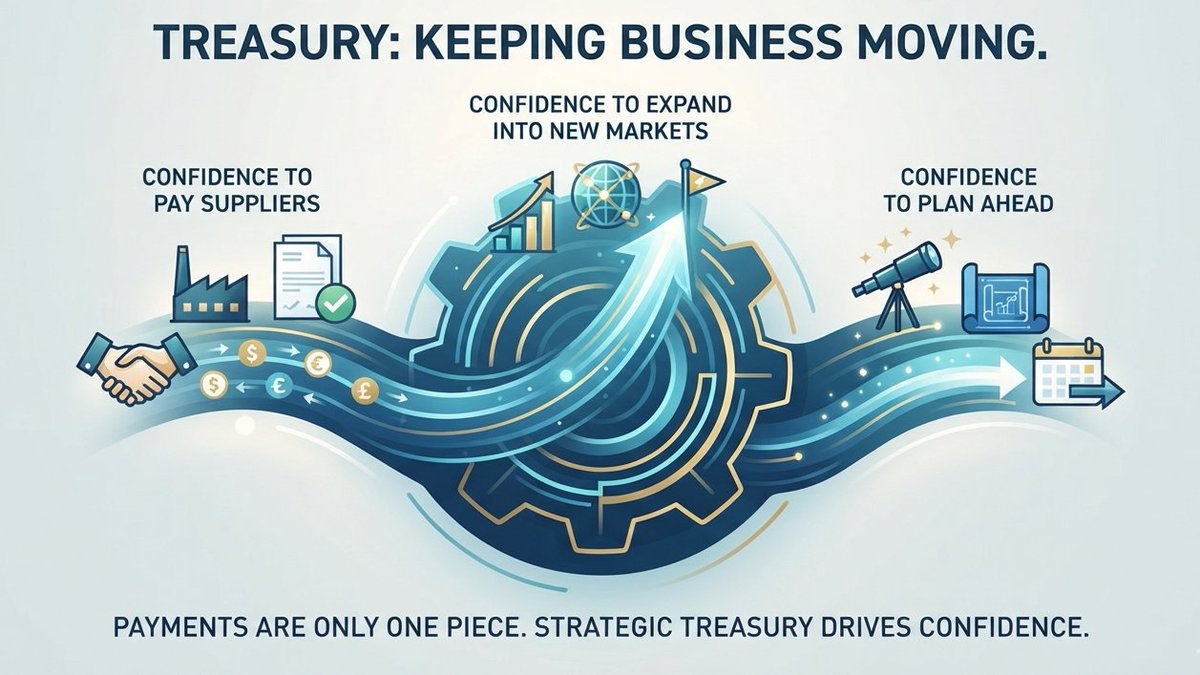
Good treasury isn't just about managing money.
Good treasury gives businesses confidence.
Confidence to pay suppliers on time.
Confidence to expand into new markets.
Confidence to plan ahead.
Payments are only one piece.
Treasury is what keeps everything moving.
Most conversations about stablecoins focus on transaction speed.
The bigger advantage?
Programmability.
Transparency.
24/7 settlement.
Global interoperability.
That's what makes them infrastructure, not just another payment method.
140+ companies, including Visa, Mastercard, and Coinbase, have joined forces to launch Open USD, a new dollar-backed stablecoin.
The story is; payments, fintech, and crypto are converging to build the next layer of global financial infrastructure.
Stablecoin adoption is growing.
The Next Finance Stack
The next finance stack won't be built around banks.
It'll be built around interoperability.
Money moves faster when systems speak the same language.
We learned something interesting while building @Paynest_ .
Company finances rn is scattered across different systems, company treasury in one tool, payroll in another, cards somewhere else. Invoices, off-ramps all around.
That’s what we’re building @Paynest_ ‘s V2 to solve.
One thing nobody tells you about paying global teams is how fast small FX gaps stack into real operational costs.
It shows up when payouts get uneven or teams doubt timing
Cross-border payouts aren’t just a money problem.
They’re a stability problem and that breaks during scale.
One thing nobody tells you about paying global teams is how fast small FX gaps stack into real operational costs.
It shows up when payouts get uneven or teams doubt timing
Cross-border payouts aren’t just a money problem.
They’re a stability problem and that breaks during scale.
At @paynest this week, we’ve been focused on one core issue:
Visibility in company finances and cross-border payments. Most teams don't see post-transaction flow.
Finance teams can’t see:
– real-time funds
– FX cost impact
– the delays happening and why
This is what we’re fixing.
At @paynest this week, we’ve been focused on one core issue:
Visibility in company finances and cross-border payments. Most teams don't see post-transaction flow.
Finance teams can’t see:
– real-time funds
– FX cost impact
– the delays happening and why
This is what we’re fixing.
Most startups think payroll is a payment problem.
I see it as a treasury coordination problem mainly across multiple countries and currencies where FX exposure, timing and reporting gaps matter.
Imo the next phase of finance ops will coordinate money flow, not just process it.
Most startups think payroll is a payment problem.
I see it as a treasury coordination problem mainly across multiple countries and currencies where FX exposure, timing and reporting gaps matter.
Imo the next phase of finance ops will coordinate money flow, not just process it.
@johnbabodor@blend_money@Paynest_ Yass 🥳 check out https://t.co/JEoV5TXEx7 @Paynest_ offers teams an expense management platform for automating stablecoin salaries, managing expenses, and tracking finances in one place.
@johnbabodor@blend_money@Paynest_ Yass 🥳 check out https://t.co/JEoV5TXEx7 @Paynest_ offers teams an expense management platform for automating stablecoin salaries, managing expenses, and tracking finances in one place.
@StellarOrg is now live on Paynest.
Teams can now deposit $XLM and $USDC directly from Stellar into their Paynest wallet and run payroll without extra steps or payment friction.
As more teams operate across different chains, our focus is making sure Paynest supports them where they already are.
A good day to connect me with Web3 teams paying in stablecoins who wants to 10x their productivity with @Paynest_
Paying salaries in Web3? Let’s chat :)